Jean-François Millet · PD
Women Sewing by Lamplight (La Veillée)
Details
The story
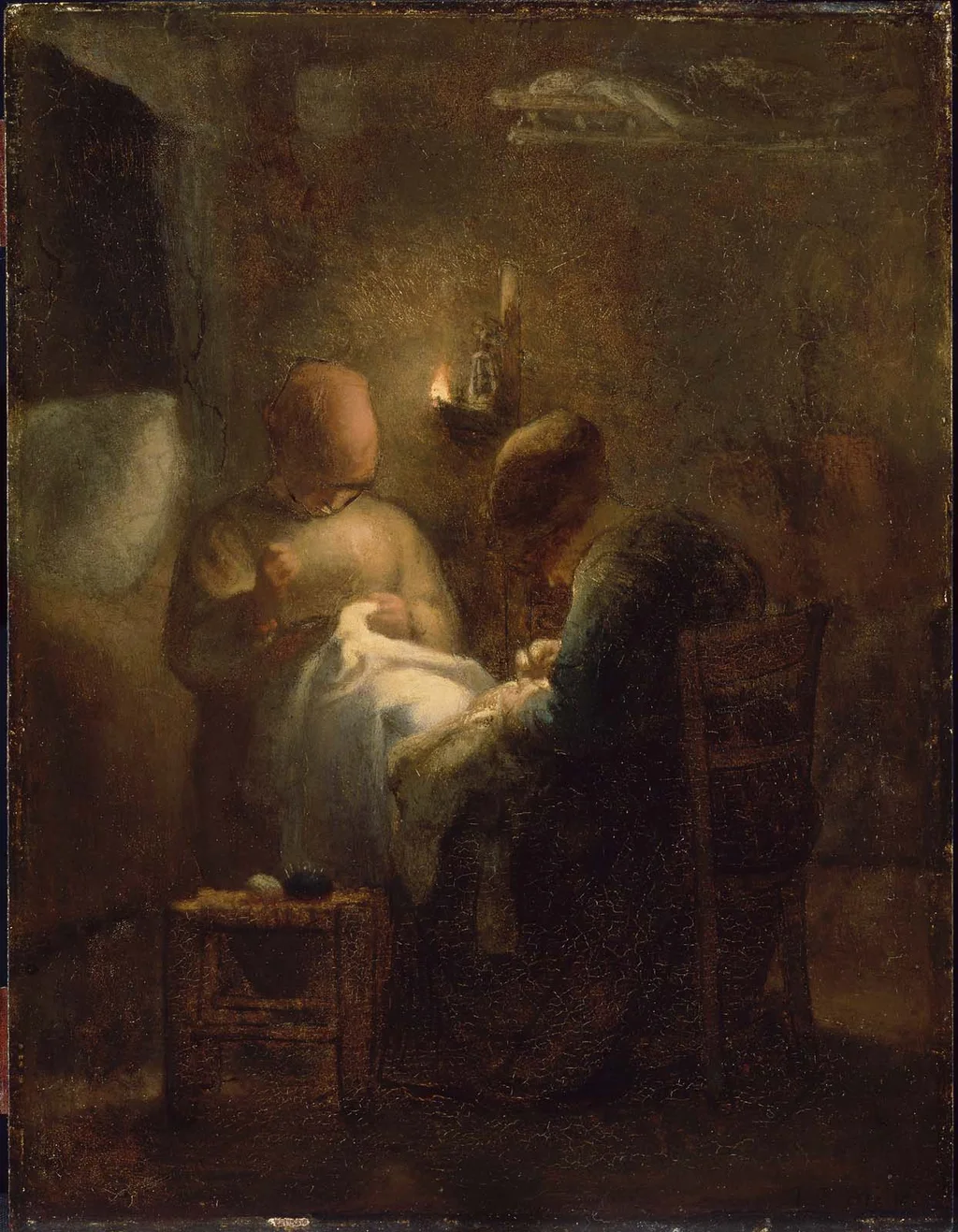
On winter evenings in the villages around Barbizon, work did not stop when the daylight went. Neighbours would gather in one house to share a single lamp and a single fire, and go on mending, spinning or weaving baskets late into the night. The custom was called the veillée, and Millet painted it here in 1853 or 1854, on a small wooden panel. Two women lean in toward the flame of an oil lamp hanging on the wall, one standing, one seated, with a curtained bed behind them and a low stool holding a pincushion within reach. Their close-fitting headscarves, called marmottes, were what peasant women wore in that part of France. The panel passed through several Paris collections, and in 1878 it was bought at auction, probably on behalf of Quincy Adams Shaw, a Boston businessman whose fortune came from copper mining. Shaw collected Millet on a scale few could match, paintings, pastels and drawings, and he left instructions that the whole group should go to the Museum of Fine Arts after his wife's death. Pauline Agassiz Shaw died in 1917, and that year the collection, this panel with it, entered the museum.