The story
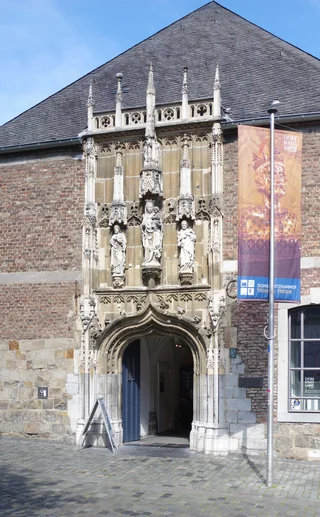
For about 600 years, from 936 to 1531, German kings came to Aachen to be crowned in Charlemagne's chapel, and the treasury beside the cathedral keeps the objects that gathered around his memory. It is one of the great church treasuries of Europe, shown in rooms on the west side of the cloister.
Much of it circles Charlemagne himself. There is a Roman marble sarcophagus from the early third century, carved with the abduction of Proserpina, in which he was buried in 814. There is the silver-gilt bust made around 1350 on the orders of Emperor Charles IV to hold part of his skull. And there is the Cross of Lothair, made around the year 1000, with an ancient cameo of the emperor Augustus set at its centre.
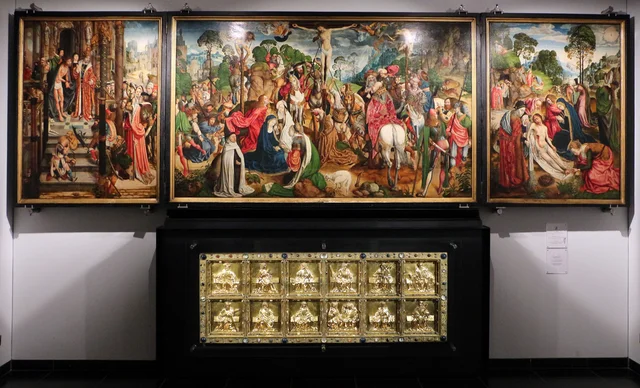
Paintings are rarer here, which makes the Aachen Altar stand out. This Passion triptych was painted in Cologne around 1515 to 1520 by an artist known only as the Master of the Aachen Altar, a name taken from this very work. It was made for the Carmelite church in Cologne, passed through private collections in the 19th century, and was bought for the cathedral in 1872.
During the Second World War the treasures were packed into boxes and evacuated, part of them to a tunnel in Siegen. In the spring of 1945 a young vicar, Erich Stephany, went to look for them and had them back in Aachen by late May.