The story
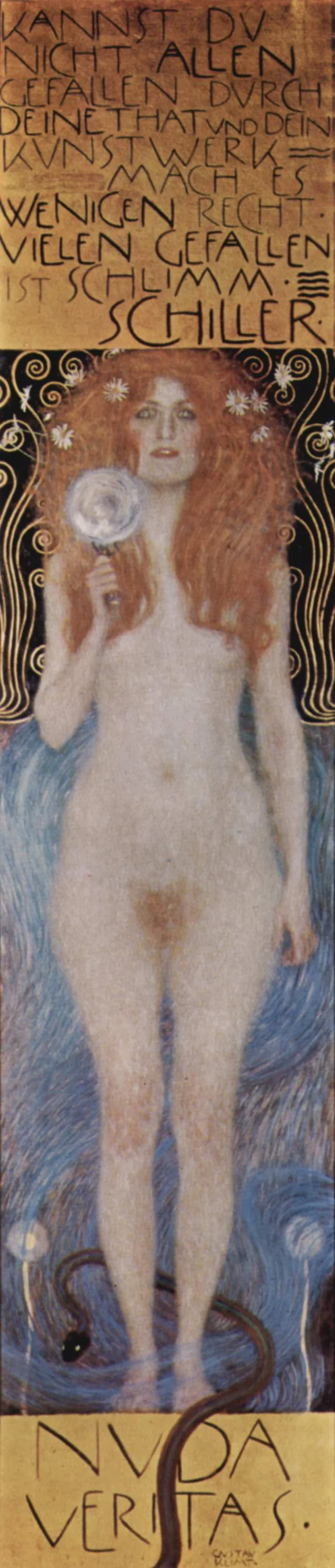
Gustav Klimt painted Nuda Veritas in 1899, two years after he and his friends broke away from Vienna's established artists' association to found the Secession. A life-size naked woman holds up a mirror to the viewer, a snake curls at her feet, and above her Klimt lettered a line from Schiller, the German poet. If you cannot please everyone with your deeds and your art, it says, please a few, because pleasing many is bad. The canvas was owned by Hermann Bahr, the writer and critic who championed the Secession, and it came to this museum with his estate.
That route says a good deal about the place. The Austrian Theatre Museum is primarily a theatre archive, grown from the theatre collection of the Austrian National Library, which became an organisation of its own in 1922 and was enlarged the next year with the collection of the actor Hugo Thimig. Among its more than two million objects are over 1,000 stage models and some 600 costumes and props from three centuries, as well as the papers of Bahr and of the writer Stefan Zweig. In 2022 Klimt's picture was given a room of its own, alongside Bahr, his wife the opera singer Anna Bahr-Mildenburg, and friends such as the composer Gustav Mahler.
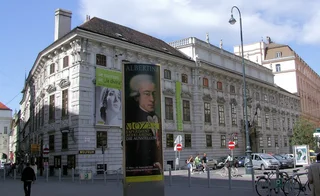
Since 1991 the museum has filled Palais Lobkowitz, a Baroque palace built in the 1690s near the Hofburg. Its grandest room is the Eroica Hall, named for Beethoven's Third Symphony, which was rehearsed and played here in 1804 for the composer's patron, Prince Lobkowitz, under a painted ceiling by Jakob van Schuppen.