The story
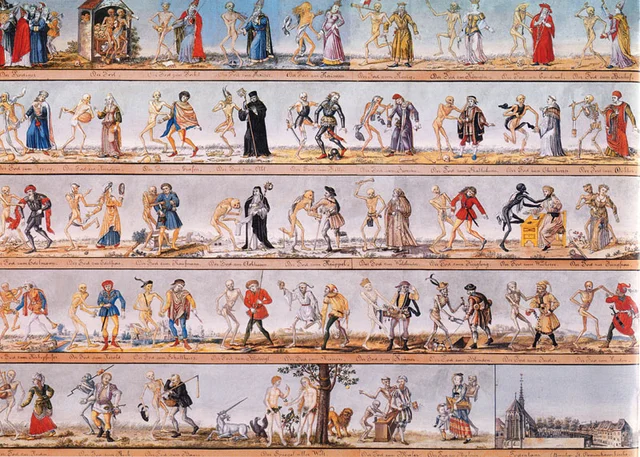
Around 1440, while churchmen from across Europe sat in the Council of Basel, a Dance of Death was painted along the cemetery wall of the city's Dominican friary. Pope, emperor, merchant and beggar each took the hand of a grinning corpse, some 40 pairs stretched over about 60 metres, and the painter Hans Hug Kluber renewed the whole sequence in 1568. When the wall was pulled down in 1805, 19 fragments were saved. They are the centrepiece of the Historical Museum of Basel today, shown with small copies of the complete dance.
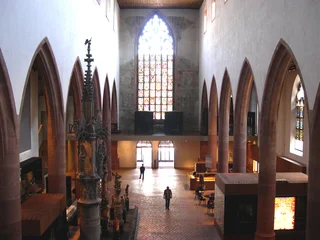
The museum's main home is itself a church. The Barfüsserkirche, built for the barefoot Franciscan friars after a fire in 1298, is a tall Gothic hall. After the Reformation the city used it as a warehouse and later as a salt store, and between 1890 and 1894 it was converted into the museum.
The other great survivor here is the treasure of Basel Minster, the cathedral's reliquaries and vessels in gold and silver. It came through the Reformation intact, then was divided in 1833, when the rural districts broke away as the canton of Basel-Landschaft and claimed a share. The new canton auctioned its portion in 1836, and pieces went to museums from London to St Petersburg. The most famous of them, the golden altar frontal given by Emperor Henry II, is now in Paris at the Musée de Cluny, while the objects Basel kept are displayed here.