The story
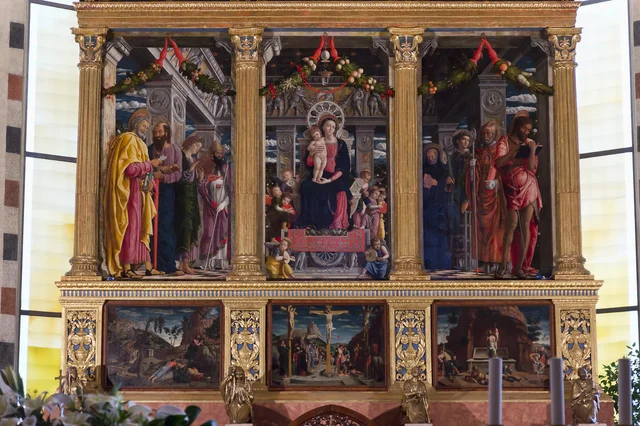
In 1797 French troops under Napoleon took Andrea Mantegna's great altarpiece from San Zeno and sent it to Paris. When it came back to Verona in 1815, after Napoleon's fall, only the main painting returned. The three small predella scenes beneath it stayed in France, the Crucifixion in the Louvre and the Agony in the Garden and the Resurrection in Tours, so the ones a visitor sees in the church today are copies.
Mantegna painted it around 1456 to 1459 for the abbot Gregorio Correr, a Venetian nobleman. The Virgin and Child sit at the centre with four saints on each side, and the carved wooden columns of the real frame continue into the painted architecture behind the figures, so frame and picture read as one structure.
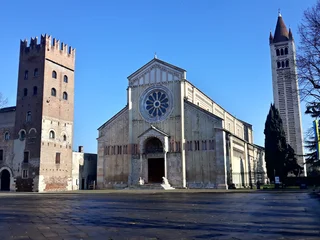
The church around it is one of the great Romanesque buildings of northern Italy, largely complete by about 1138 after an earthquake in 1117 had interrupted the work. Its bronze doors carry dozens of panels with Bible stories and the miracles of Saint Zeno, the 4th-century bishop of Verona whose remains lie in the crypt. Above them, the rose window by the sculptor Brioloto is known as the Wheel of Fortune, with six figures marking the rise and fall of human life.