Church of Saints Nazarius and Celsus
Brescia, Italy
The story
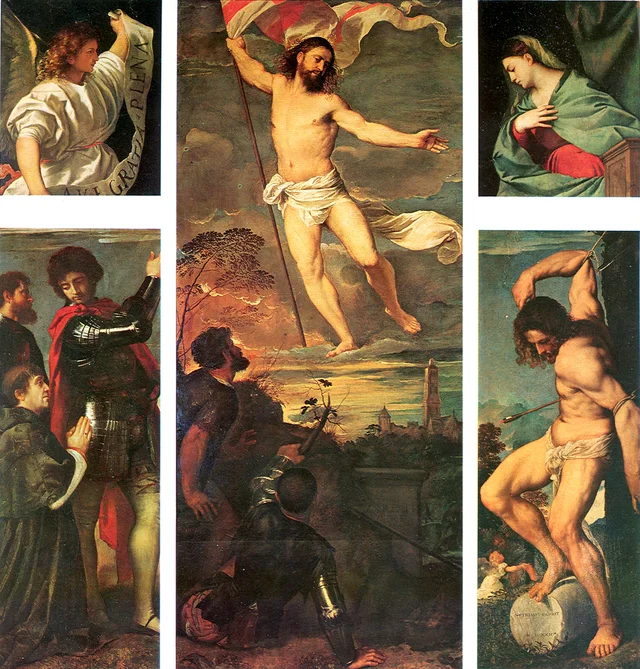
In December 1520 Jacopo Tebaldi, the Duke of Ferrara's agent in Venice, wrote home about a panel he had seen in Titian's studio. It was a Saint Sebastian, and Titian told him it was the best picture he had ever made. Tebaldi urged the duke to buy it for 60 ducats, although the panel belonged to an altarpiece commissioned by Altobello Averoldi, a bishop from a Brescian family who was serving as papal legate in Venice and paying 200 ducats for the whole work. The deal never went through.
So Sebastian came to the church of Saints Nazarius and Celsus in Brescia, where the Averoldi Polyptych has stood since 1522. It has five panels. The risen Christ fills the centre. On the right Sebastian strains against his bonds, and this panel carries Titian's signature and the date 1522. On the left the two patron saints present the kneeling Averoldi, and across the top an angel and the Virgin of the Annunciation face each other. The muscular bodies of Christ and Sebastian owe something to the ancient Laocoön group, unearthed in Rome in 1506.
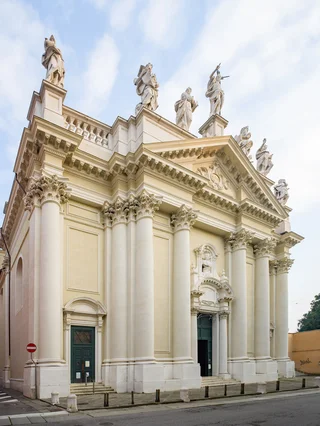
The church around the altarpiece is younger than the painting. It was rebuilt in neoclassical style from 1746, and the work was interrupted in 1769 when a powder magazine at the nearby Porta San Nazaro exploded. Worship resumed in 1780. At the second altar on the left hangs the Coronation of the Virgin by Moretto da Brescia, the city's leading Renaissance painter, made around 1534.