The story
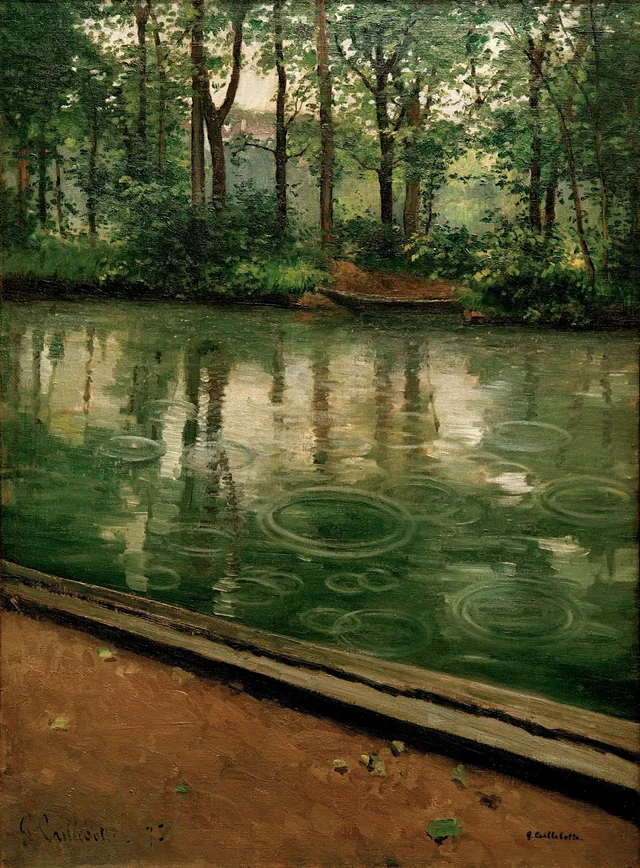
In 1875 Gustave Caillebotte painted the river Yerres beside his family's country estate south-east of Paris and left out nearly everything except the rain hitting the water, its rings spreading across the surface. The picture is one of the best known at the Eskenazi Museum of Art, the museum of Indiana University in Bloomington, and it shares the European rooms with Claude Monet's Port of Argenteuil and a portrait of Mrs Chinnery by Élisabeth Vigée Le Brun, once painter to Marie Antoinette.
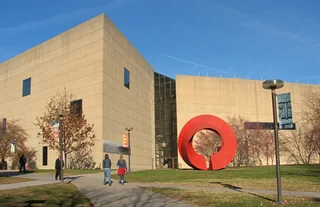
The museum began in 1941 under Henry Radford Hope, who led the university's fine arts department, and its first show was devoted to painters from nearby Brown County. The present building, by the architect I. M. Pei, opened in 1982 as two concrete triangles joined by an atrium under a glass roof. After a gift of 15 million dollars from Sidney and Lois Eskenazi, it closed in 2017 for renovation and reopened in 2019 under their name.
The collection runs to about 45,000 objects, with Picasso and Jackson Pollock in the modern galleries and African and Oceanic art in a gallery of its own. The ancient rooms draw on the American diplomat Burton Y. Berry, whose gift of ancient jewellery numbers about 5,000 pieces.