The story
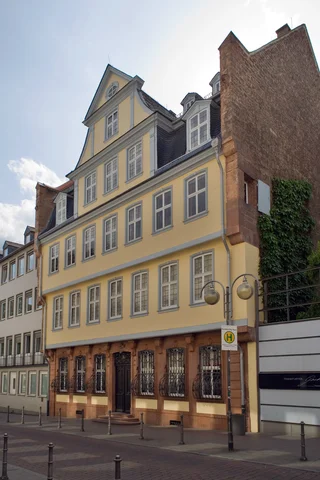
On 22 March 1944, the anniversary of Goethe's death, bombs destroyed the house in Frankfurt where he was born in 1749. Almost everything inside it survived. The Freies Deutsches Hochstift, the citizens' society that had owned the house since 1863, had moved the furniture, books and pictures to safety in time. After a heated public debate over whether a rebuilt copy made sense, the house was faithfully reconstructed and reopened in 1951.
The Hochstift was founded in 1859 by Otto Volger, a Frankfurt geologist, as a free society for the sciences and the arts, and it still runs the whole complex on the Großer Hirschgraben. A visit leads through the Goethe family's rooms and on into the Deutsches Romantik-Museum, which opened next door in 2021 together with a new gallery of paintings from the Goethe era. Its building, by the Frankfurt architect Christoph Mäckler, is organised around a long, straight staircase that climbs three floors.
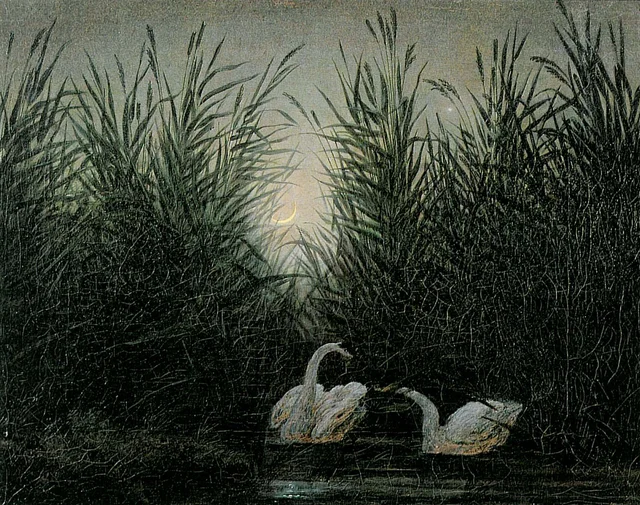
Two paintings there show how far the Romantic imagination could range. Caspar David Friedrich's small Swans in the Reeds, first shown at the Dresden Academy exhibition in 1820, sets two swans among the reeds under a crescent moon and the evening star. Henry Fuseli, the Swiss-born painter who made his career in London, painted Britomart Freeing Amoret in 1824, a large canvas from Edmund Spenser's poem The Faerie Queene in which a woman knight breaks a sorcerer's spell. It has belonged to the Hochstift since 1957.