Hospital de la Santa Caridad
Seville, Spain
The story
Step into the church of San Jorge at Seville's Hospital de la Santa Caridad and the first two pictures are about death. Near the entrance, a skeleton reaches out to snuff a candle beside the Latin words In ictu oculi, in the blink of an eye. Facing it, a bishop and a knight lie decaying in their coffins under Finis gloriae mundi, the end of the world's glory. The Sevillian painter Juan de Valdés Leal made both for Miguel Mañara, a nobleman who wanted every visitor to remember where wealth and rank end.
Mañara joined the Brotherhood of the Holy Charity in 1662, a confraternity whose old duty was to bury executed criminals and people drowned in the Guadalquivir. As its head he turned old shipyard warehouses by the river into a hospital for the destitute, and gave the church one programme built on the works of mercy. Bartolomé Esteban Murillo, the city's best-loved painter, made the great canvases of Moses striking water from the rock and the feeding of the five thousand, and the sculptor Pedro Roldán carved the gilded high altar with Christ being laid in the tomb.
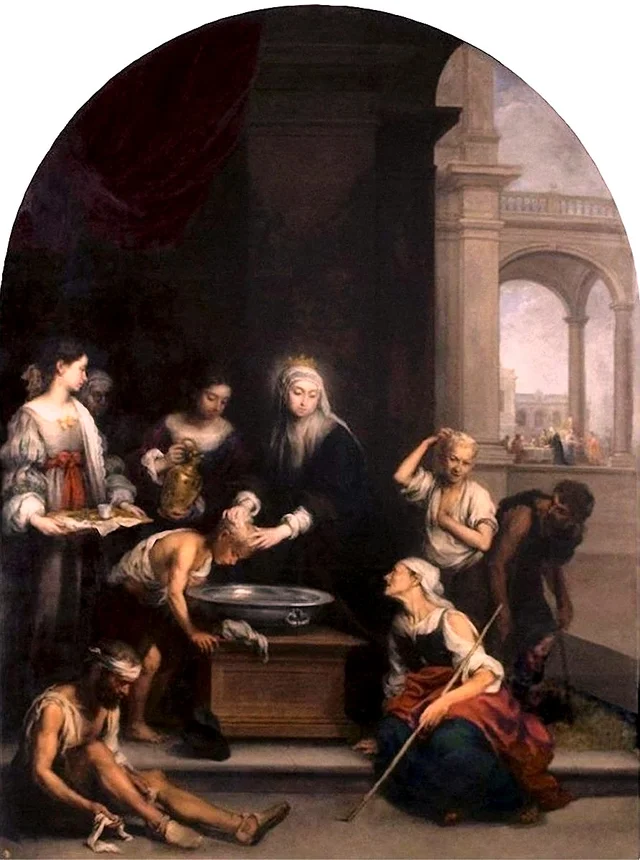
The set did not stay whole. During the French occupation of Seville, the French marshal Soult removed several Murillos, and four of them now hang in London, Washington, Ottawa and Saint Petersburg. Murillo's Saint Elizabeth of Hungary, washing the scalp of a boy with ringworm, came back only in 1939 after more than a century in Madrid. In 2026, with the church under restoration, 14 of these works went on show together in Madrid at the Conde Duque cultural centre.
The brotherhood still runs the hospital as a home for elderly people, and its rooms also keep a small Christ on the cross by Francisco de Zurbarán.