The story
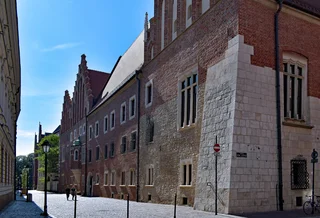
Around the arcaded Gothic courtyard of the Collegium Maius, the oldest surviving building of Kraków's university, the Jagiellonian University Museum keeps the academy's own memory. Nicolaus Copernicus studied here in the early 1490s. In 1492 the astronomer Marcin Bylica, a Kraków graduate who had worked in Italy and at the Hungarian royal court, gave his instruments to the university, and they began a collection of scientific objects that the museum still shows.
Its most famous small object is the Jagiellonian globe, a gilded armillary sphere made in France before 1510. At its centre sits a tiny map of the Earth, and on it a new landmass is labelled America Noviter Reperta, America newly found, which makes it one of the earliest globes to carry that name.
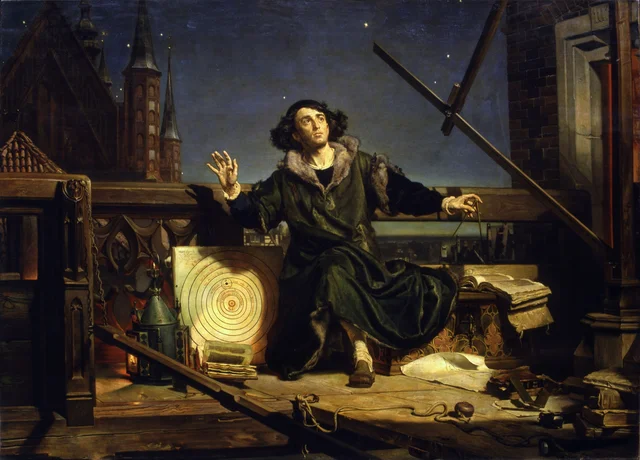
The museum's best-known painting hangs a short walk away. Jan Matejko, Poland's great history painter, finished Astronomer Copernicus, or Conversations with God in 1873, for the 400th anniversary of the astronomer's birth. It shows Copernicus at night on a terrace by the cathedral in Frombork, kneeling among his instruments under an open sky. The canvas was bought by public subscription that same year and presented to the university, and it hangs in the great hall of the nearby Collegium Novum.