The story
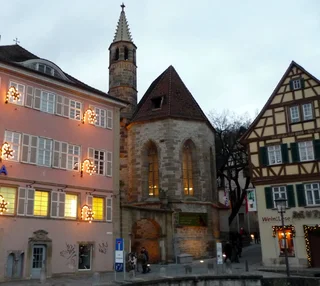
Around 1400, carpenters raised a new roof over a small church in the Weiler, an old suburb of Schwäbisch Hall by the Hangman's Bridge over the Kocher river, and much of that timberwork survives. The church belonged to the Knights of St John, the crusading order of hospitallers, who had settled in Hall in the late 12th century and from 1249 ran the town's hospital. Around 1404 they enlarged their Romanesque chapel with Gothic tracery windows and a many-sided choir, and local noble families chose it for their graves.
The Reformation made it the Protestant parish church of the Weiler. In 1812 Württemberg abolished the parish, the town bought the empty building in 1816 to store fodder for passing troops, and from 1846 it was the gym hall of a newly founded gymnastics club. After the Second World War it became a hall for concerts and lectures.
The Würth Group, the fastener and tools company, bought it in 2004, and the Stuttgart architect Erich Fritz restored it and added a glass cube alongside. Since November 2008 the church has shown the group's Old Masters, many from the former collection of the princes of Fürstenberg at Donaueschingen. Visitors find altar panels by the Master of Meßkirch, an anonymous Swabian painter of the 1530s, carved figures by Tilman Riemenschneider, the Würzburg sculptor, and Christ Blessing the Children by Lucas Cranach the Elder, court painter in Wittenberg, a subject his workshop painted more than 20 times.
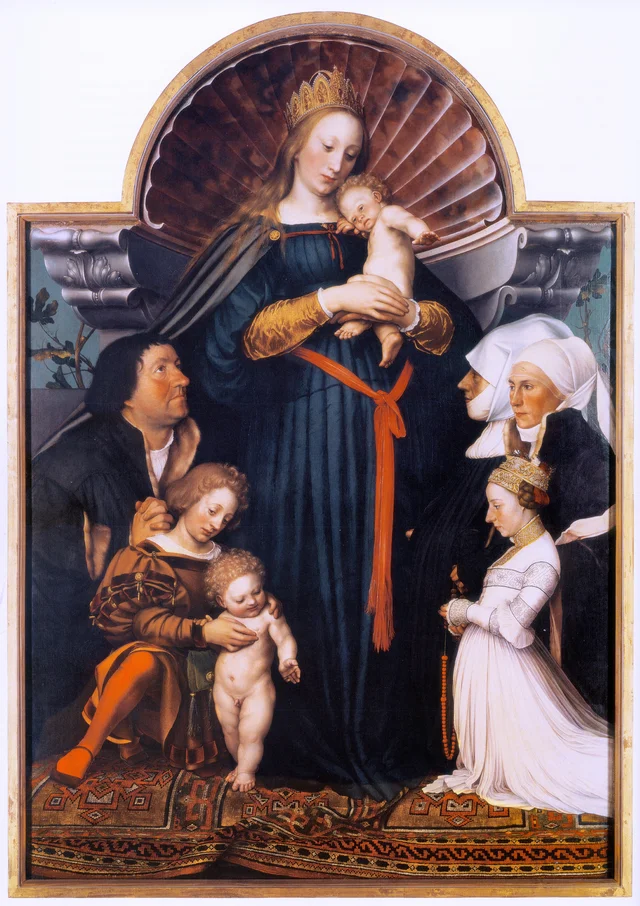
In the choir, where the high altar once stood, hangs Hans Holbein the Younger's Madonna of Burgomaster Jakob Meyer, painted in Basel around 1526. It is known as the Darmstadt Madonna after the city where it hung for over a century, and it has been here since January 2012.