The story
In August 1945, days after Japan's surrender, Puyi, the last Qing emperor and by then the puppet ruler of Manchukuo, tried to fly out of Shenyang with more than 120 scrolls from the old imperial collection. He was detained at the airport, and those paintings later went to a new museum in the city. Many more works he had left behind in his palace in Changchun were taken by the guards and scattered, and the search for them went on for years.
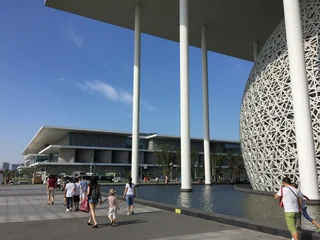
That museum opened on 7 July 1949, a few months before the People's Republic was proclaimed, under the name Northeast Museum. It became the Liaoning Provincial Museum in 1959, and in 2015 it moved from the city centre into a large new building in Shenyang's Hunnan district. Its galleries cover bronzes, ceramics, embroidery, stone inscriptions and the archaeology of the northeast, but the museum is best known for early Chinese painting and calligraphy.
The most famous scroll is Court Ladies Wearing Flowered Headdresses, traditionally given to Zhou Fang, a Tang-dynasty painter of palace women, although scholars treat that attribution with caution. It shows five aristocratic women with flowers in their hair, an attendant holding a fan, two little dogs and a crane. Puyi had taken it out of the Forbidden City in the early 1920s, passing it to his brother as a gift. Another treasure is Prosperous Suzhou, finished in 1759 by Xu Yang, a Suzhou-born painter at the Qianlong court. Over about 12 metres it follows a route from the hills west of the city, through its gates and on to Tiger Hill, with some 4,800 figures and more than 260 shops along the way.
