Loggia dei Lanzi
Florence, Italy
The story
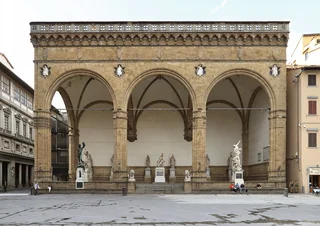
Step up between the two marble lions and you are standing on what was built as the Florentine Republic's open-air stage. Between 1376 and 1382 the architects Benci di Cione and Simone Talenti raised these three wide round arches beside the Palazzo Vecchio, the city's town hall, so that public assemblies and ceremonies could be held in full view of the square. Newly chosen magistrates swore their oaths here. Above the arches, four Virtues designed by the painter Agnolo Gaddi still look out from their stone frames.
Under the Medici dukes the loggia took on new roles. Cosimo I stationed his German pikemen here, the Landsknechte, and Florentines shortened their name to "lanzi", which is how the place got its name. Later the architect Bernardo Buontalenti turned the roof into a terrace reached from the Uffizi, so the ducal family could watch events in the piazza below.
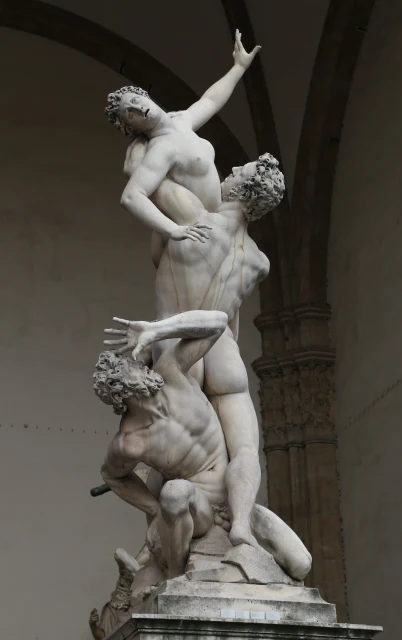
Then came the sculpture. In 1554 Cosimo had Benvenuto Cellini's bronze Perseus set up at the front, the hero holding Medusa's severed head out over the square. By Cellini's own account, when the casting faltered he fed the furnace with his household furniture and threw in his pewter plates. In January 1583 Giambologna's marble Rape of the Sabine Women took the place of Donatello's Judith, three bodies spiralling upward from a single block, meant to be walked around with no one front view. The lions at the steps arrived in 1789, one of them ancient Roman and its partner carved in 1598 to match, and a row of Roman statues of women lines the back wall.