The story
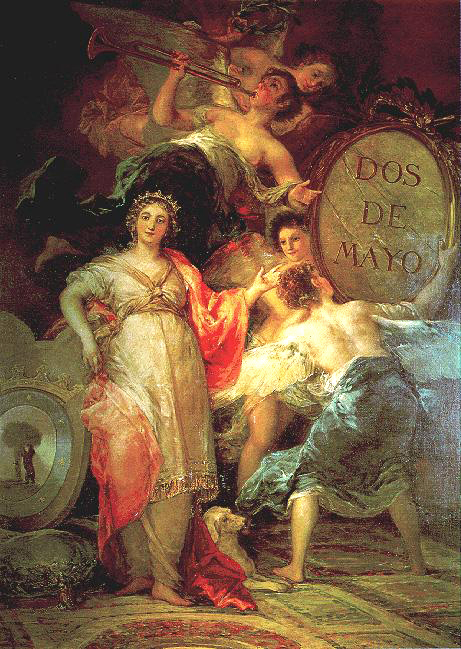
Look closely at Goya's Allegory of the City of Madrid and you will see that the oval at its centre carries only the words Dos de Mayo, the Second of May. That is the last of many changes. Madrid's city council ordered the picture in 1810 to honour Joseph Bonaparte, the king Napoleon had placed on the Spanish throne, and Goya painted his face in the oval. As the war swung back and forth, Joseph was painted out for the word Constitución, put back, painted out again, and replaced after 1814 by a portrait of Ferdinand VII, which was itself later covered by an inscription. In 1872 the city settled on the date of the 1808 uprising against the French.
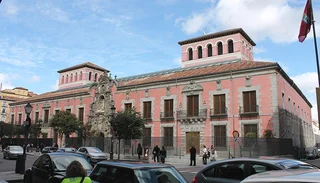
The painting belongs to the city's own history museum, which opened as the Municipal Museum in 1929. It occupies the old Royal Hospice of San Fernando on Calle Fuencarral, a house for the poor whose carved stone portal, designed in the 1720s by the architect Pedro de Ribera, is one of the best-known pieces of Baroque architecture in Madrid.
Inside, paintings, maps and prints follow the city from the 16th century onward. The piece many visitors linger over is a large scale model of Madrid made by the military engineer León Gil de Palacio and finished in 1830, showing the streets, convents and palaces as they stood after the Napoleonic wars.