The story
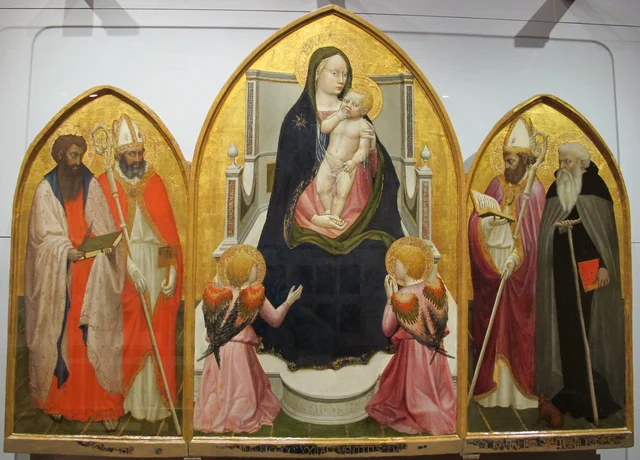
A line of lettering runs along the foot of the central panel here, giving a date, 23 April 1422. It is written in Roman capitals of the kind Florentine humanists had just revived, at a time when painters still used Gothic script. That small choice is one of the first signs that the young painter behind it, Masaccio, then about 21 and born in San Giovanni Valdarno some 20 kilometres away, was already working in the new Florentine manner.
The San Giovenale Triptych spent centuries in a small country church near Cascia, its author forgotten, until the art historian Luciano Berti connected it with Masaccio in 1961. The Virgin sits at the centre with the Christ Child and angels, with two saints on each side. The side panels still look back to the 14th century, while the Virgin's throne is set out in geometric perspective, and the work is often cited as the earliest known painting to use that new method.
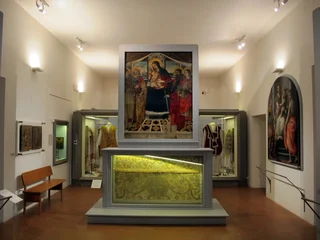
After years in storage it was placed in the Romanesque parish church of San Pietro a Cascia in 1988, and since 2002 it has hung in the small museum of sacred art beside that church, which now carries Masaccio's name. The rooms around it hold paintings, vestments and church silver gathered from the surrounding parishes, including works by the Florentine painters Alessandro Allori and Santi di Tito, and one room is furnished as a village priest's study.