The story
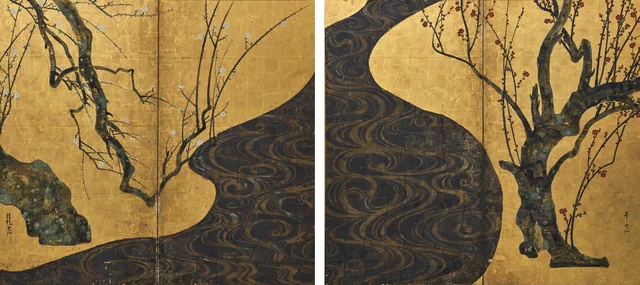
Around February each year, when the plum trees are in flower, the MOA Museum of Art brings out its most famous possession. Red and White Plum Blossoms is a pair of folding screens by Ogata Kōrin, the Kyoto painter of the early 18th century, with two flowering trees on a gold ground and a stylised stream curling between them. It is a National Treasure, and Kōrin painted it late in life, in the house he built in Kyoto in 1712. A reconstruction of that house, based on his own plan, now stands in the museum garden.
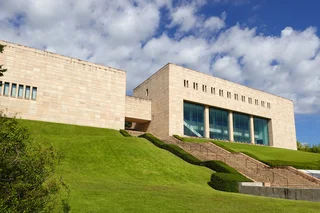
The collection was gathered by Mokichi Okada, founder of the religious movement known in English as the Church of World Messianity, who bought Japanese art after the Second World War partly to keep it from being sold abroad. He died in 1955, and the present museum opened in 1982 on the hillside above Atami, looking out over Sagami Bay. Visitors climb to it through a tunnel of seven escalators, about 200 metres in all, lit in changing colours.
The galleries were redesigned in 2017 by the artist Hiroshi Sugimoto and the architect Tomoyuki Sakakida. Beside the Kōrin screens, the National Treasures include a 17th-century tea-leaf jar painted with wisteria by the potter Nonomura Ninsei. There is a full-scale reconstruction of the Golden Tea Room made for the warlord Toyotomi Hideyoshi, a Noh stage, and a small group of Western paintings that includes a self-portrait of the young Rembrandt in a beret and a steel gorget.