The story
From the balcony over the main door of Palazzo Venezia, Benito Mussolini spoke to the crowds packed into the square below, and on 10 June 1940 he announced from it that Italy was entering the Second World War. Between 1929 and 1943 the palace was the seat of his Fascist government. His office was the vast Sala del Mappamondo, and the museum that had opened inside a few years earlier could be visited only with police permission.
The building is far older. The Venetian cardinal Pietro Barbo, later Pope Paul II, began it in 1455 beside his church of San Marco, reportedly with travertine taken from the Colosseum and the Theatre of Marcellus, and it became the largest secular building of 15th-century Rome. In 1564 Pope Pius IV gave part of it to the Republic of Venice for its embassy, which is where the name comes from. From 1814 it housed the Austrian ambassador, until Italy took it back in 1916, during the First World War.
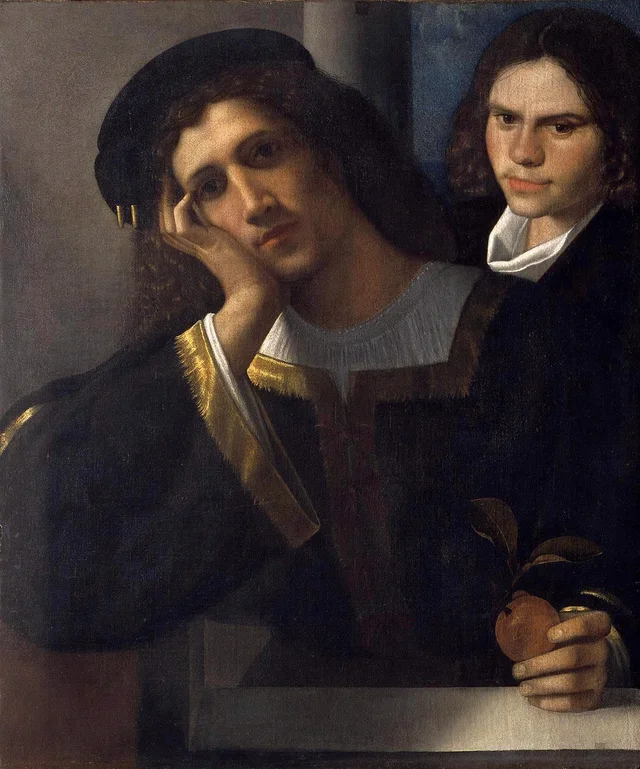
Today the national museum fills the grand rooms with medieval and Renaissance art, gathered from Castel Sant'Angelo, the old Jesuit museum of the Collegio Romano and churches in Abruzzo shaken by the Marsica earthquake of 1915. Visitors find Byzantine icons, ceramics, small bronzes and painted wooden sculpture, and among the paintings a Double Portrait from about 1502 of two young men, the one in front resting his head on his hand, which many scholars give to Giorgione, the elusive Venetian master.