The story
One painting in the Museu de la Garrotxa is roughly the size of a wall, about three metres high and almost five wide. In La Càrrega, The Charge, Ramon Casas, the Barcelona modernista painter, shows a mounted Civil Guard riding down a fallen man while a crowd of workers scatters, a scene drawn from the labour unrest of Catalonia at the turn of the century. Painted in 1899, it won a first medal at Spain's National Exhibition of Fine Arts in 1904. It came to Olot in 1919 as a permanent loan from the state's museum of modern art in Madrid, arranged by Miquel Blay, the Olot-born sculptor who sat on that museum's board.
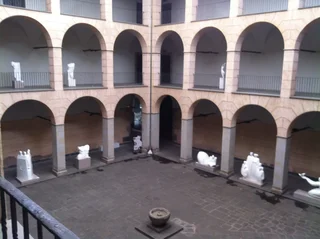
Most of the museum tells a quieter story. It occupies the Hospici, a neoclassical building for the town's poor raised between 1779 and 1784, and its core is the Olot School of landscape painting. The brothers Joaquim and Marià Vayreda and Josep Berga i Boix led it from the second half of the 19th century, painting the countryside around the town with a free hand, and their pictures are the heart of the display. Sculpture by Blay himself and by Josep Clarà, another son of Olot, rounds out the galleries.
