The story
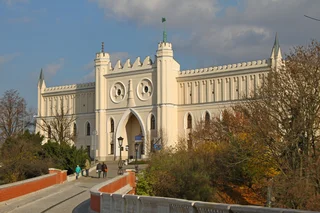
For well over a century, from 1826 to 1954, Lublin Castle was a prison. Under Russian rule it held Poles arrested after the national uprisings, during the Second World War the German occupiers ran it as a Gestapo jail, and after the war the communist security police used it against the anti-communist underground. Only in 1957 did it become the main seat of the city's museum, founded in 1906 and raised to the rank of a national museum in 2020.
The castle's oldest treasure outlasted all of this. The Chapel of the Holy Trinity was covered in 1418 with Byzantine-Ruthenian frescoes, commissioned by King Władysław Jagiełło, the Lithuanian-born ruler of Poland, and painted by Ruthenian artists working in the Eastern Orthodox tradition. Gothic vaults filled with Orthodox saints make it a rare meeting of Latin and Eastern Christian art.
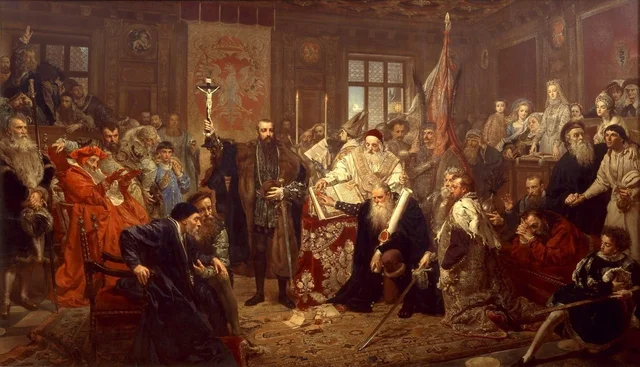
The best-known painting in the castle is Jan Matejko's Union of Lublin, a canvas about three metres high and five wide, finished in 1869 for the three hundredth anniversary of the 1569 union of Poland and Lithuania agreed in this city. It belongs to the National Museum in Warsaw and is on deposit here. During the war the Germans removed it, and afterwards it was found in Przesieka, a village in the Karkonosze Mountains, which briefly renamed itself Matejkowice in the painter's honour.