The story
In February 1933, with Japanese troops pressing south of the Great Wall, the first of more than 13,000 crates left the Forbidden City in Beijing by train. The imperial collection, opened to the public as the Palace Museum only eight years earlier, then spent a decade and a half on the move, first to Shanghai and Nanjing, and during the war deep into the southwest, to Anshun and Leshan. After Japan's surrender it returned to Nanjing. Then, between December 1948 and February 1949, as the civil war turned against the Nationalist government, 2,972 of those crates were shipped across the strait to the port of Keelung. They were only a fraction of the whole, but they had been chosen from the finest pieces.
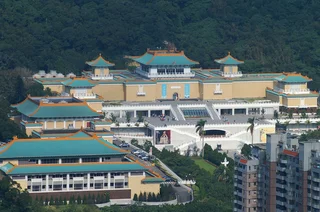
For years the objects waited in storage in the hills of central Taiwan. The museum in Taipei's northern Shilin district opened in 1965, and it still draws on that cargo, which is why its galleries read like a survey of a thousand years of imperial taste.
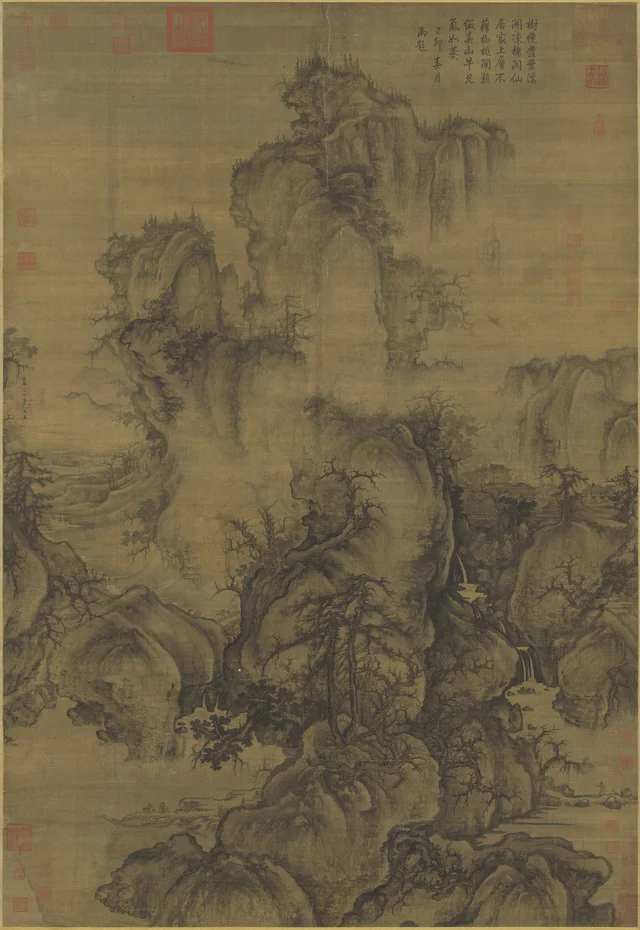
Among the paintings, look for Early Spring by the Song court painter Guo Xi, dated 1072, a towering landscape of mist and twisting pines. One Hundred Horses was painted in 1728 by Giuseppe Castiglione, an Italian Jesuit who worked at the Qing court under the name Lang Shining, and it joins European shading to the Chinese handscroll. The most storied scroll is Dwelling in the Fuchun Mountains by the Yuan painter Huang Gongwang. In 1650 a dying collector ordered it burned so that it could go with him, a relative pulled it from the fire, and it survived in two pieces. The longer section is here in Taipei, the shorter one in the Zhejiang Provincial Museum in Hangzhou, and in 2011 the two parts hung side by side in Taipei for a few months.