The story
Walk into the Palatine Gallery on the first floor of the Pitti Palace and the paintings climb the walls from waist height to the ceiling, frame against frame, three and four rows deep. You are seeing how a grand-ducal collection was actually kept, hung for symmetry in the rooms it was gathered for rather than rehung in tidy chronological lines. Raphael sits beside Titian and the Florentine painter Andrea del Sarto, arranged the way the Medici and their heirs wanted their walls to look.
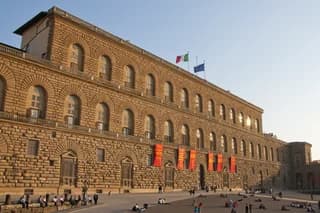
The palace itself began around 1458 as the ambition of Luca Pitti, a Florentine banker who wanted a house grand enough to rival the Medici. He overreached, fell from power, and left it unfinished. In 1550 Eleonora di Toledo, wife of Duke Cosimo I de' Medici, bought the shell, and the family the Pitti had tried to outshine moved in and made it their seat. Behind it they laid out the Boboli Gardens, and a raised passage, the Vasari Corridor, was run across the Arno so the dukes could walk from here to the Uffizi without touching the street.
Among the Raphaels here is the Madonna della Seggiola, a round painting from about 1513 of the Virgin holding the Christ child, one of the most copied images of the Renaissance. Three dynasties lived under this roof in turn — the Medici, then the house of Lorraine, then the kings of Savoy. When Florence briefly became the capital of Italy in the 1860s, Victor Emmanuel II ran the young kingdom from these apartments. His grandson gave the whole palace, gardens and all, to the nation in 1919.