Part One. The Last Medici
What Remains When a Dynasty Ends
In 1737, Gian Gastone de' Medici died without an heir. The principal grand-ducal line had reached its end after producing bankers, dukes, popes, queens, collectors, political survivors, and an extraordinary quantity of family mythology. His sister, Anna Maria Luisa, remained as its last representative. No legal document could produce another Medici ruler. What it could determine was the fate of the things the dynasty had accumulated.
She was seventy years old. She had spent a quarter of a century in Düsseldorf as the wife of the Elector Palatine, been widowed, and come home to a Florence she had left as a young woman. She had no surviving children. Everyone who might have inherited from her was already dead.
Their possessions filled palaces, villas, churches, storerooms, and galleries. Ancient statues stood beside paintings, jewels, manuscripts, scientific instruments, family portraits, and rare objects acquired over generations. Some had been commissioned by the Medici. Others had arrived through marriage, inheritance, purchase, or exchange. Together, they had become material evidence that the family had mattered.
A new dynasty was about to inherit Tuscany. In such a succession, a collection could follow its new owners. Paintings might be sent to another court. Ancient statues might be divided. Family portraits could become anonymous decoration in rooms far from Florence. Objects that had acquired meaning by remaining together could disappear into separate houses and countries.
The danger was not only that individual masterpieces might leave. Separation would break the relationships through which the collection narrated ancestry, taste, marriage, conquest, faith, and rule. Anna Maria Luisa could not save Medici government, but she could help prevent its material memory from being dismantled.
On 31 October 1737 she signed what is known as the Family Pact, part of the settlement with the Habsburg-Lorraine successors. It listed what could not go: galleries, paintings, statues, libraries, jewels and other precious things, none of them to be removed from the capital or from the state of the Grand Duchy. Then it gave a reason, and the reason has outlasted the dynasty that produced it. All of it was to remain, in the words of the agreement, for the ornament of the State, for the utility of the Public, and to attract the curiosity of Foreigners.
Read that last phrase again. In 1737, a childless widow at the end of her line wrote the curiosity of strangers into a dynastic treaty, and made it a reason for keeping her family's possessions where they were.
The popular version says that the last Medici gave the museum to Florence. The legal reality was more gradual and less sentimental. The Uffizi was not yet the public institution it would become, and Anna Maria Luisa did not create a modern museum with one generous signature. What the agreement did was secure the Medici collections to the Tuscan succession under conditions intended to prevent their removal and dispersal.
Yet its consequences ran far beyond family loyalty. A collection that stayed in Tuscany could become part of the state's identity, attract visitors, support study, and preserve relationships among objects that would have vanished if each piece had followed a different inheritance.
Anna Maria Luisa was protecting a dynastic past, not designing every future use. She could not know which paintings would dominate textbooks, which artists would be rediscovered, or how often Botticelli's Venus would be reproduced. She secured continuity without controlling the story that continuity would produce. She died six years later.
This gives the history of the Uffizi an unusual shape. Its clearest beginning comes close to the end. A family loses the future it expected, then tries to preserve the objects through which the past might continue to speak.
Why had those objects become so important? Why did paintings, sculptures, and rooms offer a form of survival that titles and bloodlines could not? To answer that, we have to return to a Florence in which the Medici possessed money and influence but no throne. We also have to begin before their version of the story became dominant.
Part Two. Before the Family Owned the Story
Three Madonnas and a Misleading Race
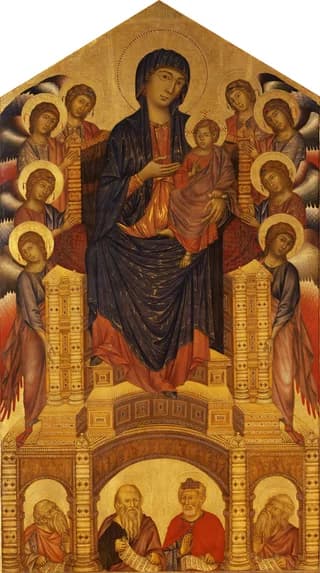
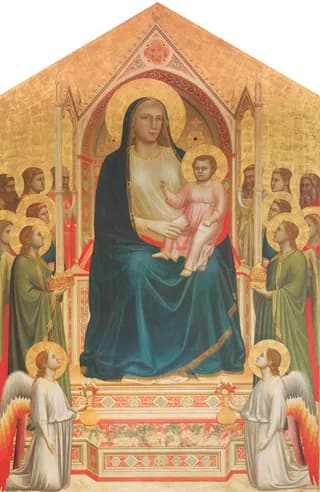
The familiar Uffizi story begins with enormous images of the Virgin and Child. Seen together, Cimabue appears older and Giotto more solid and spatial, as though a road has opened toward the Renaissance. The comparison is useful, but the paintings were sacred objects before they became stages in an art-historical race.
Cimabue's Santa Trinita Maestà was not created to demonstrate an early stage in the development of realistic painting. Its gold ground removes the Virgin from ordinary weather and ordinary time. Her scale establishes authority. Angels gather in ordered ranks around an elaborate throne, while prophets appear beneath it. Any flatness in the image is not evidence that Cimabue could not imagine depth. He uses depth selectively, preserving a sacred hierarchy that mattered more than the illusion of a real room.
Duccio's Rucellai Madonna, painted by a Sienese artist for a Florentine confraternity, immediately complicates the idea of a sealed Florentine beginning. Its long lines, floating angels, and precious surface create a different kind of sacred presence rather than an unfinished version of Giotto.
Giotto's Madonna Enthroned, the panel usually called the Ognissanti Maestà, changes the physical relationship. The throne opens more convincingly into space. The Virgin's body has weight beneath her clothing. Her knees, torso, and seat feel connected. Angels overlap and occupy different positions. The sacred figure does not become ordinary, but her body becomes more imaginable.
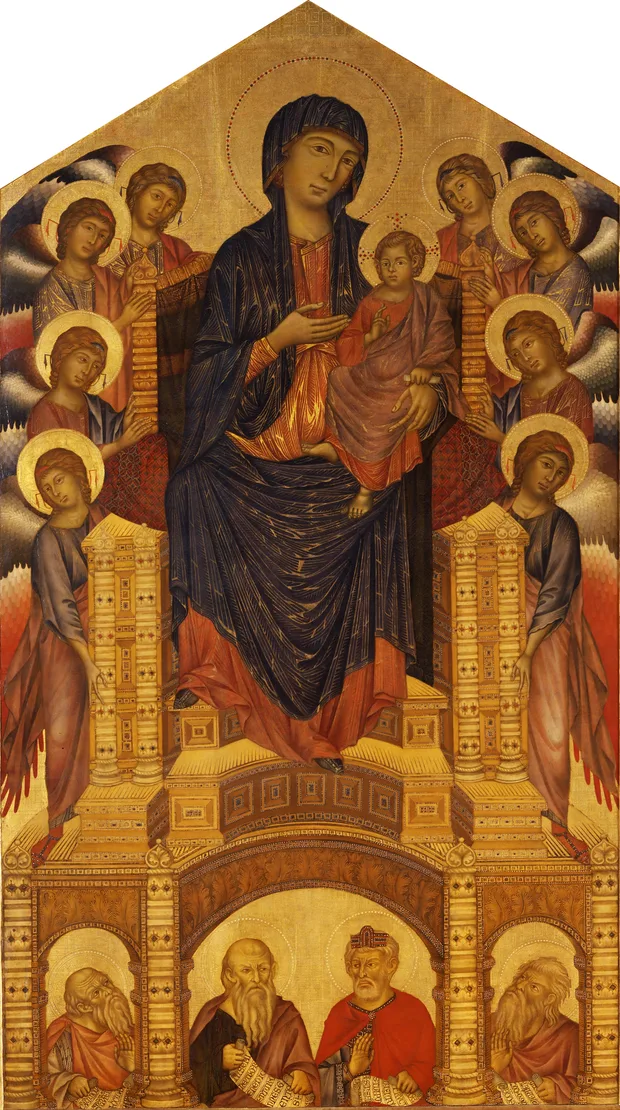
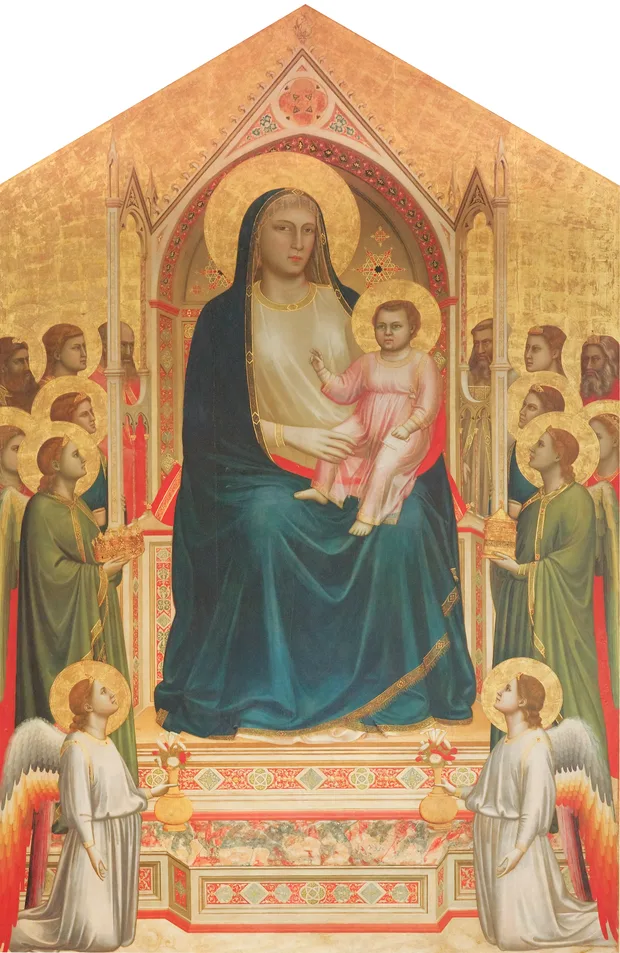
Giotto made the body more imaginable and the space more convincing, but the museum turns that change into a beginning only in retrospect. The people who first prayed before these paintings did not see Leonardo waiting at the end of history. They approached sacred images, not a timeline.
Once the works entered a museum, comparison created a new meaning. Paintings made for different churches and communities could now appear as consecutive steps in one development.
A Gold Ground Can Still Move
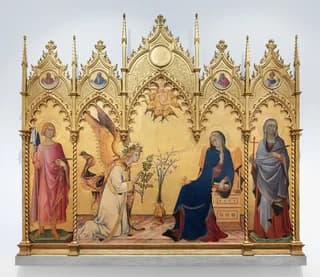
Simone Martini and Lippo Memmi's Annunciation makes the limits of a simple progress story even clearer. The angel enters with patterned wings and a body curved by speed. Words travel from his mouth toward Mary. She recoils, drawing her robe closer, not in theatrical panic but in immediate guarded response. The gold ground remains, yet the human tension is exact.
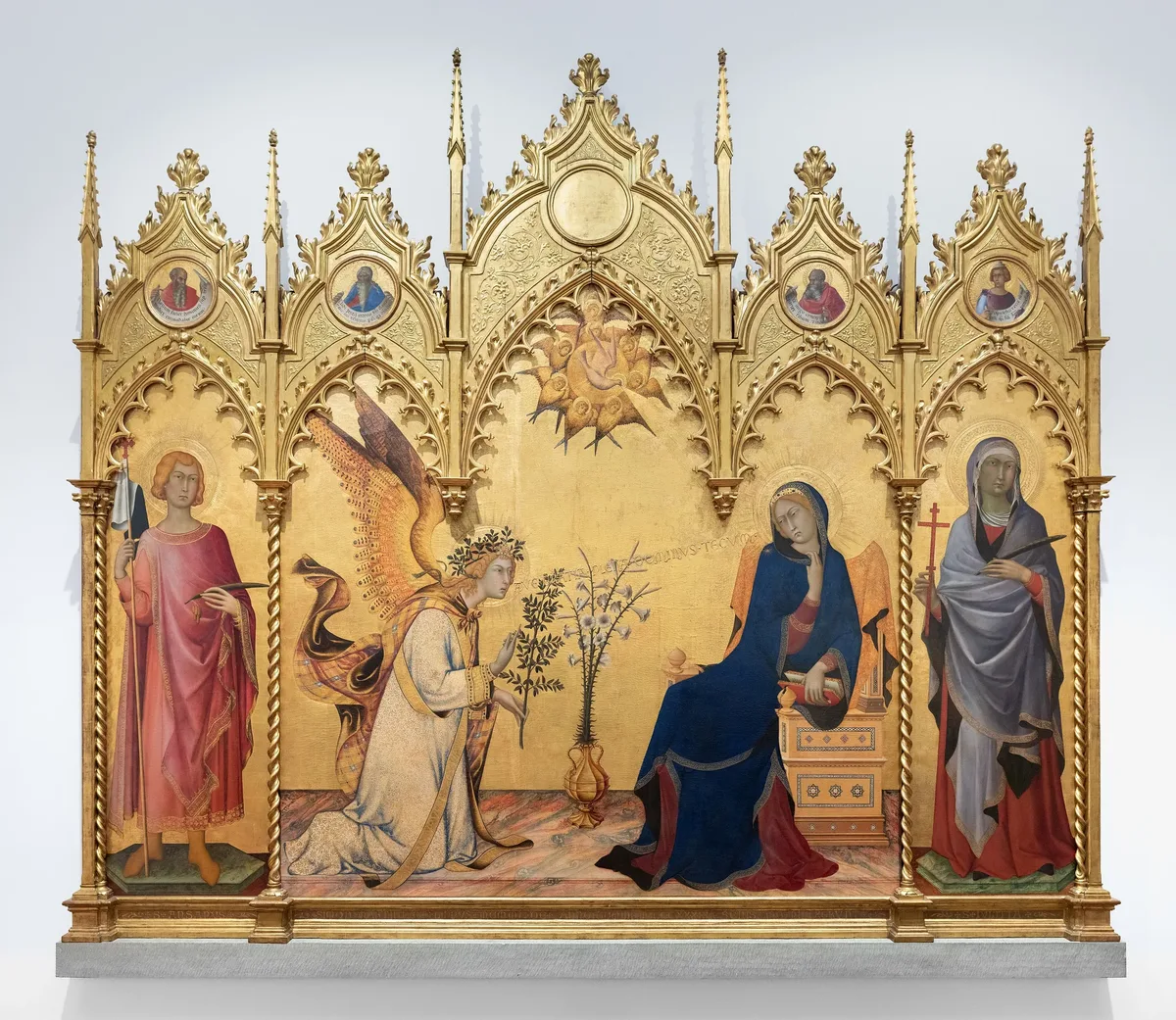
A history obsessed with volume and perspective can underestimate what line, pattern, and restraint are doing here. The absence of a convincing room does not make the scene less dramatic. The drama comes from an interruption entering a world of exquisite control.
Florence did not advance in a straight line toward one visual solution. Churches, confraternities, guilds, merchants, and rival households commissioned works for different needs, and older and newer languages continued side by side.
The Rival Who Arrived in Gold
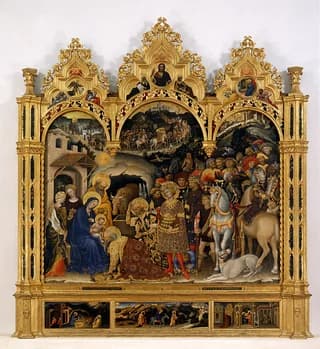
Gentile da Fabriano's Adoration of the Magi belongs to this competitive Florence. Palla Strozzi, one of the city's richest men, commissioned it for his family chapel. The painting is crowded with textiles, animals, jewels, distant landscapes, and a procession that seems to carry the wealth of the known world toward the Christ Child. Sacred history becomes an occasion for earthly magnificence, not because faith is absent, but because devotion and social display are working together.
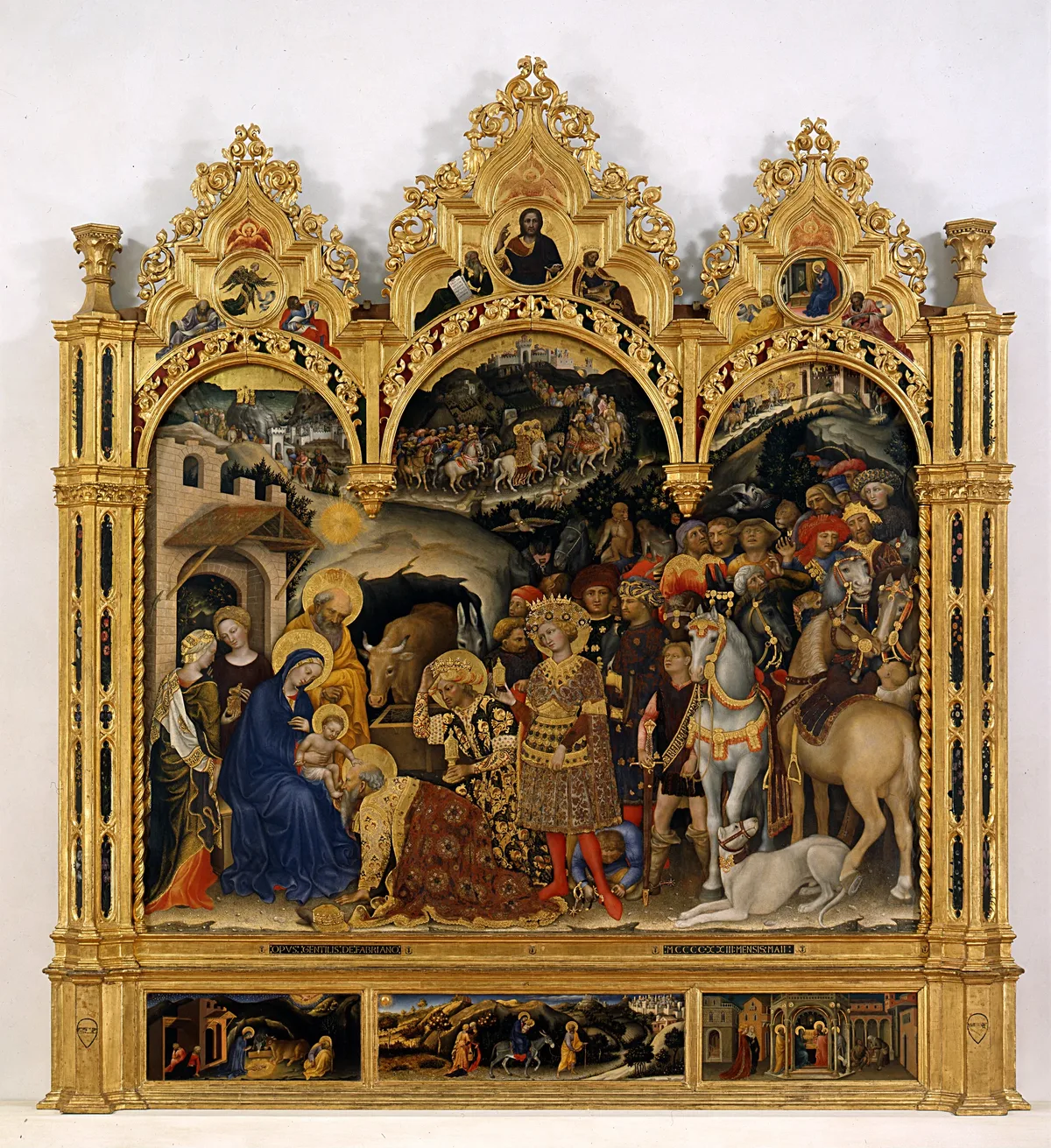
The Strozzi example is important because it stops the Medici from arriving as the only family that understood culture. Florence already contained wealthy patrons capable of commissioning astonishing work. The Medici would become unusually skilled at making patronage support a wider network of legitimacy, but they did not invent the connection between beauty and status.
Palla Strozzi's later political fate makes the rivalry sharper. He was not merely a wealthy patron whose taste lost a competition. He belonged to a family with enough power to threaten Medici dominance. When Cosimo returned from exile in 1434, Palla himself was driven into exile. The magnificent altarpiece remained in Florence while the man who commissioned it spent the rest of his life away from the city.
That reversal gives the painting another meaning. It preserves the confidence of a rival world that the Medici defeated politically but could not erase from the city's culture. The Uffizi records Medici success, but it also preserves the work of rivals who remind us that the family never had Florence to itself.
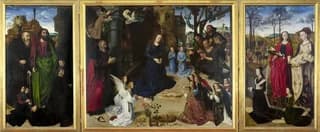
A second work widens the map beyond Italy. The Portinari Triptych was painted in Bruges by Hugo van der Goes for Tommaso Portinari, a Florentine banker working in the orbit of Medici finance. It arrived in Florence at monumental scale, carrying a fully developed foreign visual language. The shepherds have weathered faces and rough hands. Glass catches light. Tears, hair, straw, and fabric are rendered with a precision Florentine painters could now study at close range. The altarpiece did not prove that northern art was more advanced. It showed that Florentine artists were working inside an international economy of images.
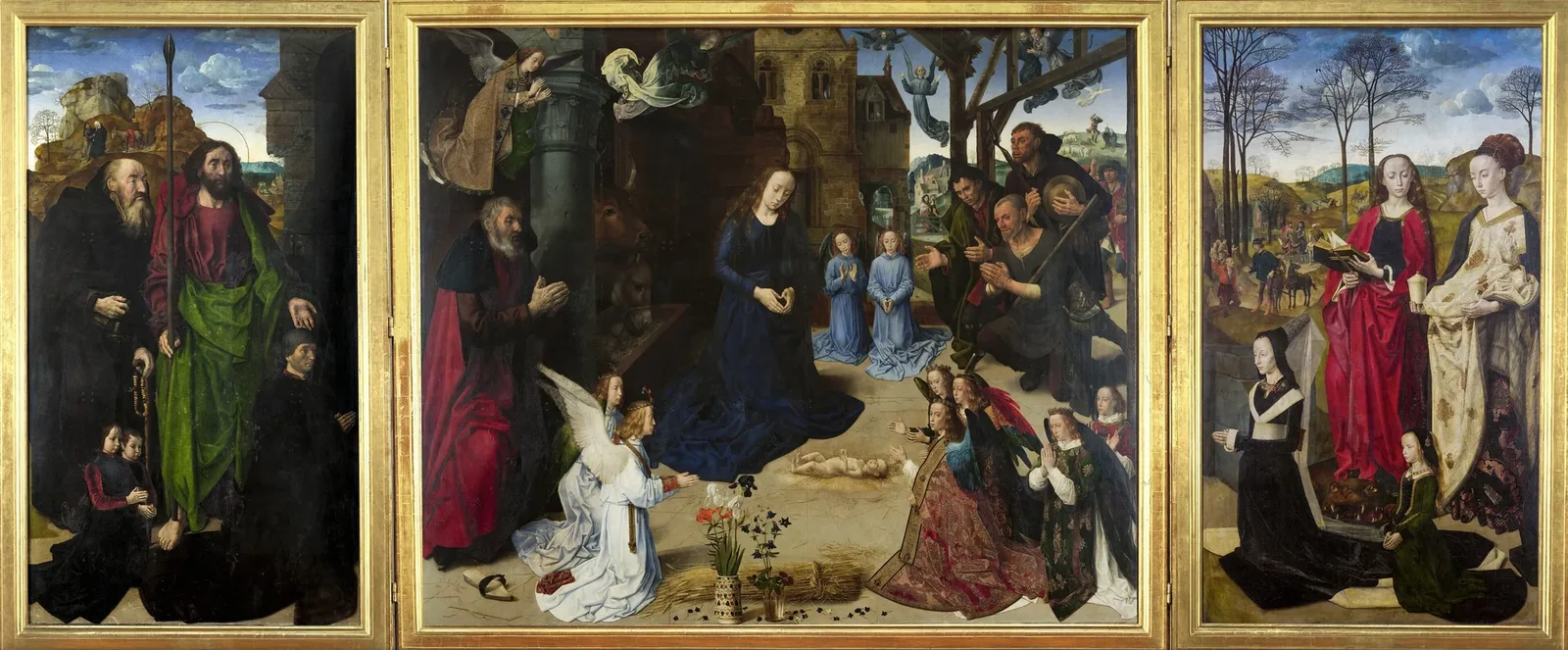
The movement of the painting also exposes the network behind culture. A Florentine banker based in Bruges commissioned a Netherlandish artist, then sent the result to a church in Florence. Finance did not merely pay for the Renaissance. It moved visual experience across borders.
By the time the Medici become central to our story, the city already knows how art can serve religion, family, reputation, competition, and international exchange. Their achievement will not be to create that system from nothing. It will be to make their family increasingly difficult to imagine outside it.
Part Three. How to Rule Without a Crown
Exile Reveals the System
In 1433, Cosimo de' Medici was arrested and sent into exile. A year later, he was back. The reversal exposed an unusual kind of power. Cosimo had no crown and commanded no royal court, yet his banking relationships, political allies, clients, and supporters made him difficult to remove from Florence for long.
The scale of those relationships is easy to underestimate. The Medici bank kept branches in Rome, Venice, Naples, Milan, Pisa, Geneva, Lyon, Avignon, Bruges, and London. It handled papal accounts. A merchant in Flanders and a cardinal in Rome could both owe their liquidity to the same Florentine family.
The city remained a republic. Offices and elections continued, and other families still mattered. Open monarchy would have provoked resistance, so Medici influence worked through the existing system. Cosimo became far more than a private citizen without needing to declare himself a prince.
This made reputation a practical instrument. A prince could rely on title, court ritual, and hereditary law. Cosimo needed citizens to encounter Medici influence as something woven into the city itself. The family name appeared in religious foundations, libraries, buildings, marriages, loans, and obligations. No single gesture created control. The accumulation did.
Patronage suited this position, and Cosimo spent on a scale that has been estimated at more than six hundred thousand gold florins across his lifetime of building and giving. Some of it went into a single monastery: tens of thousands of florins for the fabric of the Badia at Fiesole, and thousands more for what went inside it. When he wanted a library, he commissioned the bookseller Vespasiano da Bisticci to produce it, and Vespasiano set twenty-five scribes to work and delivered two hundred volumes in twenty-two months.
A chapel served worship while preserving a donor's name. A library supported learning while displaying generosity. Money spent on a monastery could express faith, strengthen relationships, and improve the city at the same time. Private fortune became visible as public benefit.
The system worked through repetition. A citizen might borrow from the bank, owe a political favor, attend worship in a Medici-supported setting, and encounter the family again through marriage or office. None of these relationships alone amounted to monarchy. Together, they made opposition expensive and loyalty useful.
This is why Medici power can be difficult to point to in one image. It did not always need a crown, throne, or official emblem. It became persuasive by appearing across the ordinary institutions of elite Florentine life.
Faces Inside Sacred History
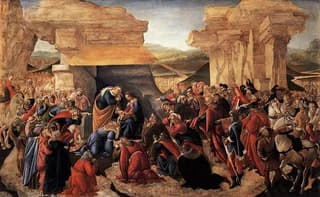
Botticelli's Adoration of the Magi shows how quietly contemporary power could enter an image. Gaspare di Zanobi del Lama commissioned it, yet the painting has long been read as including portraits associated with the Medici circle. The exact identities remain uncertain. What matters is that biblical history has absorbed the social world of Florence.
The Medici do not need to replace the sacred subject. Their presence among the worshippers is enough. Loyalty, recognition, and religion occupy the same space.
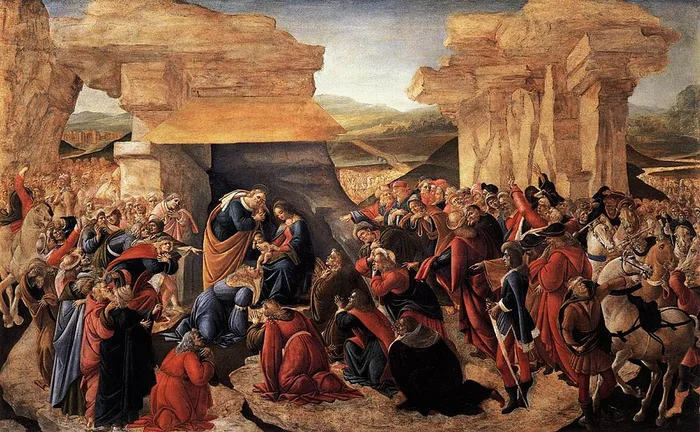
This was more effective than a blunt political emblem. Viewers could admire the painting, recognize familiar faces, participate in devotion, and absorb a social order without being told that the picture was propaganda. The sacred scene lent seriousness to contemporary relationships, while those relationships made the distant biblical event feel close.
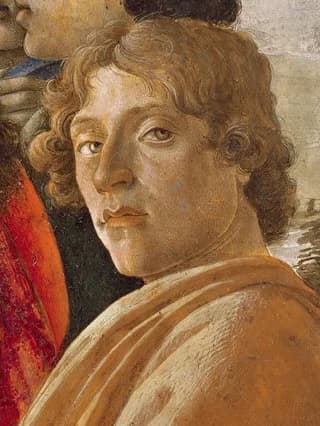
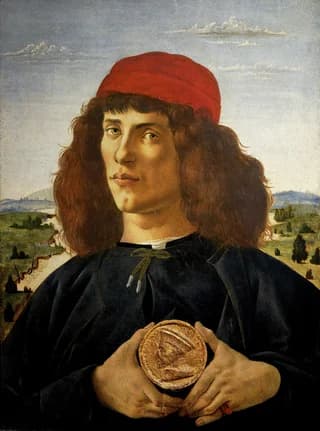
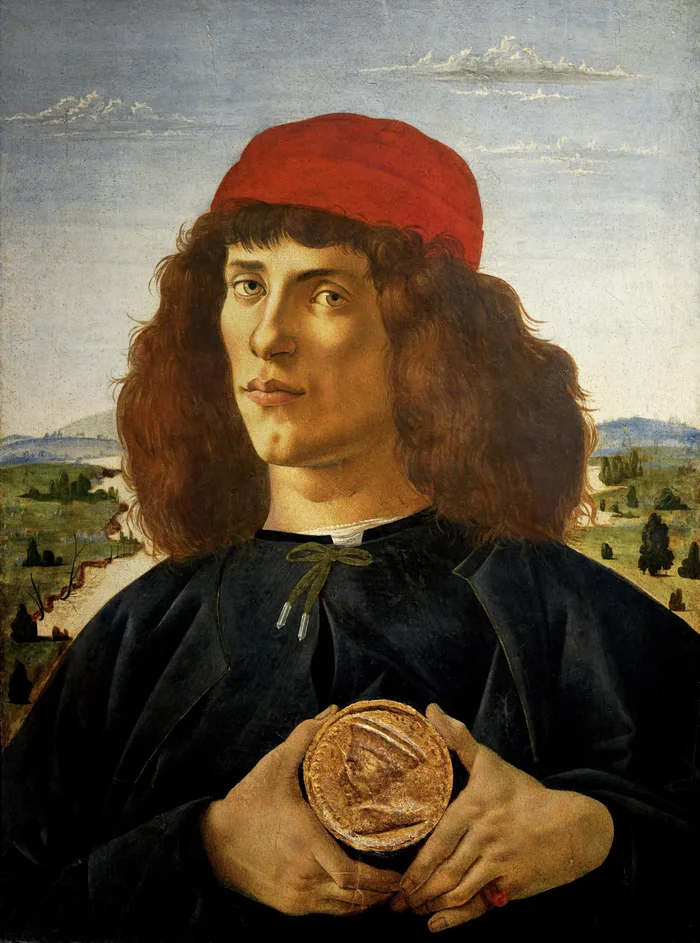
Another Botticelli portrait makes family memory even more explicit. An unidentified young man holds a medal bearing the profile of Cosimo the Elder. The sitter's name is uncertain, but the object in his hands tells us how Cosimo's image could already be used. The founder has become something another person can display and claim.
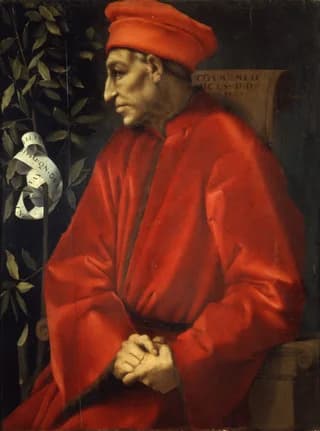
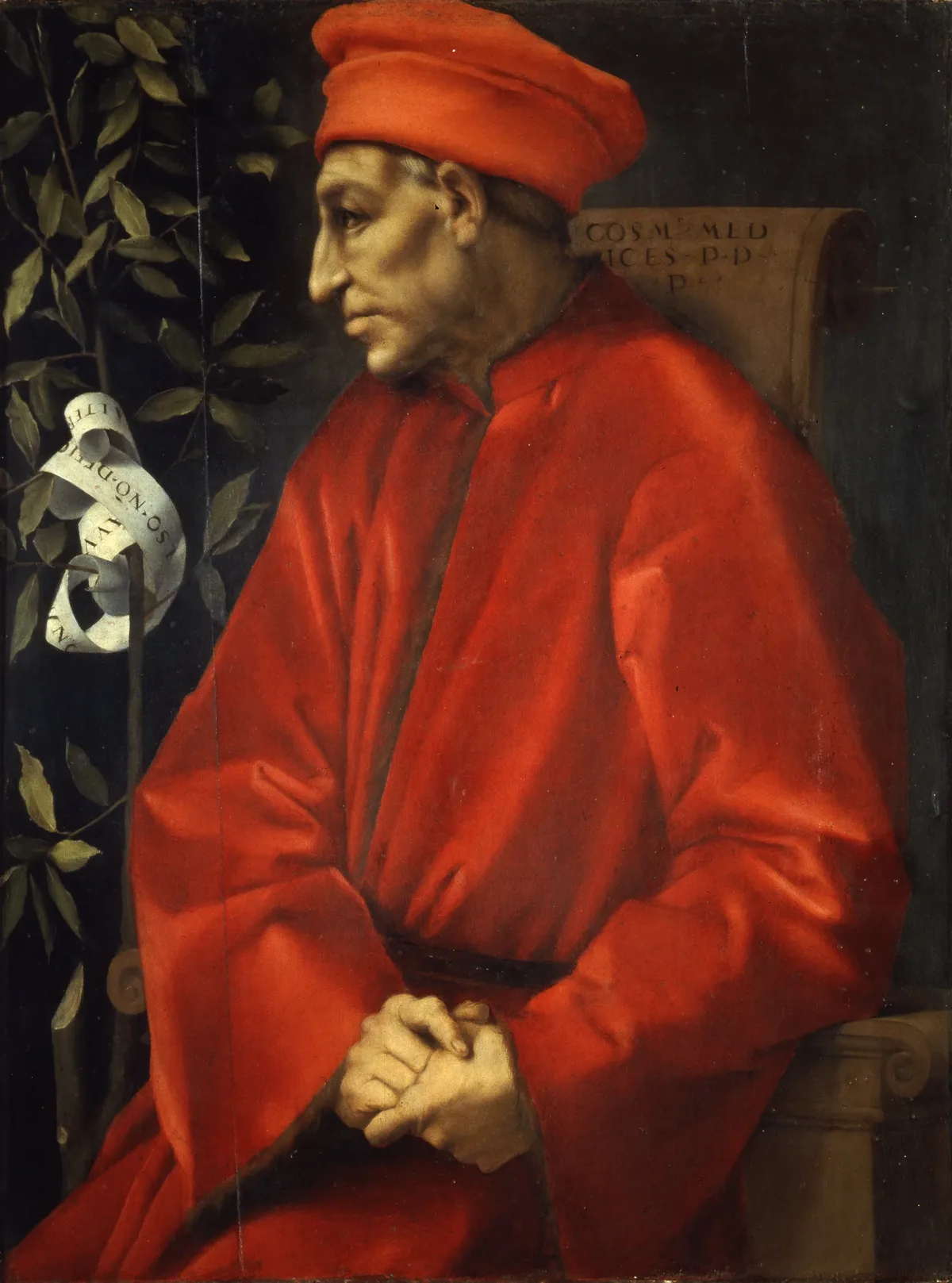
Decades later, Pontormo painted Cosimo again. This was not a portrait from life but a reconstruction for a new political generation. A dead banker returned as the ancestor of a regime that needed a usable past.
The Golden Age Turns Violent
Lorenzo the Magnificent became the most famous representative of Medici culture because he moved easily among politics, poetry, patronage, collecting, and humanist learning. Later history polished his period into a golden age.
On Sunday 26 April 1478, that golden age opened into murder.
The place was Florence Cathedral, at High Mass, with the congregation on its knees. Lorenzo and his younger brother Giuliano had come separately. At a signal during the service, men who had been standing beside them turned. Giuliano was stabbed nineteen times and died on the cathedral floor. Lorenzo, cut in the neck, fought clear, ran for the sacristy, and the heavy doors were pulled shut behind him. Outside, the rest of the plot failed within hours.
What followed was not judicial. Conspirators were hanged from the windows of the government palace, including an archbishop still in his robes. The bodies stayed up for days.
Then the city commissioned a painting of them.
The Otto di Guardia e Balìa, the magistracy responsible for public security, hired Botticelli — the same painter who would produce the Primavera within a few years — to depict the executed men hanging in their death throes. The images went up on the wall above the Dogana, beside the Palazzo della Signoria, at the heart of civic Florence. Eight conspirators, each figure accompanied by mocking verses that Lorenzo wrote himself. Anyone crossing the square saw them. They stayed up for sixteen years and were destroyed in 1494, when the Medici were driven out and the city no longer wished to be reminded.
Culture and violence were not separate Florences. The alliances that supported poets, chapels, and artists were political alliances, and losing them could be fatal. The painter of Venus also worked as an instrument of state revenge, and nobody at the time appears to have found the combination strange.
The conspiracy changed Lorenzo's image as well. In later Medici memory, his survival strengthened the idea that the family and the city's stability were connected. Danger could be turned into legitimacy, just as portraits could turn a dead banker into a founder.
Lorenzo's fame also creates a practical trap for later storytelling. Not every Medici-associated painting was his commission. The family had several branches, and Botticelli's great mythological works are linked especially to the household of Lorenzo di Pierfrancesco, a younger cousin from a junior line.
The distinction matters because Medici culture was not one program directed by one man. It was a family network whose members used art under different circumstances. Its success lay in the growing association among Florence, learning, beauty, and the Medici name.
The next paintings show how ambitious, seductive, and unstable that association became.
Part Four. When the Pagan Gods Returned
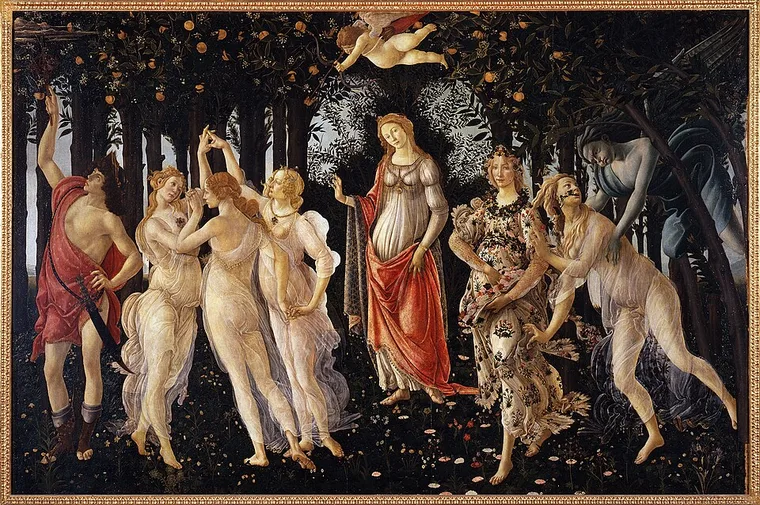
A Garden That Refuses One Explanation
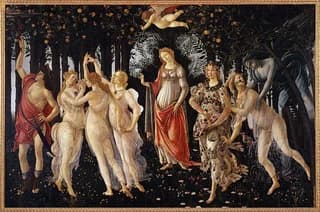
In Botticelli's Primavera, the first event is easy to miss because the painting is so beautiful. On the right, the wind god Zephyrus seizes a fleeing woman named Chloris. Flowers begin to leave her mouth. In the next figure, she has become Flora, dressed in blossoms and scattering more from her hands.
At the center stands Venus, set slightly back from the others. A blindfolded Cupid draws his bow above her. Three women dance in transparent fabrics. Mercury turns toward the trees at the edge of the garden. The figures are recognizable enough to invite explanation, but the whole painting resists becoming a solved puzzle.
By the late fifteenth century, the painting was recorded in a property associated with the heirs of Lorenzo di Pierfrancesco de' Medici. It hung above a lettuccio, a piece of domestic furniture combining the functions of a chest, bench, and daybed. That setting matters. The painting belonged to an elite household, not to a pagan temple or a modern public gallery.
Its meanings may have included marriage, fertility, education, poetry, the ordering of desire, Ovidian transformation, and the philosophical culture later described as Neoplatonic. None of these possibilities has eliminated the others. The work has accumulated interpretations because it brings several literary, social, and mythological languages into the same image without allowing one of them to settle the whole.
Even the garden resists being treated as generic decoration. Scholars and botanists have identified a remarkable variety of plants and flowers, some associated with spring, fertility, marriage, and the Medici. The orange trees have often been connected with the family, although the painting does not become a simple heraldic code because of them. The garden is both cultivated and impossible, a place where different moments of flowering coexist.
The figures also move through different kinds of time. Zephyrus, Chloris, and Flora form a sequence, almost like three frames in one transformation. The Graces turn in a circular dance. Mercury appears to guard or clear the edge of the scene. Venus occupies the still center while everything around her describes motion, pursuit, exchange, and return.
The painting's difficulty may not reflect a failure to discover the correct answer. Multiplicity may have been part of its design.
The image is often described as a celebration of spring and love. It also begins with pursuit and force. Chloris becomes Flora, but transformation does not erase the violence that starts it. Botticelli's graceful line does not make the story simple. Beauty and unease are already joined.
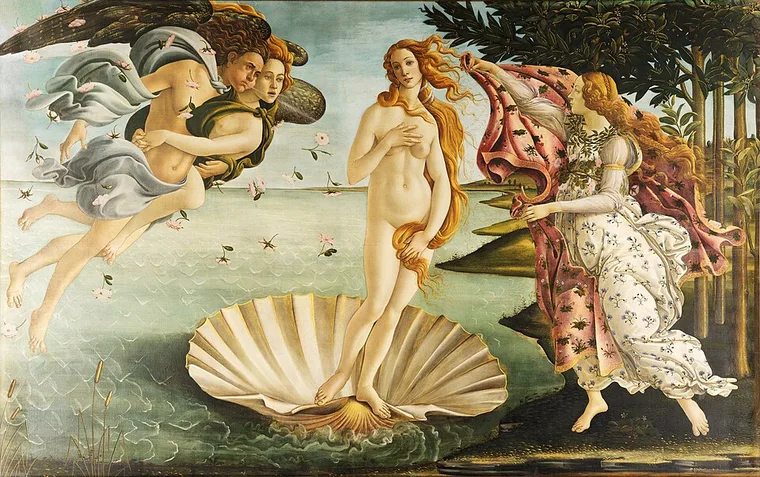
Venus Arrives in Florence
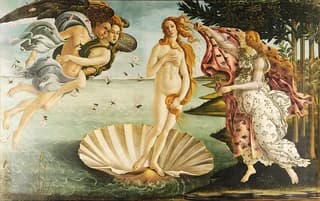
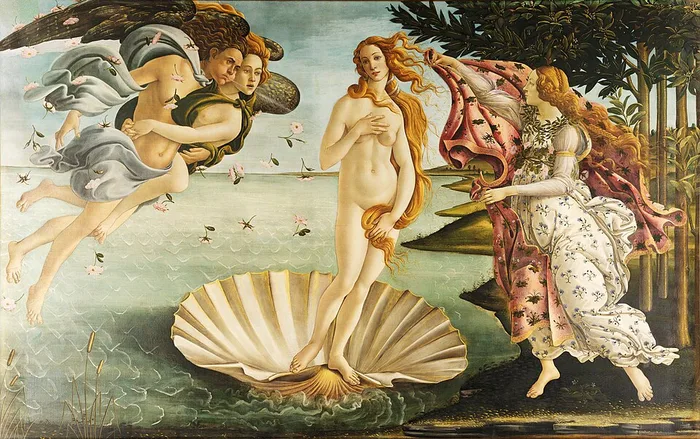
The painting called The Birth of Venus does not show the instant of birth. Venus has already emerged from the sea and is approaching land. Zephyrus and a female companion blow her toward the shore. A woman waits with a flowered mantle. Venus covers her body while remaining entirely exposed to the viewer.
The body is not anatomically natural in a strict sense. The neck is long, the shoulders slope, the stance would be difficult to hold, and the floating hair seems to obey design more than gravity. Botticelli is not failing at realism. He is constructing a body whose elegance depends on controlled impossibility.
The support is canvas, useful for decorative painting in elite domestic settings and more portable than a large wooden panel. That practical choice helps restore the work to a world before museum fame. Venus was once an object in a household. Today her face has become one of the most detachable images in Western art.
She appears in advertising, fashion, political protest, album design, memes, cosmetics, and phone cases. Most people encounter her before they encounter the painting. By the time they stand before the canvas, they are not discovering an unknown image. They are meeting the physical source of something already circulating through the world.
We will return to that modern life later. In fifteenth-century Florence, the pagan nude could enter an elite Christian household because antiquity offered poetry, education, moral allegory, erotic possibility, and prestige. Humanists did not need to abandon Christianity to read Ovid or find meaning in Venus. They adapted the ancient world to new uses.
Antiquity Was Reconstructed, Not Simply Recovered
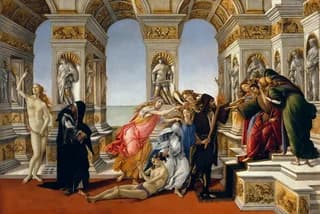
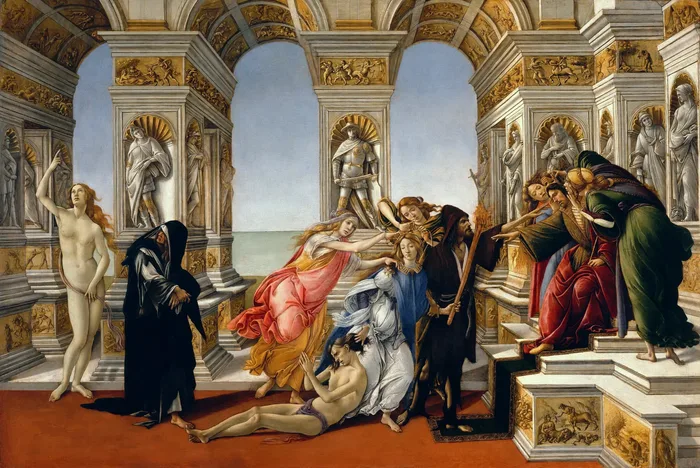
Botticelli's Calumny of Apelles demonstrates how active this recovery could be. The lost ancient painting attributed to Apelles no longer existed. What survived was a literary description. Botticelli used words to recreate an image that no one living had seen.
The Renaissance return to antiquity was therefore not a simple reopening of a sealed box. Ancient texts were incomplete, sculptures arrived broken, stories contradicted one another, and artists filled gaps with invention. The past was recovered by being remade.
This confident cultural world did not last. Lorenzo died in 1492. The Medici were expelled two years later as a French army entered Italy, and the Dominican friar Girolamo Savonarola gave moral and political force to attacks on luxury and corruption.
On 7 February 1497, the last day of Carnival, his followers went from door to door across Florence asking householders to surrender their vanities. What came out of the houses was carried to the Piazza della Signoria and stacked into a wooden pyramid several storeys high: mirrors, wigs, cosmetics, perfumes, fine dresses, playing cards, dice, chessboards, lutes and viols, books of poetry, and paintings the friar's followers judged lascivious. A figure of Satan was fixed at the top. Then they set light to it, and the city sang while it burned. Florence has called it the Bonfire of the Vanities ever since.
Fourteen months later, on 23 May 1498, Savonarola was hanged and burned in the same square, on the same spot. His ashes were shovelled into the Arno so that nobody could keep them as relics.
A famous story claims that Botticelli threw his own pagan paintings onto the 1497 fire. There is no secure evidence that he destroyed the mythological works now in the Uffizi. The legend survives because it offers a satisfying drama: the painter of Venus repents. History is less neat. Botticelli's later religious intensity belongs to a changing Florence, but it does not require us to invent a public destruction of his own masterpieces.
The pagan gods had returned, but they had not arrived in a stable world. Their beauty was part of a political and moral culture capable of collapsing around them, and of burning the people who set it alight.
Part Five. How the Artist Became the Hero
A Workshop Before the Legend
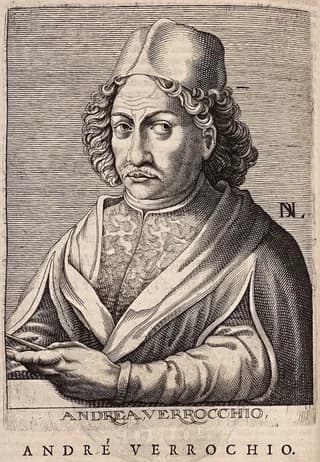
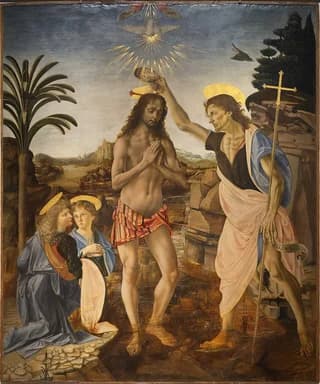
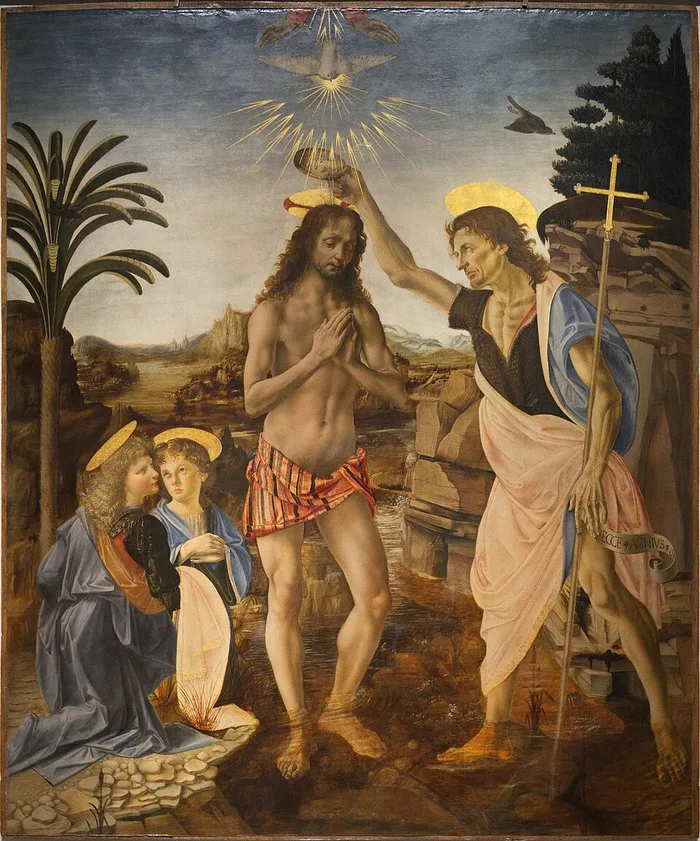
The Renaissance artist is often imagined as a solitary genius standing apart from ordinary labor. The workshop of Andrea del Verrocchio provides a better starting point. His Baptism of Christ was a collaborative object. Different hands contributed to the painting, and parts of it are traditionally associated with the young Leonardo da Vinci.
Vasari later wrote that Leonardo painted an angel so much better than anything beside it that Verrocchio put down his brushes for good, humiliated at being outdone by a boy. There is no documentary reason to accept the story as fact. It matters because it gives the birth of genius a perfect dramatic shape. The pupil reveals a gift beyond instruction, and the master recognizes that history has moved past him.
That is how artistic biography begins to reorganize our view of works. We stop seeing a workshop object and start searching for the moment when Leonardo becomes Leonardo.
Painting as Investigation
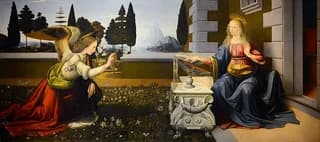
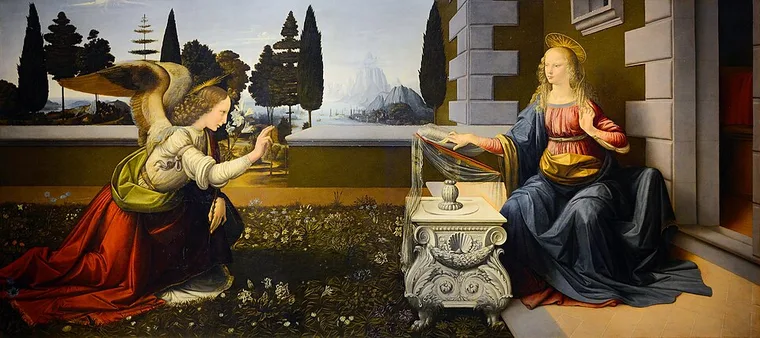
Leonardo's Annunciation places a miraculous event inside a world studied with unusual attention. Plants in the foreground have distinct structures, and the distant landscape dissolves through atmosphere. Observation does not compete with the sacred subject. It makes the visible world part of the wonder.
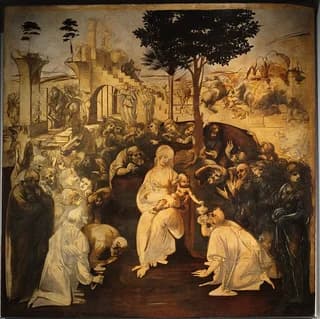
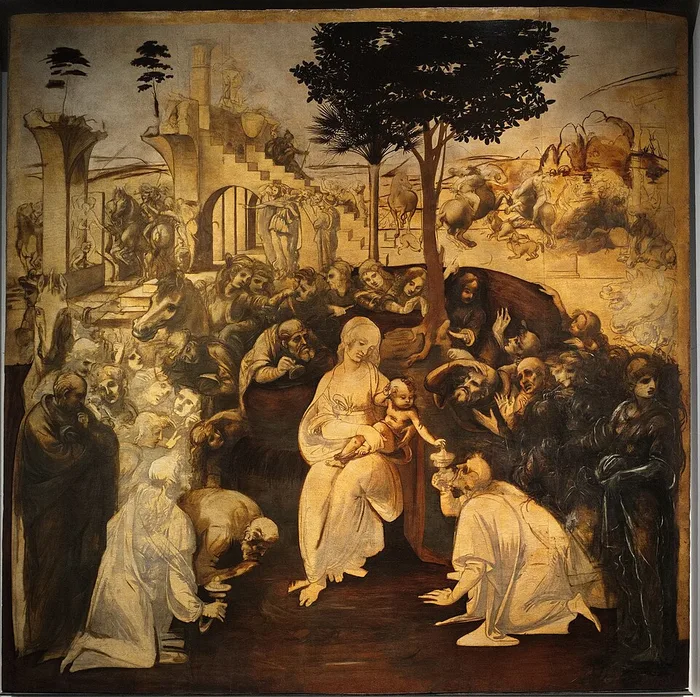
His unfinished Adoration of the Magi makes thought visible. The surface contains emerging bodies, gestures, animals, architecture, and currents of movement that have not settled into a final painted order. The incompletion is not automatically more profound than a finished work, but it lets us see composition as an active problem.
The Virgin and Child form a still center while the world around them turns, bends, points, kneels, and reacts. The unfinished state exposes the effort required to make revelation organize a crowd.
Michelangelo Refuses to Make a Gentle Family Picture
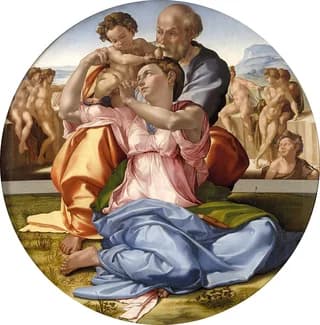
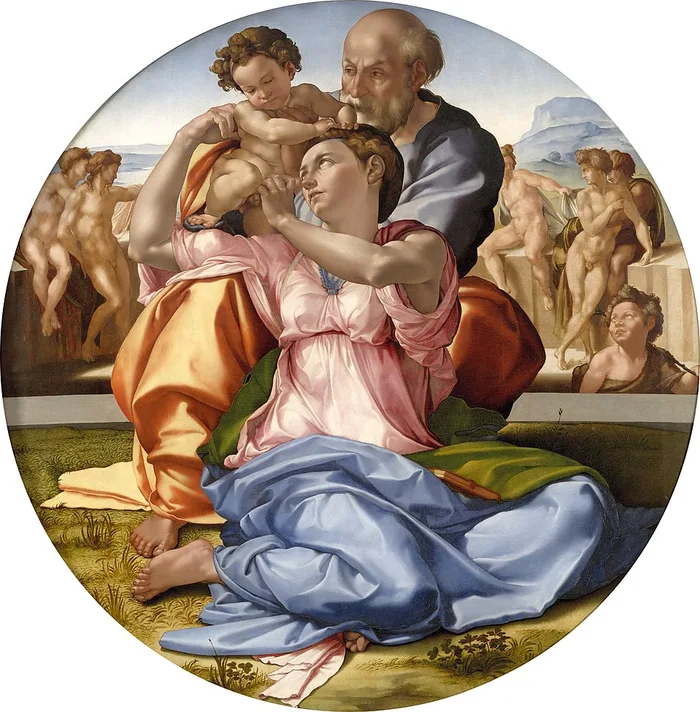
Michelangelo's Doni Tondo was commissioned for Agnolo Doni in the context of marriage and household, and it has also been connected with the couple's first child. The exact occasion remains debated. What is not uncertain is the painting's physical force.
The Holy Family forms a dense knot of turning bodies. Mary twists to receive or pass the Child. Joseph rises behind her. The figures seem carved from color rather than gently modeled by it. In the background, nude bodies occupy a separate zone whose meaning has never been settled completely.
A domestic religious commission becomes an argument about artistic authority. Michelangelo does not disappear behind the subject. His manner announces itself. The artist's identity becomes part of what the patron has acquired.
That change affects the patron as well. To own a Michelangelo is no longer only to possess a successful sacred image. It is to possess evidence of contact with a singular mind. The name begins to alter the value and meaning of the object.
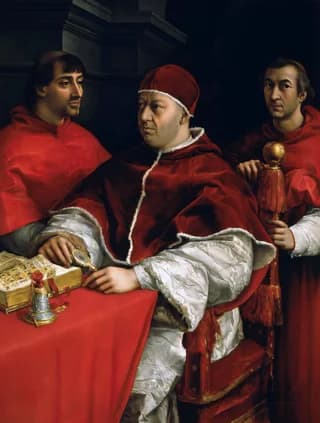
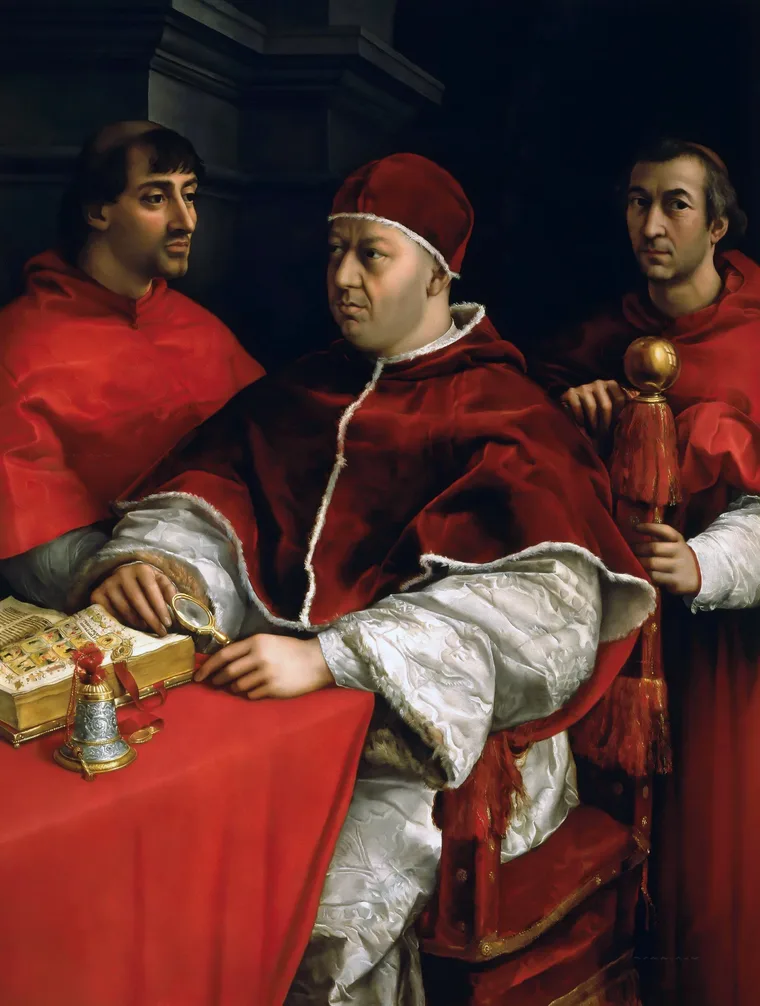
Raphael's authority took a different form in his Portrait of Leo X with Cardinals Giulio de' Medici and Luigi de' Rossi. The family that once ruled indirectly inside a republic now occupies the papal court.
The painting is rich in texture: velvet, fur, metal, paper, and the illuminated book before the pope. Leo's magnifying glass and the carefully rendered pages make scholarship part of papal display, while the bell on the table suggests a court that can be summoned into action.
Yet the three faces do not form a simple image of triumphant authority. Leo looks heavy and watchful. The cardinals approach from behind without dissolving into loyal decoration. Magnificence and tension share the table. Raphael has produced an official portrait that remains psychologically inconvenient.
By the sixteenth century, artists had become historical actors in their own right. Vasari's Lives, first published in 1550 and expanded in 1568, organized art through biographies filled with rivalries, temperaments, failures, and revelations. Michelangelo stood near the summit of a story that strongly favored Tuscany and Florence.
Biography made artistic change memorable. A technical or stylistic development could be attached to a childhood sign, a rivalry, a difficult personality, or one decisive encounter. That is why Vasari's stories remained powerful even when individual episodes could not be verified.
The method also pushed workshops, assistants, women, and unnamed laborers toward the edges. A collaborative object became a stage on which one genius first revealed himself. The Uffizi would later gather many of the works through which this sequence of great names could be seen.
The man who helped write the plot would also design the building where later generations learned to believe it.
Part Six. When the Republic Became a Court
The Difference Between Influence and Government
In 1537, after the collapse of the last republic and the assassination of Duke Alessandro, the young Cosimo I became Duke of Florence. Cosimo the Elder had worked through influence inside republican forms. His descendant built hereditary government, a territorial state, and a court that no longer pretended the Medici were merely first among equals.
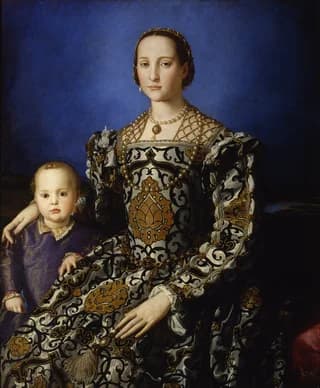
Cosimo's marriage to Eleonora of Toledo helped connect the new regime to Spanish and imperial networks. Eleonora brought wealth, property, and political value to the court. She purchased and managed estates, supported religious institutions, and gave birth to the children on whom the dynasty's future depended. Treating her only as the beautifully dressed wife in Bronzino's portrait would repeat the court image while ignoring the work required to sustain it.
The marriage joined two political systems as well as two people. Court life depended on inheritance, household management, access, ceremony, and the visible production of stability. Children were family members and political evidence.
The court depended on households, finances, marriages, heirs, officials, and controlled access. Portraiture gave that system a face.
A Dress That Becomes a State Portrait
Bronzino's portrait of Eleonora of Toledo with her son Giovanni is often remembered first for the fabric. The dress is so elaborately painted that it can seem more present than the bodies it covers. Its patterns repeat with a precision that makes luxury appear disciplined.
Eleonora does not perform spontaneous affection. Her hand rests near the child, but both figures remain composed. Giovanni is not only a son. He is evidence that the dynasty has a future. His small body interrupts the vast surface of the dress without weakening its authority.
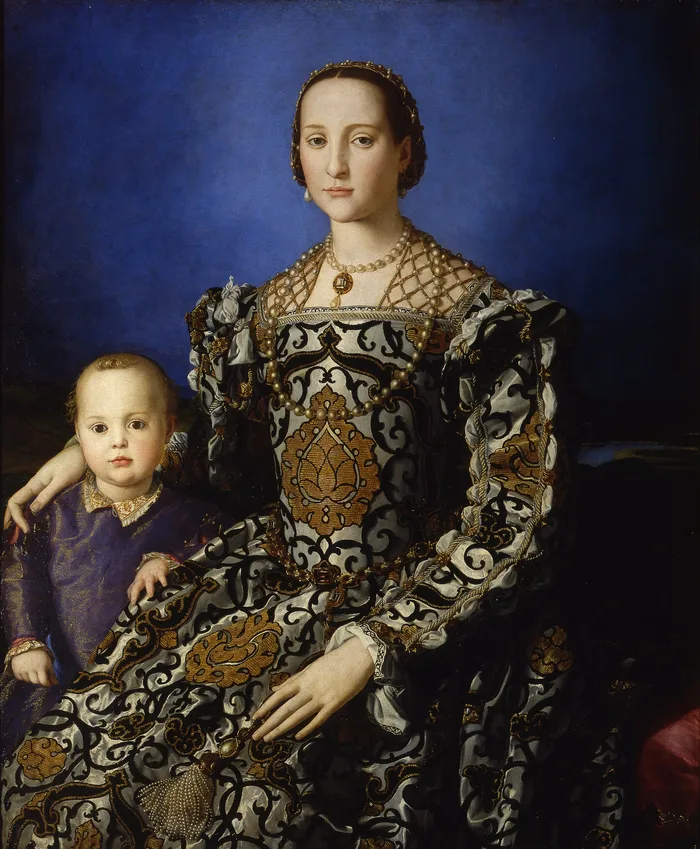
The portrait makes private continuity into public information. Eleonora's role as mother, landowner, court figure, and political partner is compressed into a surface that refuses disorder. The fabric is not decoration around the subject. It is part of the subject's power.
An older story claimed that Eleonora was buried in the exact dress shown in the portrait. Later examination of her burial clothing undermined that identification. The legend survived because the painted fabric felt almost too real not to have continued into the tomb.
Court portraiture makes identity look managed under observation. The controlled surface is not empty. It is the political content.
The Building That Was Not a Museum
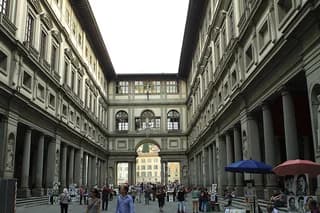
In 1560, Cosimo I commissioned Giorgio Vasari to begin the complex now known as the Uffizi. The name means offices. The building was intended to bring major magistracies and administrative bodies together beside the center of government.
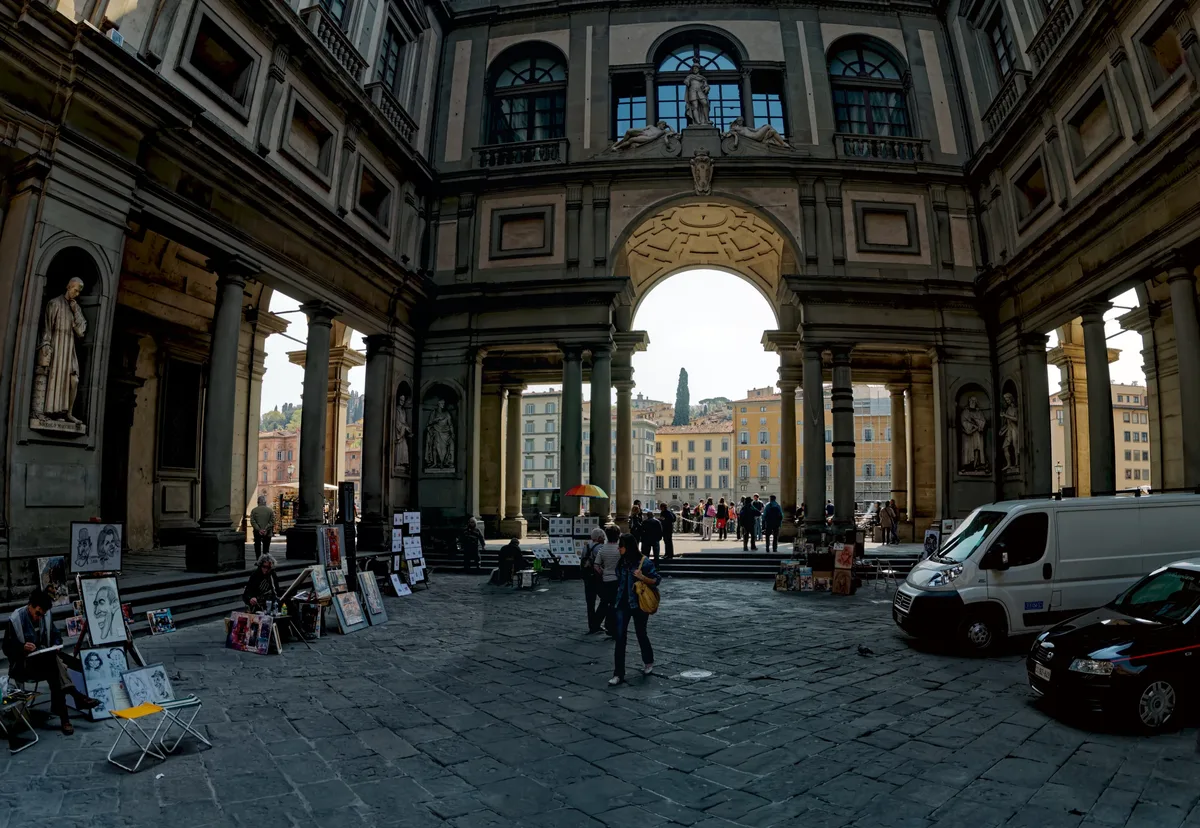
This origin changes the meaning of the museum. The Uffizi began as an architecture of administration. Cosimo gathered institutions under a more centralized government, and Vasari gave that concentration a physical form.
The building also made bureaucracy visible. Officials, records, courts, and magistracies were no longer scattered through the same urban system in quite the same way. The state could be experienced as a coordinated presence beside the ruler's seat of power.
Five years later, the same architect built the opposite.
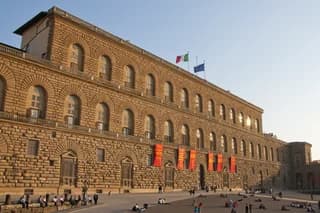
In 1565, for the wedding of his son Francesco to Joanna of Austria, Cosimo I ordered a private passage from the seat of government to the family's residence across the river. Vasari built roughly a kilometre of enclosed corridor in about five months. It leaves the Palazzo Vecchio, runs above the offices of the Uffizi, turns along the Arno, and crosses the river on top of the Ponte Vecchio, so that the ruling family could pass through the middle of Florence without setting foot in it. Because the corridor now ran over the bridge, the butchers who had traded there for generations were removed and goldsmiths installed in their place. The smell was the reason. The jewellers are still there.
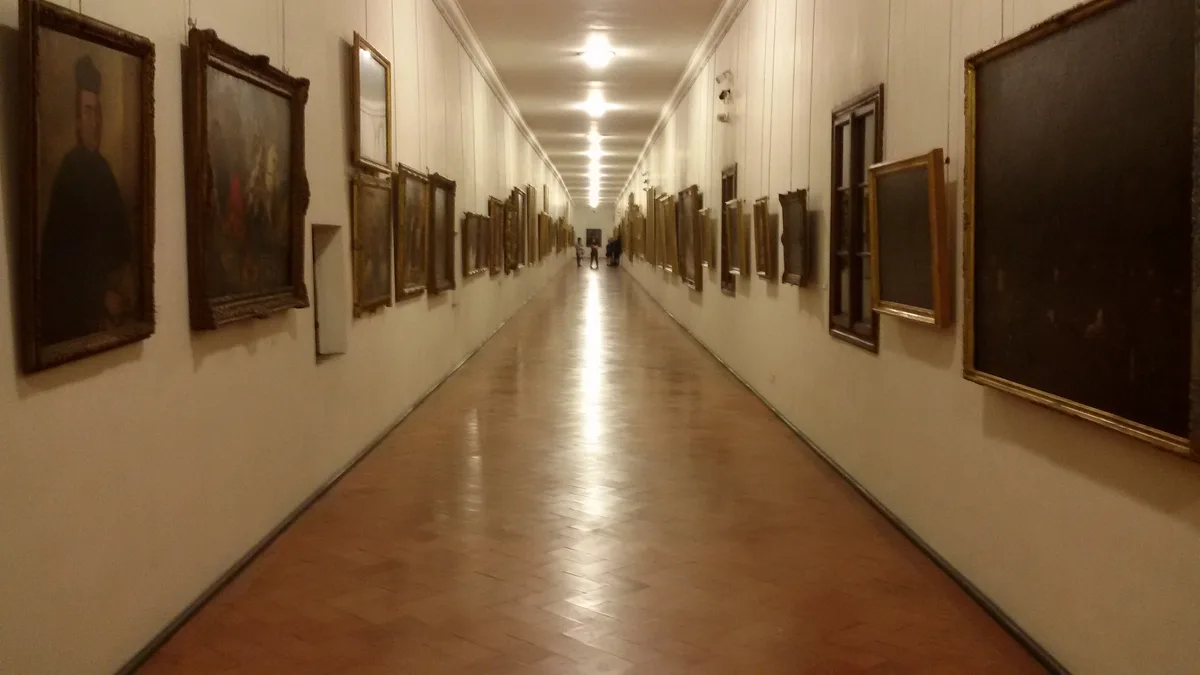
The two commissions belong together and point in opposite directions. The offices made government visible and gathered it where citizens could see it. The corridor made the governor invisible and lifted him above the street. Vasari built both for the same man in the same decade.
The long, controlled structure also reorganized the city around ducal power. Earlier works now celebrated as expressions of republican Florence would eventually be displayed inside a building created by a hereditary ruler. The museum contains the cultural world that preceded the state, while the state provides the building through which that world is later interpreted.
Today it is difficult to imagine the Uffizi as anything other than a gallery. That makes it easy to forget that a museum was never the building's original purpose. A complex designed to coordinate government gradually became the place where the political, religious, and domestic images of earlier Florence were detached from their first settings and arranged as national and artistic memory.
Vasari designed offices for Cosimo I while writing an artistic history dedicated to him. The conjunction was not a secret plan for the modern museum, which developed later. Still, both projects helped organize Florentine power and memory: magistracies within a ducal state, and artists within a genealogy centered on Florence.
Under Cosimo I, the Medici could organize the institutions through which culture was governed and remembered. His son Francesco would take the same appetite for order into a much smaller and much stranger space.
Part Seven. The World Inside One Room
The Tribune
Between 1581 and 1583, Bernardo Buontalenti created the Tribune for Grand Duke Francesco I de' Medici. The room was octagonal, enclosed, and deliberately overwhelming. Precious stones, colored surfaces, shells, metals, paintings, ancient bodies, and rare objects competed for attention inside one concentrated space.
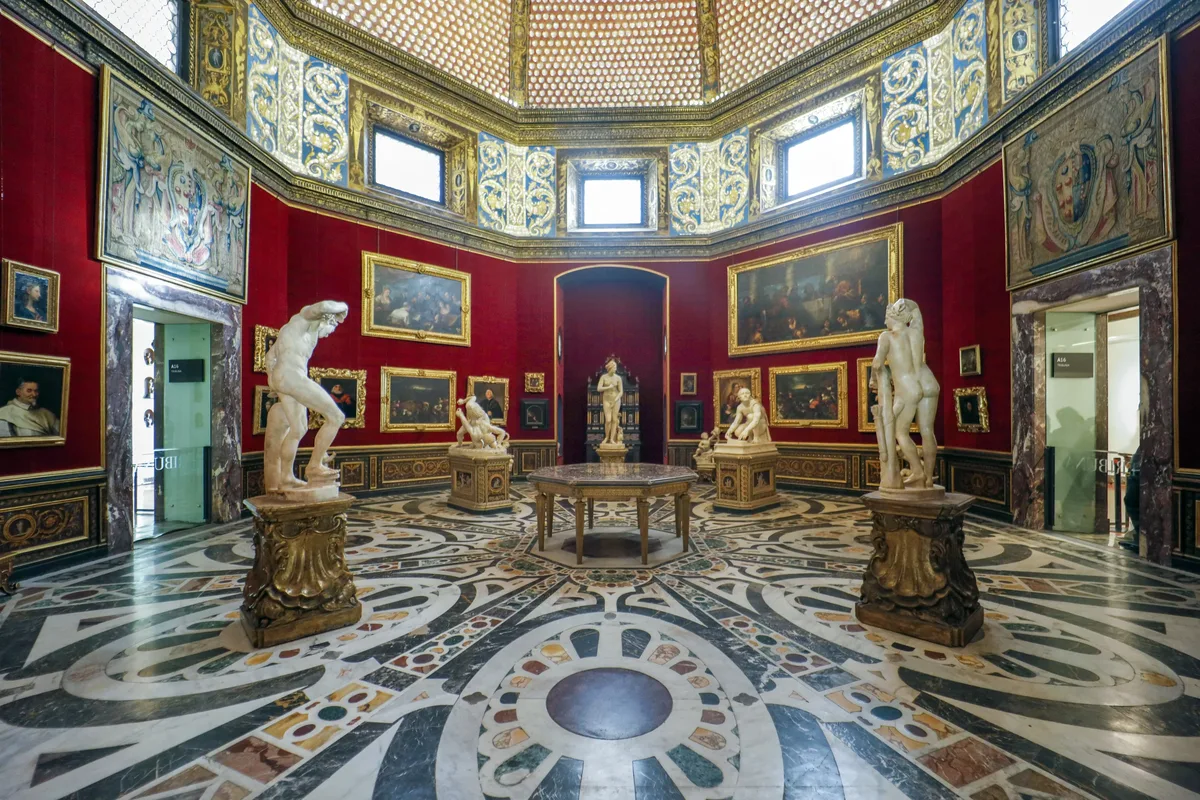
The effect was not the calm neutrality expected from a modern gallery. The room itself performed value. Materials from different places and different forms of making surrounded the visitor before any single object could be considered alone.
Its decoration turned the elements into architecture. Shells and mother-of-pearl evoked water above, rich red surfaces suggested fire, and stones brought the material of the earth into the room. Light entered from the lantern at the top. The cosmos was not represented by one picture. It was built into the container.
A shell, a gemstone, an ancient torso, and a painting by a celebrated master could occupy the same room because modern boundaries between art, science, and natural history had not yet hardened. The materials and decoration connected the Tribune with the four elements and the structure of the cosmos.
Cosimo I had gathered offices. Francesco gathered wonders.
His interest in experiment, alchemy, rare materials, and technical skill belonged to court culture as much as to private curiosity. An object that was difficult to obtain or make displayed the reach of the ruler who possessed it. Rarity made hierarchy visible.
Ancient Bodies, Modern Ownership
The Medici Venus became one of the most celebrated ancient sculptures in Europe. The goddess covers herself while presenting an idealized body shaped by ancient tradition, later restoration, collecting history, and centuries of copying.
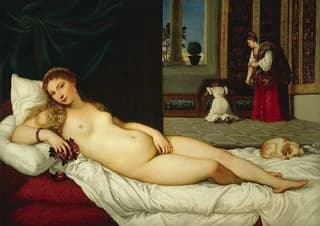
Titian's Venus of Urbino creates a very different encounter. A nude woman reclines in a domestic interior and looks directly toward the viewer. Servants search in a chest behind her. Roses, myrtle, a small dog, and household furnishings have supported interpretations involving marriage, fertility, erotic address, and domestic identity.
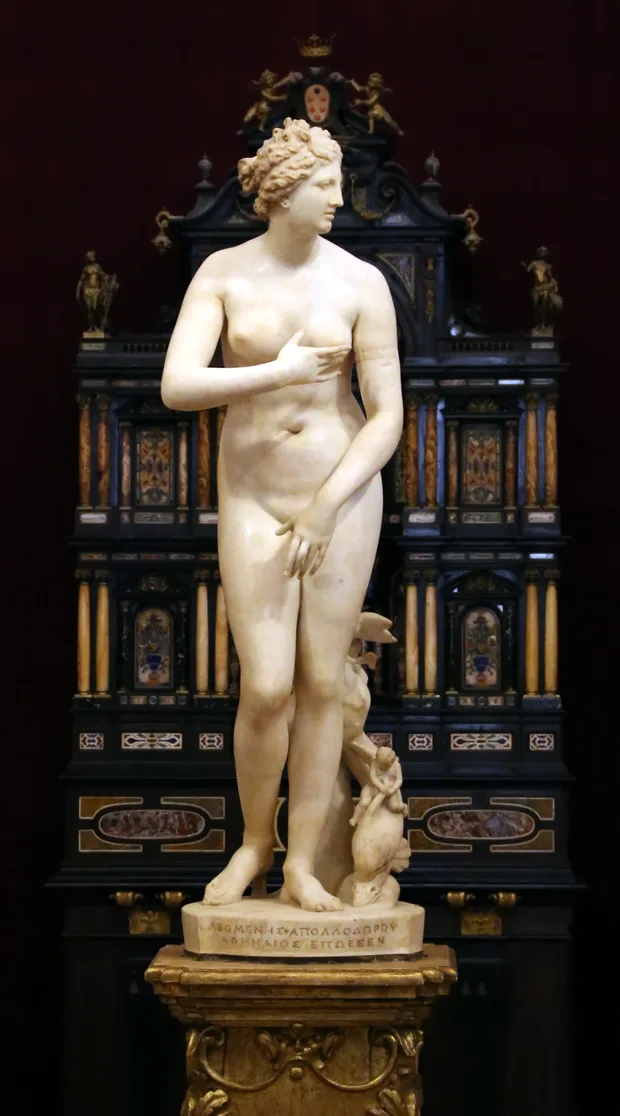
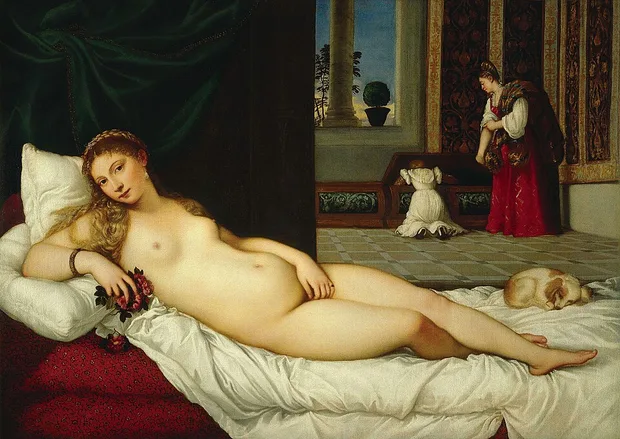
When ancient sculpture and modern painting entered the same collecting culture, they could compete across time. The collector did not merely own two beautiful objects. He owned the comparison and controlled the conditions under which it occurred.
That comparison would influence visitors, artists, and later critics. A room can make two objects ask questions of one another even when their makers never imagined the encounter.
The ancient Venus offered authority, ideal form, and the prestige of the classical past. Titian's woman seemed present, contemporary, and socially located. Her direct gaze makes the viewer part of the painting's situation in a way the ancient goddess does not.
Neither work has one permanent meaning. The sculpture is itself the result of survival, restoration, renaming, and display. Titian's painting has moved through marriage, dynasty, inheritance, erotic interpretation, and museum fame. The room may arrange them, but it cannot stop them changing.
The Past Arrives in Pieces
Other antiquities expose the same instability. The Knife Grinder, or Arrotino, received different identities as scholars tried to restore him to a lost story. The Niobe group reconstructs a mythic family destroyed because of a mother's pride.
Ancient objects arrived in pieces. Collectors restored bodies, supplied names, and arranged fragments according to later knowledge and taste. A missing arm, an uncertain head, or an unidentified figure invited intervention. The restored object became ancient and modern at once.
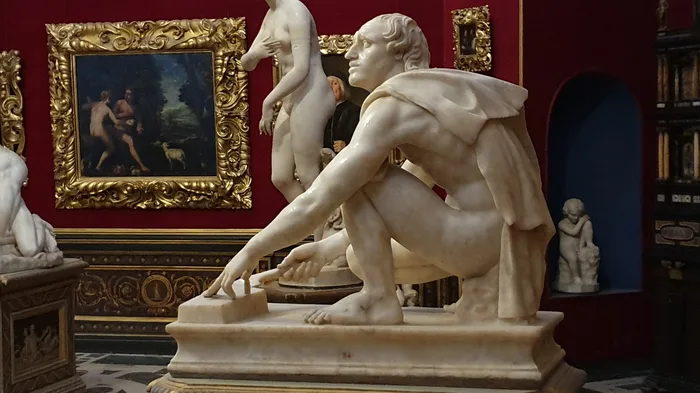
This was not necessarily deception. Restoration was one way of making fragments legible and displayable. It also allowed the collector's period to enter the ancient body.
The Niobe group offered the Medici an unintended tension: a dynasty preoccupied with heirs possessed the remains of a myth about a family whose children are destroyed. It was not a prophecy. It was a meaning the collection could acquire without the owner's permission.
The Tribune represents Medici possession at its most concentrated. The world appears gathered, classified, compared, and placed under a sovereign eye. Yet the room's power also reveals the limits of ownership. Objects can be moved into one arrangement. Their histories and future interpretations cannot be made equally obedient.
That problem becomes sharper as the collection absorbs works whose bodies and violence are increasingly difficult to reconcile with a story of harmonious Florentine greatness.
Part Eight. The Images That Would Not Behave
Beauty Becomes Strange
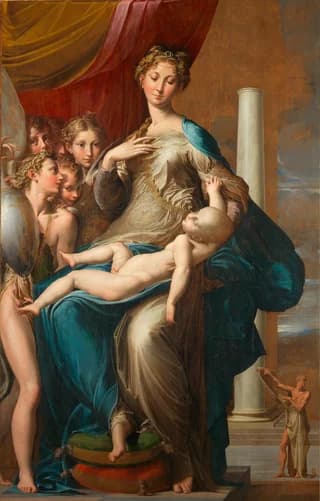
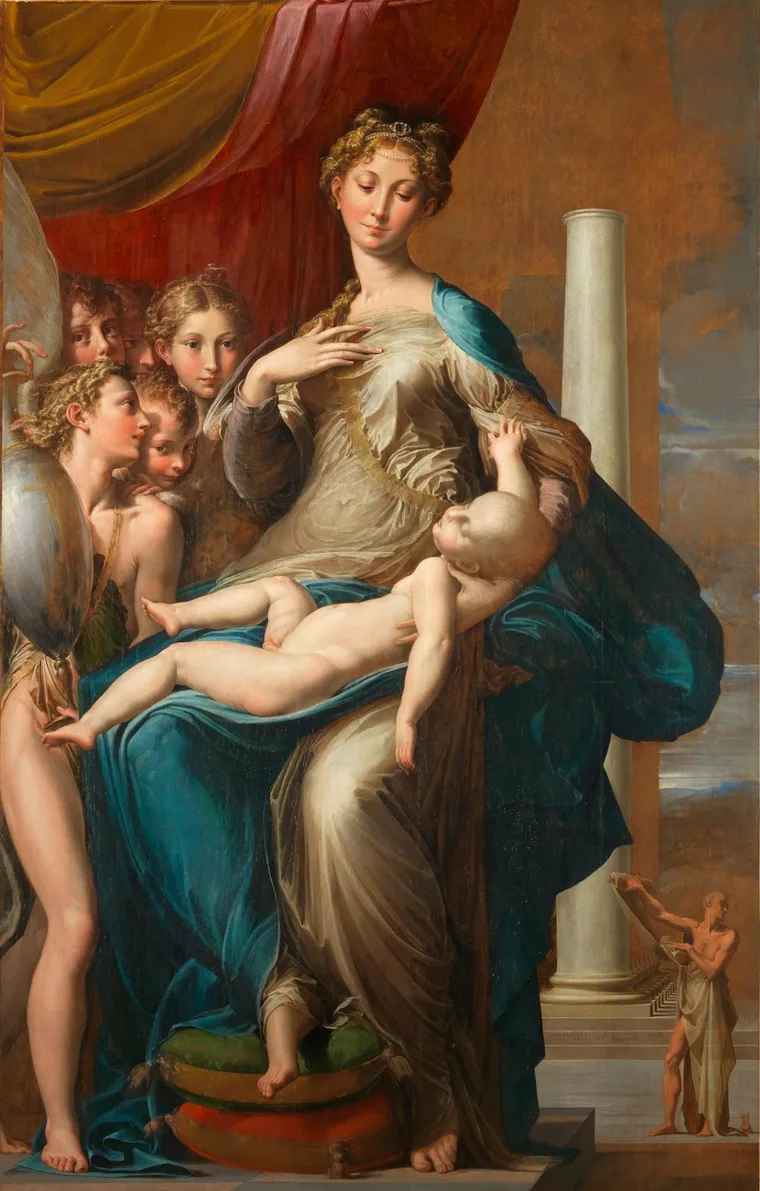
Parmigianino's Madonna with the Long Neck appears at first to offer another refined sacred image. Then the proportions begin to resist the eye. The Virgin's neck is elongated. Her body seems to continue beyond normal structure. The Child lies across her lap with the unsettling weight of a body that is asleep but can also suggest death. A column rises in the unfinished background without providing stable architecture.
This is not an artist forgetting the achievements of Renaissance proportion. Refinement has become deliberate distortion. The small figure at the side is St Jerome, unrolling a scroll as he turns toward the unfinished figure of St Francis. A column seems to promise a building and never delivers one. Space, body, and scale all remain slightly unresolved.
Beauty now depends on difficulty, elongation, and a controlled refusal of ordinary anatomy. The familiar story of art progressing toward perfect naturalism breaks apart. Once a visual language becomes established, later artists test and distort it.
Several decades later, Caravaggio would replace Parmigianino's elegant strangeness with a different kind of disturbance: bodies close enough to share the viewer's air.
Bacchus Comes Close Enough to Smell the Fruit
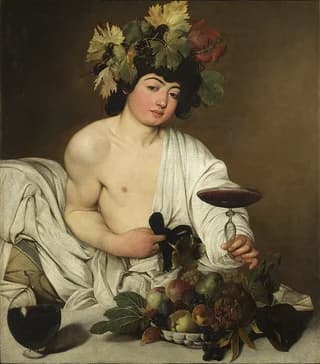
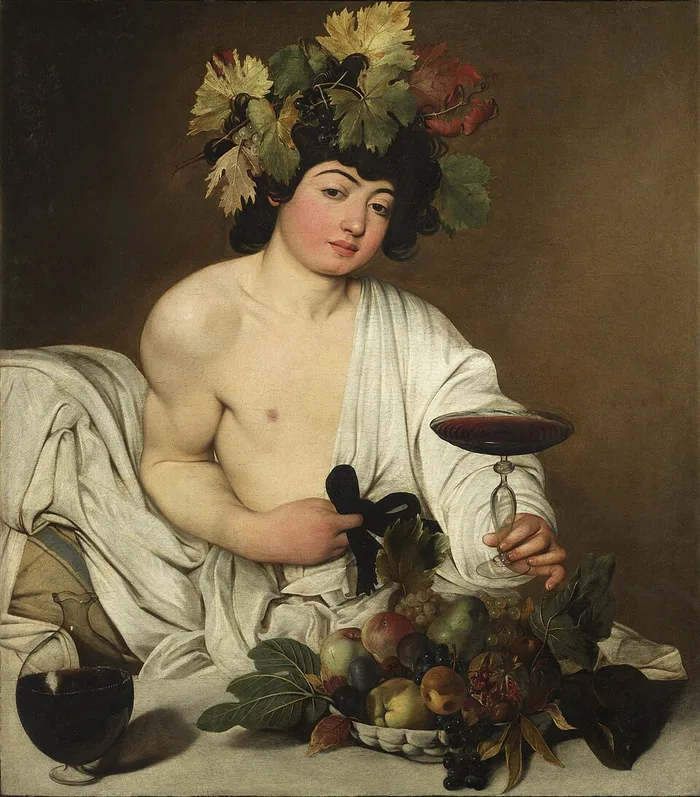
Caravaggio's Bacchus returns to pagan antiquity without Botticelli's distance. A young man dressed as the god offers wine. The fruit beside him is abundant but not untouched. Leaves curl, skins spot, and ripeness approaches decay.
The god feels staged rather than timeless. He is both classical figure and contemporary model. The wine is offered across a narrow distance, while the fruit beside him is already beginning to fail. Antiquity has entered the viewer's physical space with dirty leaves, flushed skin, and the possibility of decay.
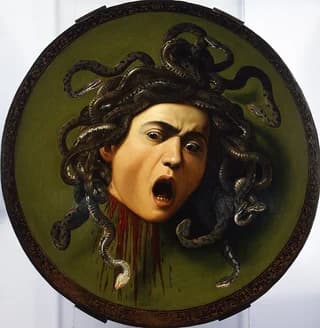
Caravaggio's Medusa makes painting itself aggressive. The image was created on a convex ceremonial shield and given by Cardinal Francesco Maria del Monte to Grand Duke Ferdinando I. Blood streams from the neck as the face registers the instant of horror.
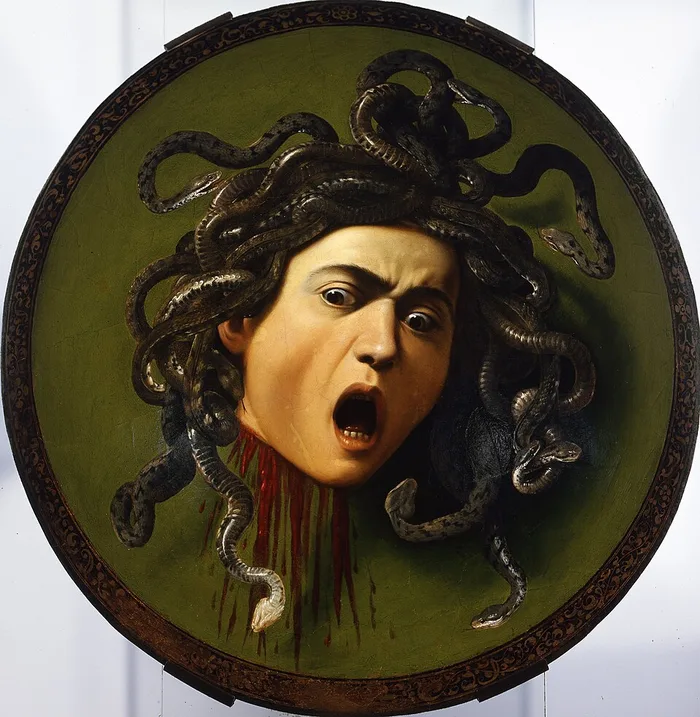
The shield should defend a body. Caravaggio turns it into a severed head. Its curved surface makes the image appear to project outward, while the painted expression catches the instant before terror becomes death. Art becomes gift, weapon, illusion, and proof of the painter's power at once.
The object also belongs to the political life of the collection. A horrifying image could function as a prestigious diplomatic present because technical mastery and controlled danger enhanced one another.
Judith and the Moment an Artist Chooses
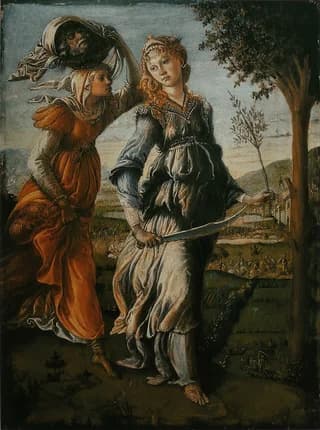
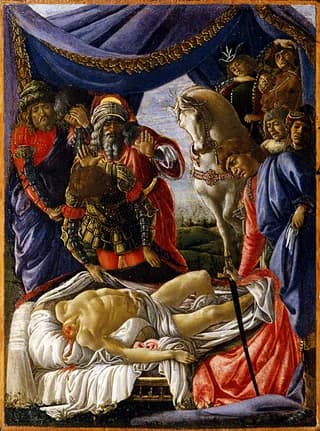
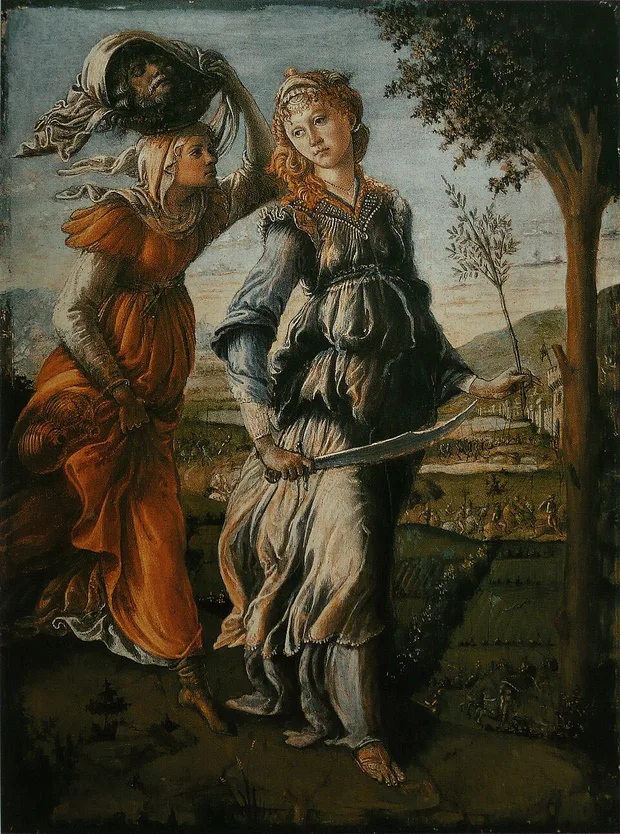
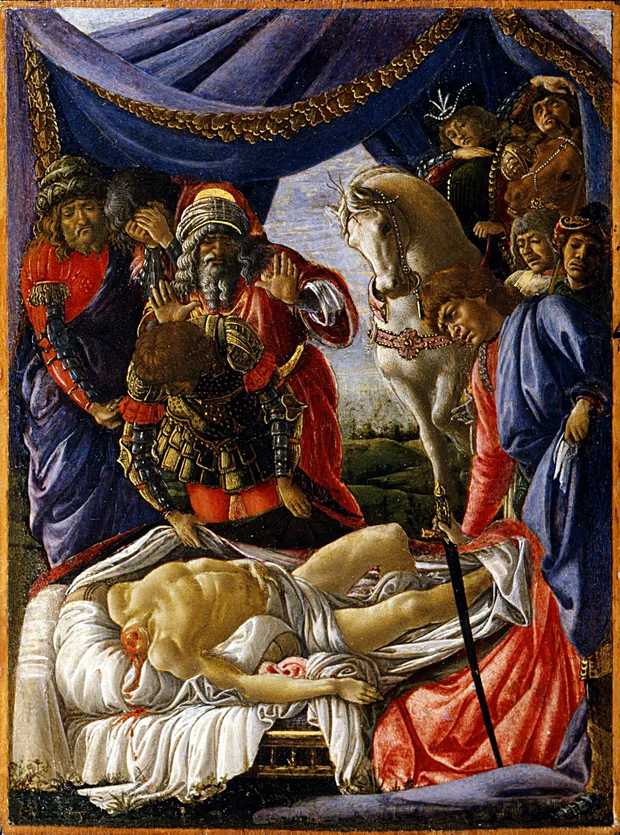
The story of Judith offered artists several possible moments, and the Uffizi itself holds more than one version of the story. Botticelli divided the aftermath between two small companion panels. In The Return of Judith to Bethulia, Judith and her maid carry Holofernes's head back toward the city. In The Discovery of the Body of Holofernes, soldiers find the headless body inside the tent. Botticelli leaves the killing itself outside both images.
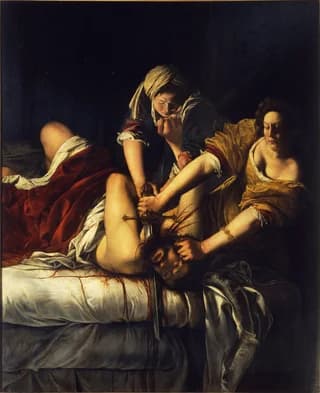
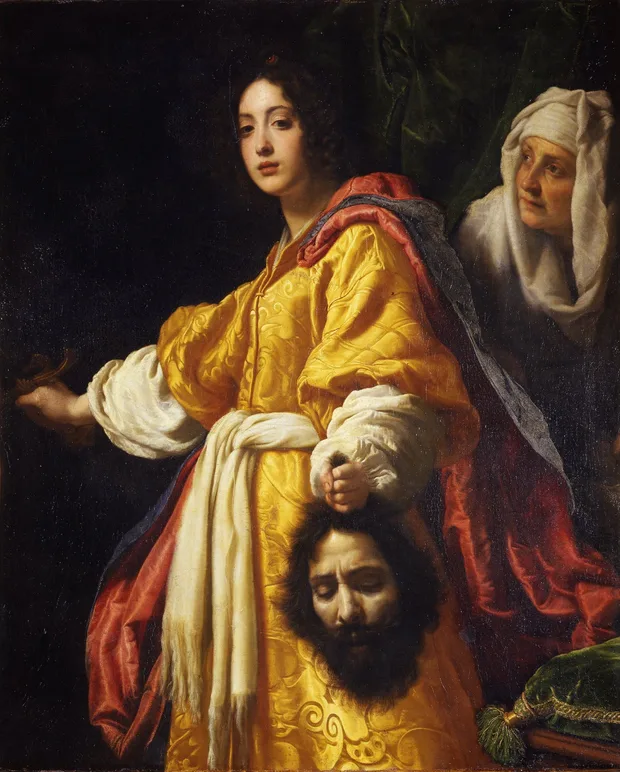
Cristofano Allori, in a painting now at Pitti Palace, chose the elegant aftermath: Judith displays the severed head as the completed result of an intimate drama. Artemisia Gentileschi's Uffizi painting chooses the act itself.
In her Judith Beheading Holofernes, two women work together against a man who fights for his life. Judith pushes away while driving the sword through his neck. Her maid restrains his arms. Fabric bunches under their weight, blood moves across the bed, and the composition depends on coordinated force. The killing requires effort.
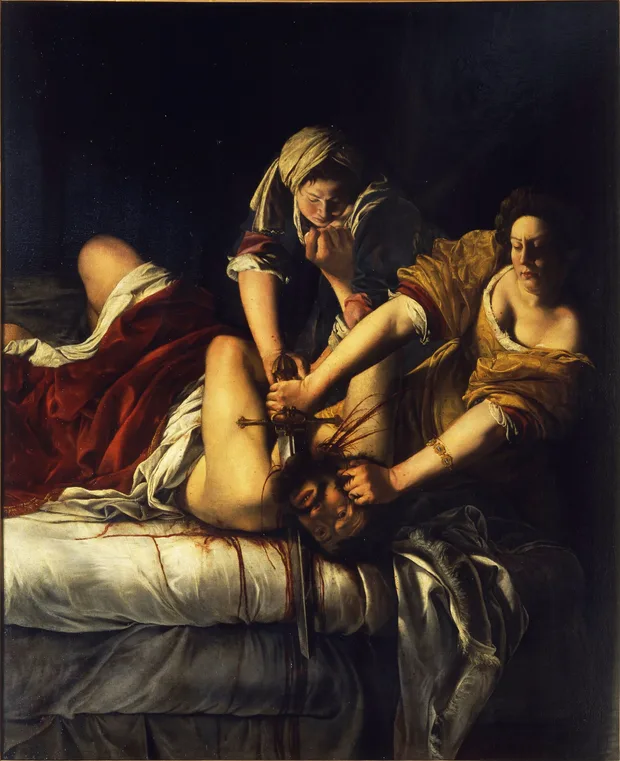
Artemisia's rape and the public trial that followed are documented parts of her biography. They have shaped the modern reception of the painting, especially its feminist significance. What is not established is the simple claim that Judith is a literal self-portrait murdering the artist's rapist in paint.
The directness of that explanation can be tempting because it appears to give the violence a personal key. It also risks treating a major painter as though she had only one subject and one source of artistic intelligence.
The surviving trial records make Artemisia unusually accessible to modern biography, and that access can become a trap. She knew Caravaggio's visual world, the long history of Judith, and the artistic problem of making biblical violence physically immediate.
Her contribution is not simply greater violence. Judith and her maid coordinate their bodies to solve a practical problem. Botticelli divided the aftermath between return and discovery, Allori chose the elegant result, and Artemisia chose the act itself. The selected moment changes the whole story.
Artemisia's biography matters, but it cannot explain the painting on its own. The work also belongs to a larger artistic contest over how force, light, bodies, and biblical courage could be painted.
A Collection Beyond Florence
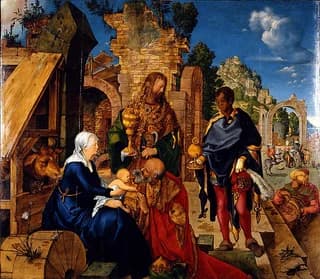
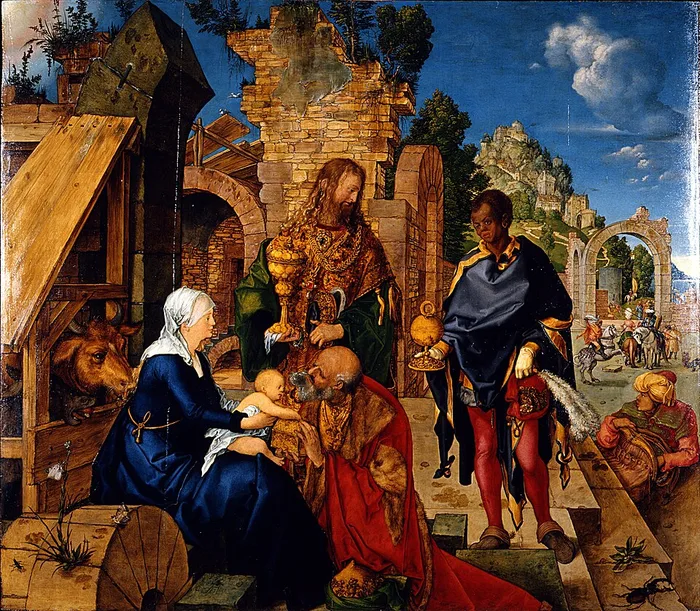
Dürer's Adoration of the Magi offers one reminder that the Uffizi cannot be sealed inside a Florentine story. Northern precision meets an artist deeply engaged with Italy, while the painting itself eventually entered a collection often narrated through Italian and Florentine artistic greatness.
By now the collection contains sacred commissions, rival patrons, foreign traditions, reconstructed antiquities, court portraits, erotic nudes, diplomatic terrors, and biblical violence. It has become too varied to deliver one obedient Medici message.
The collection continued to grow for more than a century. Then the principal Medici line disappeared.
Part Nine. When the Collection Became Public
The Pact and the Public
The Family Pact helped keep the Medici collections in Tuscany after the principal line ended. It did not instantly create a modern public museum. The Habsburg-Lorraine rulers inherited the state, reorganized the collections, and continued the transformation of a dynastic gallery into a public institution.
In 1769, Grand Duke Peter Leopold opened the Uffizi to the general public. Another dynasty had changed the social meaning of the Medici inheritance.
Public did not mean unrestricted in the modern sense. Access still followed schedules, rules, social expectations, and institutional control. Yet the decisive boundary had moved. The gallery was no longer principally an extension of private court privilege.
A painting made for a chapel, household, or court could now be encountered as art history. The viewer's purpose changed. Devotion, family memory, and diplomatic display did not disappear, but comparison, study, taste, and the search for artistic development became increasingly dominant frames.
Works were classified, restored, transferred, copied, published, and taught. Visitors no longer needed a personal relationship with the ruler to enter the gallery's historical argument.
The Uffizi began to give the Renaissance a visible structure.
The change can be seen in the works with which this story began. Cimabue and Giotto no longer faced worshippers in separate religious settings. They could be placed near one another and made to describe a transition. Botticelli's domestic mythologies could become public monuments of an age. A papal portrait, a court image, and an unfinished workshop painting could enter the same chronology.
The museum did not invent every relationship, but it gave relationships a durable stage.
The Museum and Vasari's Plot
Vasari had described artistic history as recovery, development, and individual achievement. The later museum gathered many of the objects through which his sequence could be imagined. Giotto became a beginning. Botticelli became the poet of Medicean Florence. Leonardo, Michelangelo, and Raphael became the great individuals. Caravaggio became a rupture.
The sequence contains real insight. It also makes some things harder to see. Workshops disappear behind names. Sacred use becomes style. A rival patron becomes a supporting figure in a Medici city. A museum preserves objects while creating new relationships among them.
Those relationships are powerful because they are visible. Giotto can stand before Leonardo in historical time. Botticelli can be placed between devotion and mythology. The gallery gives abstract chronology a physical form.
Fame grows from sustained attention, and institutions help decide where that attention falls. Some works remain central because they continue to reward close looking. They also gain force through copying, education, guidebooks, photography, and the repeated decision to place them at the heart of the story.
The result is neither a conspiracy nor a neutral ranking. Each generation inherits earlier habits of attention and makes them easier to repeat.
The Uffizi does more than preserve the past. It also advances an argument about it.
That argument has changed repeatedly. Works moved among Florentine collections, attributions shifted, restorations altered what could be seen, and scholars brought neglected artists and contexts back into view. A canon can be durable without being motionless.
The family remains central to that argument. It no longer controls who tells it.
Part Ten. The Museum After Its Owners
Survival Is Physical Work
A legal agreement could help prevent the future dispersal of the collection. It could not make the museum safe forever.
During the Second World War, works were removed and hidden from bombing, occupation, demolition, and theft. Paintings that had seemed permanently attached to the museum became objects that had to be packed, moved, recorded, concealed, recovered, and returned. The photographic record shows crates, empty spaces, damaged structures, and exhausted acts of repair.
The photographs make protection tangible: crates must be built, paintings lifted, routes chosen, inventories checked, and shelters improvised. The museum survives because people make decisions under pressure, often without knowing which building, road, or storage place will remain safe.
The next emergency arrived without warning and without an enemy.
At about half past two in the morning on 4 November 1966, the Arno broke into Florence. By daylight the water stood three metres deep around the Cathedral and more than five in the low quarters. Thirty-five people died. When the river withdrew two days later it left roughly six hundred thousand tons of mud in the city, and because storage tanks had burst, the mud was mixed with heating oil that soaked into everything it touched and would not wash out.
At the Uffizi, staff carried works upward and stripped the paintings from the Vasari Corridor, afraid the structure would not hold. Water reached the ground floor, the restoration rooms, the deposits, and the photographic archive.
Then the students arrived. Young people came from across Italy and from abroad, with no training and no instructions, and spent weeks in freezing cellars passing sodden books and panels hand to hand out of the mud. Florence called them the angeli del fango, the mud angels, and the name stuck.
The flood made the material nature of culture impossible to ignore. A masterpiece is wood, canvas, glue, pigment, varnish, frame, paper, and the accumulated history of earlier repairs. Water reaches every layer differently.
It also changed the public image of conservation. Rescue was no longer an invisible activity performed after damage. Photographs of mud, swollen books, stained surfaces, and volunteers made the work of rescuing art part of the city's modern identity.
On 27 May 1993, a Mafia car bomb exploded in Via dei Georgofili beside the Uffizi. Five people were killed. The blast damaged the building and, according to Uffizi documentation, harmed 173 paintings and 56 sculptures.
The collection once used to express dynastic distinction had become part of a public memory large enough to make its destruction a form of political violence.
War, flood, and bombing threatened the museum in different ways. One required evacuation, another emergency conservation, and the third forced the institution to repair deliberate violence. Each crisis changed what saving the collection required. The collection survived because every new emergency forced people to work out how to protect it again.
Venus Leaves the Museum Without Moving
Modern fame creates a different pressure. Many visitors have encountered reproductions of The Birth of Venus repeatedly before seeing the canvas itself. They arrive with a memory assembled from textbooks, advertisements, social media, and cropped details. Phones rise because people want evidence of contact with the physical source.
The painting has scale, material, and a complete movement that reproductions often remove. Venus is not only a face and a curtain of hair. Winds push from one side, the shore waits on the other, and her body arrives between them. The canvas also carries the evidence of age, restoration, and material manufacture that a clean digital image tends to suppress.
Online, the image separates easily. It can be cropped, mirrored, animated, advertised, parodied, or turned into a political sign. The face can travel without the winds, shore, body, or scale of the painting.
This is another change of context in a long sequence: household, collection, public museum, photography, digital circulation. Each stage expands access and changes the encounter.
MuseScope participates in that circulation. Selecting a detail, placing two works together, or attaching a voice changes how the work is encountered. The task is not to pretend mediation is neutral, but to make it intelligent and transparent.
The Reversal
At the beginning of this story, the Medici gather images around themselves. At the end, the works remain and the family stands among them as patrons, sitters, collectors, rulers, and historical problems. The owners have become part of what they owned.
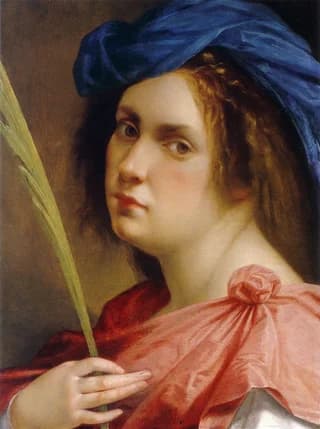
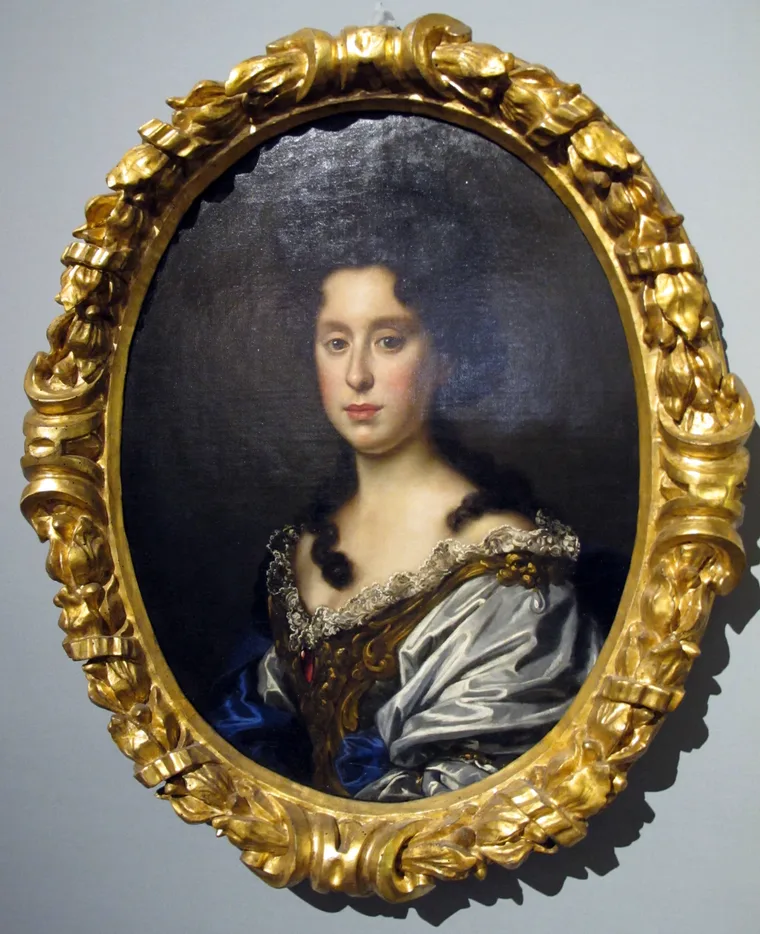
Which brings us back to the portrait at the start. Anna Maria Luisa was painted at twenty-three, the year before she married and left for Germany, half a century before the signature that is now the only thing most people know about her. She asked that the collections be kept together as an ornament of the State, for the utility of the Public, and to attract the curiosity of foreigners.
Several million foreigners arrive in Florence every year, curious, exactly as specified.