The story
The Nine, the council of merchants that governed Siena in the early 14th century, met in a room on the upper floor of this town hall, and in 1338 and 1339 they had its walls painted by Ambrogio Lorenzetti, a Sienese master. On one wall is a city at peace, with shops open, builders at work on a roof and a ring of dancers in the street, and beyond the gates farmland running out to the hills. Opposite is a city under bad government, with Tyranny enthroned among the vices, and this wall is the more damaged of the two.
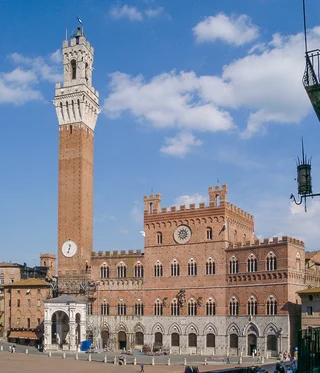
The Palazzo Pubblico went up from 1297 as the seat of the commune, facing the shell-shaped Piazza del Campo, and it is still Siena's city hall. Much of its upper floor is open as the Museo Civico, the city museum. In the neighbouring Sala del Mappamondo, Simone Martini painted his Maestà, the Virgin enthroned among saints under a canopy, completed in 1315 and reworked by the painter himself a few years later.
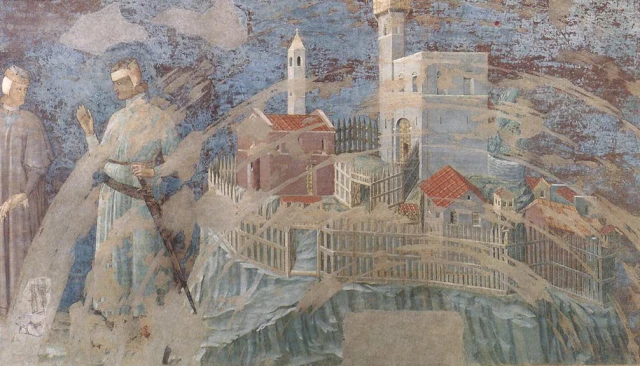
The same room holds a puzzle. Facing the Maestà, the commander Guidoriccio da Fogliano rides past a fortified camp, a fresco traditionally given to Simone Martini. In 1980 restorers uncovered another fresco just below it, a castle with two men standing before it, and scholars still disagree about who painted it, with Duccio and Simone Martini among the names proposed. The room takes its name from a revolving map of the world painted by Ambrogio Lorenzetti, which has since been lost.