Reales Alcázares
Seville, Spain
The story
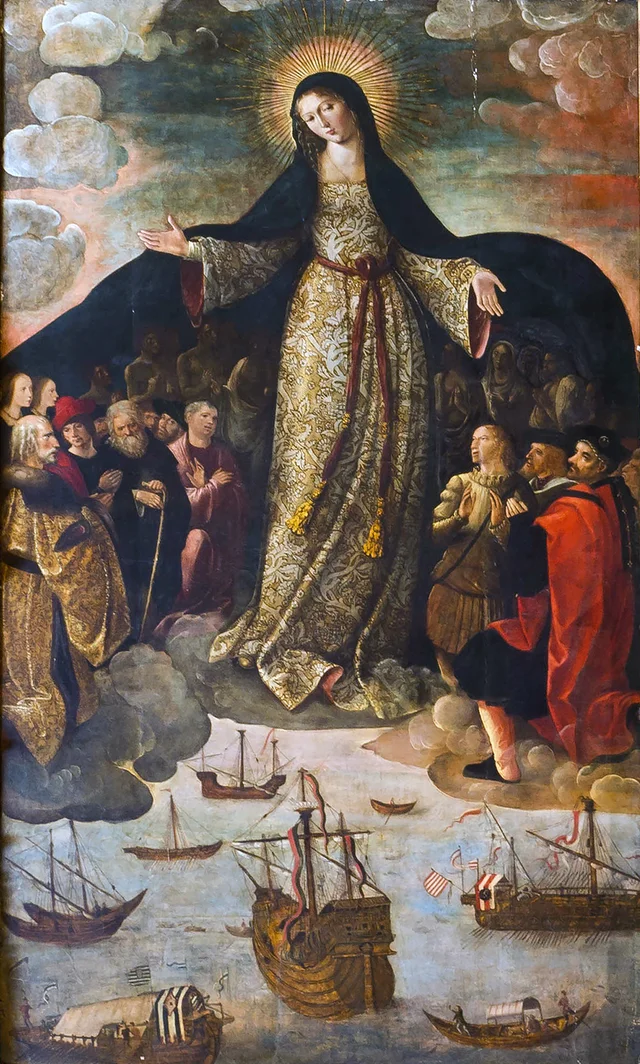
In the Admiral's Quarters of the Alcázar of Seville, a painted Virgin spreads her cloak over the sea. Alejo Fernández, the leading painter in Seville in his day, made the altarpiece in the early 1530s for the chapel of the Casa de Contratación, the House of Trade that the Catholic Monarchs founded inside the palace in 1503 to run Spain's traffic with the Americas. Ships of the period sail beneath her. The men kneeling under her mantle are traditionally identified as Columbus, one of the Pinzón brothers and the emperor Charles V, and Indigenous Americans appear in the background.
The room is a reminder that the Alcázar was a seat of government as well as a royal residence. It grew out of the palaces of Seville's Muslim rulers, and in the 1360s King Peter I of Castile added the part most visitors come for, a palace in the Mudéjar style built with craftsmen from Toledo and Granada. Its carved stucco, tiled walls and the long pool of the Patio de las Doncellas, the Courtyard of the Maidens, are a Christian king's version of Islamic court architecture.
Beyond the rooms lie the gardens, laid out and reworked over several centuries, with orange trees, pools and pavilions. In 1987 the Alcázar was declared a World Heritage Site together with Seville Cathedral and the Archive of the Indies next door, and its upper floors are still used as a residence by the Spanish royal family.