San Zaccaria
Venice, Italy
The story
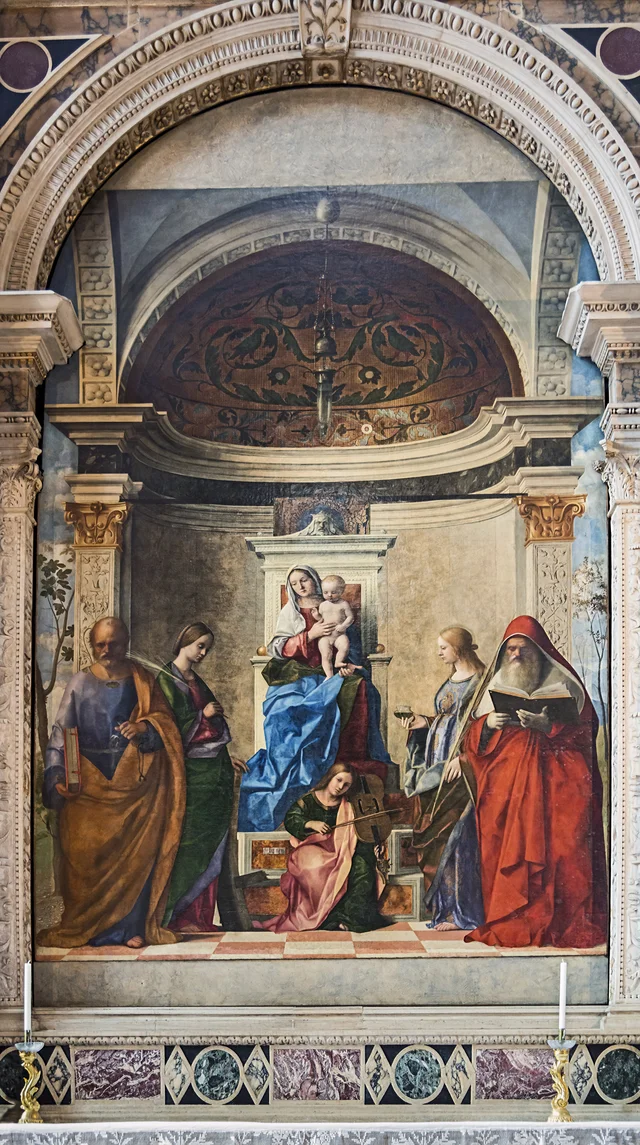
On an altar in the left aisle, Giovanni Bellini painted the Virgin and Child enthroned in a shallow apse that seems to continue the real stone of the church around it. Four saints stand with them, Peter, Catherine of Alexandria, Lucy and Jerome, and an angel plays music on the step below. Bellini signed it in 1505, when he was already an old man, and it is still the reason most visitors walk the few minutes from San Marco to get here.
The picture has travelled. After the fall of the Venetian Republic in 1797 it was taken to Paris, where it was lifted from its wooden panel onto canvas and trimmed at the top and bottom. It came back to Venice after Napoleon's defeat.
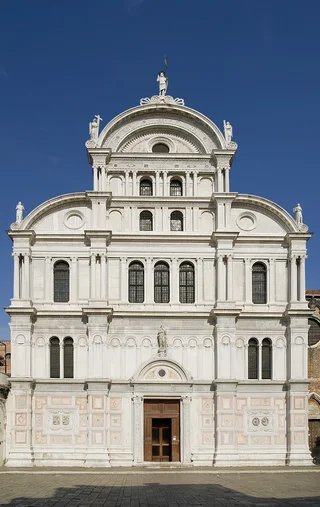
The church itself is two styles in one. Antonio Gambello began it in a late Gothic manner in 1458, and Mauro Codussi finished the upper façade in the new Renaissance style by 1515. It served a rich convent of Benedictine nuns, and every Easter the doge came here in procession, a custom that ended only when the convent was suppressed in 1797.
Reached from the right aisle, the older Chapel of San Tarasio keeps vault frescoes painted in 1442 by the young Florentine Andrea del Castagno, his earliest surviving work. Beneath it lies the crypt, where doges were buried and where the floor is usually under water.