The story
Just inside Sant'Anastasia, two hunchbacked marble figures crouch under the holy-water basins, carrying the weight on their backs. The one on the left, set in place in 1491, is attributed to Gabriele Caliari, father of the painter Paolo Veronese. Its partner, in red Verona marble, arrived a century later.
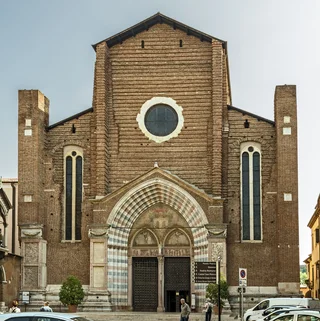
The Dominicans began this church, the largest in Verona, in 1290 and went on building for about 150 years. It was consecrated only in 1471, and its brick front never received the marble facing planned for it, apart from the carved Gothic portal.
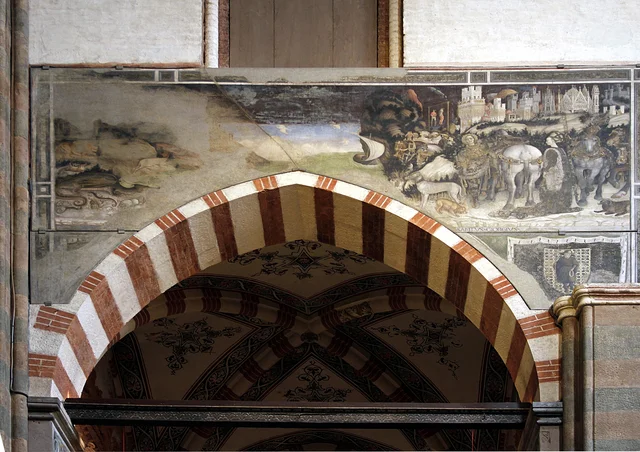
The painting most visitors look up for is high above the entrance arch of the Pellegrini Chapel, the first chapel to the right of the main altar. There, in the 1430s by the usual dating, Pisanello, the Veronese painter and medallist, frescoed Saint George and the Princess. The knight stands beside his horse, ready to ride out, the princess watches in profile, and behind them rise the towers of a fantastical city, with two hanged men on a gallows outside its walls. Water seeping from the roof destroyed much of the left side, where the dragon waited. The fresco was taken off the wall in 1891 and 1900 and returned to its original place only in 1996. Inside the chapel below, the terracotta reliefs of the life of Christ are by Michele da Firenze, a sculptor trained in Florence, from the same years.