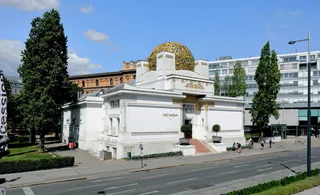
The story
Viennese wits called it the golden cabbage. The gilded dome of laurel leaves on top of the Secession is what most people photograph, and over the entrance runs the group's motto, To every age its art, to art its freedom. Joseph Maria Olbrich, a young architect from Otto Wagner's office, designed it in 1897 and 1898 as an exhibition hall for the artists who had just broken away from Vienna's established artists' society, with Gustav Klimt as their first president.
The hall still shows new art, and most visitors head down to the basement for one work. In 1902 the Secession staged an exhibition in honour of Beethoven, built around a statue of the composer by the German sculptor Max Klinger, and Klimt painted a frieze for the walls of one room. It runs about 34 metres across three walls and follows humanity's longing for happiness past the Hostile Powers, among them the giant Typhoeus and three Gorgons, to a final embrace inspired by the Ninth Symphony. Klimt worked straight onto plaster with casein paint, charcoal and gold leaf, setting in mirror fragments and mother-of-pearl buttons.
The frieze was meant to last only as long as the show. Instead it was taken down in sections and sold, first to the collector Carl Reininghaus and in 1915 to the industrialist August Lederer. The Austrian state bought it in 1973, and after a long restoration it has been shown since 1986 in a room built for it beneath the halls where it first appeared.
Collection
7 works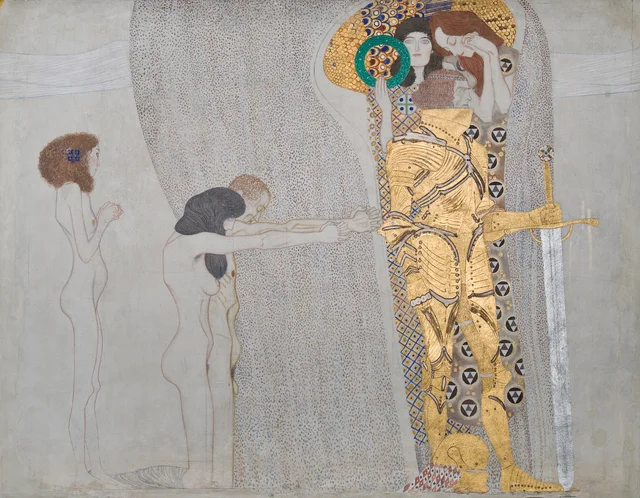 Beethoven Frieze (plate 3, left wall): Yearning for HappinessGustav Klimt, 1902
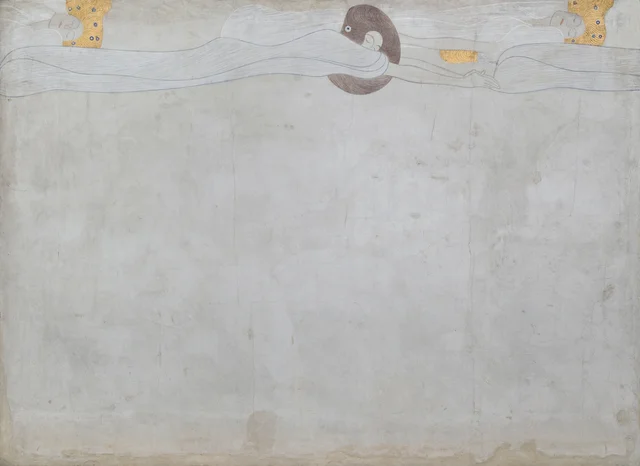 Beethoven Frieze (plate 1, left wall): Yearning for HappinessGustav Klimt, 1901
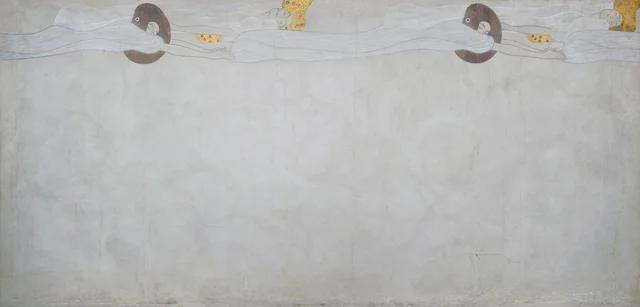 Beethoven Frieze (plate 2, left wall): Yearning for HappinessGustav Klimt, 1901
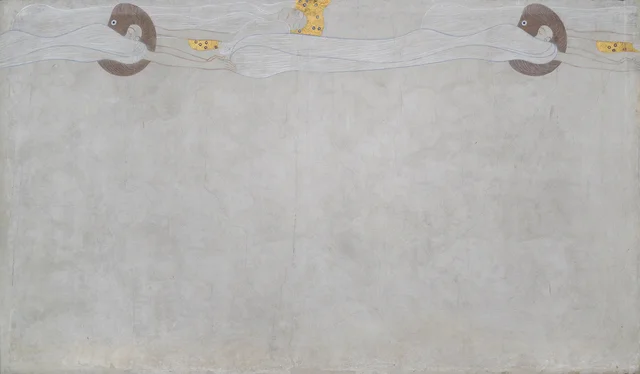 Beethoven Frieze (plate 4, left wall): Yearning for HappinessGustav Klimt, 1901
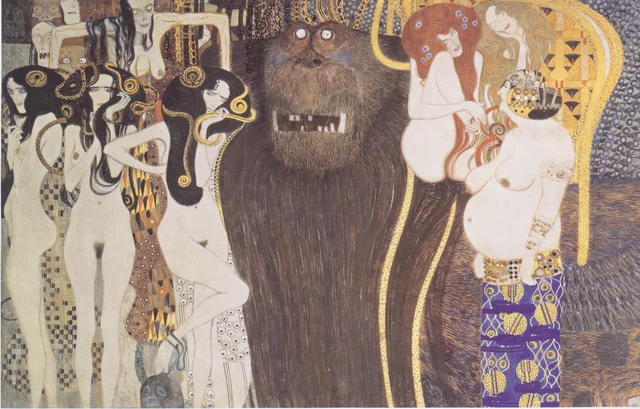 Beethoven Frieze (plate 5, center wall): The Hostile PowersGustav Klimt, 1901
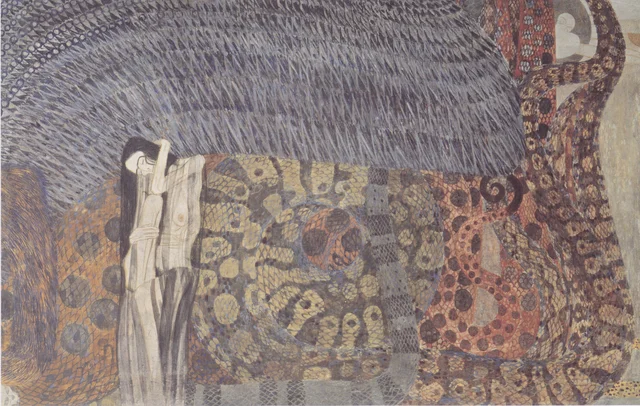 Beethoven Frieze (plate 6, center wall): The Hostile PowersGustav Klimt, 1901
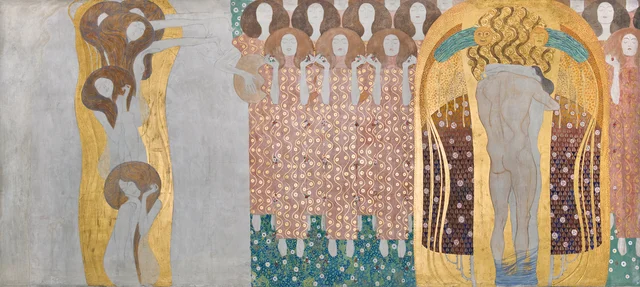 Beethoven Frieze (plate 8, right wall): Yearning for happiness is assuaged in poetryGustav Klimt, 1901