The story
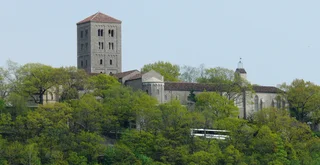
The arcades you walk through at the Met Cloisters were carved in southern France — pink marble columns from the monastery of Saint-Michel-de-Cuxa in the Pyrenees, capitals from four other dismantled cloisters — and they stand in a building that opened in May 1938. No monastery ever stood on this hill in upper Manhattan. Charles Collens, the architect of Riverside Church downtown, arranged genuine medieval stone into a place that never existed, laid out so that a chapel, a chapter house and a walled garden read together.
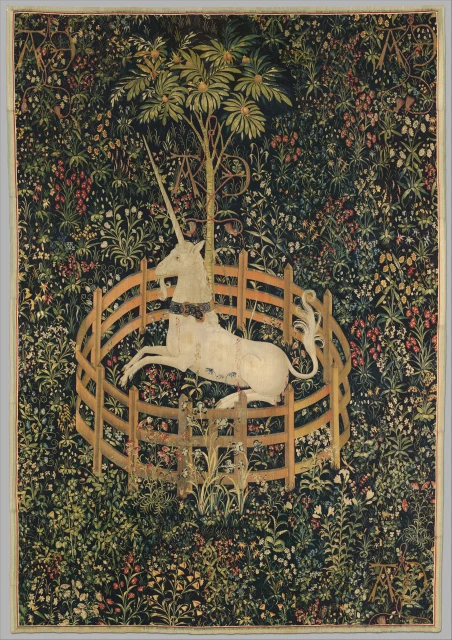
The stone came to New York with George Grey Barnard, an American sculptor who spent the years before the First World War buying medieval carving in rural France, where cloister fragments had ended up in farmyards and barns after the French Revolution. From 1914 he showed them in a brick building near his studio in Washington Heights. The Metropolitan bought the collection in 1925 with money from John D. Rockefeller Jr., who then paid for the park and the new museum and added works of his own, among them seven tapestries of the hunt of the unicorn, woven around 1500, which he bought in 1922 and gave in 1937.
Rockefeller also bought the view. He acquired several hundred acres along the top of the Palisades, the cliffs across the Hudson on the New Jersey side, and had them protected as parkland, so the view from these windows would not fill in behind him.
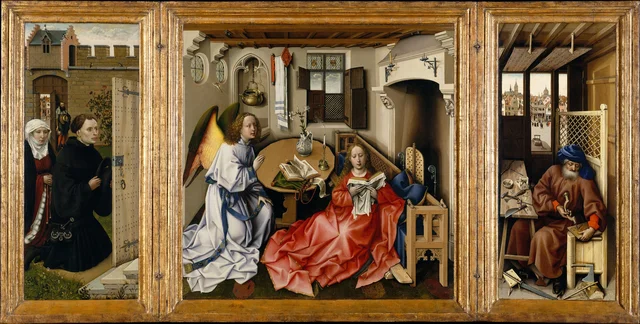
The small Annunciation triptych from the workshop of Robert Campin, painted around 1425, puts the angel in an ordinary Netherlandish parlour, with Joseph in the right-hand panel making mousetraps. The largest room holds a Romanesque apse from the church of San Martin at Fuentidueña, about 3,300 limestone blocks numbered, shipped from Spain in 1958 and rebuilt here over four years. Spain never sold it. The apse is on long-term loan, exchanged for six wall paintings that went from New York to Madrid.