The story
High above the river Saale, the palace of Heidecksburg looks down on the small Thuringian town of Rudolstadt. Until 1918 it was the seat of the counts, later princes, of Schwarzburg-Rudolstadt, a small German court with large ambitions. After a fire in 1735 they rebuilt in the newest taste, bringing in Johann Christoph Knöffel, an architect from the Dresden court, and then Gottfried Heinrich Krohne, a leading builder of Thuringian Rococo.
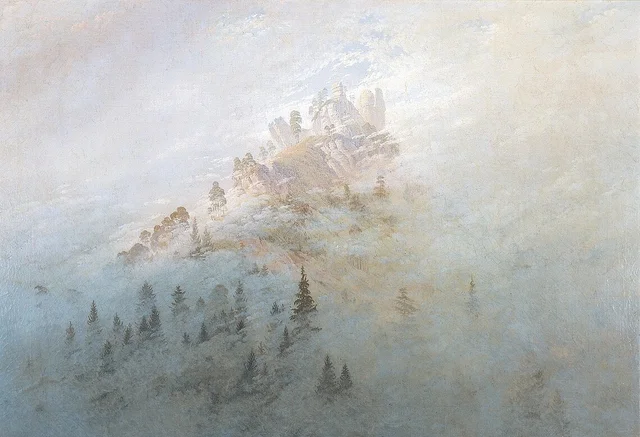
Their work is what visitors climb the hill for today. The Festsaal, the palace's great ceremonial hall, rises some twelve metres under a painted ceiling and swirling stucco, and the state rooms around it keep their eighteenth-century decoration. The Thuringian State Museum, which fills the palace, also runs a picture gallery drawing on roughly 1,100 paintings from the sixteenth to the twentieth century. Its best-known canvas is by Caspar David Friedrich, the German Romantic landscape painter. Morning Mist in the Mountains, from 1808, shows a single peak rising out of drifting cloud, with a tiny cross at its summit.
Downstairs, in the former palace kitchen, is something no prince ever saw. Rococo en miniature is a tabletop world of two invented kingdoms, with courtiers, gardens and palaces built at one-fiftieth of real size by the model makers Gerhard Bätz and Manfred Kiedorf over more than fifty years.