The story
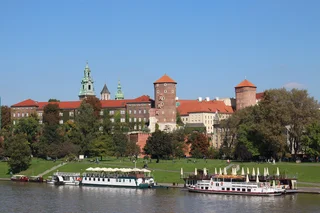
On a limestone hill above the Vistula in Kraków stands the castle that was the seat of Poland's kings for over five centuries. The palace you walk through today is largely the work of Italian masters who rebuilt it for Sigismund I the Old between 1517 and 1536, wrapping the courtyard in three tiers of slender arcades that still feel more Florentine than Polish.
The rooms upstairs were made for one spectacular collection. King Sigismund II Augustus ordered around 360 tapestries from the best Brussels workshops in the mid-16th century, woven in wool, silk and silver thread with the story of Adam and Eve, exotic animals and grotesque borders. About 137 survive, and their journey is half the reason to look up. They were looted by Russia, returned to Poland in 1921, then rolled up and shipped to Canada in 1939 to keep them from the Germans, and they only came home in the early 1960s.
In the Crown Treasury sits the Szczerbiec, the jagged-edged sword used to crown Polish monarchs from 1320 onward and almost the only piece of the royal regalia to survive a Prussian raid on the vaults in 1794. Nearby is the cathedral where those kings were crowned and buried. The castle also holds the rooms where, for a few wartime years, the Nazi governor Hans Frank kept his residence, which is part of why so much of Wawel had to be hidden or carried abroad.