Gustave Caillebotte · PD
雨のパリの通り
作品情報
ストーリー
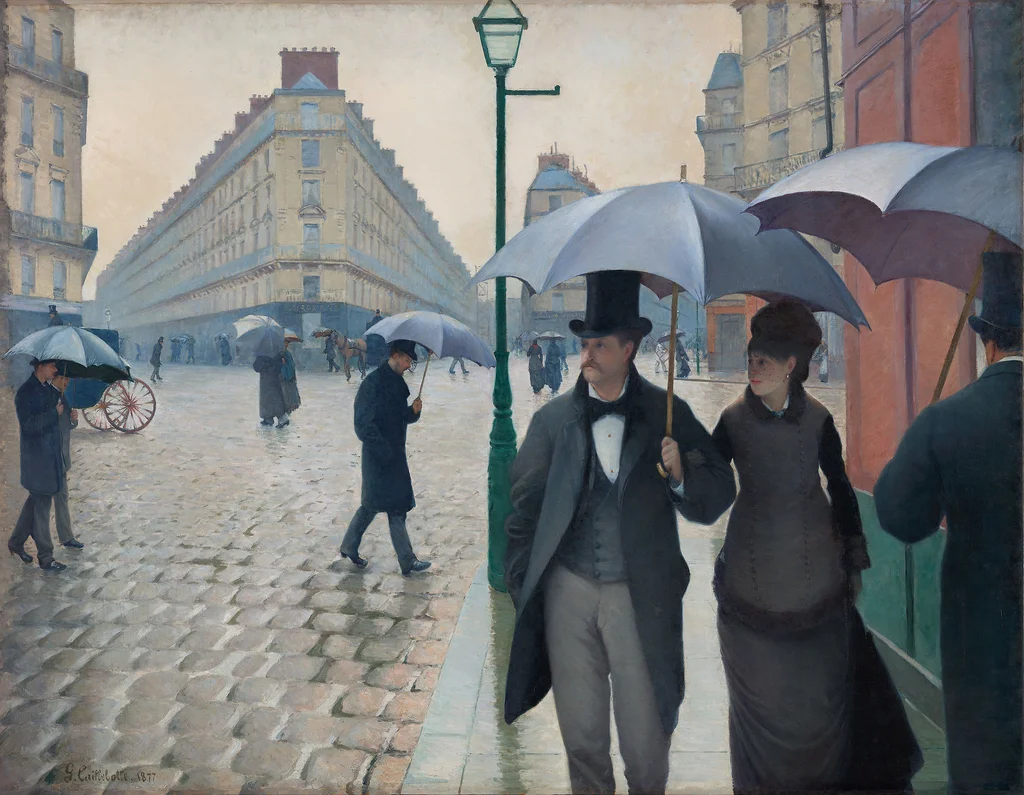
The Paris in this painting was only a few years old. Through the 1850s and 1860s the city planner Baron Haussmann had torn out medieval Paris and cut these wide straight boulevards, and by 1877, when Caillebotte painted it, that new stone city still felt raw and modern to the people living in it. He set the scene at a big multi-street junction near the Saint-Lazare station, in a district of identical new apartment blocks. One of Haussmann's cast-iron lamp posts rises right up the middle of the canvas and splits it in two. Well-dressed Parisians cross under their umbrellas on wet cobblestones, not talking, each sealed in their own errand, the way strangers move through a modern city. Caillebotte was the youngest and richest of the Impressionists, and he showed this at their third exhibition in 1877, but he drew it far more sharply than his friends did, with clean edges and careful perspective learned in the academy. The couple at the right walk almost straight toward you, so close it feels as if you should step aside to let them pass. Chicago bought it in 1964, before Caillebotte's own work was widely known.