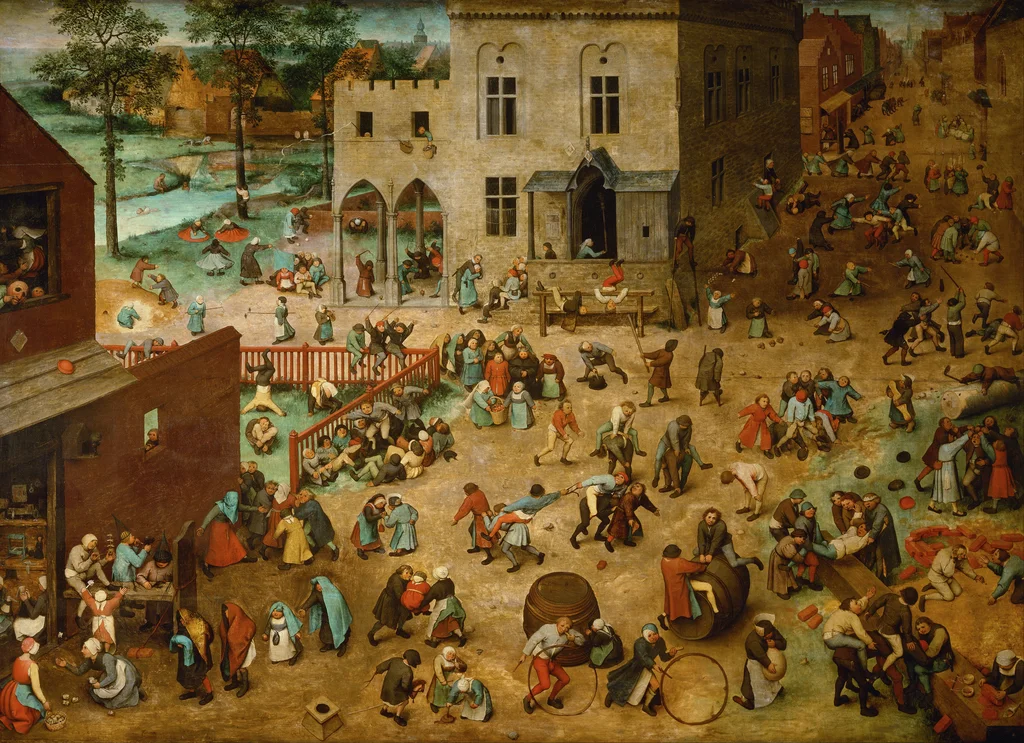
Pieter Brueghel the Elder, Children's Games, 1560. Wikimedia Commons. · PD
아이들의 놀이
상세 정보
이야기
Bruegel painted this town square in 1560 and packed it with more than 230 children playing something like 80 different games. They roll hoops, walk on stilts, ride hobby-horses, turn cartwheels, play leapfrog and blind man's buff, blow up a pig's bladder like a balloon. Scholars have spent a long time identifying every one, and a surprising number are still played today. But it isn't really a cheerful scene of fun, and Bruegel didn't mean it as an encyclopedia of toys. Notice that not one grown-up is in sight, and that the children go about their games with a heavy, joyless seriousness, the same intent frowns adults wear over their own supposedly important business. That was the point. It belonged to a set on human folly, and a popular idea of the day, written in a Flemish poem a generation earlier, held that from God's view all our grown-up striving looks as small and foolish as children lost in their play. So the square reads two ways at once. Down in the lower corner a girl scrapes a shard against a brick, one of the plainest, oldest games of all, doing it as gravely as everyone else.