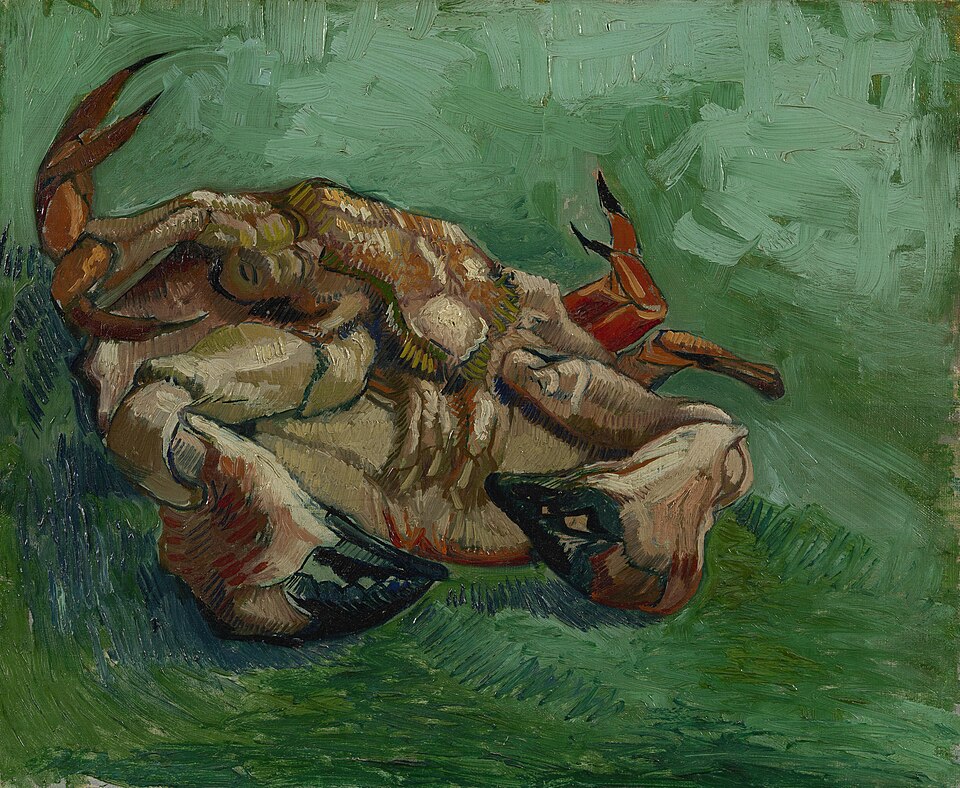
Vincent van Gogh, Crab on its Back, 1887. Wikimedia Commons. · PD
뒤집힌 게
상세 정보
이야기
This small still life of a single crab, flipped helplessly onto its back, comes out of Van Gogh's Paris years. The Van Gogh Museum, which holds it, dates it to late 1887, when he was living with his brother Theo and soaking up everything new in the city. Two things are pressing on it. One is the flood of Japanese prints then reaching Paris. Van Gogh collected them and admired a print of crabs by the Japanese master Hokusai, which he called admirable. The other is colour theory. He was working through the ideas of the painter Delacroix, that red and green set side by side make each other burn brighter, and here he tests exactly that, a red crab laid against a green ground. There is no story to the creature beyond what you see, a hard shell turned upside down, its legs in the air. Within a year he would leave Paris for the south and the sunflowers and wheat fields. This bright little experiment stayed behind as a record of what he was teaching himself, and it is in the Van Gogh Museum in Amsterdam.