피에타
상세 정보
이야기
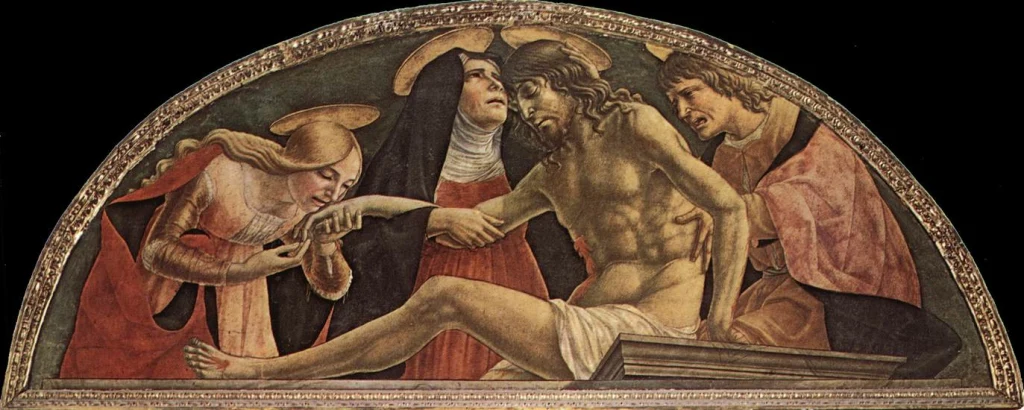
By 1491, when Lorenzo d'Alessandro made this Pietà, Florence and Rome were deep in the new Renaissance style. He worked far from all that, in San Severino, a small town in the Marche on the far side of the Apennines, where older late-Gothic habits still held. You can see both worlds meet in the panel. The bodies have the weight and modelling of the new painting, while the mood, the sharp grief and the burnished gold, belongs to an older tradition. Lorenzo had learned from the Salimbeni brothers of his own town and had studied Carlo Crivelli, another painter working the Adriatic side of Italy. The detail people remember is Mary Magdalene, her face carrying real, glistening tears painted as tiny raised drops, so that grief becomes something you could almost touch on the surface.