Agasias of Ephesus
Ancient Greek · Hellenistic art
The story
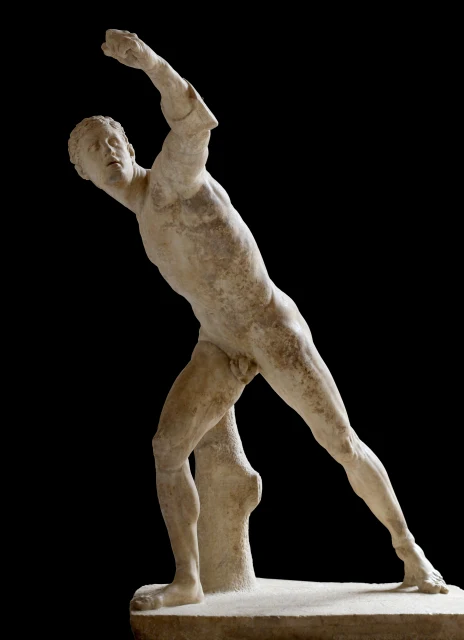
On the tree stump that props up the Borghese Gladiator in the Louvre, a Greek inscription reads "Agasias, son of Dositheos, of Ephesus, made it". Ephesus was a rich Greek city on the coast of today's Turkey. Beyond that single line, nothing is known of the sculptor. The statue is his only signed work to survive, and scholars cannot say whether he was related to other sculptors of the same name.
Carved around 100 BC, it shows a naked warrior lunging forward, his left arm raised to meet a blow from above. The pose suggests a fight against a man on horseback, so the old name "gladiator" comes from a later misreading of the subject.
The statue was dug up before 1611 at Anzio, on the coast south of Rome, among the ruins of Nero's seaside palace. It entered the collection of the Borghese, the family of Pope Paul V, and stood in their villa in Rome. In 1807 Prince Camillo Borghese, Napoleon's brother-in-law, sold it to the emperor along with much of the family's antiquities, and it went to Paris. Casts spread across Europe, and painters from Rubens onward studied its straining body. The Royal Academy in London still keeps a plaster cast of it.