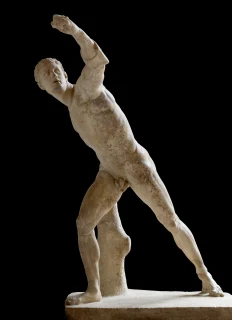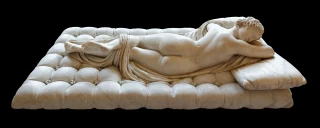
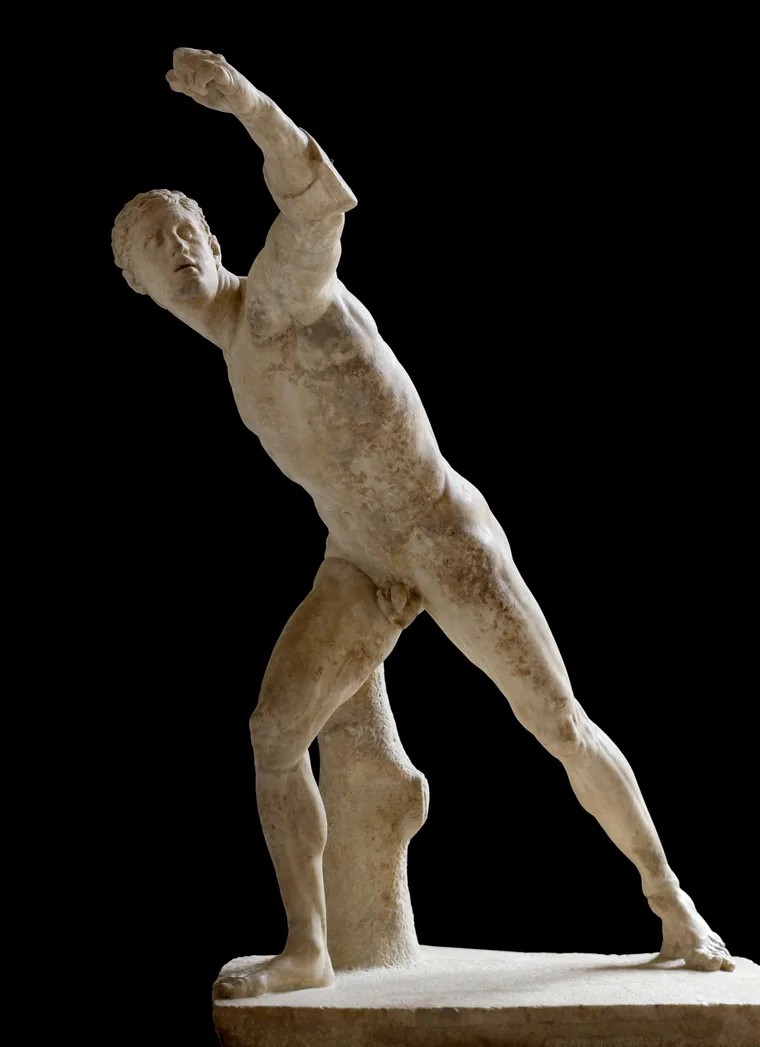
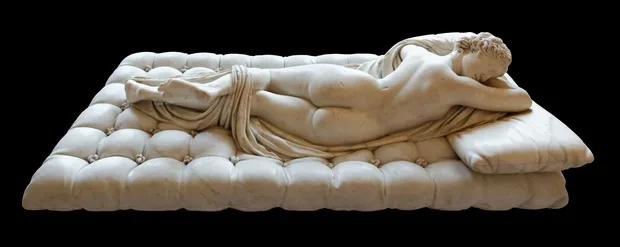
In 1807 Prince Camillo Borghese, the husband of Pauline Bonaparte, sold his brother-in-law Napoleon nearly seven hundred ancient statues, busts and reliefs from the family collection. The sale was formalised by a decree of 27 September, the price was set at 13 million francs, and Camillo received much of it in land. Among the works sold were the Borghese Gladiator and the Sleeping Hermaphroditus, and both statues have stood in the Louvre ever since. The Hermaphroditus that lies in the villa today was brought here to replace the one that was sold.
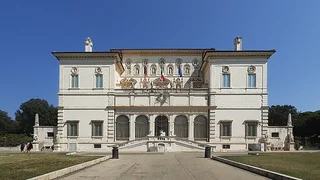
The collection was begun by Pope Paul V's nephew, Cardinal Scipione Borghese, who died in 1633. In 1613–1616 he built a country house on the Pincian Hill in which to show his paintings and statues, and he got them sometimes with money, sometimes by force.
By the end of the 19th century the Borghese family was deep in debt, and on 26 December 1901 the Italian parliament passed two laws at once. One approved the State's purchase of the collection (the literature gives the sum as 3.6 million lire), and the other bought the park separately, for no more than 3 million, and handed it over to the city of Rome.
What the Cardinal-Nephew Took (1606–1613)
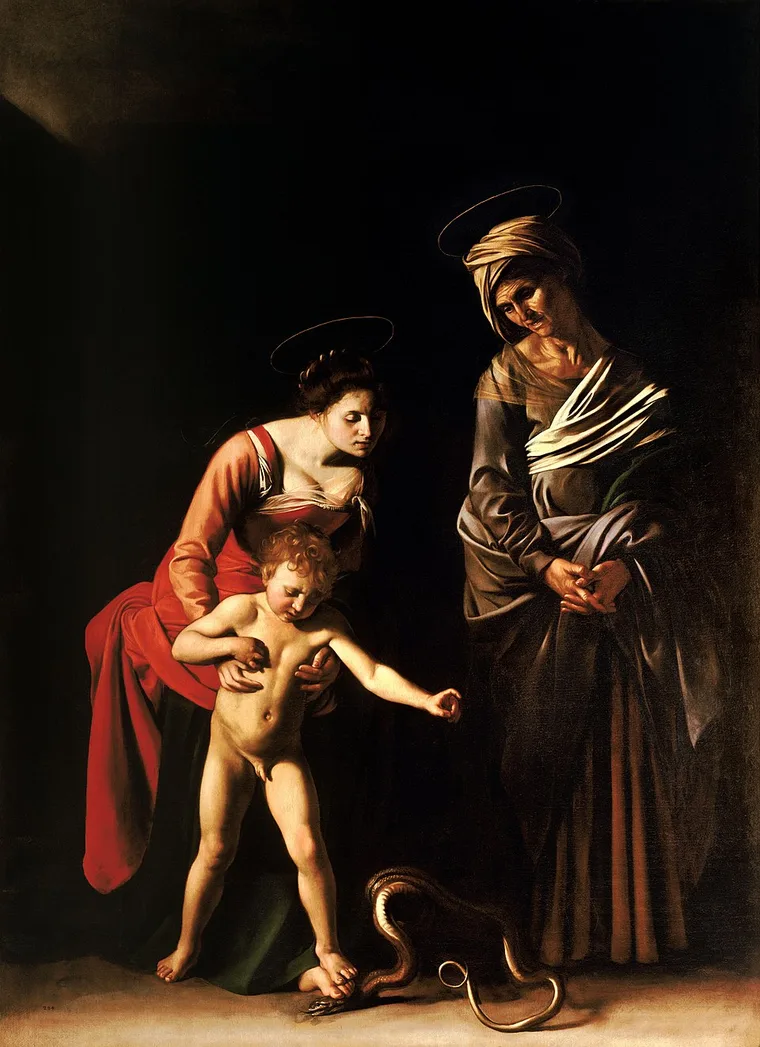
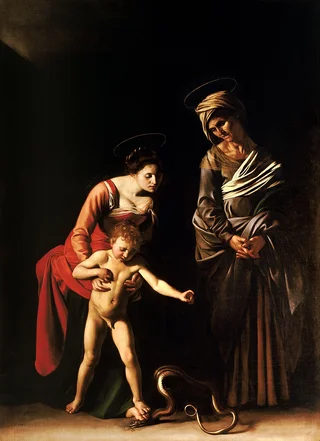
1. Madonna and Child with Saint Anne — Caravaggio
In the autumn of 1605 the confraternity of the palafrenieri, the papal grooms and chair-bearers, commissioned from Caravaggio a picture for their altar of Saint Anne in the new basilica of St Peter's. On 8 April 1606 the painting was handed over to the dean of the confraternity, and on 16 April the confraternity paid porters to take it down from the altar and carry it to the confraternity's own church, Sant'Anna dei Palafrenieri in the Vatican. It hung in St Peter's for eight days at most, and it may never have been properly installed.
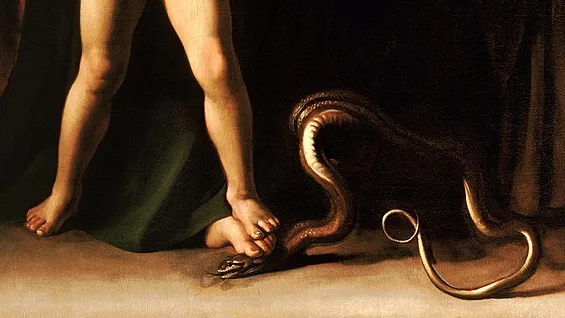
The subject goes back to the Book of Genesis, where God curses the serpent and promises that its head will be crushed. Catholics and Protestants argued over who would do it, the Virgin Mary or her Son, and in 1569 Pope Pius V approved a formula under which the Son crushes the serpent's head with his Mother's help. Caravaggio painted the formula literally: Mary's bare foot rests on the head of a dark, glistening serpent, the boy sets his own foot on top of hers, and they press down together. Mary holds her son under the arms, the way one holds a child who is learning to walk. The boy is naked and looks three or four years old. Saint Anne, patroness of the confraternity, stands a little apart, old, with a wrinkled neck and a yellow cloth over her head, her hands folded, looking down at them.
Historians still argue about why the painting was removed. The painter and biographer Giovanni Baglione, a contemporary of Caravaggio, wrote that it was taken away on the orders of the cardinals in charge of building the basilica. The Roman biographer Giovanni Pietro Bellori complained in 1672 that the Madonna and the naked Child were painted “basely”. In the 20th century some scholars held that the canvas was too tall for the altar, while others connected its fate with the rebuilding of the altars in the new basilica. Maurizio Marini pointed out that the model for the Madonna was Lena Antognetti, a woman of doubtful reputation whom people in Rome knew by sight, and Salvatore Settis noted that Saint Anne, to whom the altar belonged, does nothing in the scene. Maurizio Calvesi, on the other hand, argued that the iconography of the painting follows Pius V's formula strictly.
On 20 July 1606 Cardinal Scipione Borghese bought the painting, paying the confraternity 100 scudi, 25 more than the confraternity had once paid Caravaggio. By then the painter had already fled Rome, because on 28 May he had killed Ranuccio Tomassoni in a fight and had been sentenced to death in his absence.
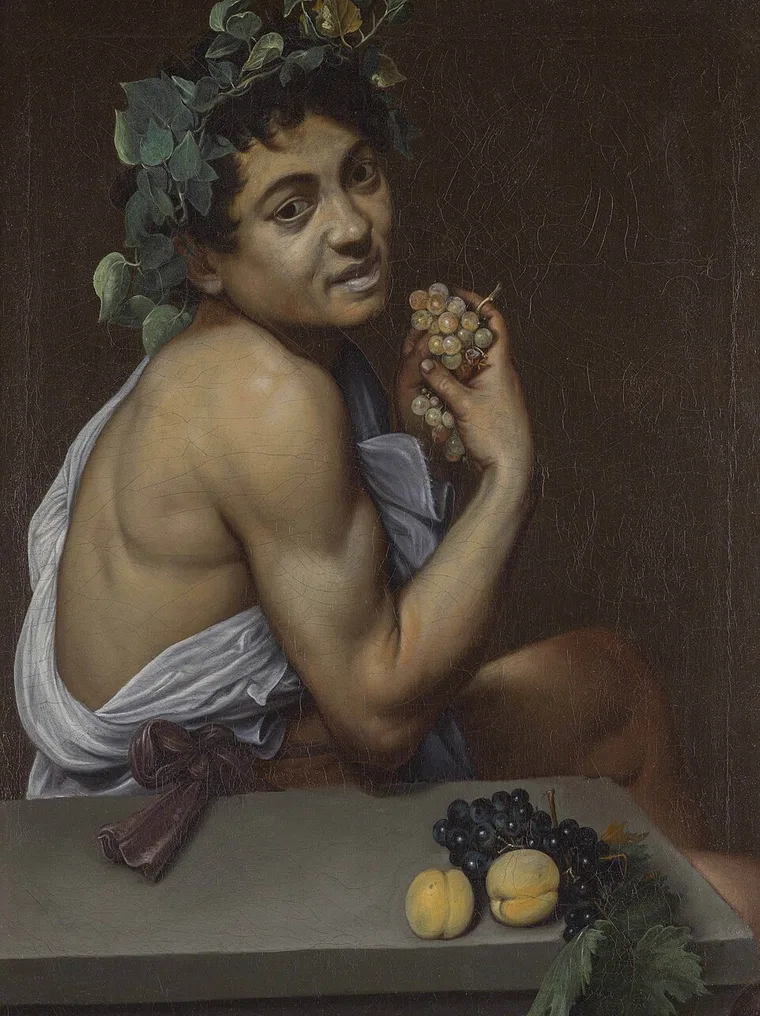
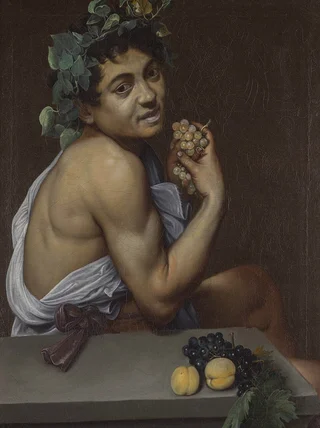
2. Self-Portrait as Bacchus — Caravaggio
Caravaggio's first independent pictures were described by his rival and far from friendly biographer, Baglione. In 1642 he wrote that Caravaggio, after leaving the workshop of the Cavalier d'Arpino, “tried working on his own” and painted small pictures of himself, looking in a mirror. The first, according to Baglione, was a picture of Bacchus with bunches of different grapes. It is usually taken to be this painting, in which Bacchus holds white grapes in his hand, while a black bunch and two yellow peaches lie on the stone slab in front of him.
Documents found in 2011 place Caravaggio in Rome by March 1596, and the museum dates the Bacchus to about 1595. The physician and connoisseur Giulio Mancini describes these years as years of poverty. For several months Caravaggio worked for d'Arpino. At one point he fell ill, was taken penniless into the hospital of Santa Maria della Consolazione, and while he was recovering painted several pictures there for the prior.
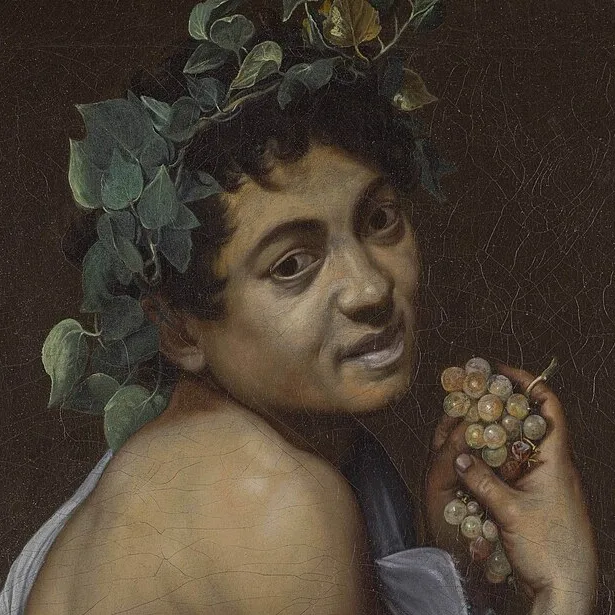
Bacchus sits with his back to the viewer and looks round over his shoulder. The shoulder that catches the light is painted in warm ochre, while his face and lips are greyish green and the whites of his eyes have a yellow tinge. In 1927 the art historian Roberto Longhi connected this colour with the painter's illness. Marini later argued that the green came from a bad restoration, but studies in 2001 showed that the colour is the painter's own. Bacchus wears a wreath of ivy, and one leaf at the top has already turned yellow. His thumb presses on the white grapes as if he were about to crush them.
By 1607 the painting belonged to the Cavalier d'Arpino, Giuseppe Cesari, the most successful painter in Rome at the time. That year papal fiscal officials arrested him for keeping arquebuses illegally. Mancini writes that d'Arpino did indeed own a fine collection of arquebuses, while the Treccani, the Italian biographical dictionary, calls the charge a pretext. The case ended in a deal: d'Arpino surrendered his paintings to the Apostolic Camera, about 107 of them by the museum's count, and the pope gave them to his nephew Scipione. The Bacchus is number 54 on that list. Historians differ over who was behind the arrest, the pope or the cardinal himself. In the inventory of 1790 the painting is recorded as a “Satyr”, and the nickname Sick Bacchus was invented for it by the same Longhi.
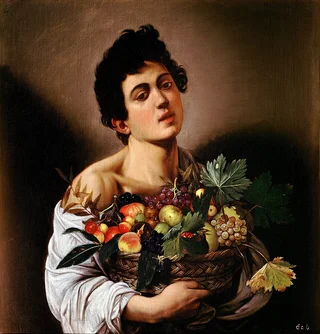
3. Boy with a Basket of Fruit — Caravaggio
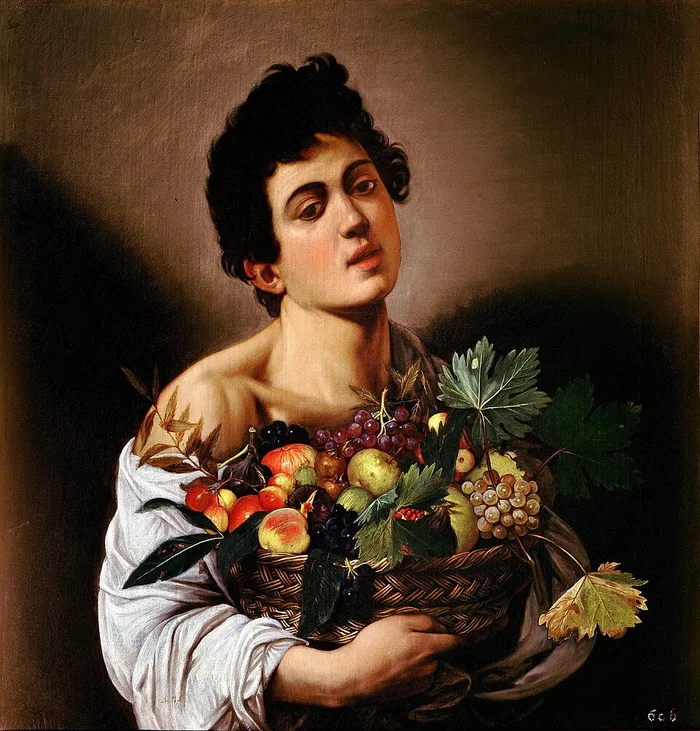
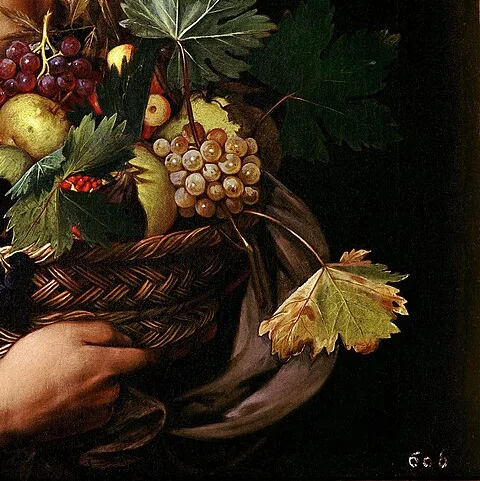
In the lower right corner of the canvas the number 606 is painted in white, and on the boy's white sleeve at the left a second number, 475, shows through in brown. The Borghese inventory of 1693 describes a picture of a young man holding a basket of fruit “with two numbers, one 606 and the other 475”, and both numbers can still be seen on the canvas.
Bellori wrote that Caravaggio, having taken work with the Cavalier d'Arpino out of need, painted flowers and fruit for him. Scholars usually assign this picture to those months, though no document has been found showing that it was painted in d'Arpino's workshop. What is certain is that before 1607 the picture belonged to d'Arpino and that it passed to Scipione Borghese, together with the Sick Bacchus, when its owner was arrested.
The basket fills the whole lower half of the canvas, and it is the most minutely painted part of the picture. In 2004 Jules Janick, a horticulturalist and researcher at Purdue University in the United States, identified its contents: a peach with a red blush, four bunches of grapes (black ones, a red and a white), a split pomegranate spilling its seeds, four figs, two medlars, apples, and sprigs with small pears. The fruit, he said, is almost flawless, while the leaves are diseased. One vine leaf has fungal spots, another carries the white egg mass of a leaf-roller moth, the peach leaves are speckled, and the vine leaf hanging over the edge of the basket at the lower right has yellowed and dried along its margin. In 1962 the art historian Giulio Carlo Argan saw in these leaves an allusion to decay and death.
By tradition the boy is identified as Mario Minniti, a Sicilian who lived alongside Caravaggio in Rome and later became a painter back home. The only support for this is the likeness of the face to faces in other early pictures by Caravaggio.
The painting appears in the Borghese inventories without a break from 1607, and yet in 1921–1922 the art historian Matteo Marangoni published it as an old copy, and in 1942 Ludwig Schudt agreed with him. Hermann Voss argued against this in 1924, Longhi in 1927 and Denis Mahon in the early 1950s, and today everyone accepts it as Caravaggio's. The 1790 inventory lists next to the Boy a “man with a basket of flowers” by Caravaggio, but that picture no longer appears in the inventory of 1833 and is not in the collection.
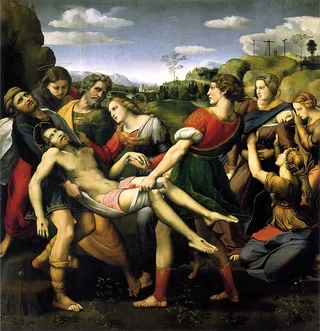
4. The Deposition — Raphael
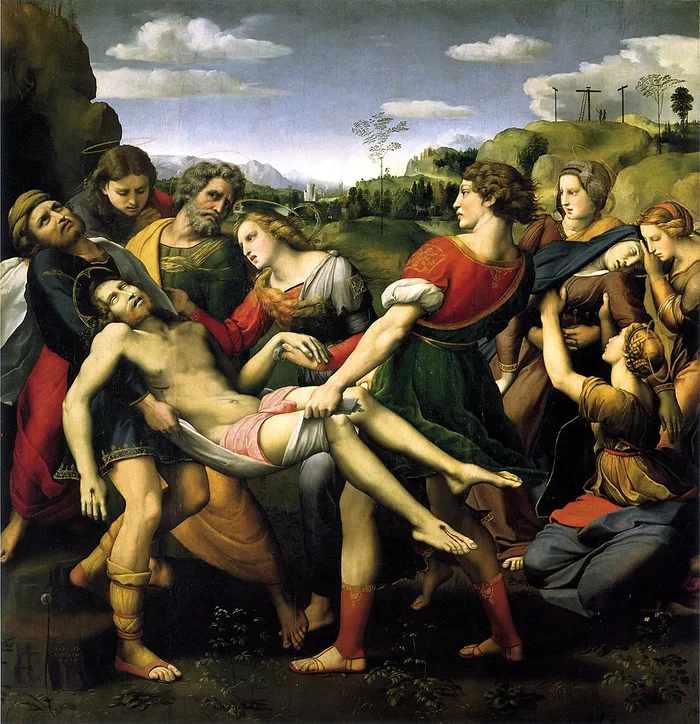
On the night of 18 to 19 March 1608 the friars of San Francesco al Prato in Perugia helped carry Raphael's altarpiece out of their church. The painting was taken to Rome, to Pope Paul V, who gave it to his nephew, Cardinal Scipione Borghese. Depending on whose account one reads, the order came from the pope himself, the cardinal's men were behind it, or the friars planned it all. Two copies were ordered for the city in exchange. One was painted by Giovanni Lanfranco, and its trail has been lost. The other was painted by the Cavalier d'Arpino, the same man whose pictures had passed to the Borghese a year earlier, and this copy is now in Perugia, in the Galleria Nazionale dell'Umbria. The crowning panel of the altarpiece, with God the Father, is kept there too, while the predella with the three Virtues is in the Vatican.
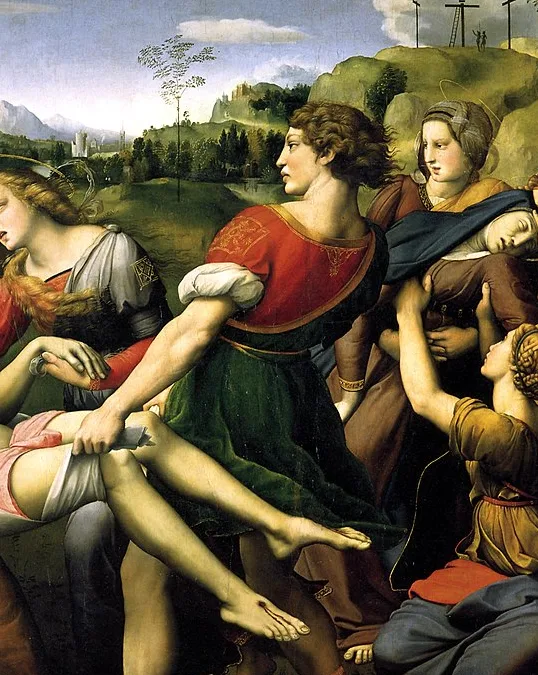
The altarpiece was commissioned by Atalanta Baglioni for the family chapel where her son Grifonetto was already buried. Since the Swiss historian Jacob Burckhardt the painting has been linked with his death, though the Borghese museum treats that link cautiously, because seven years passed between the son's death and the altarpiece. In July 1500 Grifonetto took part in a conspiracy that Perugia came to call the “Bloody Wedding”: during the wedding festivities the conspirators slaughtered his Baglioni kinsmen, and a few days later, in the reprisals, he himself was killed. In this tradition the young bearer in red at the right, who leans back with his whole body as he holds up the body of Christ, is identified as Grifonetto.
Raphael was 23 or 24 when he signed this panel. About 16 preparatory drawings for the altarpiece survive, and they show a static Lamentation in the manner of Perugino turning into a scene in which the body is carried to the tomb. Two men carry Christ on a white sheet towards a cave at the left edge of the panel. The bearded one braces his foot against a stone step, the young one leans back, Mary Magdalene holds Christ's hanging hand, and at the right the Virgin faints into the arms of three women. On a green hill in the upper right corner stand three empty crosses, with a ladder propped against the middle one. The signature RAPHAEL VRBINAS M.D.VII is written in gold on a stone in the lower left corner.
In 1809 Camillo Borghese, appointed governor-general in Turin, took the panel to his residence there. From Turin it went to Paris, and it came back to Rome in 1816, damaged on the journey. In 1874 the restorer Luigi Lais fixed a heavy metal framework to its back, and the framework was removed only in 1966–1972, by the restorers Laura and Paolo Mora of the Central Institute for Restoration.
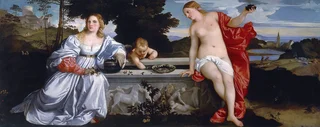
5. Sacred and Profane Love — Titian
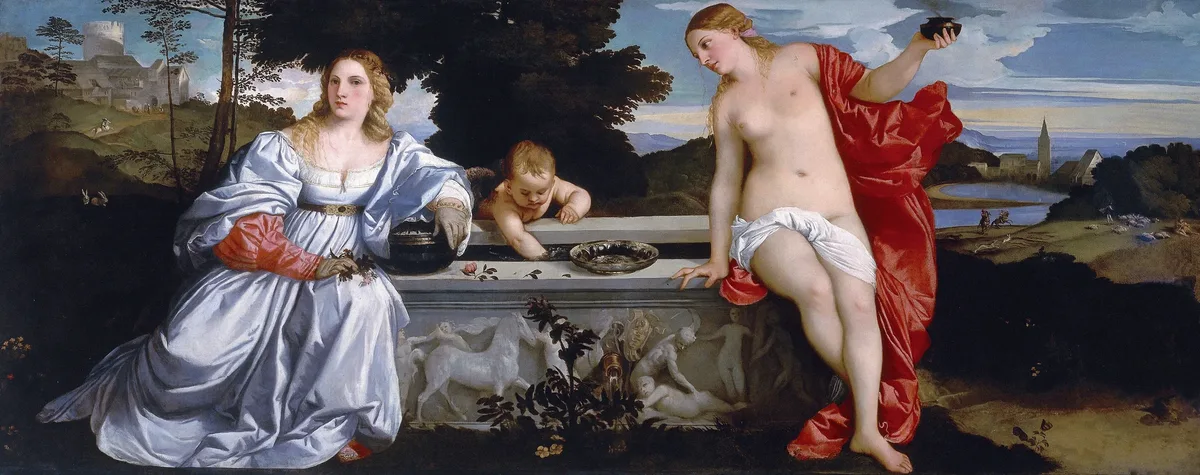
Niccolò Aurelio, secretary to the Venetian Council of Ten, commissioned the painting from Titian for his marriage to Laura Bagarotto of Padua. The bride's father, the Paduan jurist Bertuccio Bagarotto, had been hanged in Venice as a rebel in 1509, during the War of the League of Cambrai, together with other Paduans, and to the end he insisted that he was innocent.
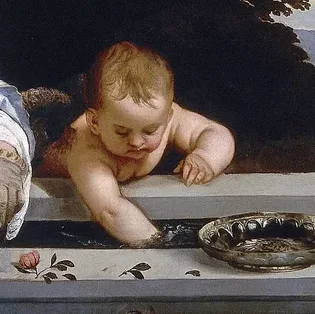
Two women sit at either end of a long ancient sarcophagus adapted as a fountain, and between them Cupid, leaning over the rim, stirs the water with his hand. The woman at the left wears a silvery-white satin dress with a red sleeve, gloves, a buckled belt and a myrtle wreath, and the museum sees in these the marks of a bride. The woman at the right is naked except for a white cloth over her hips, a huge red cloak billows behind her shoulder, and in her raised hand she holds a lamp. The museum takes both to be the same bride, in public and alone with her husband, while Erwin Panofsky in 1939 saw in them two Venuses, the heavenly and the earthly. Titian placed the arms of Aurelio and his wife on the front of the sarcophagus and at the bottom of the silver bowl standing on its rim.
The first to record the painting firmly in the Borghese collection was the Venetian biographer of artists Carlo Ridolfi, in 1648. Most scholars, following the art historian Paola della Pergola, believe that Scipione bought it in 1608 with a group of paintings from Cardinal Paolo Emilio Sfondrato, though nobody has found a list of that group.
In 1899, when the family was already negotiating the sale of the collection to the State, the Rothschild bankers offered 4 million lire for this one painting, more than the State, according to later writers, paid for the entire collection. The deal did not go through, and accounts differ as to why. In the common version the prince did not want to let the painting leave the villa. In 1995 the journalist Roderick Conway Morris told the opposite story: the family offered to give the State the whole collection for nothing if it could keep this painting and take it abroad, and the State refused. In any case the Borghese could not have sold it to a private buyer, because since 1633 the collection had been entailed family property that could not be alienated.
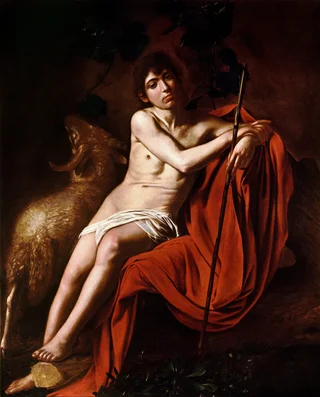
6. Saint John the Baptist — Caravaggio
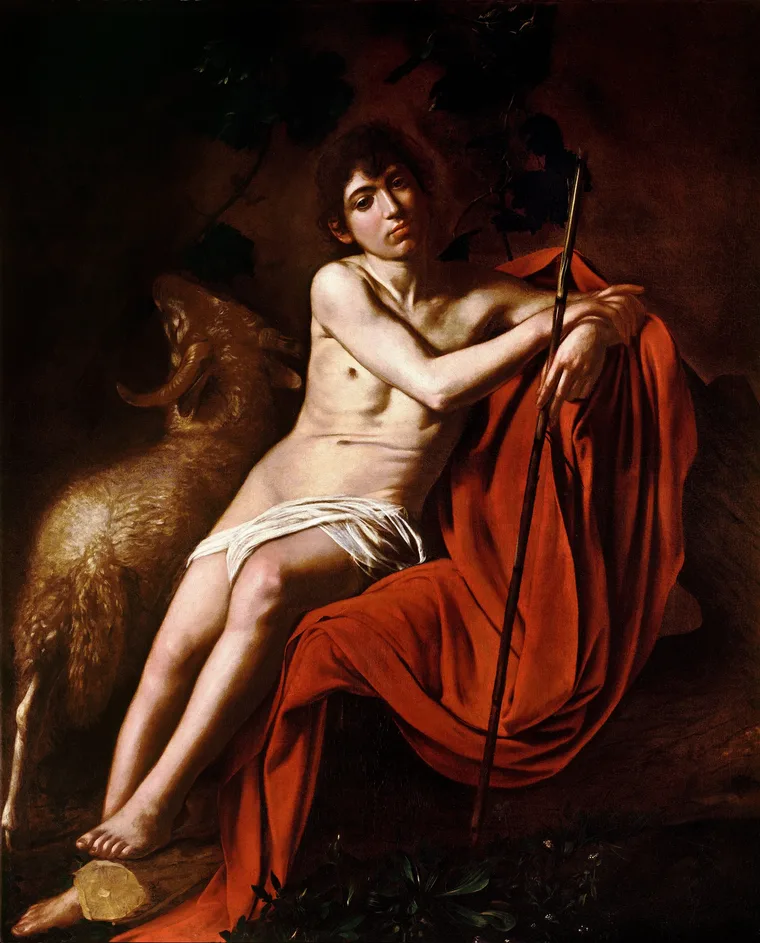
The felucca on which Caravaggio sailed from Naples in July 1610 “with a few belongings” was carrying three paintings for Scipione Borghese, two of Saint John the Baptist and a Magdalene. According to the traditional account, the painter went ashore at Palo, north of Rome, and was arrested there, and by the time he had bought his release the felucca had sailed on without him, taking the paintings with it. In 2023 the historian Francesca Curti argued that he was arrested at Porto Ercole and that he was travelling to make peace with the family of the murdered Tomassoni, since without that peace the law did not allow him to ask for a pardon. He died at Porto Ercole that same July.
The fate of the paintings has been pieced together from the letters of Deodato Gentile, the apostolic nuncio in Naples, to Scipione, which the historian Vincenzo Pacelli published in 1991. On 29 July 1610 the nuncio reported that the felucca had returned to Naples and the three paintings were safe, in the house of the Marchesa Costanza Colonna at Chiaia, where Caravaggio had lived before he left. Two days later Gentile wrote that the paintings had been taken by the Prior of Capua, Vincenzo Carafa, on behalf of the Order of Malta, which regarded itself as the heir of its former knight. Then the new viceroy of Naples, the Count of Lemos, stepped in, wanting the paintings for himself. He kept one Saint John, and Scipione proved that the other had been painted to his own order. On 29 August 1611 this Saint John the Baptist set out for Rome.
The teenage boy sits, almost reclining, against a dark slope, one knee drawn up and his arms folded on it, and looks at the viewer with a tired, sullen gaze. Of the Baptist's attributes Caravaggio left him only a thin reed, without the cross at its tip and without the scroll reading “Behold the Lamb of God” by which the saint is usually recognised. Half the canvas is taken up by a huge red cloak, and at the left, behind the youth, a ram stretches its muzzle upward and nibbles at vine leaves. Several scholars see in the ram and the vine a reference to Christ's sacrifice.
Until the letters were found, the painting was dated in different ways. Denis Mahon put it in 1602–1604, Longhi first at the end of the Roman years and then in the painter's time in Palermo, and only after 1991 was the date narrowed to 1609–1610.
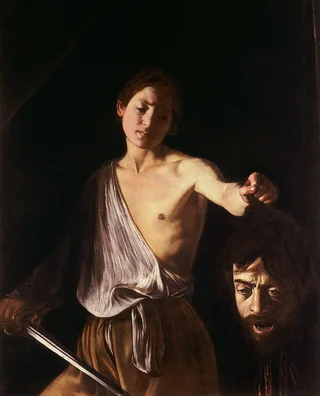
7. David with the Head of Goliath — Caravaggio
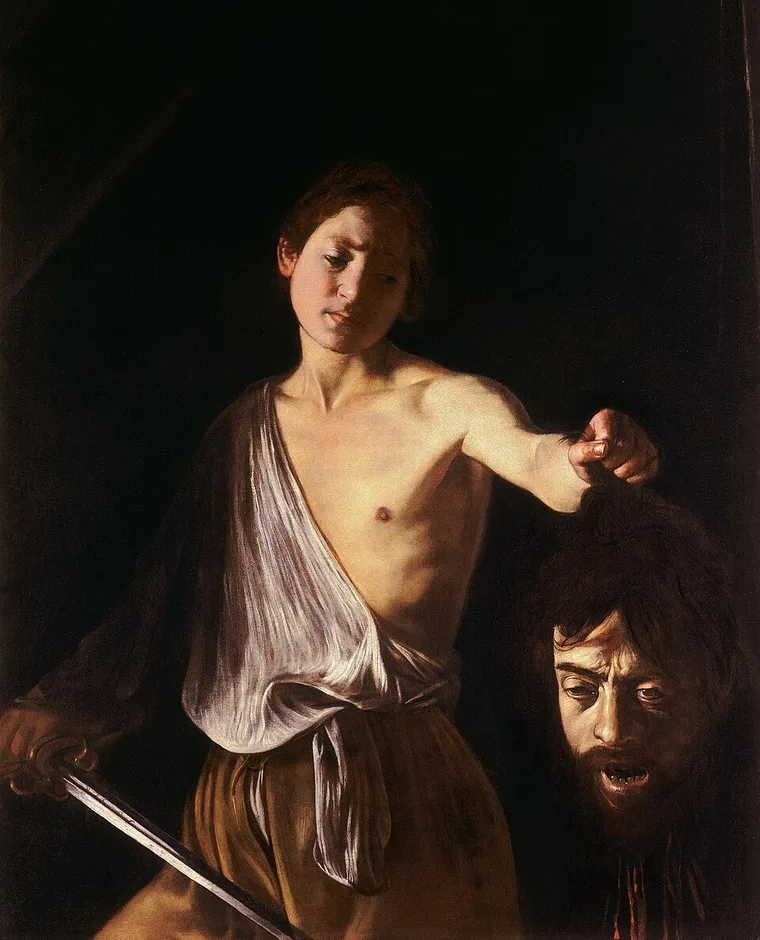
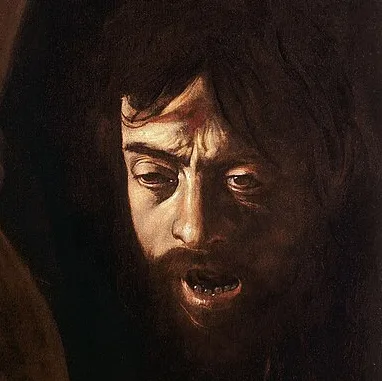
David holds Goliath's head by the hair at arm's length, straight out towards the viewer. One of the giant's eyes is half-closed, the other open and glazed, his mouth hangs open so that the teeth show, there is a red mark on his forehead from the stone, and at the bottom edge of the canvas trickles of blood run from the neck, the only red in the whole picture. As early as 1650 Giacomo Manilli, author of a description of the Villa Borghese, wrote that in this head Caravaggio “meant to portray himself”, and in 1672 Bellori said the same.
David looks at the head sadly, the corners of his mouth turned down. Manilli called the model for him “his Caravaggino”, that is, a boy from the painter's circle, and among the candidates scholars name Cecco del Caravaggio. On the blade of the sword in David's hand are the letters H.AS O S, and in 1987 Maurizio Marini read them as an abbreviation of the Latin saying “Humility kills pride”.
The best-known reading of the painting rests on no document, though the museum considers it probable. In 1985 Calvesi proposed seeing it as a pledge sent to Scipione Borghese so that he would beg his uncle, Pope Paul V, to pardon the painter for killing Tomassoni. For a long time the painting was placed in 1605–1606, because Bellori wrote that Scipione had commissioned it directly from Caravaggio while he was still in Rome. Later it was moved to Naples, and the museum leaves two possibilities, 1606–1607 or 1609–1610, that is, the painter's first or second stay in the city. The ground beneath the paint layer resembles the one Caravaggio used in 1606–1607.
By 1613 the painting was certainly in Scipione's hands. In that year the poet Scipione Francucci described it in his poem about the cardinal's gallery, and the cabinetmaker Annibale Durante was paid by the cardinal for frames, one of which was intended for “the picture of David with the head of the Giant”.
The Cardinal Commissions and Coerces (1617–1632)
8. Diana and her Nymphs — Domenichino
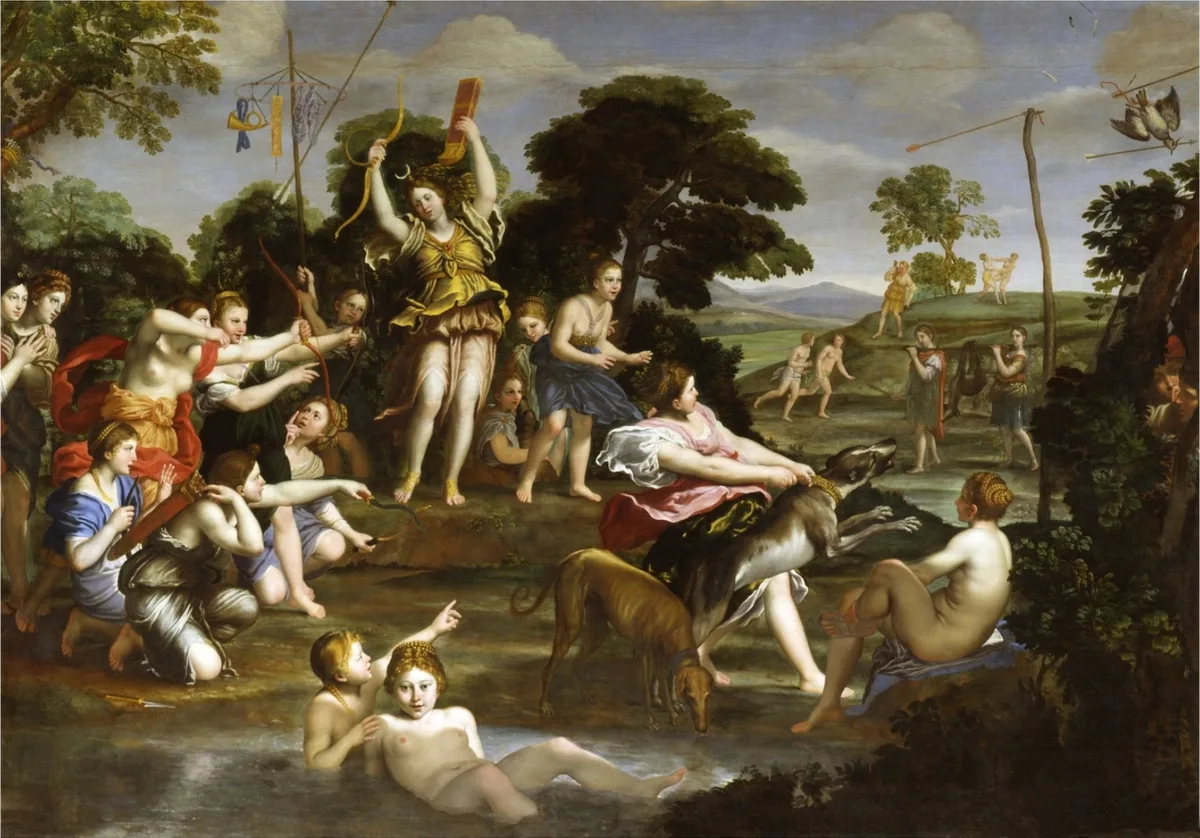
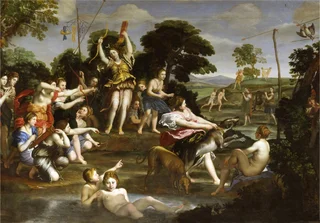
Domenichino, a Bolognese painter trained under the Carracci, had this picture taken from him while he was painting it for his chief patron, Cardinal Pietro Aldobrandini, nephew of Pope Clement VIII. The story was told by the biographer Giovanni Battista Passeri, whose lives of artists were written in the 17th century and published in 1772, and the Borghese museum cites him. Scipione Borghese heard about the painting and asked for it. Domenichino apologised, explaining that he had painted it on Aldobrandini's commission. The offended cardinal sent men who took the painting from the artist's house by force, and had Domenichino himself thrown into prison and kept there for several days.
According to a document of 21 April 1617 Domenichino received 150 scudi, and the document states that this was full payment for two paintings, this one and the Sibyl. The museum also gives the sum from the biographer's account, 40 scudi, and scholars take it to be the last instalment of the settlement.
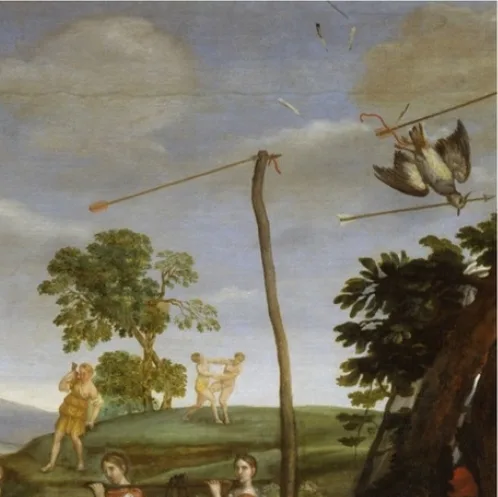
The painting has come to be known as The Hunt of Diana, although Domenichino took the subject from the fifth book of Virgil's Aeneid. At the games held in memory of Aeneas's father, Anchises, a dove was tied by a cord to a mast, and archers shot in turn: the first arrow hit the mast, the second cut the cord, and the third brought down the bird as it broke free. Domenichino gave the contest to Diana's nymphs. Diana stands in the centre on a rise, holding her bow and quiver above her head, and at the right edge a pole sticks up with an arrow in it and a snapped cord, from which the pierced dove is falling. Two nymphs stand in the water in the foreground, and one of them looks straight at the viewer. At the right a nymph in pink holds a grey greyhound by its golden collar, and the dog strains towards the bushes at the very edge of the picture, where two men are peering out.
9. Aeneas, Anchises and Ascanius — Gian Lorenzo Bernini
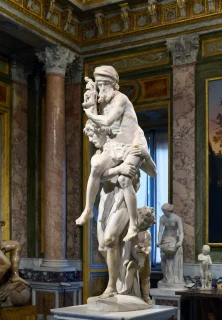
The Florentine sculptor Pietro Bernini moved his family from Naples to Rome in 1605 or 1606, because Pope Paul V had called him to make reliefs for the Pauline Chapel in the basilica of Santa Maria Maggiore. On that job the pope and his nephew Scipione noticed the sculptor's son, Gian Lorenzo. The boy trained in his father's workshop and drew the ancient statues in the Vatican and in the Borghese collection, and in 1618–1619, at the age of 20, he carved his first large group for Scipione.
The German painter and art historian Joachim von Sandrart wrote in 1675 that Gian Lorenzo made this group together with his father, and its tight vertical composition, in the manner of late Florentine Mannerism, long struck scholars as more likely the work of Pietro. The first biographers, Filippo Baldinucci in 1682 and the sculptor's son Domenico Bernini in 1713, gave the group to Gian Lorenzo but dated it to 1613, when he was 15. The dispute was settled by documents of 1619 published in the 1950s by the historian Italo Faldi: a payment to Gian Lorenzo himself and, with the same date, a stonecutter's bill for the base. Some specialists still see the father's hand in the design of the group.
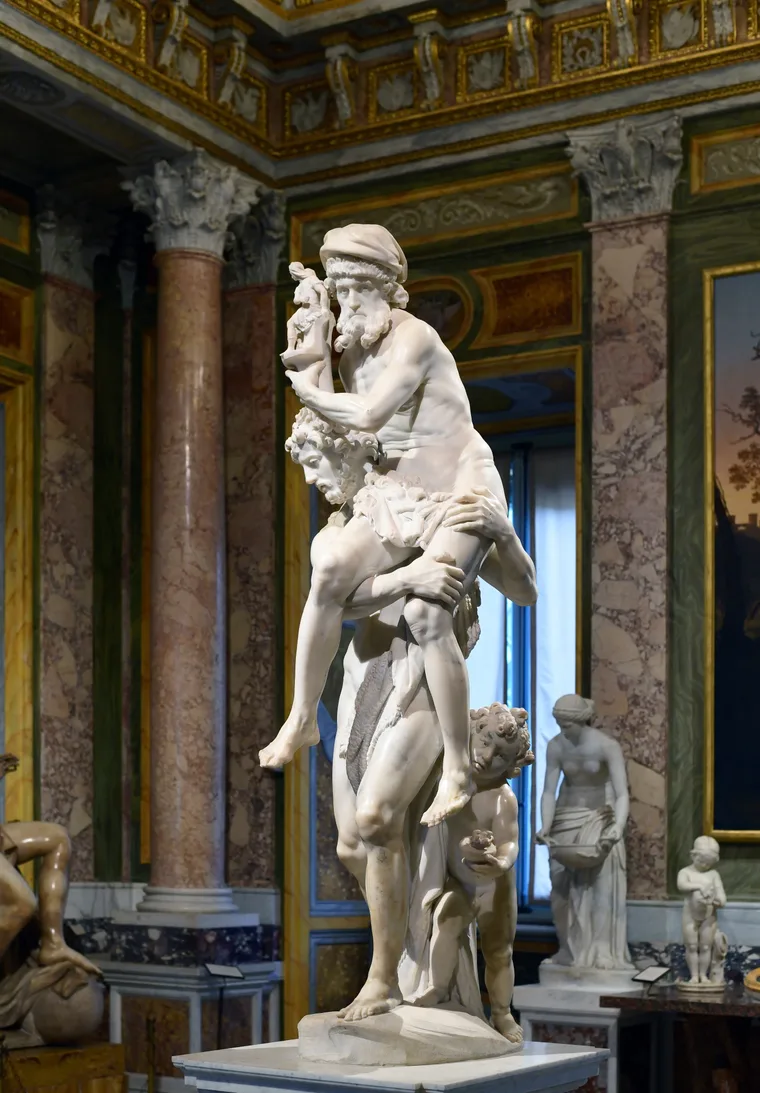
Aeneas carries his father out of burning Troy, as in the second book of the Aeneid. Old Anchises sits on his shoulder holding a vessel with the Penates, two tiny figures of the household gods of Troy, and little Ascanius peers out from behind Aeneas's leg, carrying a lamp with the fire of Vesta. The museum draws attention to the skin at three ages. The boy's is soft and plump, the skin of Aeneas is stretched tight over the muscles, and that of Anchises sags, with the veins standing out on his arm. The museum also reads the group as an allusion to the patron, the young Scipione carrying his old uncle the pope, all the more so because the Latin word scipio means “staff”.
In 1619 a round ancient altar with ox skulls and garlands was chosen as the base for the group. According to the museum's record, the stonecutter Giuseppe di Giacomo cut away about a fifth of it so that the group could stand right against the wall (Kristina Herrmann Fiore, a former director of the gallery, allows that the cut may have been made later, in the 19th century). The altar is still in the museum, separate from the group.
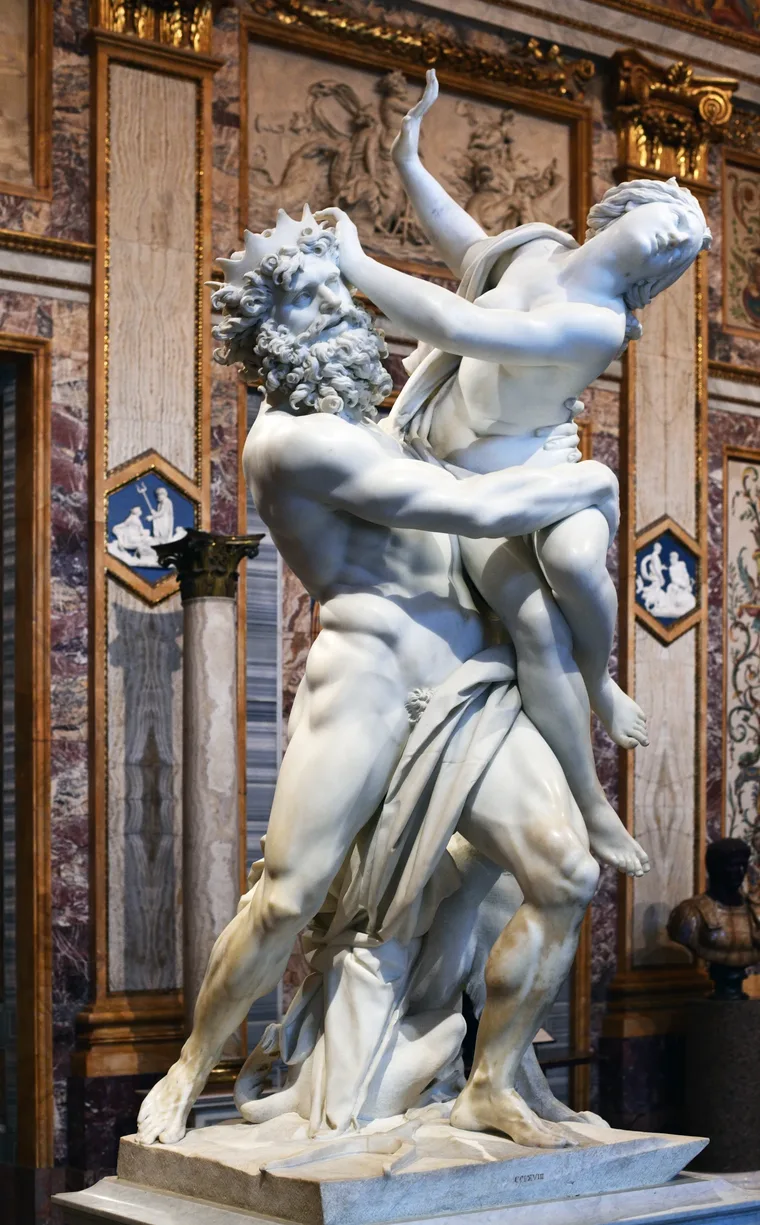
10. The Rape of Proserpina — Gian Lorenzo Bernini
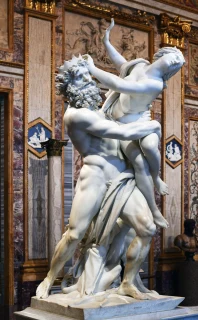
Scipione Borghese gave this group away before it ever reached his house. Bernini received the first 300 scudi in June 1621, the group was finished in September 1622, and in October it was taken straight from the sculptor's workshop to the Villa Ludovisi by the Porta Pinciana, to Cardinal Ludovico Ludovisi. A year and a half earlier Ludovisi's uncle had become Pope Gregory XV, so the cardinal-nephew was now Ludovisi, and Borghese was left as a cardinal of a pontificate that had ended. The museum explains Scipione's quick decision by this change. The art historian Christina Strunck has proposed a darker reading: the myth of a girl carried off to the underworld while every living thing on earth withers might have reminded the ailing pope that he had not long to live. Gregory XV died in July 1623.
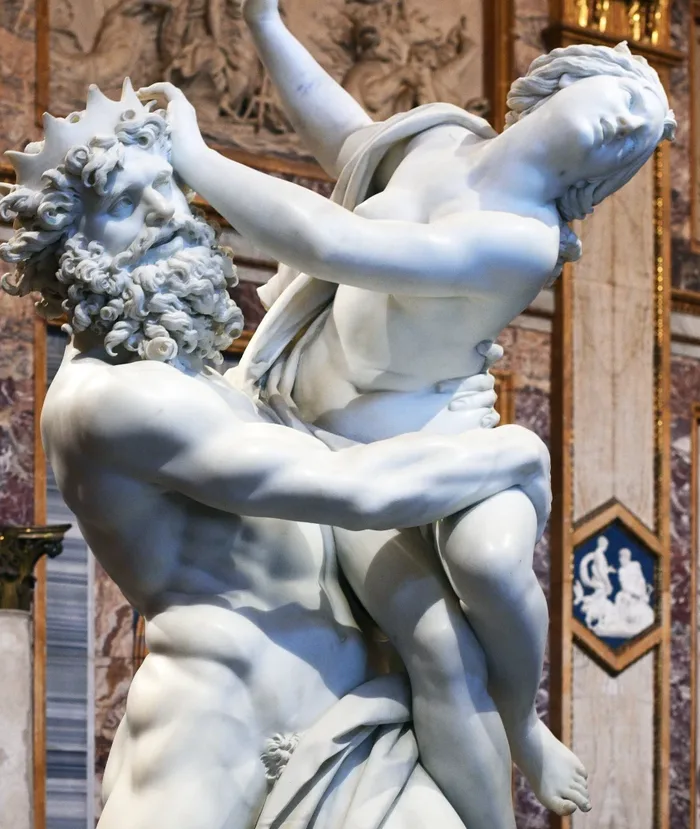
Pluto, bearded and wearing a pointed crown, strides forward, clutching Proserpina against his left side and lifting her off the ground. She twists away and pushes her palm against his head, so that his face crumples and his beard is shoved to one side. With his right hand Pluto grips her thigh, and his fingers have sunk in so far that the skin swells between them. A tear is carved on Proserpina's cheek. Behind, between Pluto's legs, the three-headed Cerberus bares his teeth, and his fur is left matt, in small parallel chisel grooves, beside the polished skin of the human figures.
The first base, with verses by Cardinal Maffeo Barberini, is lost, and the present one was made in 1911 by the sculptor Pietro Fortunati. In 1883 the Boncompagni Ludovisi sold their villa to a building company, the park was cut up into plots, and the group was moved to the family's new palace on Via Veneto, where Queen Margherita later lived. In 1908 the Italian State bought The Rape of Proserpina, and the group came to the Villa Borghese for the first time.
11. David — Gian Lorenzo Bernini
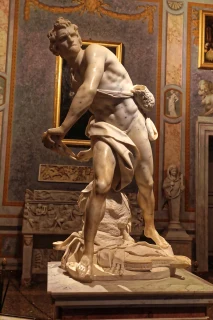
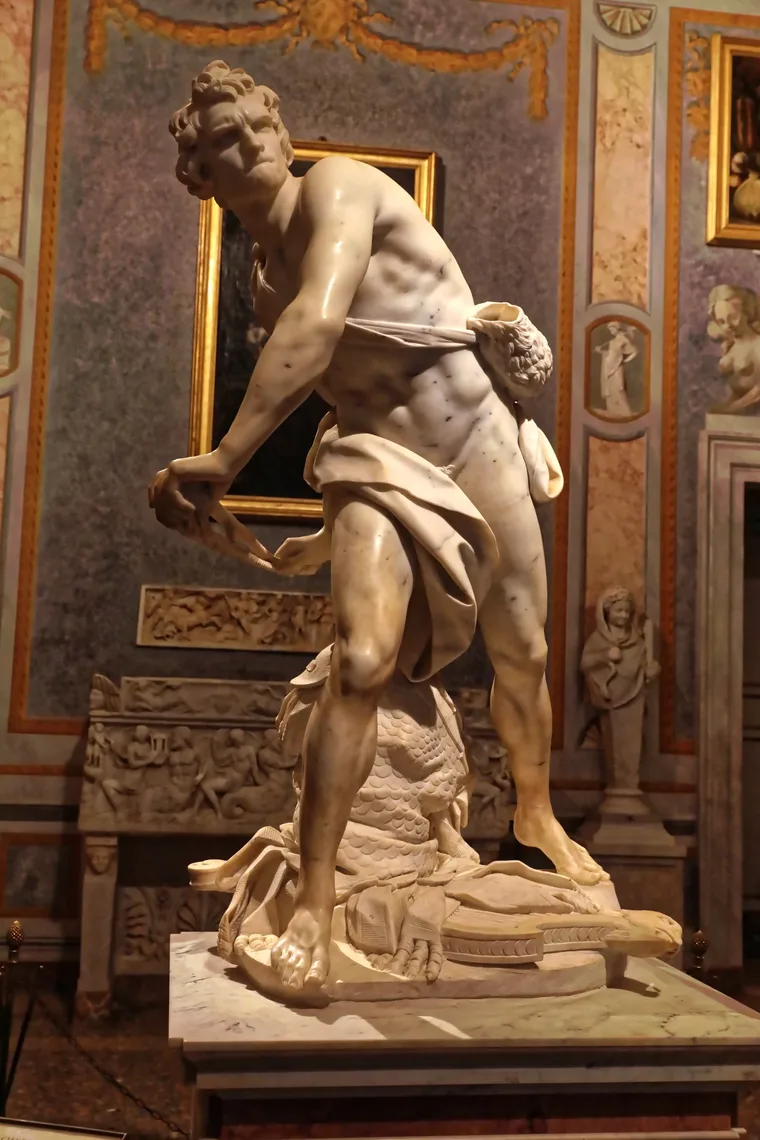
In March 1623 Cardinal Alessandro Peretti Montalto, nephew of Pope Sixtus V, commissioned from Bernini a statue of David for his villa, and on 2 June of the same year he died. According to the museum's record, Scipione Borghese took over the commission. Baldinucci does not mention Montalto and writes that Bernini made the statue for Borghese in seven months, and the museum adds that for its sake the sculptor set Apollo and Daphne aside for a time.
Bernini showed David mid-swing, just before the throw. His legs are set wide apart, one foot flat on the ground and the other far behind him, pressing its toes against the base, his body is twisted and leaning, both hands hold the sling, and its cords, carved in marble, are stretched taut between his palms. David looks over his shoulder towards where the stone will fly, his brows knitted and his lower lip bitten. At David's feet lies the breastplate of King Saul. In the First Book of Samuel, Saul himself put his armour on David before the fight, and David took it off because he was not used to walking in it. Beside it lies a harp, its end curling into a small eagle's head, and the eagle was the heraldic bird of the Borghese. At first the statue stood against a wall, which is why the back and the rear of the cloak are more roughly worked, in broad planes.
Baldinucci, writing almost sixty years later, relates that Bernini modelled David's face on his own, and that Cardinal Maffeo Barberini came to his workshop several times and held the mirror for him himself. In August 1623 Barberini was elected pope and took the name Urban VIII.
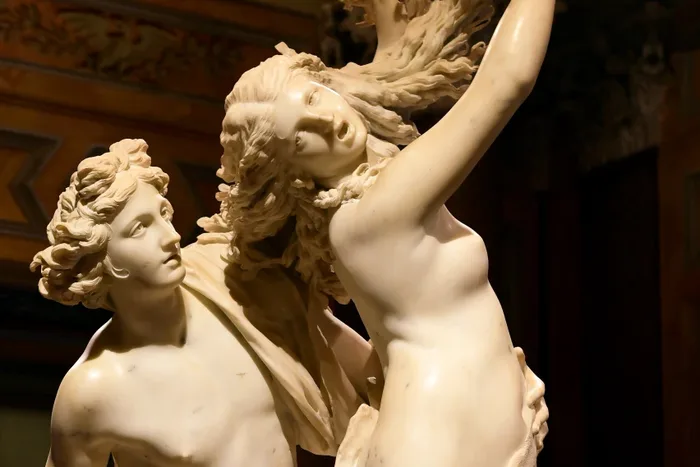
12. Apollo and Daphne — Gian Lorenzo Bernini
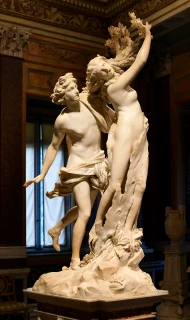
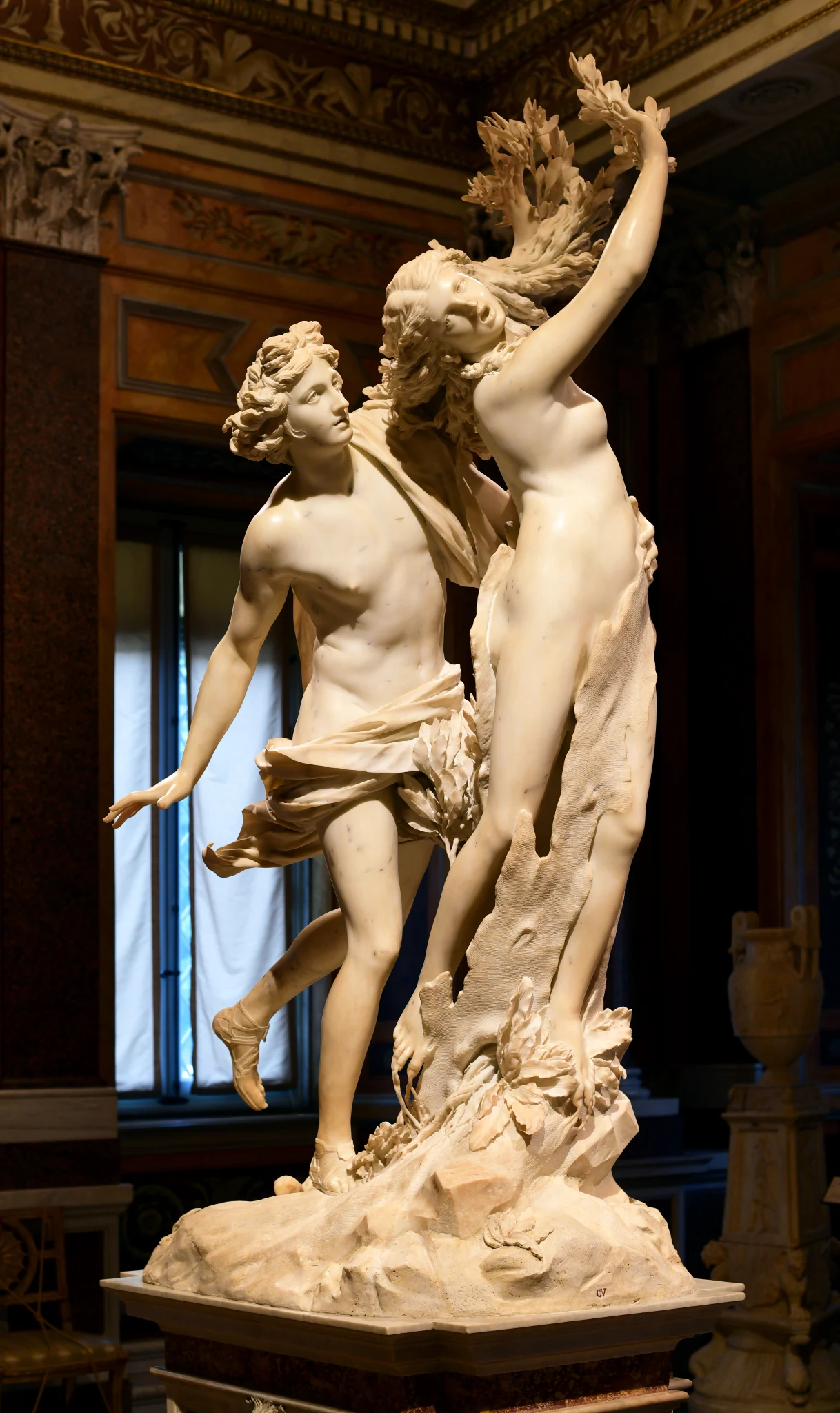
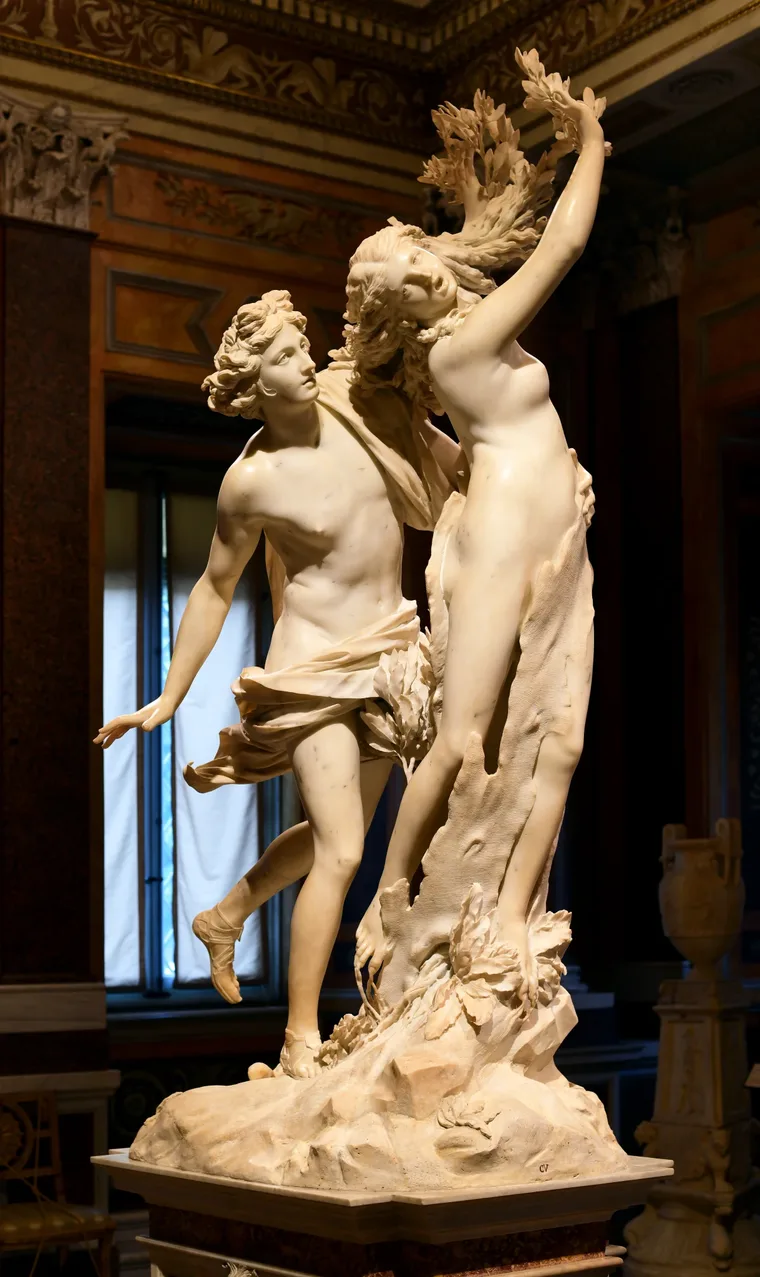
In Ovid the nymph Daphne runs from Apollo, and when he has almost caught her she begs her father, a river god, to take away the form that so pleased her pursuer. At once bark closes over her body, her hair turns to leaves, her arms to branches, her feet to roots. Bernini chose the moment when Apollo's hand has come to rest on her hip and the bark beneath his hand has already closed. The bark climbs her legs, her toes are turning into roots that grip the rock, and thin, translucent laurel leaves burst from her fingers and from the locks of her hair. Apollo's face is still calm, while Daphne has thrown her head back and is screaming.
Scipione bought the marble for the group on 2 August 1622. Work stopped for about a year while Bernini made the David, in August 1625 the group was installed at the villa, and on 24 November Bernini received the last payment. In all he was paid 1,000 scudi.
It is usually thought that Maffeo Barberini composed an inscription for the group so that a pagan chase of naked bodies could be shown in a cardinal's house. His Latin couplet is carved on a cartouche shaped like a dragon's skin on the base: “Whoever, loving, pursues the joys of fleeting beauty fills his hand with leaves or plucks bitter berries.” When the group was moved to the centre of the room in 1785 and turned round, the sculptor Lorenzo Cardelli added a second cartouche, in the shape of the Borghese eagle, with lines from Ovid, and both are now on the base.
The biographer Passeri wrote that the leaves and roots were carved by Bernini's assistant Giuliano Finelli, though in the museum's view this can mean no more than the usual help of a workshop. During the restoration of 1996–1998 it emerged that Bernini had packed the thinnest parts with small plaster pads while he worked, so that they would not crack under the blows of the chisel, and removed them only at the very end.
13. Busts of Cardinal Scipione Borghese — Gian Lorenzo Bernini
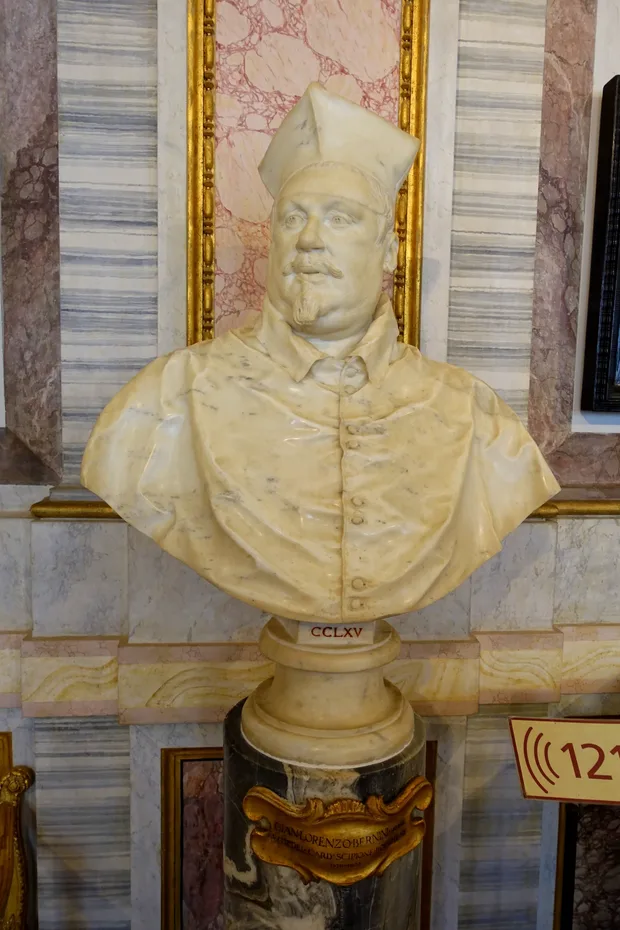
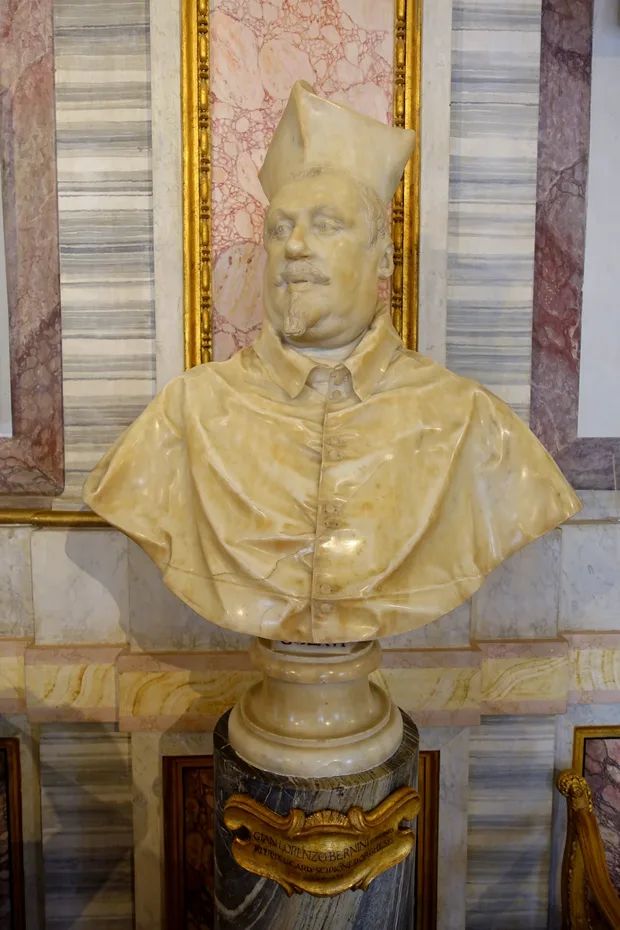
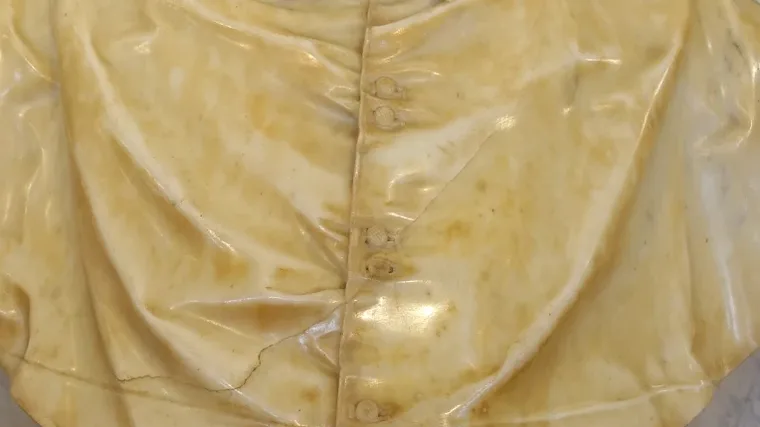
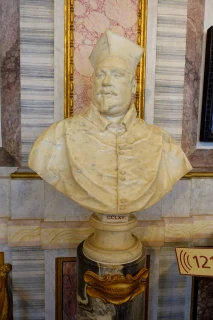
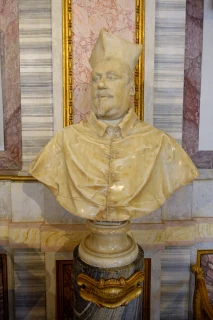
A thin dark crack runs across the forehead of the marble Scipione Borghese, from the hairline up under the cardinal's cap. It became clearly visible after the cleaning of 1997, though it had already been noticed in the workshop. Baldinucci relates that a hairline crack ran across the cardinal's forehead during the final polishing, and a bust like that could not be shown. Bernini carved a new one in 15 nights, or, according to his son Domenico, in three days. First, in Baldinucci's account, the sculptor showed Scipione the spoilt bust, and the cardinal was upset but hid it so as not to hurt the sculptor's feelings, and then Bernini uncovered the second before him. In December 1632 Scipione paid 500 scudi for the portrait, and in October 1633 he died.
On the first bust the cardinal has turned his head to one side and parted his lips, as if he had begun to speak to someone beside him, and the museum calls this bust the first of Bernini's “speaking portraits”. The heavy face with its double chin spills over the collar, the moustache curls upward, the small beard is pointed, and the short cape, the mozzetta, with its row of little buttons, is crumpled in deep folds. On the second the cardinal looks almost straight ahead, the mozzetta lies more quietly, with a single horizontal fold at the bottom, and the marble is whiter. A crack runs diagonally across this mozzetta too.
The busts were not part of the family's entailed property, and in 1892 the heirs put them up for auction in Rome as a single lot, number 341. The State bought them, and until 1908 they were kept in the Gallerie dell'Accademia in Venice, after which they returned to the villa. Scipione himself, according to the museum's record, placed the cracked bust downstairs, among the busts of Roman emperors, and sent the flawless one upstairs to the picture gallery.
The Borghese Princes Sell and Buy (1804–1839)
14. Pauline Borghese as Venus Victrix — Antonio Canova
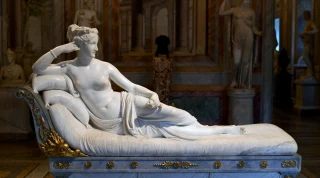
Prince Camillo Borghese commissioned the statue of his wife, Pauline Bonaparte, from Canova in 1804, and in 1807 he sold the family antiquities to Napoleon. Among them was the Sleeping Hermaphroditus, for which Bernini as a young man had carved a marble mattress, and Canova is believed to have modelled the mattress under Pauline on Bernini's. According to the museum's record, Canova was paid 6,000 scudi for the statue on 15 May 1808, though other sources place the payment in 1809.
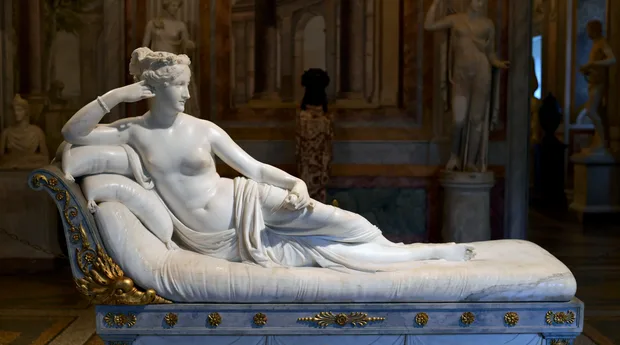
Pauline half-reclines, propped on two pillows, touching her head behind the ear with her right hand, while in her left, by her hip, she holds a small apple. It is the apple that Paris awarded to the most beautiful of the goddesses, Venus, which is why the statue is called Venus Victrix, Venus the victorious. A thin cloth covers her from hips to ankles, and the shape of her knees shows through it, while seams, piping and tassels at the corners are carved on the mattress and pillows. Canova polished the body with water from a grindstone, and the museum writes that the pinkish sheen of the marble was calculated for candlelight. There is a story, confirmed by no witness of the time, that when Pauline was asked how she could have posed almost undressed, she answered that the stove in the studio had been lit.
In 1809 the statue was sent to Turin, to Palazzo Chiablese, where Camillo lived, in 1814 it came back to Rome, to Palazzo Borghese, and only in 1838 was it moved to the villa. The wooden bed beneath the marble mattress is painted to look like stone and decorated with gilded rosettes. Hidden inside it is a mechanism on which the statue was turned round in front of viewers, and the mechanism was added in Turin.
15. Danaë — Antonio da Correggio
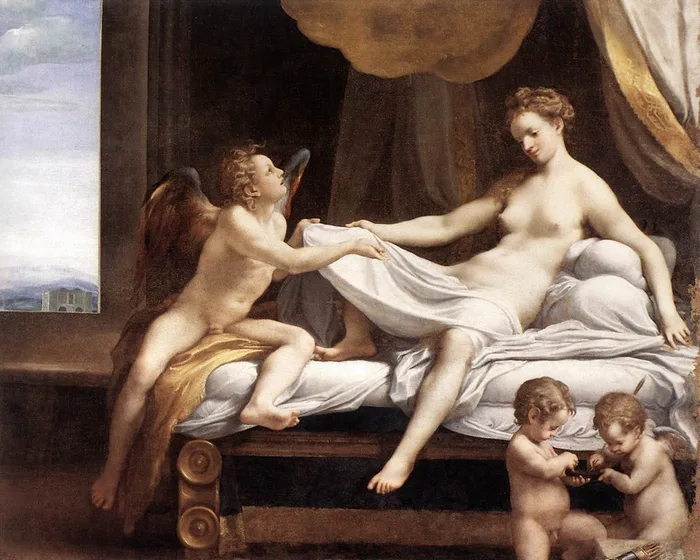
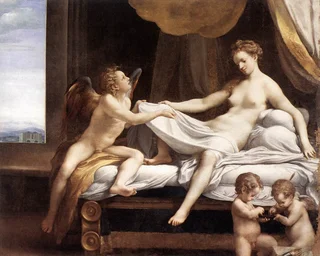
At the papal customs in 1827 the Danaë was brought into Rome as a doubtful Correggio. Prince Camillo Borghese had bought it in Paris from the dealer Bonnemaison for 285 pounds sterling, and his agent Evasio Gozzani, according to the museum's record, played down the attribution on purpose to lower the papal duty. In Rome artists confirmed that it was by Correggio, and the painter Vincenzo Camuccini praised its chiaroscuro and its transparent, luminous colour. Until 1891 the Danaë hung in the Borghese palace in Rome, and only then did it come to the villa.
Correggio painted it around 1530–1531 for Federico II Gonzaga, Duke of Mantua, as one of a series of four Loves of Jupiter. According to Vasari, the duke meant to give the series to the Emperor Charles V, though some scholars think Federico commissioned it for himself. Later the Danaë was in Milan with the sculptor Leone Leoni and in Prague with the Emperor Rudolf II, and in 1648, when Swedish troops sacked Prague, it was carried off to Stockholm, to Queen Christina. When Christina gave up the throne, she took the painting with her to Rome. After the queen's death the Danaë passed to her heir, Cardinal Decio Azzolino, then to Prince Livio Odescalchi, to the regent of France, the Duke of Orléans, to English collectors and to a Paris dealer.
Danaë half-reclines on white pillows and holds one end of the sheet, and the other end is held by a winged boy sitting on the side of the bed. The museum calls him Hymen, god of marriage, though guidebooks usually call him Cupid. The boy looks up at a dark cloud under the canopy, and this is Jupiter, who has come to Danaë, shut away by her father, as a shower of gold. In the lower right corner two putti bend over a stone: in the museum's interpretation they are Eros and probably Anteros, testing gold and an arrowhead on a touchstone. These putti are how the painting is recognised in Vasari's Lives, where he mentions cupids trying their arrows on a stone.
16. Gladiator Mosaic — Roman mosaicists, 3rd–4th century
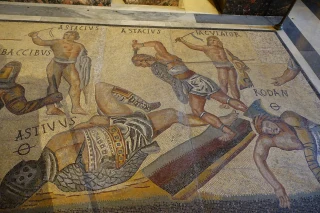
In 1834, on the Borghese estate of Torrenova by the Via Casilina, south-east of Rome, excavators uncovered the floor of the portico of a large Roman villa, laid with scenes of gladiator fights and wild-beast hunts. The dig was carried out on the orders of Prince Francesco Borghese Aldobrandini, brother and heir of Camillo, who had died in 1832. After the sale of 1807 the rooms of the villa had been left empty, and Camillo, and Francesco after him, filled them with statues from storerooms, from the market and from the family estates. The mosaic was lifted from its bed, cut into rectangular panels, restored in the Casino dell'Orologio in the villa's park, and by 1839 laid flush with the marble floor of the main hall.
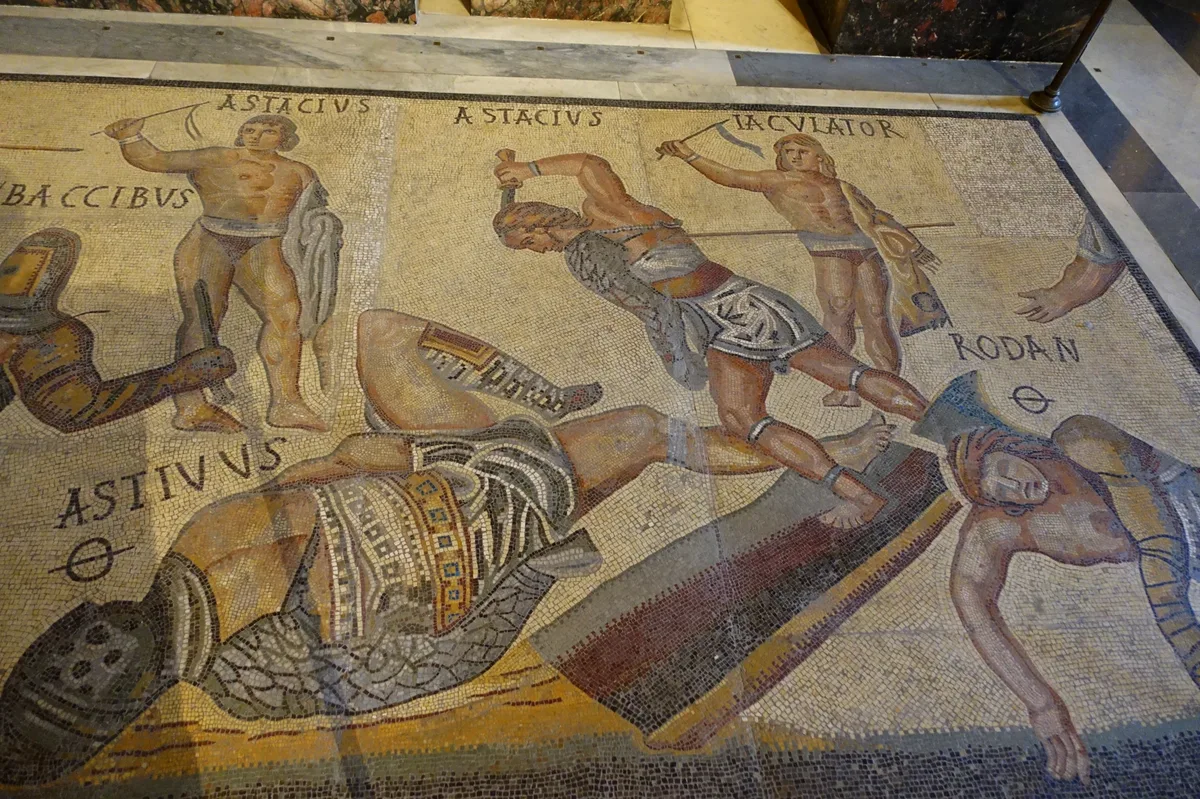
Above each fighter his name is set out in black capital letters. Some names are followed by the Greek letter Θ, the first letter of the Greek word for death: it marks the dead, while the craftsman marked the winners with the abbreviation VIC. On the best-known panel the gladiator Astacius, raising a dagger in both hands, stands over Astivus, who lies on his back with his leg caught on his huge rectangular shield, and there is a Θ under the name of Astivus. The same sign stands under the name of Rodan, who has fallen backwards at the edge of the panel. On another panel a leopard, bleeding from a wound in its side, has sunk its teeth into the arm of the hunter Serpentius.
The mosaic lay in the portico, where people walked along it as along a long frieze, and the museum believes the owner of the villa commemorated in this way games he had paid for himself. In 1845 the German epigraphist Wilhelm Henzen published a detailed description of it in Latin. The straight seams and shifts of tone in the white ground show where pieces have been reset, and some scholars believe that the 19th-century restorers put the floor together largely in a different order from the one in which it lay in the portico.
The Museum Era: Purchases, Restorations and New Names
17. Truth Unveiled by Time — Gian Lorenzo Bernini
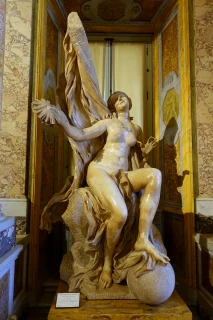
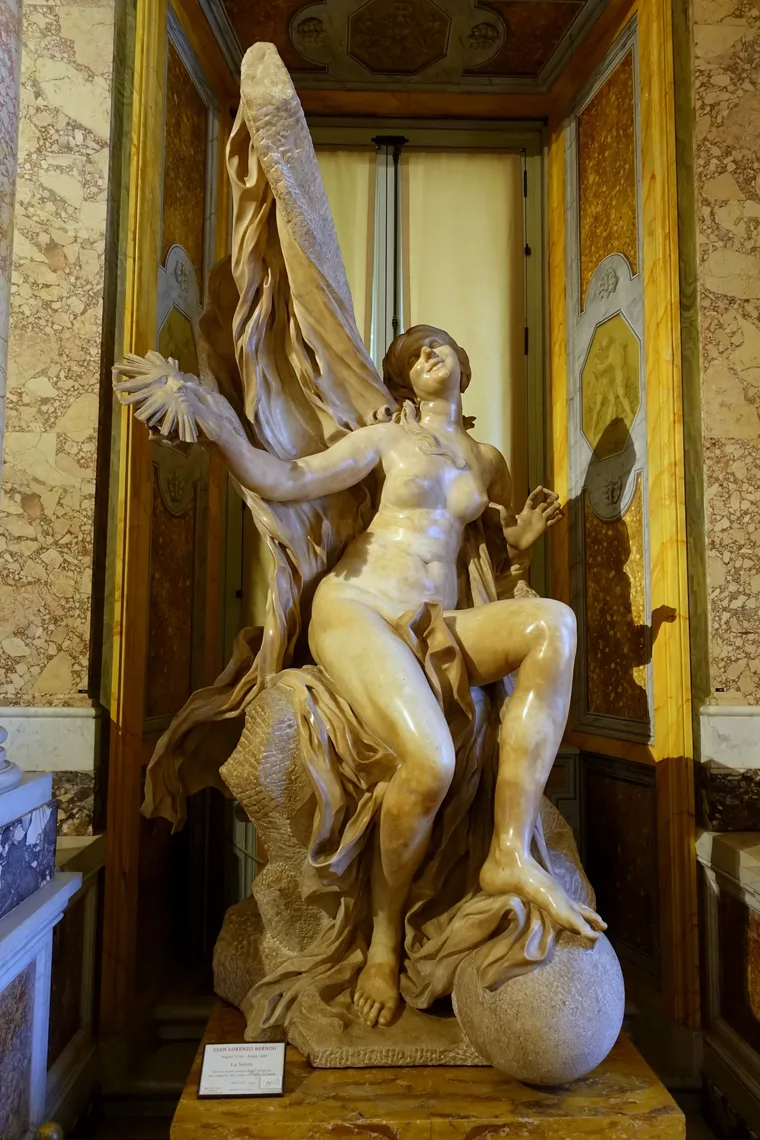
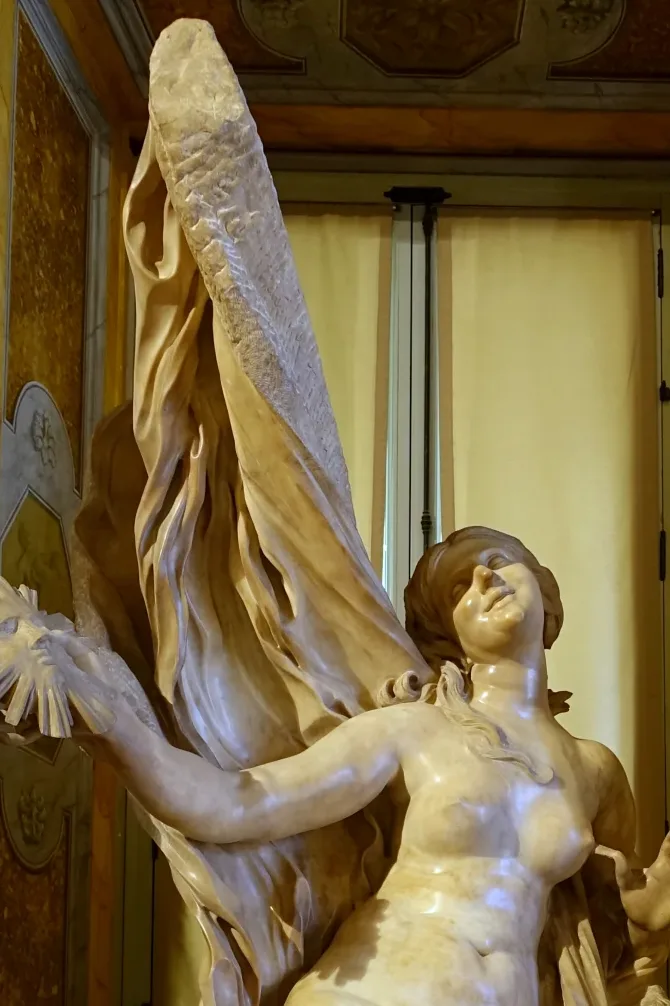
The bell tower that Bernini had begun to raise on the façade of St Peter's was pulled down in 1646 on the orders of the new pope, Innocent X. It was Urban VIII who had ordered it built, but cracks spread across the façade, work was stopped in 1642, and in 1644 Urban died, leaving Bernini without a patron. Baldinucci, a biographer partial to Bernini, writes that the chief accuser at the inquiry was his rival, the architect Francesco Borromini. In that same year, 1646, Bernini began to carve at his own expense, from a single block of Carrara marble, a figure of Truth whose veil is being pulled away by Time.
Truth sits on a rock, naked, her head thrown back, smiling broadly, almost laughing. In her outstretched right hand she holds a sun with a human face, her left foot rests on a globe, and behind her the veil flies upward as though someone were pulling it from above. Time, a winged old man, was to have hovered over her, but he was never carved. At the top the veil ends in a rough square projection of marble with the marks of a claw chisel, at the point where Time's hand was meant to hold it. In Paris in 1665 Bernini told the French courtier Paul Fréart de Chantelou that he was making this statue to leave to his family, that Time was not yet finished, and that in the model he was held up by columns, obelisks and mausoleums, “even though he has wings”, and he laughed as he said it.
Two years after the tower came down Bernini was already at work on the Fountain of the Four Rivers for the same Innocent X, commissions followed one after another, and he never went back to the figure of Time. The block set aside for that figure lay by his house until the sculptor's death, and then his heirs sold it. Bernini left the Truth to his eldest heirs in the male line and forbade them to sell it. In 1846 his descendant Prospero Bernini set the statue on a new base with a Latin inscription saying that Bernini, “once wounded by slander, carved it as a consolation for his pain”.
According to a genealogical study of the family, the entail on the statue ended around 1841, and after Prospero's death in 1858 the statue passed through his adopted daughter to other families, so that by the 20th century “Bernini's heirs” were no longer his direct descendants in the male line. In 1924 they deposited the statue with the Galleria Borghese, and according to the museum's English-language record it was put in the storerooms. In 1958 the State bought it.
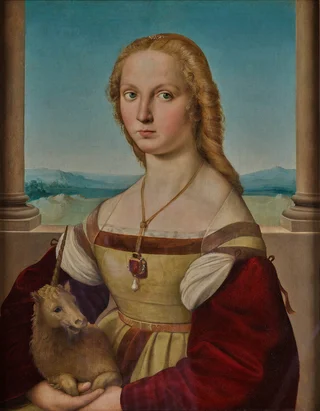
18. Young Woman with Unicorn — Raphael
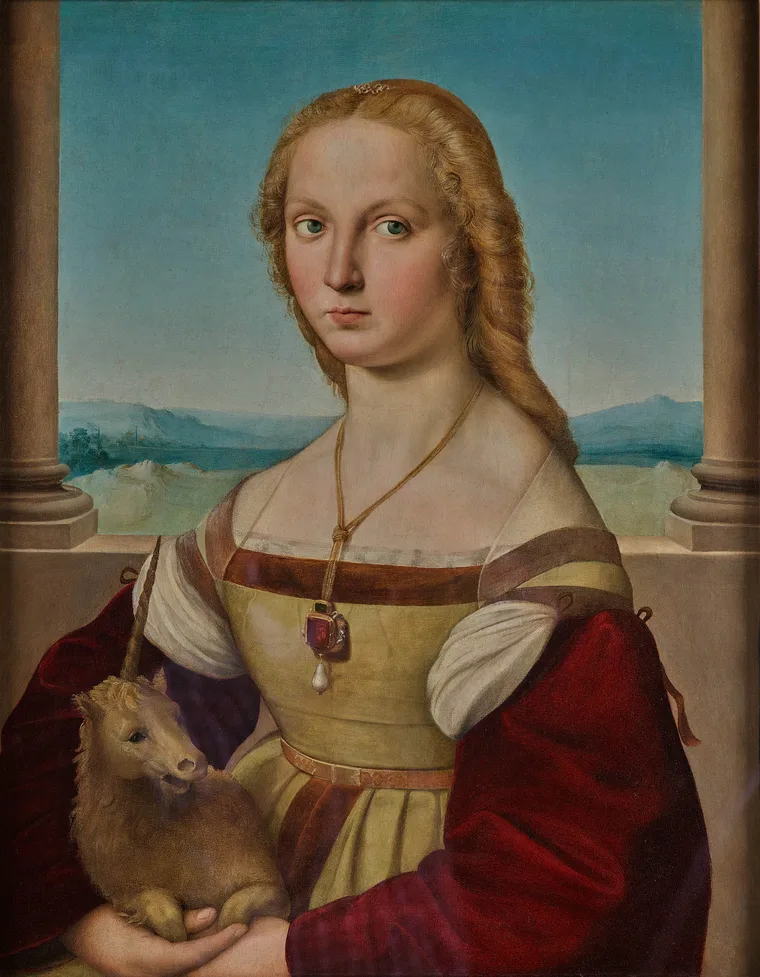
In the inventory of 1833 the picture is listed as “a portrait representing Saint Catherine with the wheel, school of Perugino”. Someone had painted the martyr's attributes over the portrait, a spiked wheel in place of the unicorn and a heavy cloak over the shoulders. In 1927 Roberto Longhi made out Raphael beneath this overpainting. In 1933 the gallery's director, Achille Bertini Calosso, had X-rays taken, and they showed a figure under the overpaint. In 1934–1936 the restorer Augusto Cecconi Principe transferred the paint layer from the decayed panel to canvas and removed the later painting with a scalpel. The wheel and the cloak came away, and a unicorn appeared in the woman's lap. Because of the transfer to canvas, the weave of the fabric shows in the sky and on the face.
In 1959–1960 X-rays taken by the Central Institute for Restoration showed that a dog lay under the unicorn. The dog stood for fidelity and the unicorn for chastity, and both suit the portrait of a bride or a young wife. Scholars have not settled who painted the unicorn over the dog, Raphael himself or another artist. The identity of the sitter is disputed too. Proposals have included Maddalena Strozzi, wife of the Florentine Agnolo Doni, Giulia Farnese, because the unicorn was a Farnese emblem, and Caterina Gonzaga di Montevecchio. A minority of scholars, beginning with Sydney Freedberg and Luitpold Dussler, give the painting to Ridolfo del Ghirlandaio.
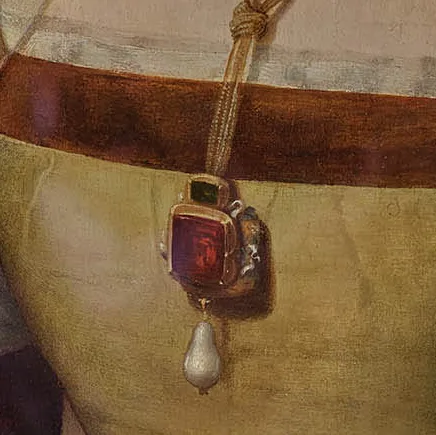
Raphael took the composition from the Mona Lisa, which Leonardo was painting in Florence in those years. The woman sits in a loggia between two columns, beyond a low parapet a landscape opens out with a lake and blue hills, and a small golden unicorn the size of a lapdog lies in her arms. The pendant is the most precisely painted detail in the portrait: from a fine gold chain tied in a loose knot hang a square ruby in a gold setting and a large irregular pearl.
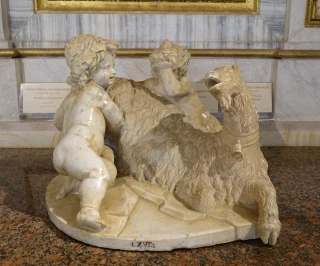
19. The Goat Amalthea with the Infant Jupiter and a Faun — attributed to Gian Lorenzo Bernini
In 1675 Sandrart named as Bernini's first famous work “a group in white marble in which two Bacchic infants drink the milk of a recumbent goat”. He had lived in Rome at the end of the 1620s and was writing from memory almost half a century later, without saying where the group was. In 1926 Longhi connected his words with a small marble group in the Borghese collection, and almost everyone agreed with him, from Rudolf Wittkower to Anna Coliva, who later ran the gallery for many years. Irving Lavin even dated the group to around 1609, when Bernini was about ten.
Before Longhi the group had no author. Scipione already owned it by August 1615, when the carver Giovan Battista Soria was paid for a walnut base for it. Giacomo Manilli described it in 1650 without naming a sculptor, and the 1796 catalogue of the villa's sculptures called it an anonymous work of the 16th century.
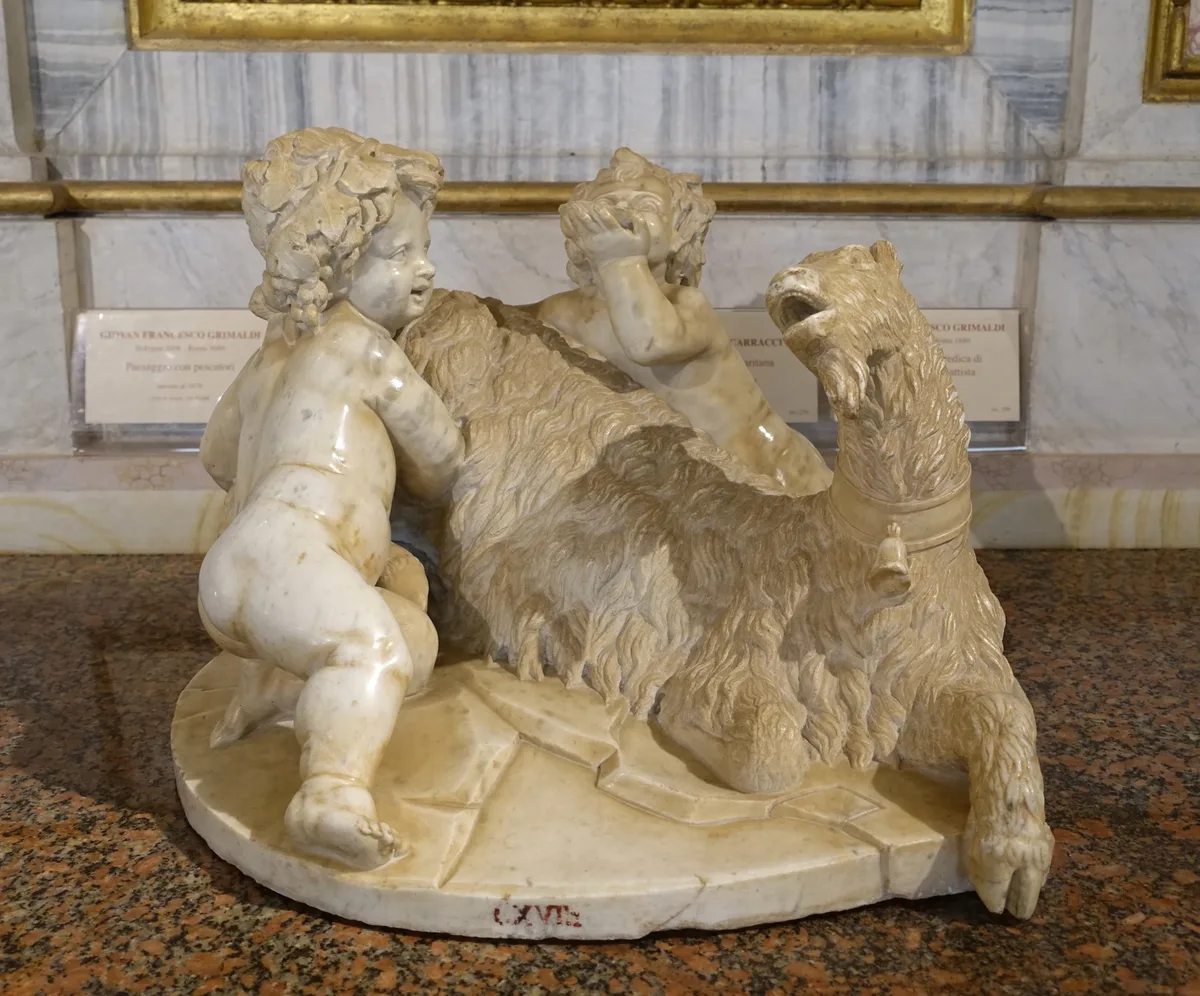
The goat lies with its legs folded under it, its head turned and its mouth open so that the teeth show, and it wears a collar with a little bell. Jupiter, crowned with vine leaves, kneels at its side with his back to the viewer and milks it, while a small faun peers out from behind the goat's back and drinks milk from a bowl. The goat's coat is cut in long wavy grooves, and the children's bodies are polished to a shine.
In 2022 a new catalogue of the gallery's sculpture, edited by Coliva, was published, and it gives the group to an “unknown sculptor”. Coliva pointed out that both of Bernini's early biographers are silent about it, that the goat's horns and the faun's tail were carved separately and fixed on metal pins, that the whole surface was worked with a flat chisel alone, without the claw chisel that Bernini used from the very start, and that the leaves are flat and the faces rigid. In 2023 the historians Maria Grazia Bernardini and Francesco Petrucci disputed this, and on the museum's website, in an entry of 2024, the group is still listed as “attributed to Bernini”. Coliva acknowledged that she herself had once taken these flaws for the inexperience of the young Bernini.
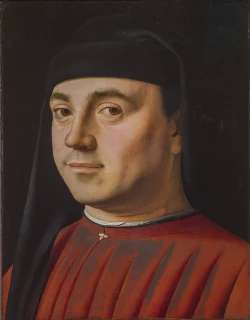
20. Portrait of a Man — Antonello da Messina
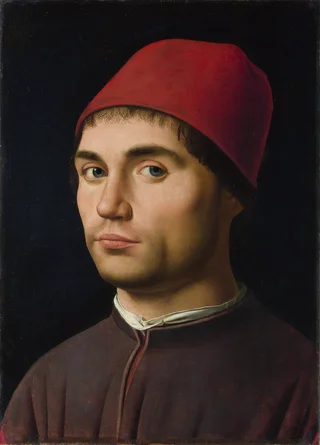
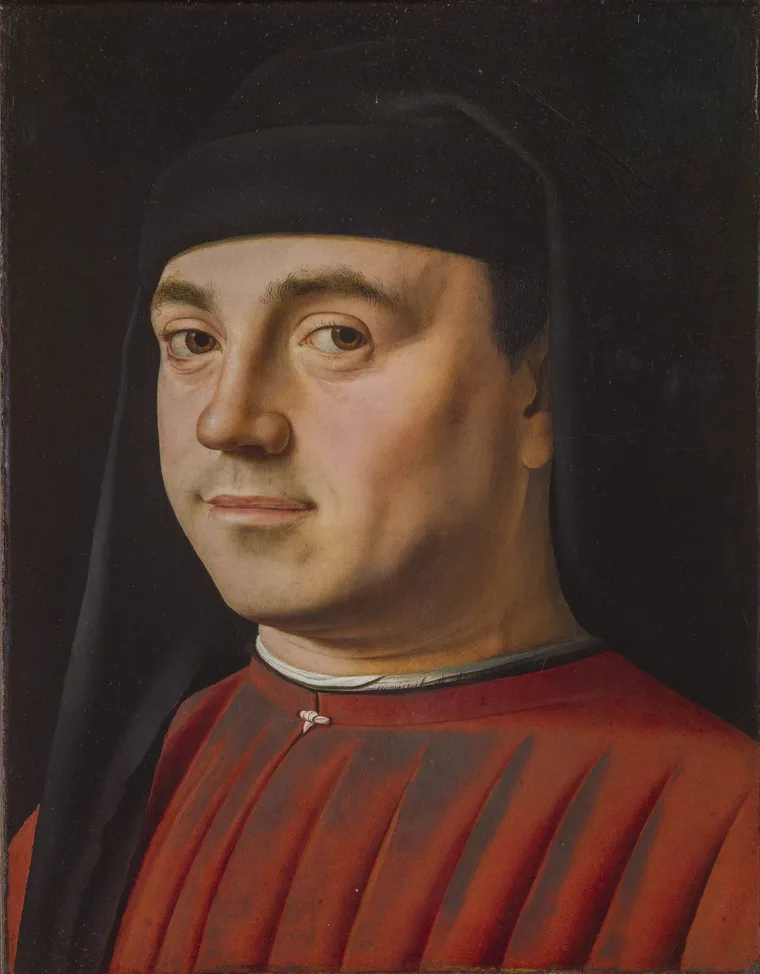
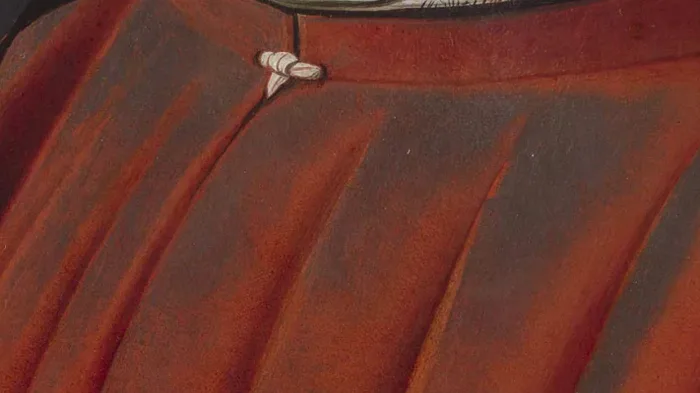
The man in the black cap and red garment has turned to the left, while his eyes glance sideways to the right, at the viewer, and the corners of his mouth are slightly raised. The stubble on his upper lip and chin is painted in the tiniest dots, the eyebrows hair by hair. On the crests of the red folds there are grey, smoky patches. Antonello laid the highlights on the garment in cinnabar, which has darkened over time, and before the restoration of 2002 these areas looked greenish.
Around 1790 the portrait was entered in the Borghese inventory as a work by Giovanni Bellini. In 1869 the German connoisseur Otto Mündler, in the second edition of Jacob Burckhardt's guide to the art of Italy, gave it to Antonello da Messina and also suggested that it was a self-portrait, though the museum considers the guess unfounded. Antonello, a Sicilian, lived in Venice in 1475–1476 and painted portraits of merchants and well-to-do citizens there, and the museum dates this portrait to about 1476. The red garment and the black cap with a long end falling to the shoulder were the dress of Venetian patricians. Scholars have never established how the portrait came to the Borghese before 1790.
In 1871 the art historians Joseph Crowe and Giovanni Battista Cavalcaselle identified it with the portrait of Michele Vianello that the Venetian connoisseur Marcantonio Michiel saw in a Venetian house in 1532, “dressed in pink, with a black hood on his head”. The portraits Michiel described were signed and dated, whereas this one bears no signature, and Crowe and Cavalcaselle concluded that the panel had been cut down. On all four sides, however, the paint stops just short of the edge of the panel in an even, untouched border, and on the evidence of that border Paola della Pergola showed that nobody had cut the panel.
Scipione Borghese gathered paintings and statues for this house with the help of papal power, money and sometimes outright pressure. Two centuries later his descendants sold Napoleon nearly seven hundred ancient statues, busts and reliefs, and in 1901 the State bought the remaining collection and the villa itself from the family. The Borghese Gladiator and the Sleeping Hermaphroditus, sold in 1807, have remained in the Louvre. The paintings by Caravaggio, Raphael and Titian and Bernini's great groups have remained at the Villa Borghese.
What Else to See
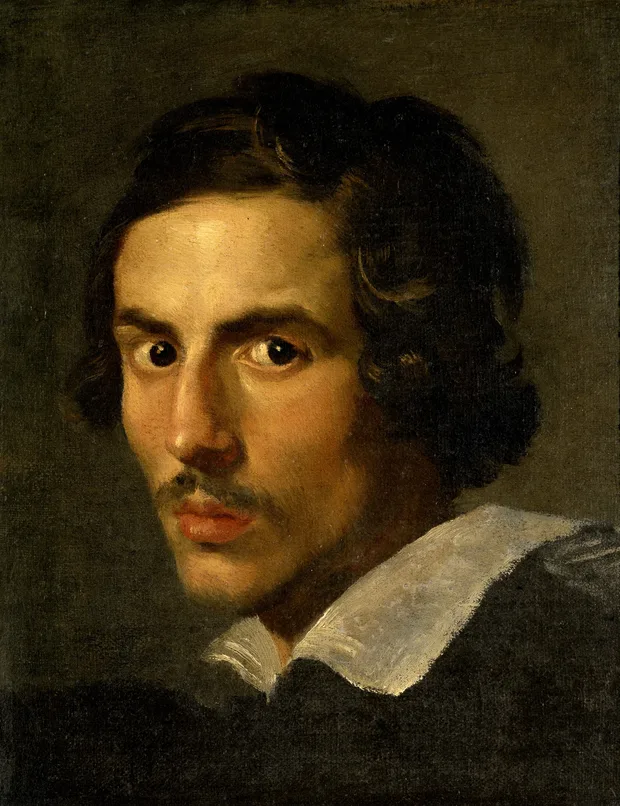
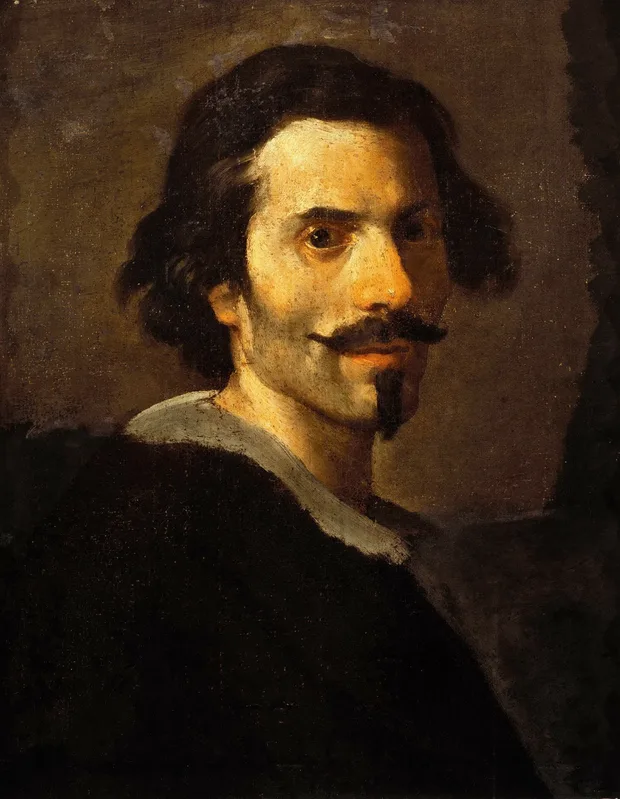
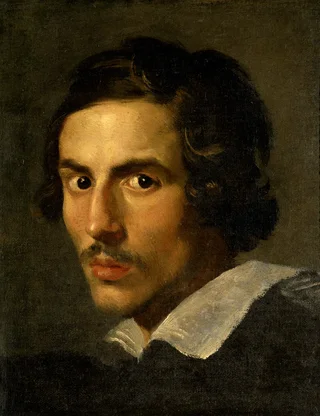
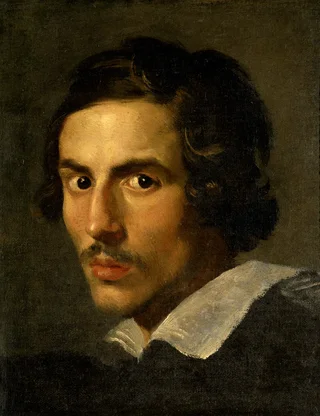
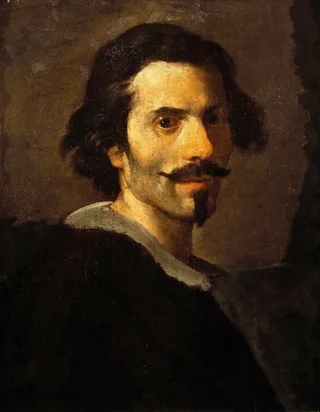
Among the works left out of these 20 are Titian's late Venus Blindfolding Cupid, Caravaggio's Saint Jerome, Lucas Cranach the Elder's Venus and Cupid with a Honeycomb and Dosso Dossi's Melissa. The two painted self-portraits of the young Bernini are also worth seeking out. One was given to the gallery by Baron Messinger in 1911, and the other was bought by the State in 1919 as a work by Andrea Sacchi.