Andreas Pavias
1440–1512 · Republic of Venice · Cretan school, Icon painting
The story
Most of what is known about Andreas Pavias comes from notaries. He worked in Candia, the Venetian name for the capital of Crete, the city Greeks called Chandax. In a Venetian town every agreement went into a notary's book, and his name runs through those books from 1470 on. In a deed of 1480 he signs as a witness, magister Andrea Pavia, penctor — master Andreas Pavias, painter.
Many of the entries are apprenticeships. In 1482 he undertook to train a boy for five years, and that pupil, Angelos Pitzamanos, became a painter himself. In 1499 he took on a Jewish pupil, contracted to teach him painting and letters. In 1504 he bought a warehouse and promised his stepdaughter a heavy dowry. By 1512 the papers name Marieta, his widow.
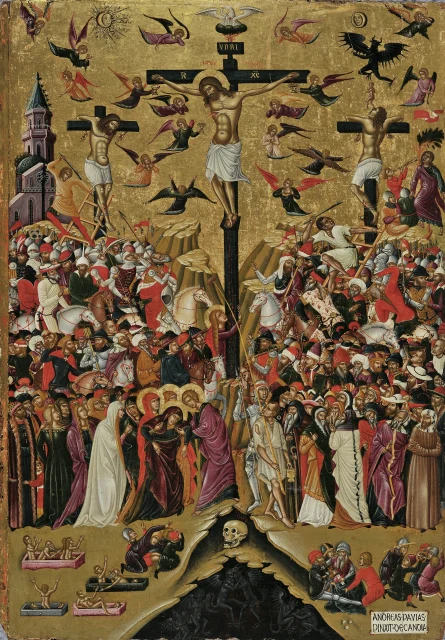
Seven panels survive, most of them signed. He served Orthodox and Catholic customers out of the same workshop, which was ordinary on Venetian Crete. A Pietà he painted for a Catholic bishop is now in Rossano in southern Italy, and the Crucifixion in Athens, egg tempera on a wooden panel 83 by 59 centimetres, is packed with small figures.