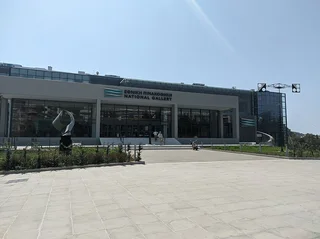
When the first public picture gallery opened in Athens in 1878, it held 117 paintings, most of them by foreign artists. The National Gallery was founded only by a law of 10 April 1900, and a year later it received the collection of Alexandros Soutsos, who had left his fortune for a “Museum of Painting”. In 1954 the Soutsos foundation was merged with the gallery, and his name became part of its full title.
Greek painters of the 19th century learned their trade in Munich, because King Otto of Greece was a Bavarian, and almost all of them went through the Munich Academy. Some came home and taught in Athens, others stayed in Germany and painted the Greek village from memory. First on this list is a Cretan who left for Venice, then for Toledo, and never went home, and last is a picture painted around 1925 in the courtyard of an island house, in the heat of summer.
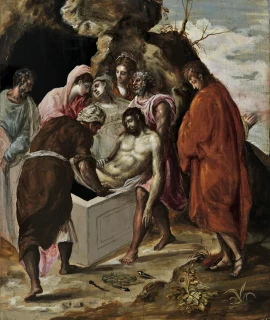
1. The Entombment of Christ — El Greco
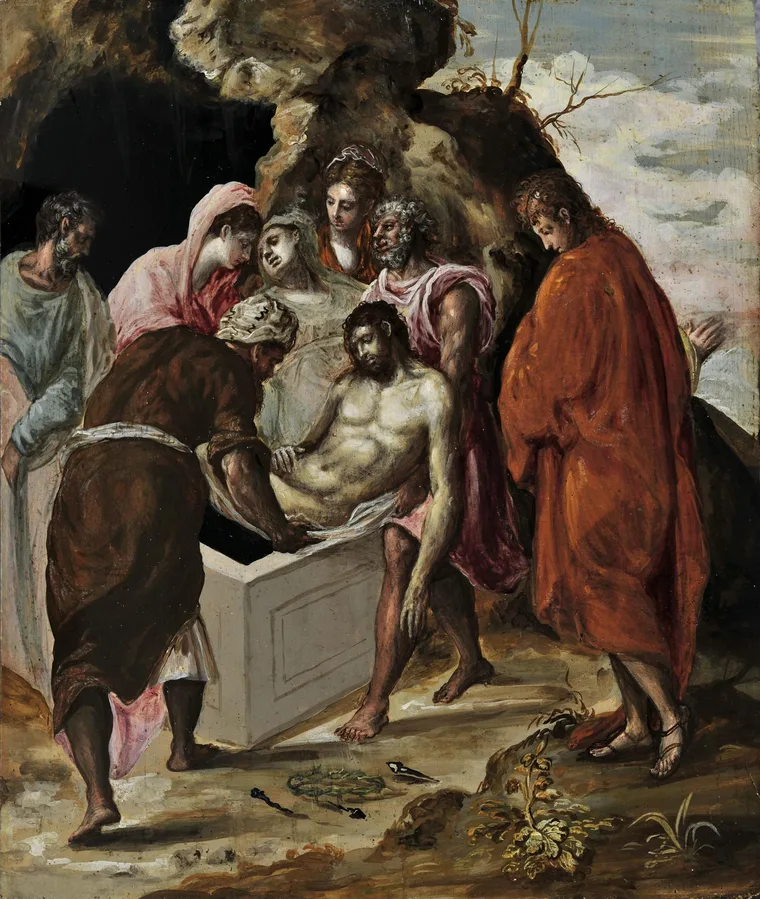
In December 1566 an icon of the Passion of Christ on a gold ground, painted in Candia by the young Domenikos Theotokopoulos, was valued and sold for 70 gold ducats. Candia, today's Heraklion, was the chief city of Crete, the island then belonged to Venice, and, as the National Gallery writes in its 2014 catalogue, that was roughly what a picture by Titian or Tintoretto cost in Venice. The icon itself is lost. Soon afterwards the painter left for Venice, moved to Rome in 1570 and from there to Spain, where he was nicknamed El Greco, “the Greek”. He died in Toledo in 1614 without ever returning to Crete, and all his life he signed his name in Greek letters.
Like its painter, The Entombment had never been in Greece until it was bought. Its history was pieced together by Michalis Doulgeridis, head of the gallery's conservation department. The back of the panel bears the arms of the Ledesma de la Fuente family, made counts by the King of Spain in 1710. Later the panel was in a Mexican collection and then with a 19th-century French collector, though Doulgeridis does not say when or how it changed hands. In January 1995 it was sold at Christie's in New York, soon afterwards it was with the London dealer Derek Johns, and around 2000 the gallery bought it, for $700,000 according to Doulgeridis. The money came from a nationwide public appeal, contributions from state companies, the Onassis Foundation and the gallery's own funds.
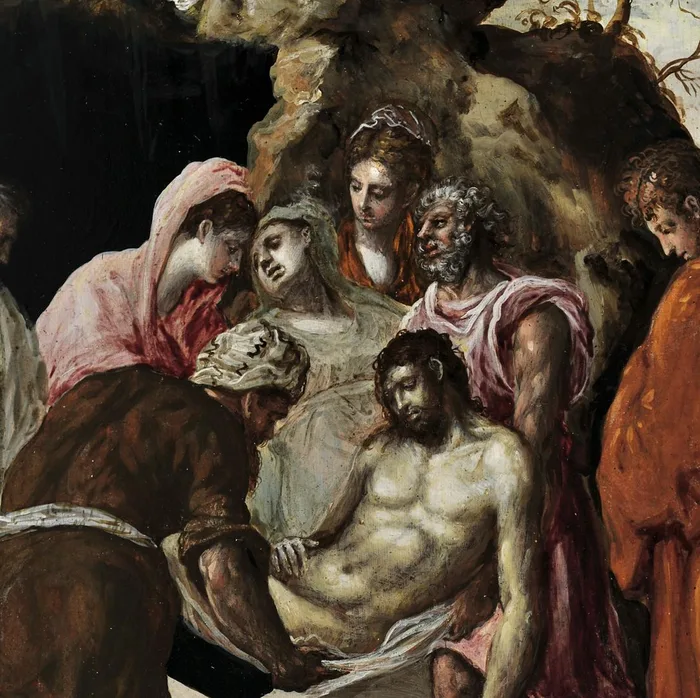
The gallery dates the panel to about 1568–1570, the painter's Venetian years. All that is left of icon painting in it, the museum writes, is the wooden support and the egg tempera, and he mixed the tempera with oil, as the Venetians did. He assembled the composition from two engravings, Parmigianino's Descent from the Cross and Battista Franco's Entombment. The white stone sarcophagus is set at a slant, one corner towards the viewer, to lead the eye into depth. Christ sits on its edge, pale and heavy, his head fallen on his shoulder, his eyes closed, his left arm hanging and one bare foot on the ground. On the left a man in brown with a white cloth on his head bends with his back to us and pulls the shroud over the edge of the tomb. Behind the body, among the women, the Virgin in a grey-green veil has thrown her head back, and the museum says she is fainting. On the ground in front of the sarcophagus lie the crown of thorns and three dark nails.
On the right, a little apart from the others, a young man in a fiery orange cloak stands with his head bowed. He is Saint John the Evangelist, and he entered the composition later than the rest. The gallery's conservators examined the panel in infrared and found that the painter had finished the first stage of the work and only then decided to add John. Doulgeridis notes that this figure appears in none of the known engravings El Greco worked from.
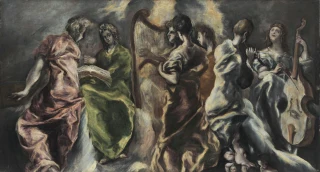
2. The Concert of the Angels — El Greco
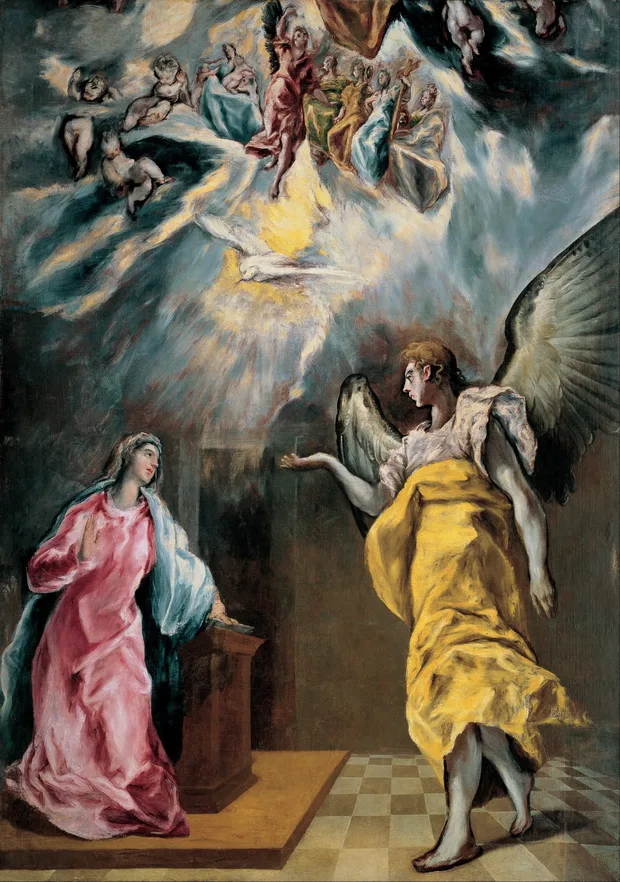
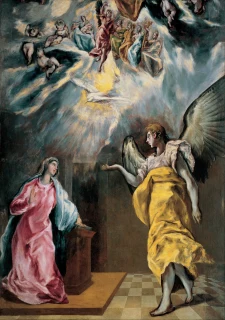
The Concert of the Angels was once the upper part of an Annunciation. In 1608 El Greco was commissioned to paint the altarpieces for the church of the Hospital de Tavera in Toledo, the Annunciation was meant for the right-hand side altar, and when the painter died in 1614 the pictures for the hospital were still unfinished. The canvas was apparently cut in two at the end of the 19th century. The lower part, with the Virgin and the archangel Gabriel, is in Madrid, in the collection of Banco Santander, and the sky above them went to Athens.
The Hungarian collector and dealer Marczell Nemes was one of the men who rediscovered El Greco at the beginning of the 20th century and bought his pictures in Spain. He died in 1930, and in June 1931 his collection was sold at auction in Munich. There the Greek state bought the long strip of canvas with the angel musicians for 5,900,775 drachmas, and the gallery calls it the most important purchase of the years when the writer Zacharias Papantoniou was its director.
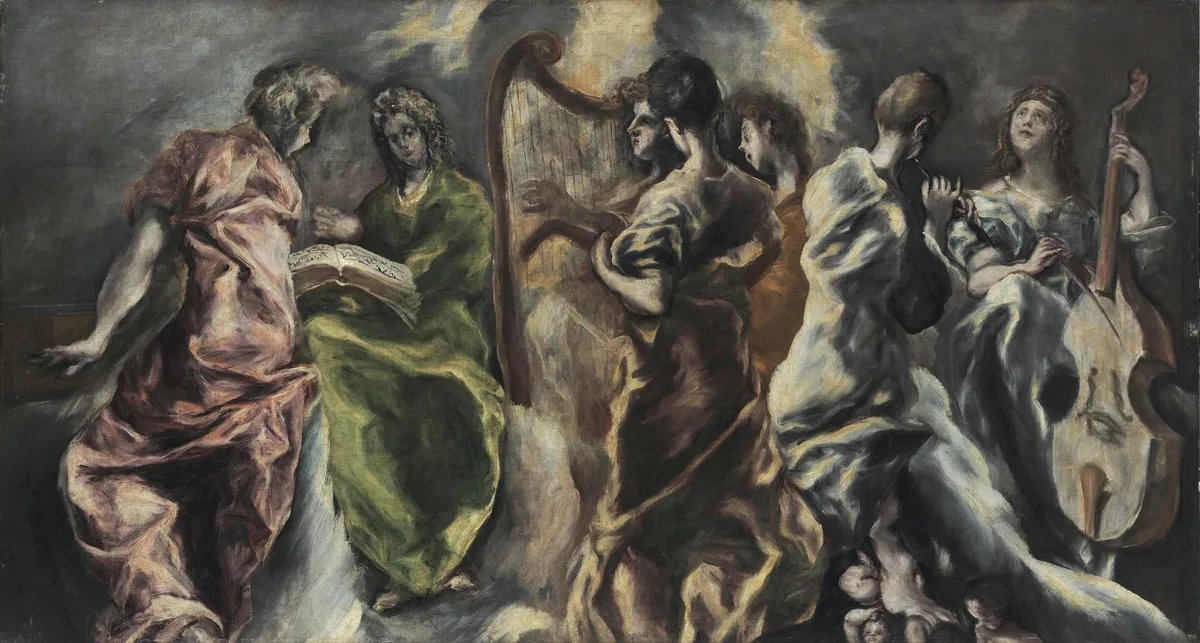
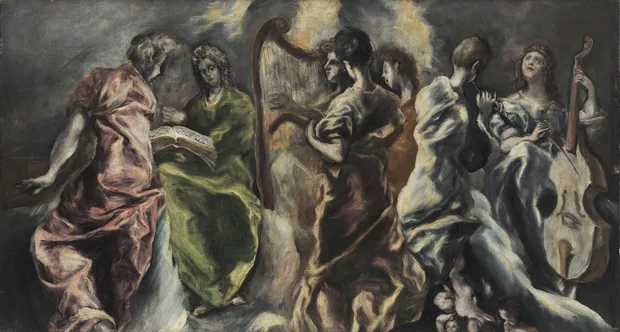
The angels have no wings, and the museum makes a point of it. They stand and sit on clouds against a dark grey-green sky, and the museum lists their instruments as a spinet, a harp, a flute and a viola da gamba. The spinet seems to be cut off almost entirely by the left edge, and all that shows of it is a dark wooden lid on which the angel at the far left, in rose-mauve, rests a hand. Next to it a curly-haired angel in yellow-green holds an open music book with square notes, in the centre rises a tall harp, further right an angel in silvery white, his back to us, raises a flute to his lips, and at the right edge an angel in pale blue looks upwards and holds a viol whose light body fills the lower right corner. The robes are painted in long streaks of light, and the colour changes within a single fold, from pink to white, from green to yellow. The museum considers the canvas unfinished. Small naked putti tumble in the clouds below, and the bottom edge of the canvas runs straight through them, where the strip was cut from the Annunciation.
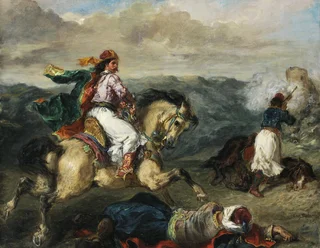
3. Episode from the Greek War of Independence — Eugène Delacroix
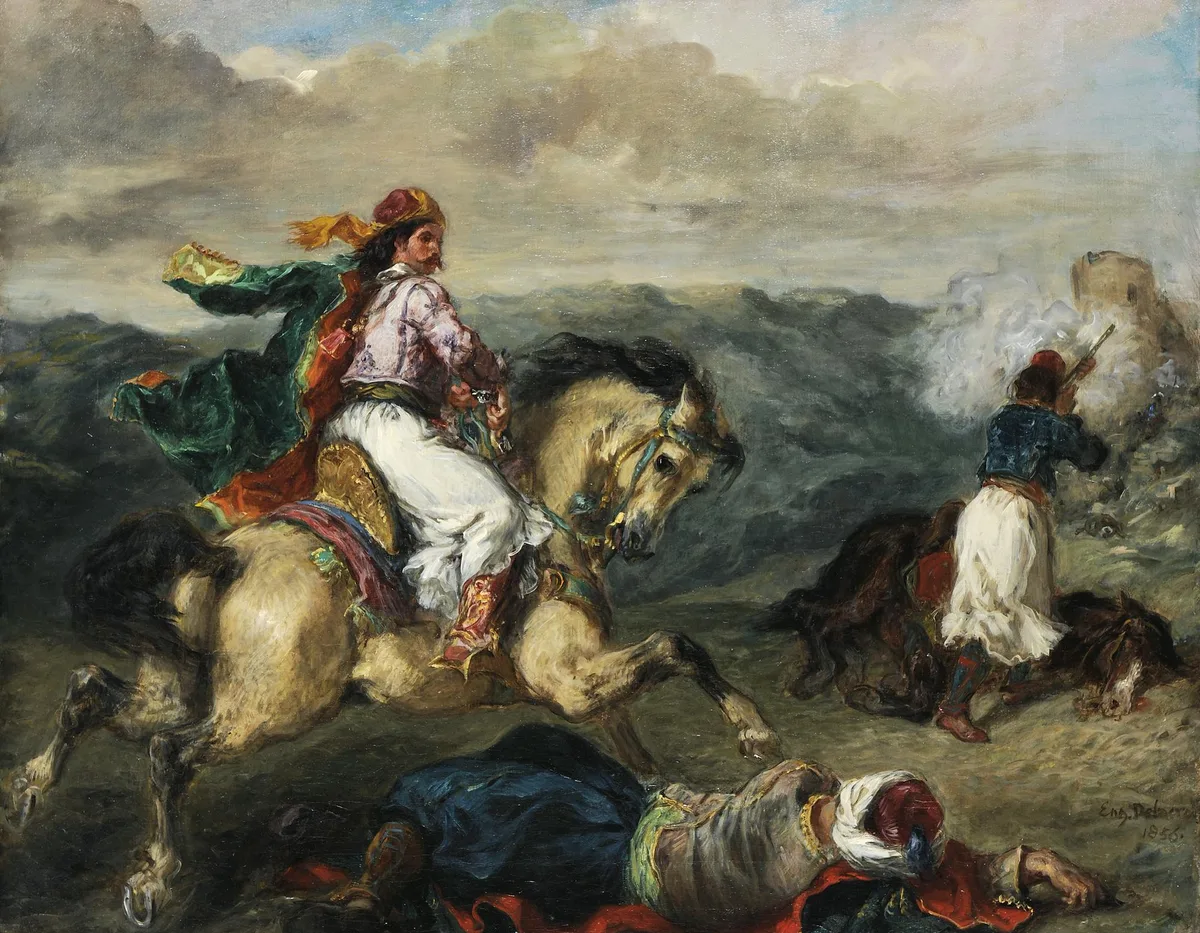
A Greek insurgent in a white foustanella gallops on a pale cream horse, and the horse, in mid-leap, has tucked up its forelegs. The rider wears a red cap wound with a yellow scarf, the ends of the scarf and a green cloak lined with red stream out behind him, and in the hand that holds the reins is a small weapon with a silver grip, apparently a pistol. Under the hooves, along the bottom edge of the canvas, a dead Turk in a white turban lies face down. On the right a Greek on foot, his back to us, fires a long gun towards a ruined round tower wrapped in white powder smoke, and two dead horses lie on the ground nearby. The museum calls the picture “antiheroic, antiepic” and sees the rider as the embodiment of an ideal.
Delacroix made his name in the 1820s with Greek subjects. He showed The Massacre at Chios at the Salon of 1824 and painted Greece on the Ruins of Missolonghi in 1826. The Greek uprising was then one of the prominent themes of artistic and public life in Paris. He never went to Greece. He painted this canvas in 1856, 30 years after the war, as an established master, and in the same year he painted a similar one, with a Greek horseman and a Turk surrendering, which is now in the Harvard Art Museums. The signature and date are in the lower right corner, “Eug. Delacroix / 1856”.
In 1978 the picture came up at auction in Paris, and the Greek state bought it with help from the shipowners Vassilis Goulandris and Stavros Niarchos. The Greek broadcaster ERT reported at the time that the price was about 3.7 million francs and that the actor Alain Delon was among the rival bidders.
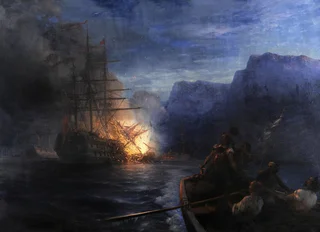
4. The Burning of the Turkish Flagship by Kanaris — Ivan Aivazovsky
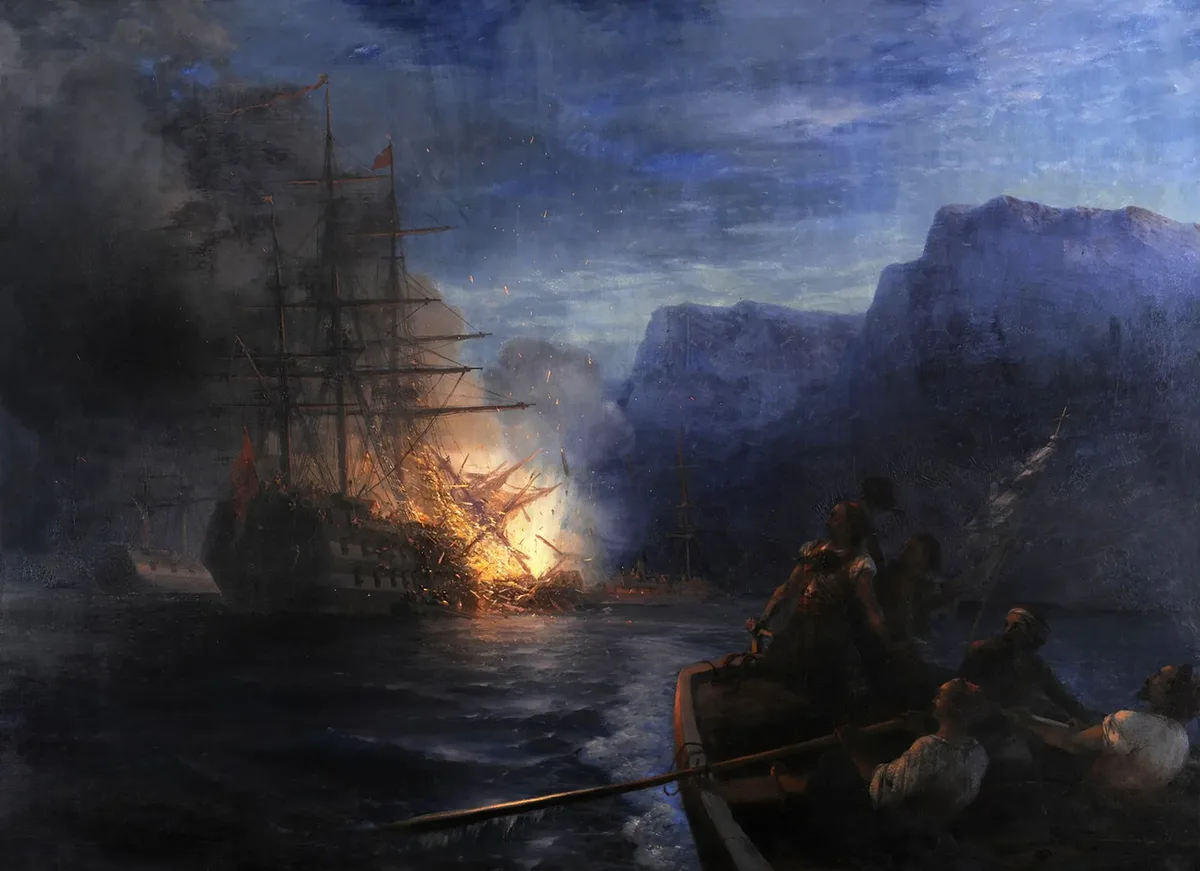
In the spring of 1822 Turkish troops massacred the people of Chios, the massacre Delacroix painted two years later, and in June the Turkish fleet lay off the island celebrating Bayram, the end of Ramadan. On the night of 18 to 19 June two Greek fireships, vessels packed with combustibles, approached the fleet. Konstantinos Kanaris from the island of Psara grappled his fireship to the flagship of the Kapudan Pasha Nasuhzade Ali Pasha, commander of the Ottoman fleet, set it alight and got away in a boat. The fire reached the powder magazine and the ship blew up. By the usual count about 2,000 people died, and the Kapudan Pasha was mortally wounded and died ashore. Kanaris later became an admiral, served several times as prime minister and died in 1877.
Aivazovsky painted that night in 1881, 59 years later. In 1822 he was five years old and living in Feodosia. His sky, sea and rocks are a cold blue-violet, and only left of centre does a yellow-orange flame burn. The three-masted ship with red flags is turned stern towards the viewer, fire bursts from the bow together with splinters of timber, sparks fly higher than the spars, and the upper left corner is choked with black smoke. On the right, cut by the edges of the canvas, a boat pulls away with about six men in it. One of them stands, in a white shirt and a red sash, and looks up at the fire, and a golden path runs across the water from the blaze to the boat. The viewpoint is low, at the level of the oarsmen.
In the gallery's record the picture is listed as a gift of the Athens Polytechnic. From 1841 pictures belonging to the state were gathered there, and Aivazovsky's canvas probably came to the gallery in 1900, when the Polytechnic handed them over to the new museum. Researchers have not found out how the picture reached the Polytechnic itself. When Aivazovsky died in Feodosia in 1900, the unfinished Explosion of a Ship stood on his easel, and in it Kanaris is once again blowing up the Turkish flagship off Chios.
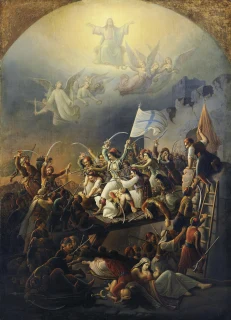
5. The Exodus from Missolonghi — Theodoros Vryzakis
Theodoros Vryzakis's father, Petros, was hanged by the Turks in 1821, the first year of the uprising, and the gallery opens its account of the painter by saying that he “was left an orphan in the War of Independence”. As a boy he lived in an orphanage on the island of Aegina, in 1832 he was taken to Munich, to a school for Greek orphans founded by King Ludwig I of Bavaria, and in 1844 he entered the Munich Academy. The gallery gives his year of birth two ways, 1814 or 1819. Vryzakis painted the war almost entirely in Bavaria, from memory, from prints and from the studies he made in Greece in 1848–1851.
Turkish and Egyptian troops besieged Missolonghi for a whole year. By the spring of 1826 the town was starving, and on the night of 22 to 23 April, the eve of Palm Sunday, the garrison and the townspeople together tried to break out. The Turks had learned of the plan in advance, and many died as they left the town.
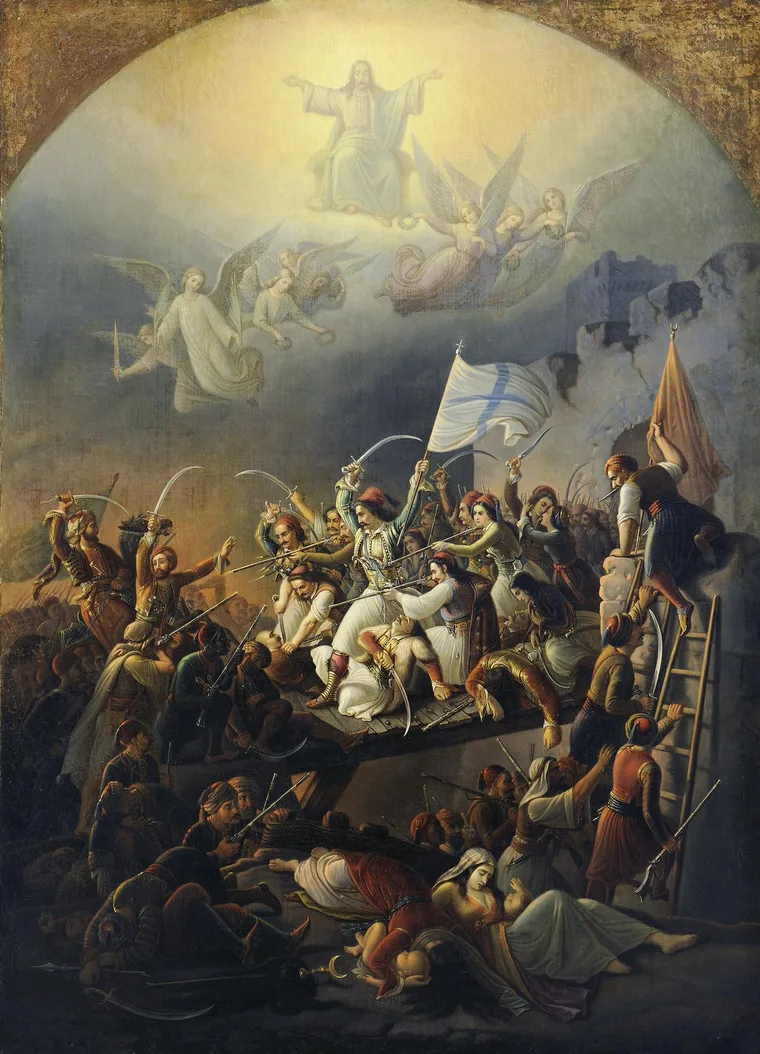
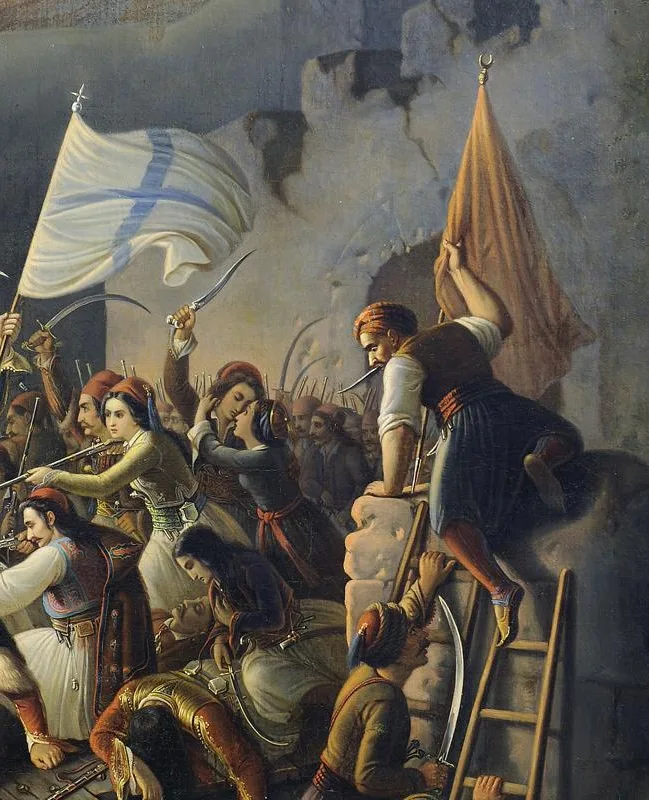
Vryzakis painted the Exodus in Munich in 1853, on a tall canvas with a rounded top, and divided it into two zones, heavenly and earthly. Above, Christ sits enthroned on a cloud with his arms spread wide, and around him are angels with laurel wreaths and palm branches. Below, fighters charge across a wooden bridge, and above their leader, who wears a white foustanella and raises a curved sabre, flies a white flag with a blue cross. Among the men a young woman in a red fez takes aim with a rifle, on the right a man with a knife between his teeth climbs over the wall holding a red banner with a crescent on its staff, and under the bridge lie fallen women and children, one mother clutching her baby. The museum writes that the composition unfolds vertically, without depth, and in its construction the picture is like an icon. According to the museum, it won a first prize in Vienna in 1853.
Vryzakis painted this subject three times, and only this canvas survives. According to Katerina Spetsieri-Beschi, who has studied his work, it was bought by King Ludwig I, then left the Munich collection, passed through private hands and ended up in the Greek embassy in Rome, where Spetsieri-Beschi found it in 1977. No document has been found showing when or how it was transferred to the gallery.
The other two versions, she also says, burned in 1929 when the town hall of Missolonghi was set on fire. The image survived, because in 1856 a lithograph had been made from this painting in Paris. After the fire the 23-year-old Angelos Kasolas painted a copy from the lithograph for Missolonghi, and every year that copy is carried through the town in procession as the Holy Icon of the Exodus.
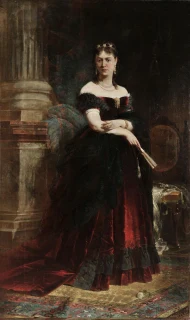
6. Portrait of Mrs Serpieri — Nikiforos Lytras
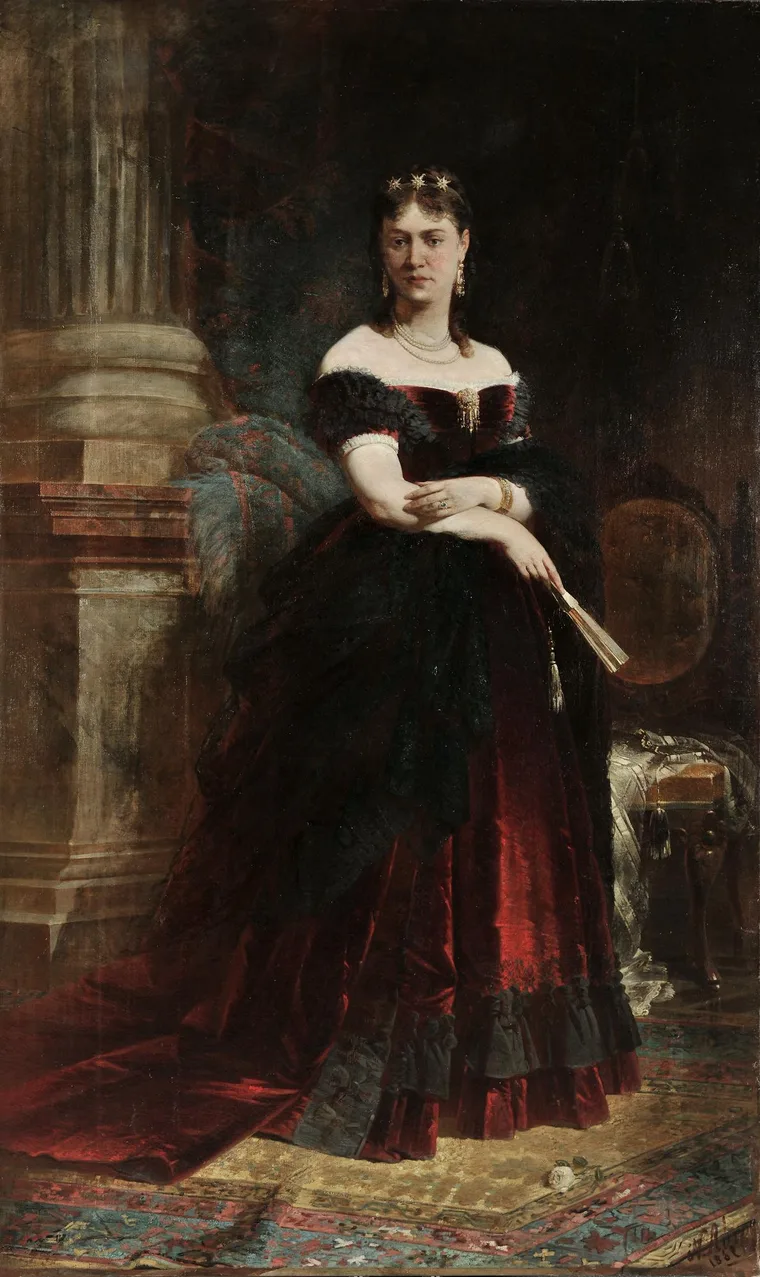
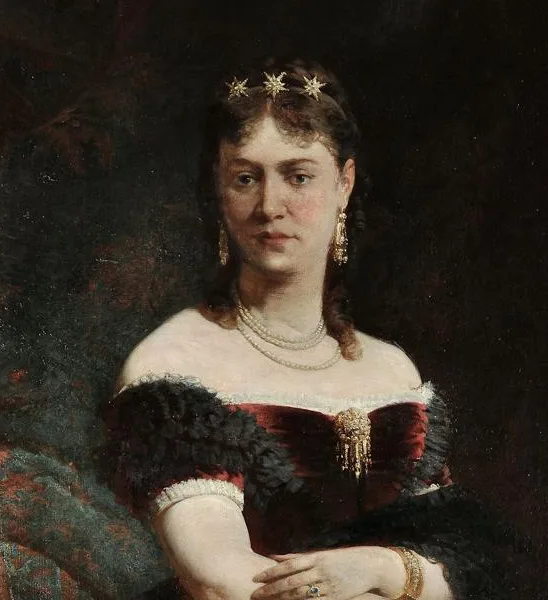
Clémence Serpieri stands full length and life-size on a canvas almost two and a half metres high. The 1869 portrait is the grandest Lytras painted. She wears a dark wine-coloured velvet dress that leaves her shoulders bare, the train spills into the lower left corner, the lit folds of the skirt glow bright red, and the rest of the velvet is almost black. A black lace shawl is draped over her arms, there are three small jewelled stars in her hair, a double string of pearls at her neck and a half-open fan in her lowered right hand. On the left rises a huge fluted column, as a formal portrait required, and on the oriental carpet by her hem lies a single white rose. She looks straight at the viewer, calmly and without a smile.
She was the wife of Giovanni Battista Serpieri, an Italian metallurgical engineer who in 1864, with partners from Marseille, founded a company to mine silver and lead at Lavrio, south of Athens. The company mostly re-smelted the slag left over from the ancient mines. In Athens Serpieri had a mansion on Panepistimiou Street, and the Italian and his French-named wife belonged to the top of the new Athenian society that Lytras painted.
Nikiforos Lytras was born in 1832 at Pyrgos on the island of Tinos, studied at the Athens School of Arts, and in 1860 went to Munich, where he trained at the academy under Karl von Piloty. In 1865 he returned to Athens, and from 1866 he taught painting at the same School of Arts and kept the post for almost 40 years, until his death in 1904. The gallery calls him the father of modern Greek painting. Among his pupils were Altamouras and Iakovidis, who come later in this list, and his son Nikos, also a painter, painted the last picture on it.
In the gallery's record the credit line reads “Donated by Ioannis V. Serpieris”, one of the family. In 2011 the portrait was shown at an exhibition of unknown treasures from the gallery's collections, and the gallery's director, Marina Lambraki-Plaka, chose it as the exhibition's main picture. The Greek magazine LiFO writes that the gilt frame was ordered from abroad and is so heavy that it took eight people to hang the picture.
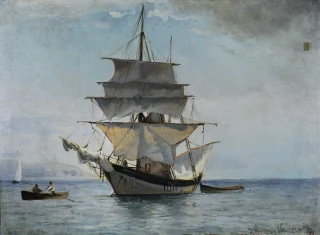
7. Caique at Spetses — Ioannis Altamouras
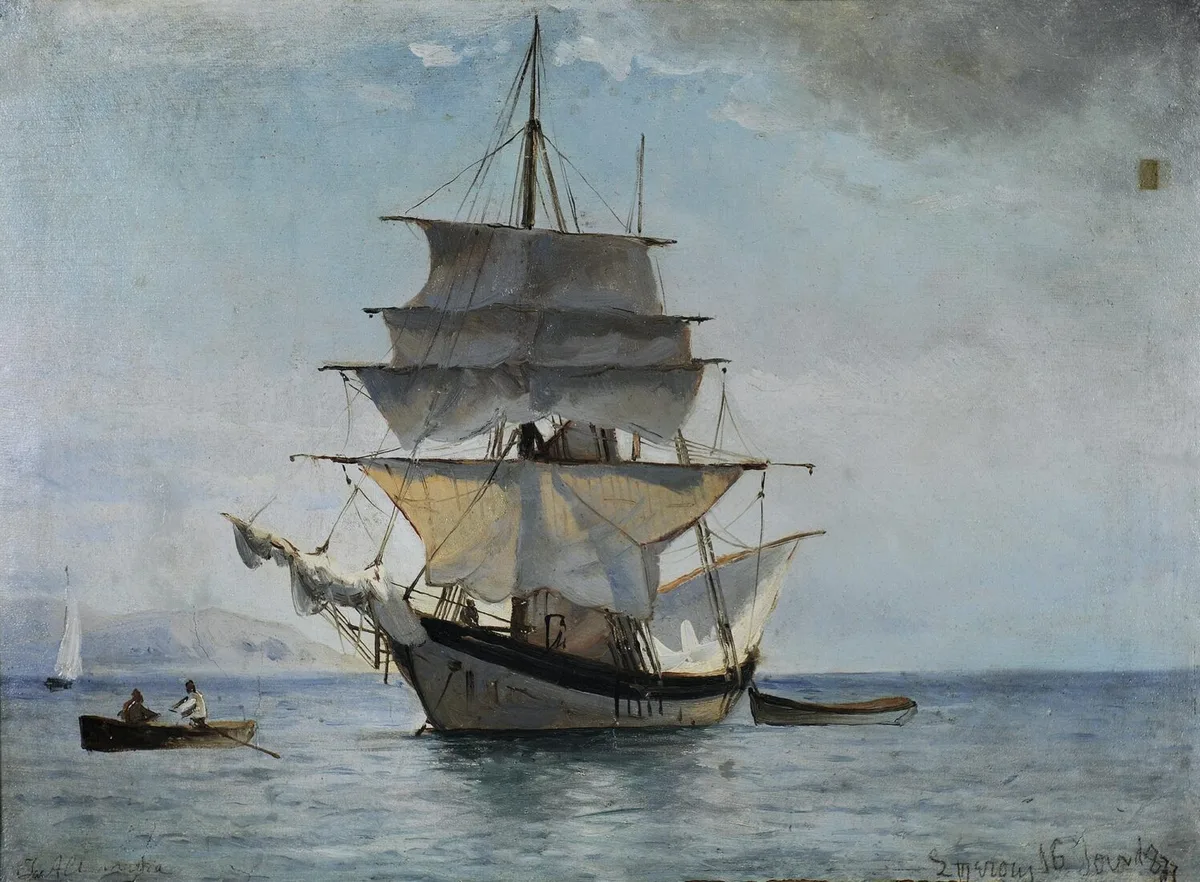
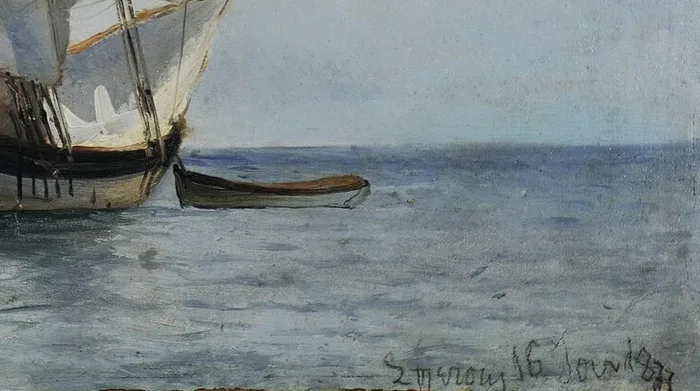
In the lower right corner of this small picture Ioannis Altamouras wrote in Greek the place and the day: Spetses, 16 June 1877. In the middle stands a square-rigged sailing ship, although in Greek a caique was any working sailing vessel. All the sails hang crumpled and slack, as in a calm, and only the lowest and largest catches a warm, creamy ochre light. The sea is flat and pale, two men sit in a dark boat by the hull, one of them, in a white shirt, at the oars, an empty dinghy lies on the water astern, and the weave of the canvas shows through the thin paint of the sky. Near the right edge, in the upper third, a small opaque olive-ochre rectangle lies over the sky. It is no part of the image and looks like later retouching or a filled loss.
Altamouras was born in 1852 in Italy, the son of the Neapolitan painter Francesco Saverio Altamura and a Greek woman, Eleni Boukoura, from a shipowning family of Spetses. His parents separated, and around 1857 his mother took the children to Athens. In 1871–1872 he studied in Nikiforos Lytras's class, and in 1873–1876 in Copenhagen, at the Royal Academy, under the marine painter Carl Frederik Sørensen, on a royal scholarship (according to the Benaki Museum it was granted by King George I, himself a Danish prince). In 1876 Altamouras came back ill with tuberculosis, settled on Spetses, his mother's home island, and painted ships there. He died on Spetses in 1878, at the age of 26.
His mother, Eleni Boukoura-Altamoura, is called the first Greek woman painter with an academic training, and she herself became an almost legendary figure. The story goes that women in Italy were not admitted to the study of painting, so she cut her hair and passed herself off as a man in order to study. The story became especially well known through Rhea Galanaki's novel Eleni, or Nobody, published in 1998. An exhibition at the Benaki Museum in Athens in 2011 showed her self-portrait in clothes that look like a monk's habit, with cropped hair and a wedding ring. Her daughter Sofia died in 1872 and her son in 1878, and another story has it that after their deaths Eleni burned her pictures. The curator of that exhibition, Eleni Kypraiou, takes a different view and believes that the pictures and papers were burned by relatives when they cleared the house on Spetses after Eleni's death in 1900.
8. Gathering the Nets — Konstantinos Volanakis
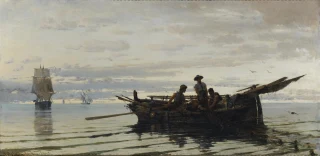
Marina Lambraki-Plaka, who headed the National Gallery, told the magazine LiFO that in 2002 the gallery bought this picture at a favourable price. Volanakis's usual buyers are Greek shipowners, and according to her they prefer pictures of ships and care less for fishermen in an old boat.
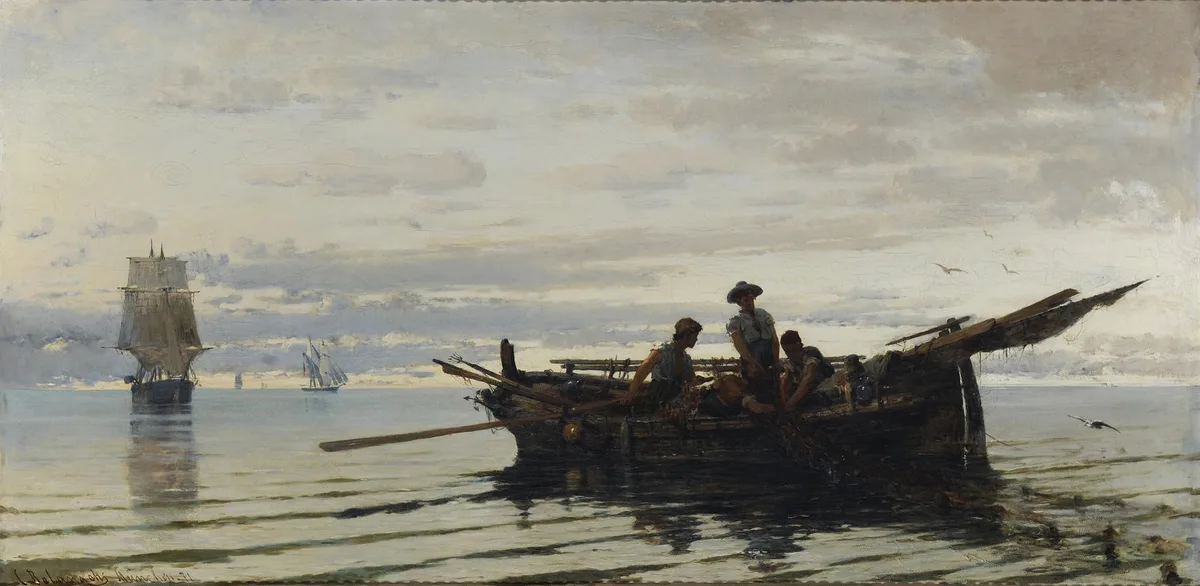
The boat sits right of centre, heavy and worn, and reads as an almost black silhouette, because the light comes from deep in the picture, from the horizon, where dawn is breaking over the sea. There are five men in the boat. A bare-armed fisherman bends over the net, another lies so low that only his head and back show, the head of the only man standing, in a wide-brimmed hat, comes just above the horizon line, a fourth leans over the side hauling in the net, and in the stern a small man in a cap sits behind a blue glass jug. A wet net hangs over the side, above the stern a yard with a torn sail juts up on a slant, and that diagonal is the strongest line in the picture. Off to the left stands a square-rigged ship, and the clouds are pearl-grey and cream, pale yellow at the horizon. In the lower left corner is the signature “C. Bolanachi München 71”, which means the picture was painted in Munich, far from any sea, in 1871.
Volanakis was born in 1837 in Heraklion on Crete and as a young man worked as a bookkeeper in Trieste, in the trading house of his brother-in-law Georgios Afentoulis. Greek newspapers retell the story of how Afentoulis found ships drawn in the account books and after that paid for his training. In 1864 Volanakis entered the Munich Academy under Piloty, a few years later he won an Austrian competition for a picture of the naval battle of Lissa, and that picture was bought by Emperor Franz Joseph. The gallery files Gathering the Nets under “The First Impressionist Signs” of Greek painting and counts it among his freest pictures. Volanakis returned to Greece only in 1883, settled in Piraeus and in 1895 opened his own school there.
9. The Betrothal of the Children — Nikolaos Gyzis
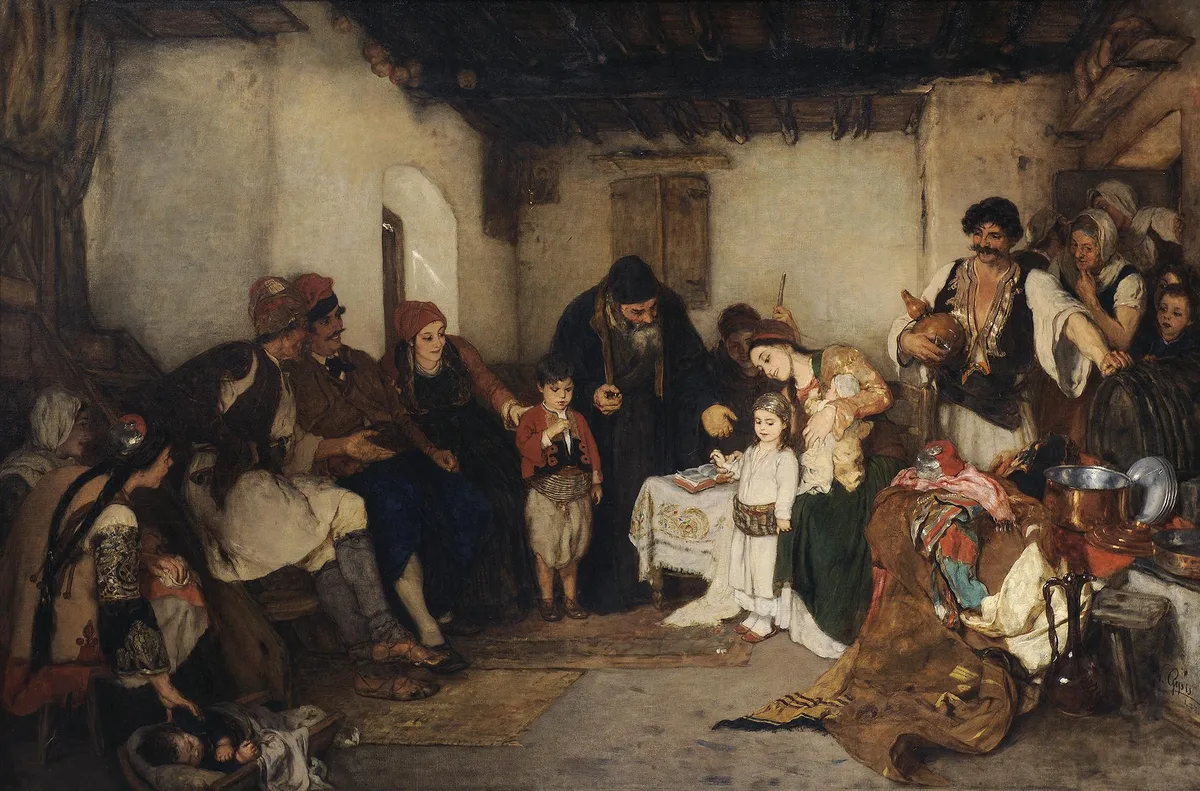
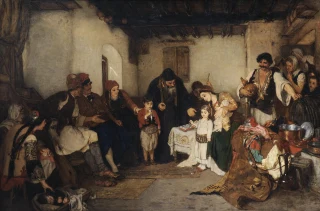
The village priest in his black cassock has already put the ring on the boy's finger and, as the museum describes it, holds out his open palm to the girl so that she will take hers. The boy, in a red jacket and white baggy trousers, looks in bewilderment at the hand he holds pressed to his chest, and the girl, all in white, in a little cap, has lowered her eyes and reaches towards an open book on a small table. The children stand in the middle of a low village room, and the adults sit and stand round them in a semicircle. On the right a moustached man roars with laughter, holding a round gourd flask which, the museum says, holds the wine for the toast. The men on the left exchange glances and grin, women in white headscarves crowd the doorway, and in the lower left corner a young woman in an embroidered sleeveless jacket bends over a cradle where a baby is asleep.
The museum explains the custom this way: children were betrothed early, perhaps to protect them from the devshirme, the levy in which the Ottoman authorities took Christian boys and raised them as janissaries and officials.
Nikolaos Gyzis was born in 1842 in the village of Sklavochori on Tinos, moved with his family to Athens at the age of eight and studied at the School of Arts. In 1865 he went to Munich on a scholarship from the foundation of the Evangelistria, the main pilgrimage church of Tinos, and from 1868 he studied under Piloty. In 1872 Gyzis came back to Greece for two years, and in 1873, with Nikiforos Lytras, whom the museum calls his friend, compatriot and teacher, he travelled to the East, to Asia Minor. In 1874 he settled in Munich for good, became a professor at the academy there and never went back to Greece. He painted The Betrothal of the Children in his Munich studio in 1877, from memory and from sketches made on that journey, and, as the gallery writes, there are two versions of the picture and both won awards.
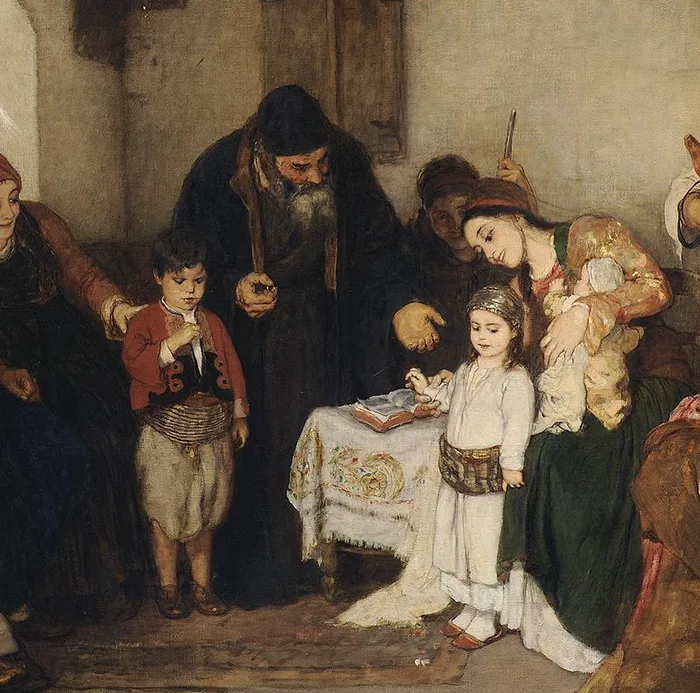
Light falls into the room from a deep white window on the left, and the brightest things in the picture are the girl's dress and the embroidered tablecloth. In the lower right corner Gyzis heaped up striped, red and golden fabrics, a copper cauldron, pewter plates and a red fez, and the museum explains the pile as his wish to show off textures, from shining copper to silk.
10. Behold the Bridegroom Arriving — Nikolaos Gyzis
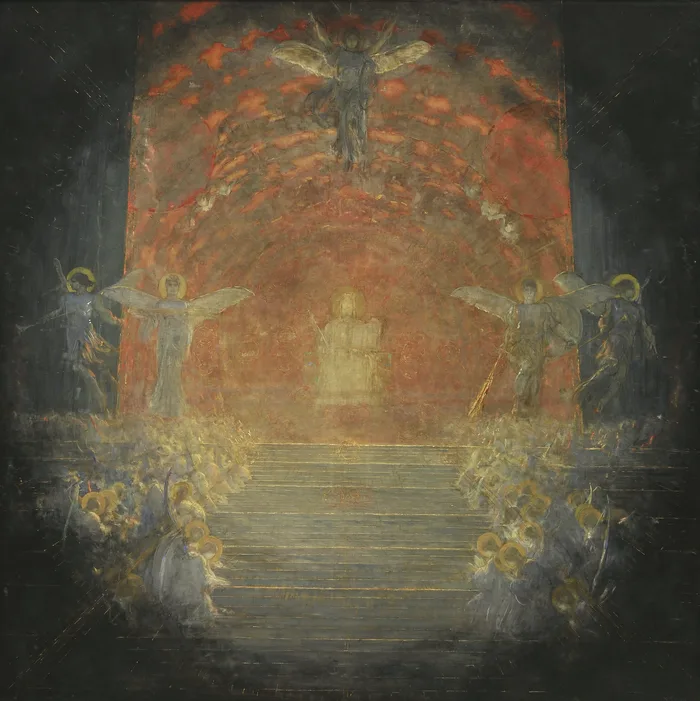
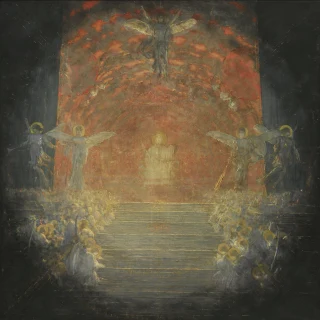
“Behold, the Bridegroom comes at midnight” is sung in Orthodox churches in the first days of Holy Week, and the words go back to the Gospel parable of the ten virgins. Gyzis took the troparion as the title of the last large picture he painted in Munich, in 1899–1900. Its subject, according to the museum, is the Second Coming as the Revelation of Saint John describes it, and in a letter quoted by the museum, Gyzis calls his Christ “a sweet god” who brings the world light, salvation and comfort.
The canvas is square, two metres high and two metres wide, and everything in it is built around a vertical axis. Between two broad blue-black bands rises a red-orange field, and at its centre a small, almost white Christ sits enthroned with a golden halo. Red and orange clouds spread round him in arcs, like a vault, a winged figure with raised arms hovers above him, angels stand on either side, and two of them are clearly holding trumpets. From below, a broad pale blue staircase ruled with thin gold lines climbs to the throne. The steps are empty, and on both sides of them small kneeling figures with golden haloes crowd together. Many of the figures are only outlined over a thin layer of paint, and the canvas shows through it.
Gyzis had conceived this composition long before, and already in a letter of 1894 he mentions his paradise, with Behold the Bridegroom in brackets, and hopes he will have the strength to paint it. In 1900 the picture was shown in Munich. It was part of a large religious cycle that Gyzis did not live to finish, and according to the scholar Spyros Petritakis he never painted its lower zone, with the Fall of Satan. Gyzis died in Munich in January 1901. Petritakis also writes that in 1910 the philosopher Rudolf Steiner devoted a whole lecture in Munich to this painting.
11. On the Terrace — Iakovos Rizos
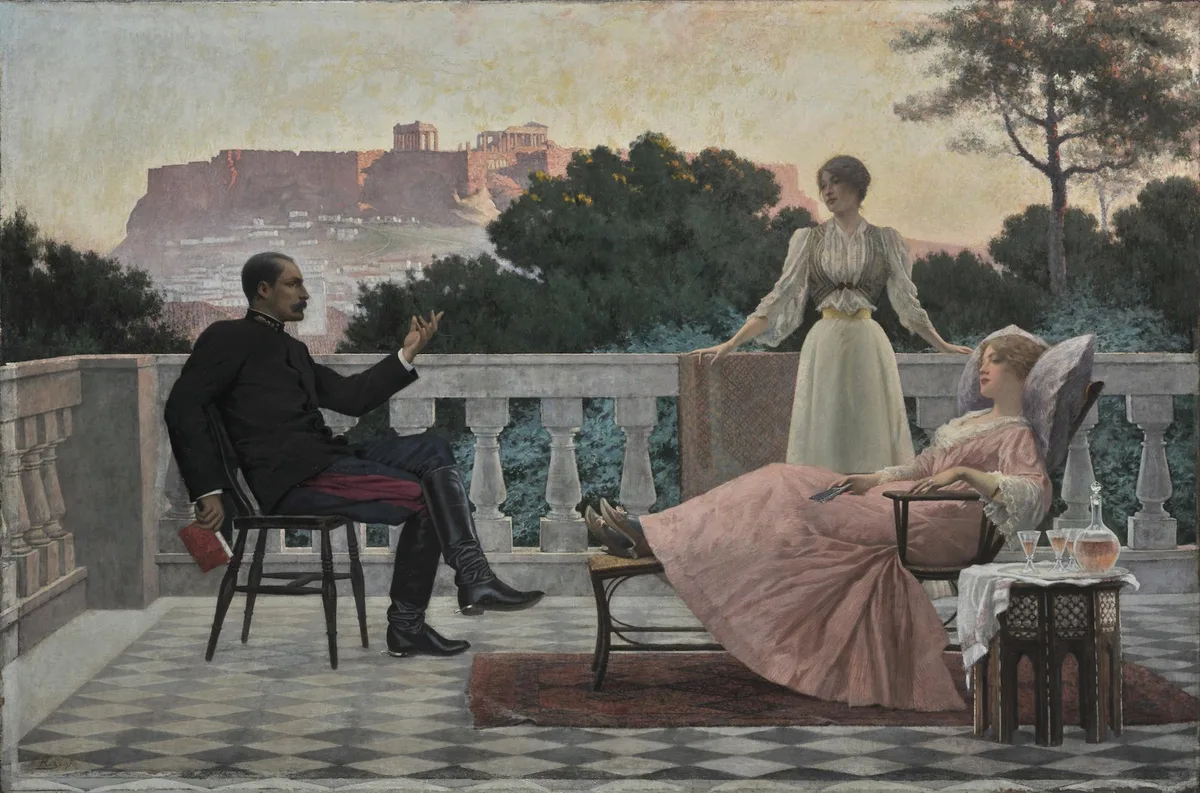
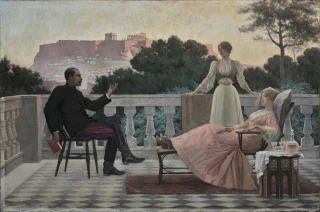
An officer sits in profile on a dark chair on a marble terrace, his legs crossed, in a black tunic with a stand-up collar, blue trousers with a broad crimson stripe and tall spurred boots. He has raised his right hand, palm open, in mid-sentence, and in his lowered left hand he holds a small red book, with a finger keeping his place. The museum calls him “a handsome Cavalry officer”. In 2023 the critic Christoforos Marinos, writing in LiFO, read the insignia on his collar, a flaming grenade and three stars, and concluded that he is a colonel of artillery. The picture was painted in 1897, the year Greece lost its war with Turkey within a month, and Marinos sees in it a scene in the shadow of that war, an officer at ease among ladies in the year of defeat.
Beside him are two young women. One, in a white blouse with puffed sleeves, leans with both hands on the balustrade, and the other, in a pink dress, reclines in a bentwood chair with her feet on a footstool. Marinos notes that their faces are very alike and allows that Rizos may have used a single model. On a table inlaid with mother-of-pearl on the right stand a carafe of rosé wine and three glasses, and far off on the left the Acropolis rises above the trees, pink in the evening light. The museum says this is the terrace of a neoclassical house in Plaka, the old quarter below the Acropolis, whereas Marinos considers the view invented.
According to Marinos, Rizos had lived in Paris since 1875 and put Athens together for this picture from memory and from albums of photographs. He studied under Alexandre Cabanel and painted elegant ladies in drawing rooms and gardens. The signature “Rizo 97” is at the lower left, on the floor tiles. At the Paris World's Fair of 1900 the picture won a silver medal, the artist later gave it to the gallery, and in 2021 the Louvre put it on the poster for its exhibition Paris–Athens. The Birth of Modern Greece, 1675–1919.
12. The Booty — Théodore Ralli
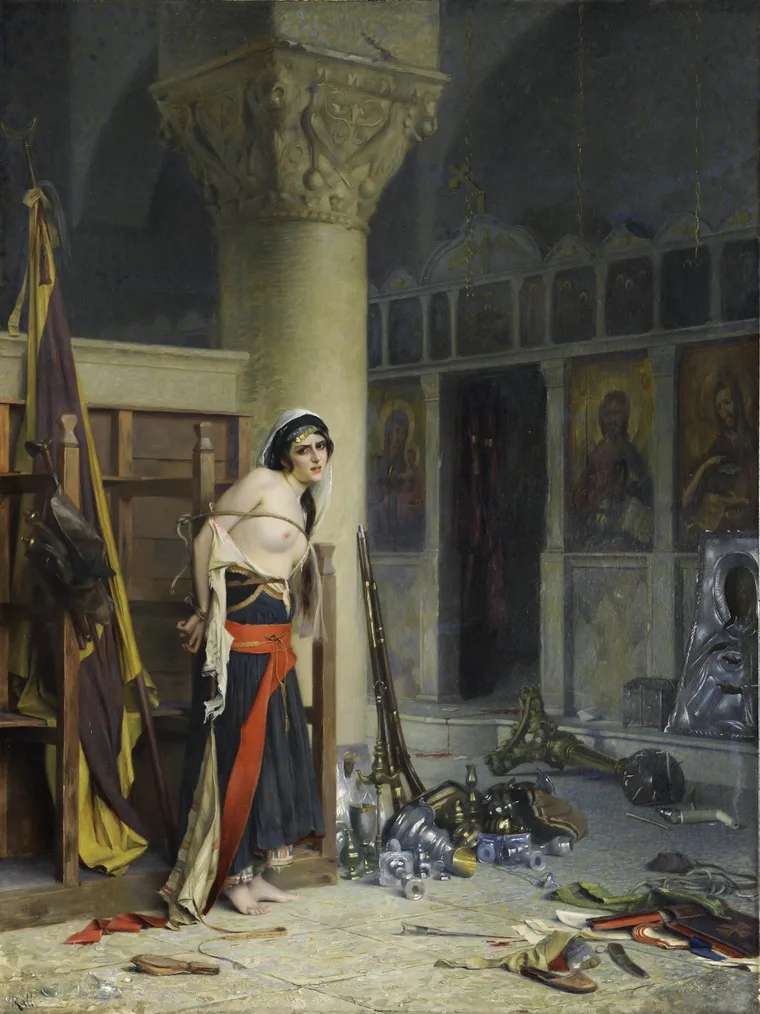
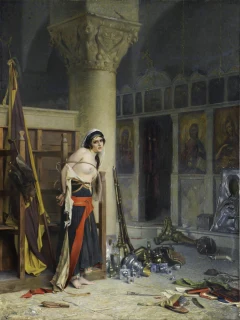
Théodore Ralli first painted this subject in 1885, and in that picture, now in a private collection, a captive Greek girl stands submissively among Turkish soldiers and their plunder. For the Paris Salon of 1906 he painted the scene again and took the soldiers out. The girl stands alone in a ransacked Orthodox church, barefoot, her blouse torn to the waist and her hands tied behind her back, and she looks straight at the viewer, brows drawn together, lips parted. She wears a white headscarf with a band of gold coins, a braid falls over her shoulder, and a wide red sash is wound round her waist.
Ralli was born in 1852 in Constantinople, into a merchant family from Chios, worked briefly in the family firm in London, then moved to Paris and studied under Jean-Léon Gérôme. From 1875 he showed at every Salon, until 1904 he spent his winters in Cairo, and he painted harems, captive women and Greek churches and sold the East to the Paris public. He died in 1909 in Lausanne. In the Salon catalogue The Booty was accompanied by French verses about a Greek girl in chains who sheds no tears among the trophies, defies the Turkish victor and will avenge her brothers. The picture belongs to the foundation of the businessman and collector Evripidis Koutlidis, and the gallery shows the foundation's collection together with its own under a long-term agreement.
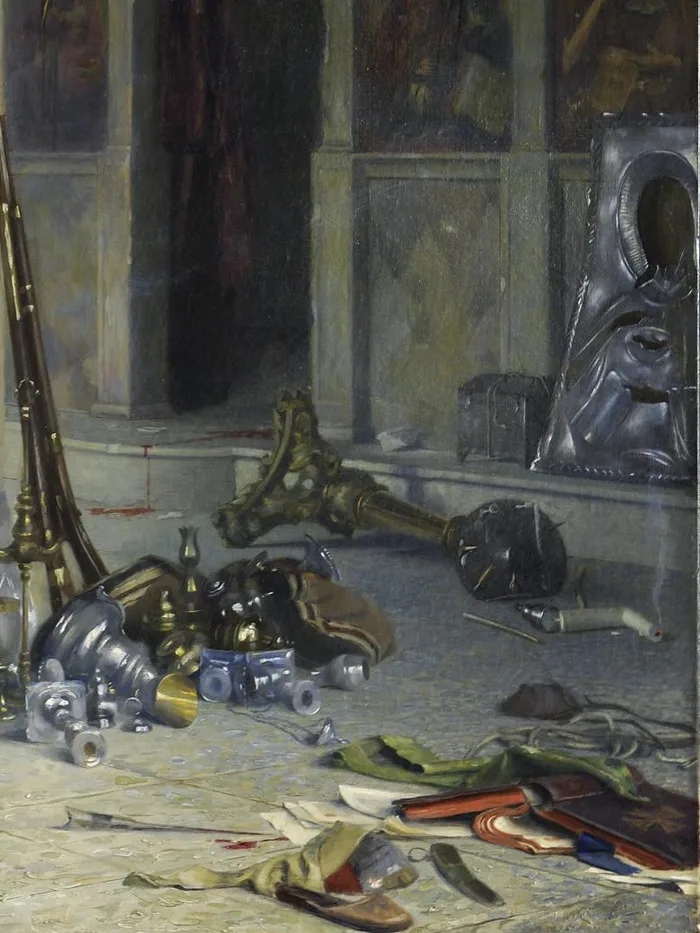
Church plate lies heaped on the floor, silver and gilt chalices, candlesticks and a hanging lamp, and across the altar step lies an overturned gilt candelabrum. Three empty chains hang from the ceiling, and Christoforos Marinos notes that lamps once hung from them. Under an icon of Saint John the Baptist leans an embossed silver icon cover with an empty cut-out where the face should be. At the lower right lies an open book with red edges, and beside it on the floor lies a white candle, a thin thread of smoke rising from its smouldering tip.
13. Children's Concert — Georgios Iakovidis
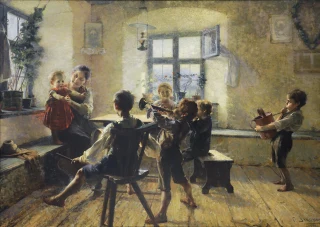
Four barefoot boys have set up an orchestra in a village room. One sits astride a chair with his back to us, holding a drumstick, a red-haired boy leans back and blows a brass trumpet, a small one behind him cups his hands round his mouth, and the fourth, in rags, stands to one side and blows into the long spout of a copper watering can, because, as the museum writes, he did not get a real instrument. Listening to them are a young mother on a bench, holding a little girl in a red dress who stretches both arms out towards the musicians, and a fair-haired older sister at the table. The museum calls the room a Bavarian village house.
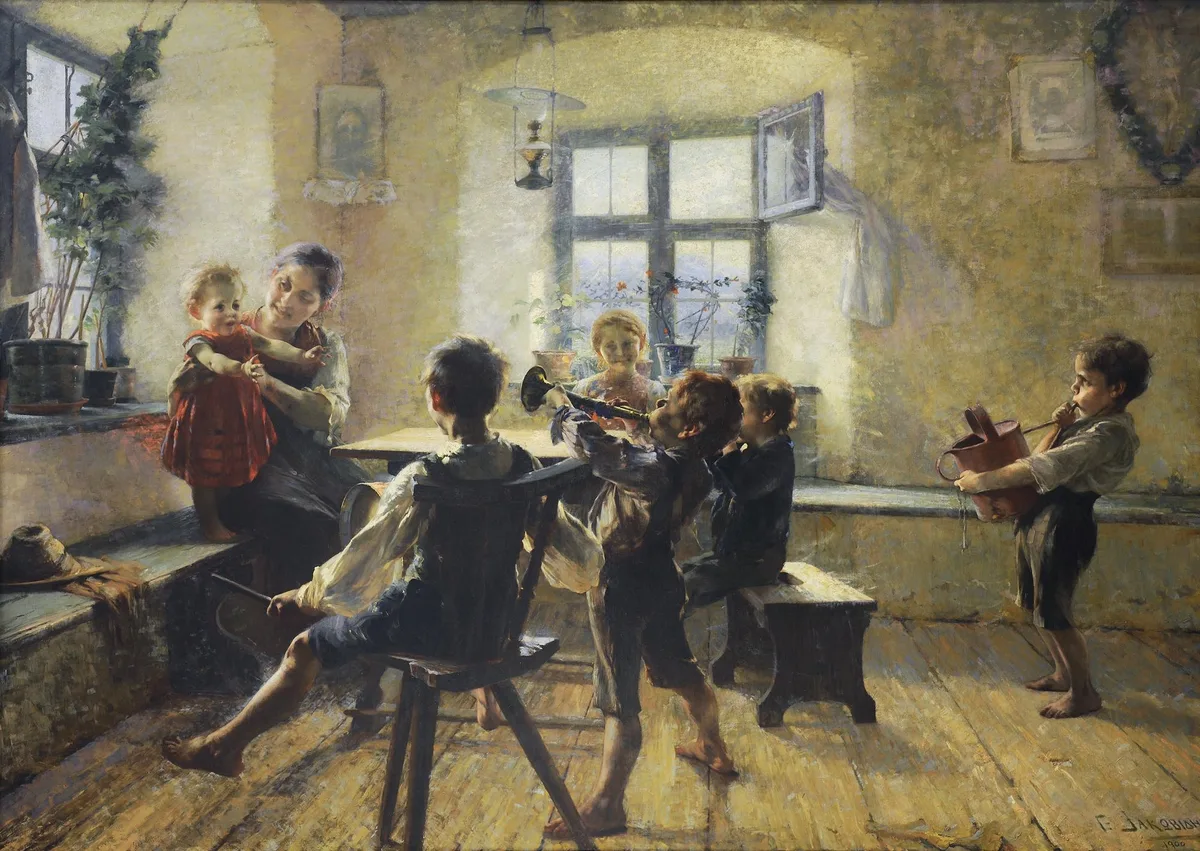
The light comes from two sides, from a window on the left overgrown with greenery and from a deep window in the centre, and the whole room is flooded with orange, with blue shadows. The white shirt of the boy at the drum glows right through. The museum counts the picture among Iakovidis's boldest and writes that here he came close to Impressionism. He painted this subject twice. The earlier, cooler version was shown in the 1890s, in Athens in 1896 among other places, and in it, judging by descriptions, the children's audience was a grandmother covering her ears. He painted the bright version for the Paris World's Fair of 1900, where it won a gold medal.
Iakovidis was born in 1853 on Lesbos, studied in Athens under Nikiforos Lytras and from 1877 at the Munich Academy, and lived in Munich for more than 20 years. In 1900, the year of the Paris medal, the Greek government called him home to set up the newly founded National Gallery. His title was ephor, that is, supervisor, and on 28 July 1900 the Polytechnic and the University of Athens handed over to him the 258 works with which the gallery began. He signed this picture at the lower right, on the floorboards, in Greek capitals, “Γ. ΙΑΚΩΒΙΔΗΣ” and the year, but shaped the first letter of the surname like a Latin J. In Munich he signed himself Jakobides.
14. Delphi — Konstantinos Maleas
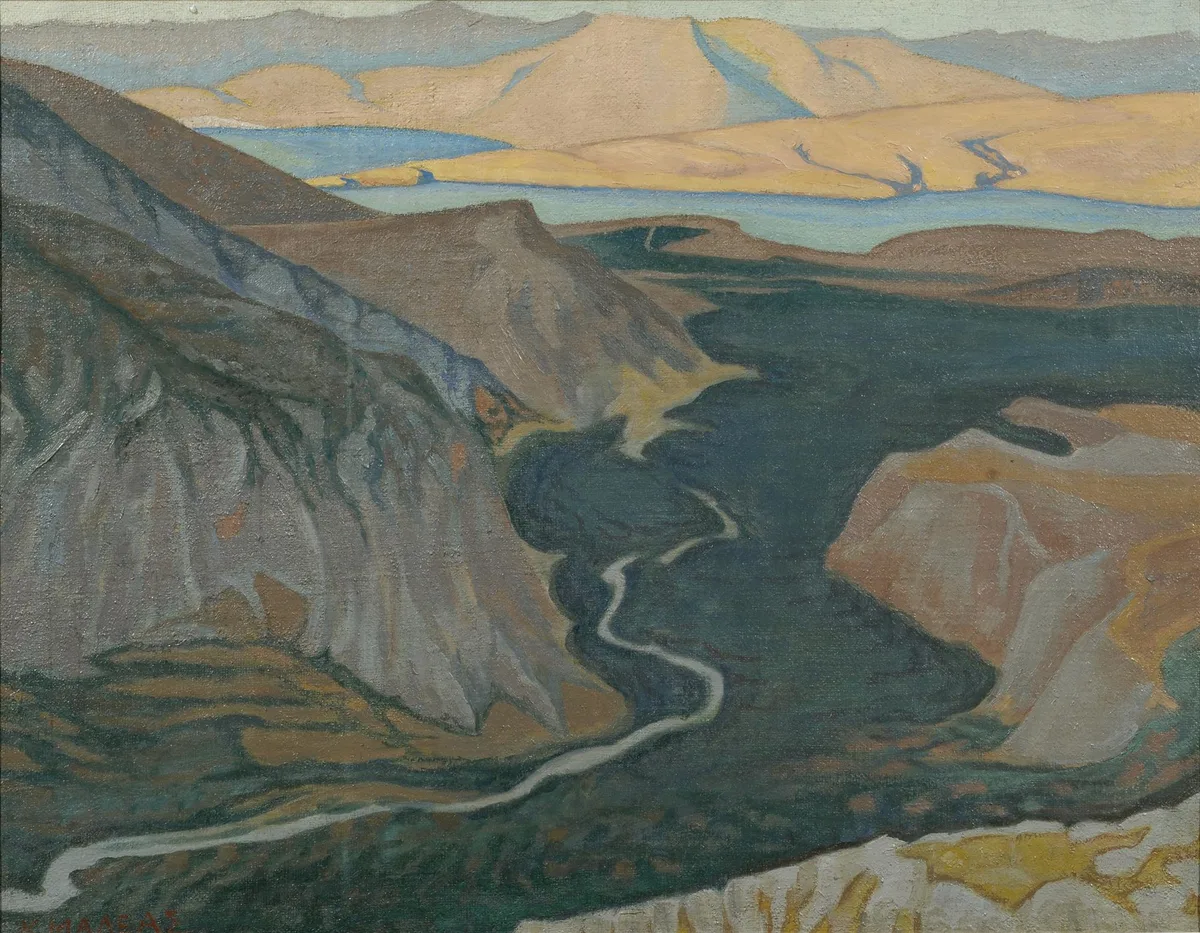
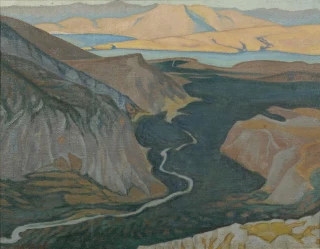
Maleas painted Delphi in 1922–1923, and he looks down on the mountains, the valley and the water from above. On the left a slope runs down on the diagonal, blue-grey and lilac, with dark blue-green gullies, the floor of the valley is taken up by a single large dark green patch, and through it a thin pale line winds up from the lower left corner, either a road or a riverbed. Higher up lie two bands of pale blue water, and beyond them sand-yellow and pink mountains, lit head-on, almost without shadow. The lightest part of the picture is the distant mountains, while the near slopes and the valley are cold, grey and dark green. The paint is laid on thin and dry, the weave of the canvas shows through it, and the forms are simplified into flat patches with soft edges. The signature “Κ ΜΑΛΕΑΣ” is at the lower left, in rust-red letters.
Konstantinos Maleas first trained as an architect in Constantinople, where he was born in 1879, and studied painting in Paris in 1901–1908, at the École des Arts Décoratifs and under the Neo-Impressionist Henri Martin. In 1913–1917 he worked as municipal engineer in Thessaloniki, and many of his pictures burned there in the fire of 1917. In the same year he became one of the founders of the Art Group, which Nikos Lytras brought together so that its members could stand up to academic painting as one.
The gallery places Maleas beside the painter Konstantinos Parthenis among the founders of Greek modernism. He was one of the first to paint the Greek landscape in planes of pure colour, without the brown chiaroscuro of Munich, and in 1923 he received the Award for Letters and Arts. In 1919 the Art Group held an exhibition in Paris, opened by the Greek prime minister Eleftherios Venizelos, and Maleas and Parthenis each showed about 30 pictures there.
15. The Straw Hat — Nikos Lytras
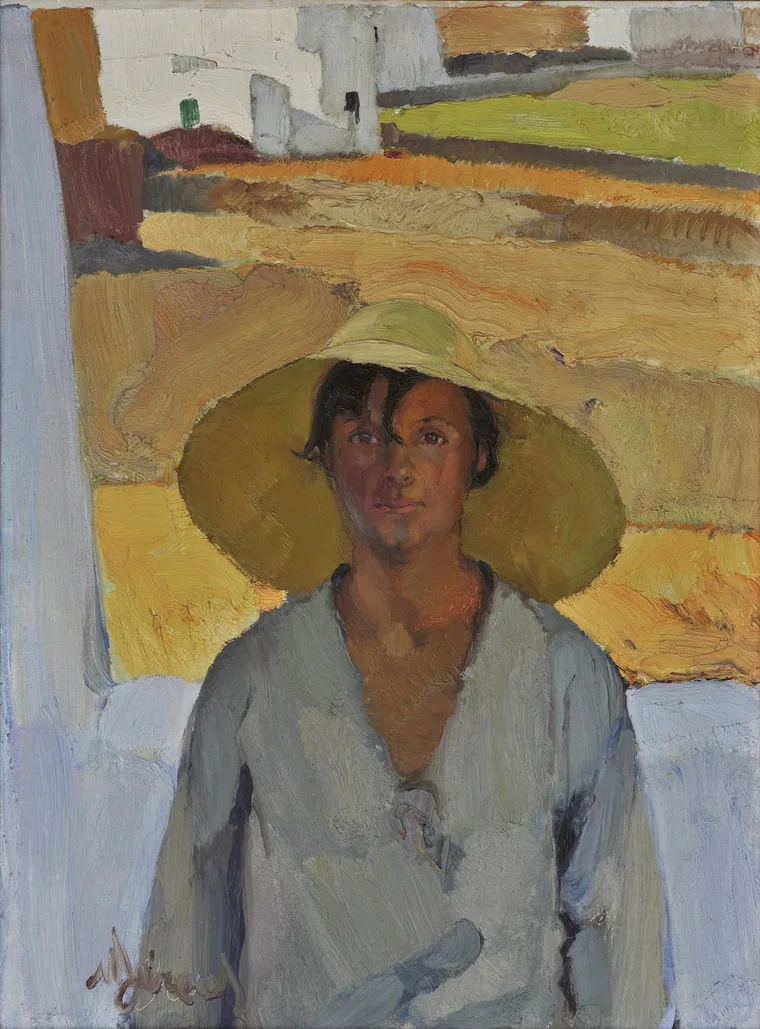
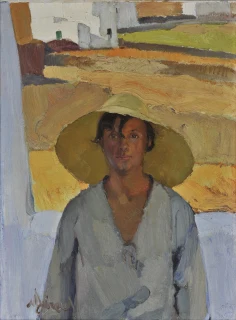
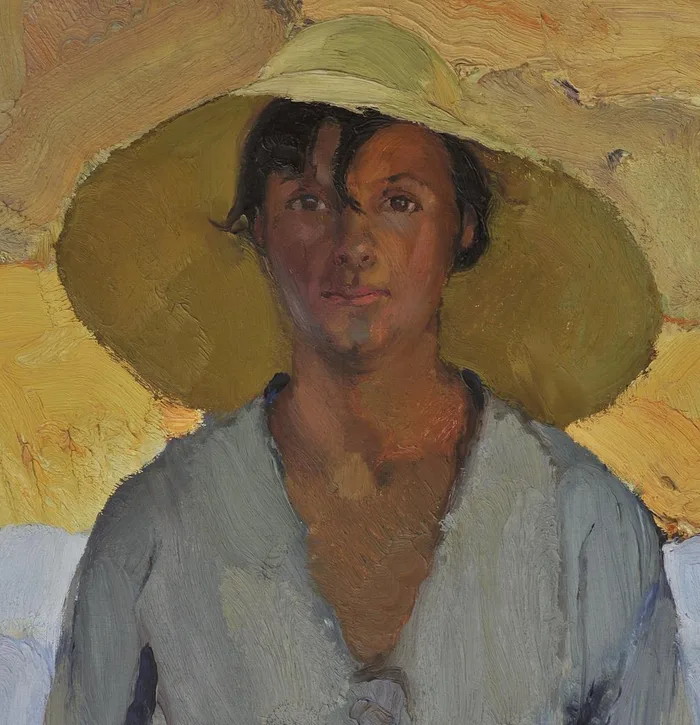
Describing this picture, the museum writes of “the suntanned girl” and adds at once, in brackets, “for it is a girl”. The child, with short dark hair and a lock falling over the forehead, looks at the viewer calmly and without a smile, and the face could be taken for a boy's. It is deeply tanned and divided along the line of the nose, one half in dark brown shadow, the other in warm orange light. A broad hat of olive and yellow-green straw surrounds the head like a disc, and the girl wears a loose grey-blue shirt with a deep neckline and a small lilac bow.
Lytras gathered the cool colours at the bottom and the warm ones at the top. Grey-blue and lilac pass from the shirt to the whitewashed wall behind her, above it lies a broad band of dry grass, gold and orange, its yellow carries on into the straw of the hat, and the top of the picture is closed off by the white cubes of island houses. The museum speaks of a “closed horizon”, because Lytras left neither sky nor sea. The paint is thick and the strokes are broad, and from them one can see in which direction and how fast the brush was moving. The museum calls the picture “the ideogram of the Greek summer on an Aegean island” and says the island may be Tinos, where the artist's family came from.
Nikos Lytras, son of Nikiforos Lytras, who painted the portrait of Mrs Serpieri, was born in Athens in 1883 and studied at the School of Arts under his father and under Georgios Iakovidis. From 1907, as his father had once done, he studied at the Munich Academy, although what he found there by then was German Expressionism and the painters of the Blue Rider. He fought in the Balkan Wars of 1912–1913, in 1917 he took the initiative in founding the Art Group, and in 1923 he was elected professor of painting at the School of Fine Arts, beating Parthenis in the election. He painted The Straw Hat around 1925. Nikos Lytras died in December 1927, aged 44.
What Else to See
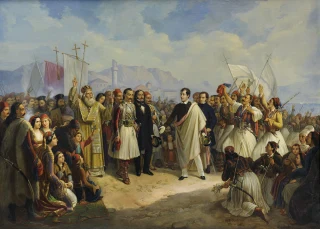
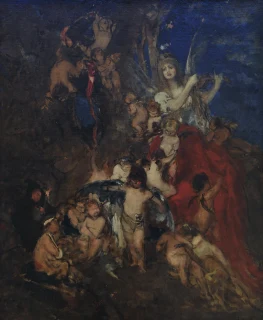
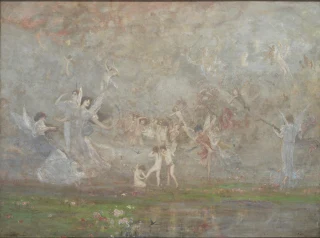
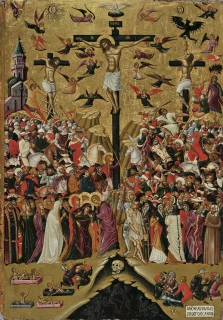
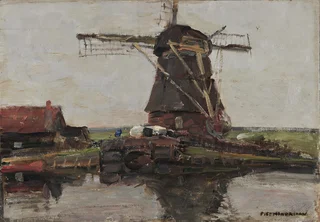
By Nikiforos Lytras it is worth seeing The Dirge in Psara (1888), by Vryzakis The Reception of Lord Byron at Missolonghi (1861), and by Gyzis, besides his Greek scenes, his Munich allegories Art and its Spirits and Spring Symphony. The collection also reaches back before the Munich painters, to post-Byzantine icons, among them The Crucifixion by Andreas Pavias, painted in the second half of the 15th century. The 20th century is represented by Konstantinos Parthenis's Apotheosis of Athanasios Diakos (1930–1933) and Nikos Hadjikyriakos-Ghika's The Studio (1960). Piet Mondrian's Stammer mill with summer house was stolen from the gallery in 2012 together with Picasso's Woman's Head, and in 2021 it was found in a gorge near Keratea.