Anton Romako
1832–1889 · Austrian Empire · Realism, Academic art
The story
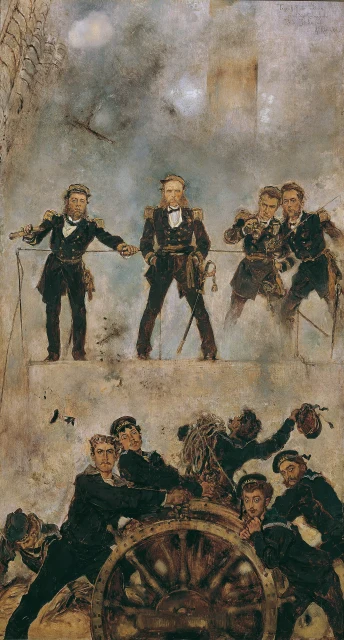
On the bridge of an Austrian flagship, sailors brace themselves and cling to whatever they can reach as the ship drives straight into an Italian ironclad. Only the admiral, Wilhelm von Tegetthoff, holds on to nothing. He stands with his hands in his pockets, cap askew, feet turned slightly inward. Anton Romako painted this moment from the Battle of Lissa, an Austrian naval victory of 1866 in the Adriatic, around 1878 to 1880. The scene is all nerves and tense faces, stripped of the usual battle heroics, and viewers in Vienna disliked it.
Rejection was familiar to Romako. At the Vienna Academy his teacher, the Biedermeier painter Ferdinand Georg Waldmüller, thought him untalented. Romako trained further in Munich and with the Viennese history painter Carl Rahl, and in 1857 he settled in Rome. For almost 20 years he was the favourite portraitist and genre painter of the city's foreign colony. In 1862 he married Sophie Köbel, an architect's daughter, and they had five children.
His wife left him in 1875, and the next year Romako returned to Vienna. The city's taste then belonged to Hans Makart, a painter of vast, lavish decorative canvases, and Romako's restless, psychologically sharp portraits found few buyers. He came to depend on the charity of wealthy patrons. In 1887 two of his daughters, Mathilde and Mary, took their own lives, and he never recovered. He died in poverty in March 1889.
Recognition came later. The Viennese physician and collector Oskar Reichel championed him in the early 20th century as a forerunner of Oskar Kokoschka, the Expressionist painter. Today the Belvedere in Vienna holds both versions of the Tegetthoff picture, the second one almost half the size of the first.