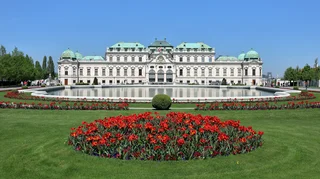
The two Baroque palaces of the Belvedere were built by the architect Johann Lucas von Hildebrandt for Prince Eugene of Savoy and completed in 1723. From the late 18th century the imperial picture gallery hung in the Upper Belvedere. In 1891 it was moved to Vienna's newly built Kunsthistorisches Museum, and today's museum made a fresh start in May 1903, when the Modern Gallery opened in the Lower Belvedere. It was Gustav Klimt and the artists of the Vienna Secession who pushed it through, and for several years beforehand they had been buying pictures and giving them to the State.
On 20 March 1938, eight days after the Anschluss, the new director, Bruno Grimschitz, closed the gallery's department of modern art, and the purchases made under him came from collections taken from Vienna's Jews. After Austria passed its restitution law in 1998, the museum began checking the provenance of its holdings. By its own count ten Klimt paintings have been returned to the heirs of their former owners, among them the golden portrait of Adele Bloch-Bauer of 1907, which the Neue Galerie in New York bought in 2006.
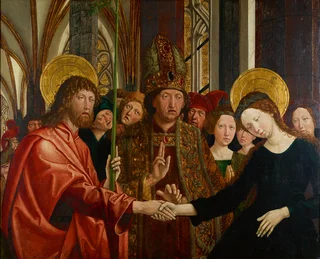
1. The Marriage of the Virgin — Michael Pacher
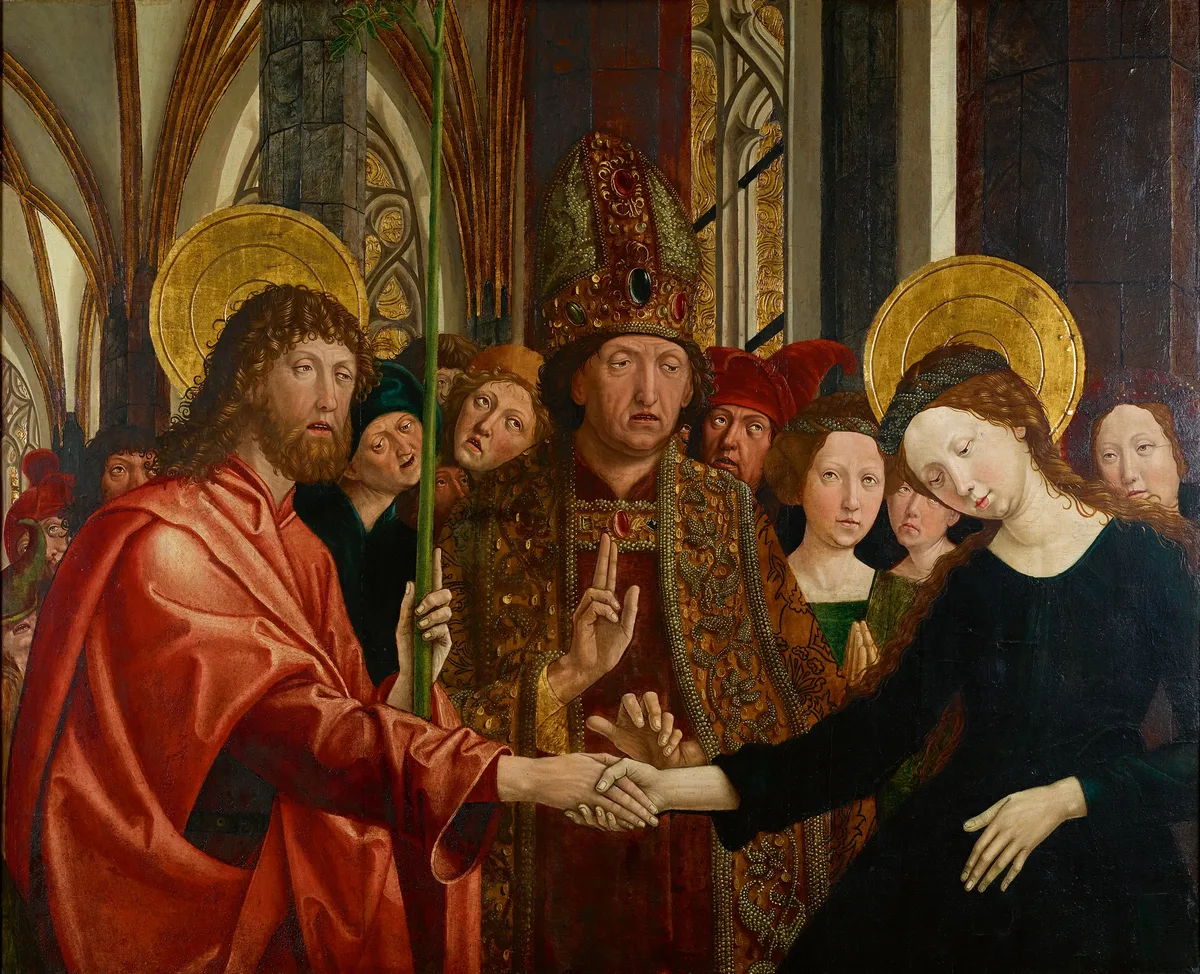
The hands meet at the exact centre of the panel: Joseph and Mary have joined their right hands, and the high priest, in a tall mitre studded with stones, supports them from below and blesses them with his other hand. Joseph was usually shown as an old man in this scene, but Pacher made him a young man with dark curls and a reddish beard, and his enormous vermilion cloak fills the whole left third of the panel. In his hand Joseph holds a thin green staff, which according to legend burst into flower and so marked him out as the chosen bridegroom. The staff runs off the top edge, and all the figures are cut off at the left, the right and the bottom, roughly at the knee, because the panel was once more than twice its present size.
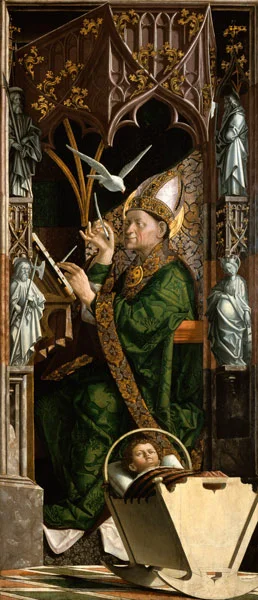
The panel is a wing of the high altar of the parish church in Salzburg, now the Franciscan Church. The town commissioned the altarpiece in 1484 from Michael Pacher, a master from Bruneck in South Tyrol, and paid 3,300 guilders for it. According to Salzburg sources, it was the largest and most expensive winged altarpiece of its time. Pacher moved to Salzburg in 1495 to finish the work, and he died there in 1498.
In 1709 the Gothic altarpiece gave way to a Baroque one by Johann Bernhard Fischer von Erlach. Of the old altarpiece only the carved Madonna on her throne was kept, since by then she was venerated as a miracle-working image, and the other parts went to various owners. Historians have not been able to establish when this double-sided wing was trimmed and sawn through its thickness. Its reverse became a separate picture, The Flagellation of Christ, which is also in the Belvedere. Another fragment of the altarpiece, the scene in which his brothers throw Joseph of the Old Testament into a well, was found in 1951 in the Franciscan friary of Salzburg itself.
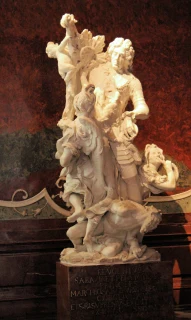
2. Apotheosis of Prince Eugene — Balthasar Permoser
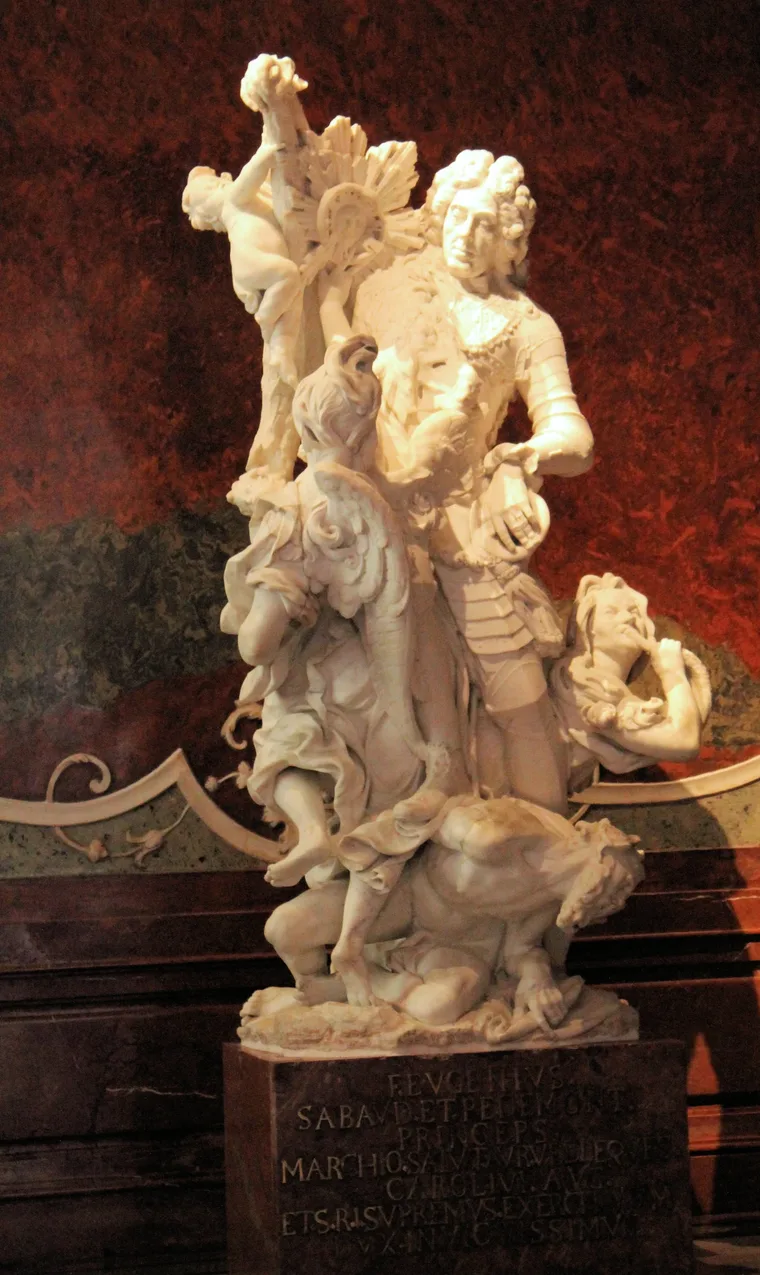
Prince Eugene of Savoy, the general who fought the Turks for the Habsburgs, kept this marble group, in which he himself appears as Hercules, in the dining room of his household officers, on the ground floor of the south-west tower of the Upper Belvedere. It was carved in Dresden between 1718 and 1721 by Balthasar Permoser, court sculptor to the Elector of Saxony, shortly after Eugene's victories over the Turks at Peterwardein and Belgrade. The museum holds that Eugene commissioned it himself, although a German biographical dictionary of 1887 stated that the name of the patron was unknown.
Eugene stands at the centre in the armour of his day and a luxuriant curled wig, with a lion skin thrown over the armour. On the left Fame bursts out in a long diagonal with her trumpet, and the prince covers its bell with his left palm, as if to stop her trumpeting his deeds. A Turkish captive crouches under his feet. There is a tradition that Permoser gave this Turk his own face, and the museum allows that he may have done so.
Eugene never explained why he placed the group away from the state rooms. The museum offers two suggestions: either the marble struck the prince as not antique enough, or he had commissioned it from the start as a monument for after his death. All the same, Permoser's group was put on the title page of the series of engravings of the Belvedere published by Salomon Kleiner. After the prince's death in 1736 the marble stood in a corner of the courtyard between the garden and the palace. In 1836 it was moved into the garden hall on the ground floor as a pendant to the statue of Emperor Charles VI by the sculptor Georg Raphael Donner, and in 1922 it was taken to the Lower Belvedere, to the newly opened Baroque Museum.
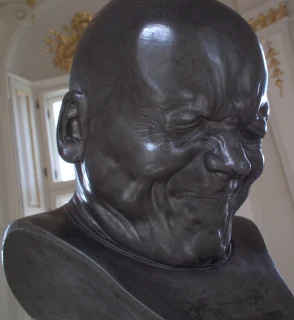
3. Character Heads — Franz Xaver Messerschmidt
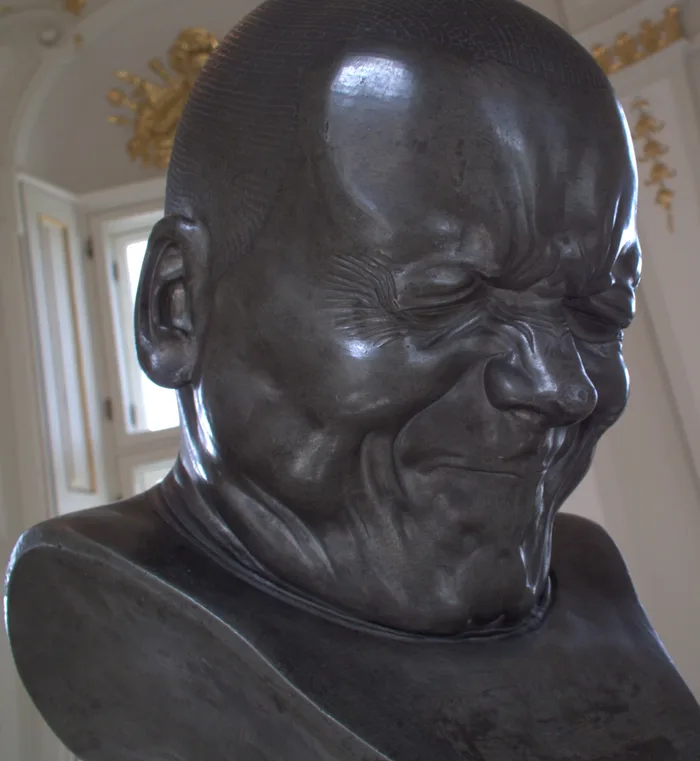
In 1774 the sculptor Franz Xaver Messerschmidt was refused a professorship at the Vienna Academy of Fine Arts, although he had stood in for the professor of sculpture for five years and before that had made busts of Maria Theresa and her husband. According to later accounts of his letter, the State Chancellor, Kaunitz, wrote to the empress that he valued Messerschmidt's talent, and mentioned “confusion in the head” and unseemly behaviour. The sculptor turned down the pension offered in place of the post, left Vienna and in 1777 settled with his brother in Pressburg, today's Bratislava.
He began the heads around 1770 and went on making them until his death in 1783, with no patron, for himself. The Belvedere's curators believe that he started from his own face and was building up a set of expressions. The Berlin publisher Friedrich Nicolai, who visited him in 1781, described how Messerschmidt would pinch himself under the rib and watch the resulting grimace in a mirror.
Head No. 33 is cast in an alloy of tin and lead. It is sunk into the chest so that the chin disappears into the folds of the neck, the eyes are squeezed shut until wrinkles run out to the temples, the nose is screwed up, and the mouth is pressed into a line lifted at the corners, which may be a suppressed grin or may be strain. The Belvedere bought it in 1923 at the Albert Kende auction house in Vienna. The museum has about 16 heads in all, and a few of them are lent by their owners.
For much of the 20th century the heads were put down to the sculptor's mental illness, and in its 2025 exhibition the Belvedere argued against this, setting them beside 18th-century studies of facial expression. The heads acquired their titles only after Messerschmidt's death. His brother Johann Adam bought them at the auction of the dead man's estate and around 1791 sold them to Franz Strunz, a Viennese restaurateur. In November 1793 Strunz exhibited 49 heads in the Bürgerspital, the city's large almshouse, where he was then running the kitchen. An anonymous pamphlet written for the exhibition gave each head a name. No. 33 was called “An Arch-Villain”, and the museum still gives the nickname beside the number.
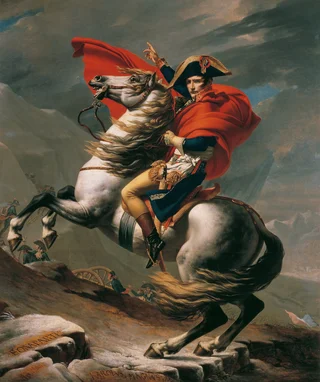
4. Bonaparte Crossing the Great Saint Bernard Pass — Jacques-Louis David
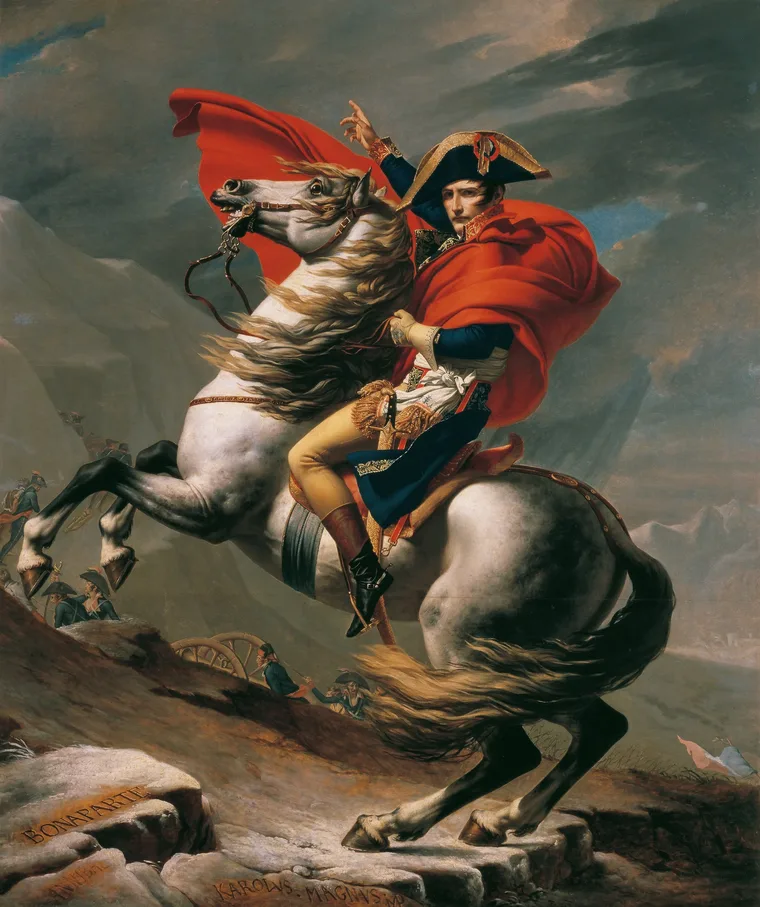
Jacques-Louis David's portrait of Bonaparte as First Consul was sent from Paris to Milan in 1803, to the palace of the Italian Republic, which France then held under its control. In 1834, when Milan belonged to Austria again, the picture was taken to Vienna, to the imperial gallery, which was then housed in the Upper Belvedere. So a state portrait of the Habsburgs' recent enemy ended up in Prince Eugene's palace. When the gallery moved to the new Kunsthistorisches Museum in 1891, the picture went with it, and it still belongs to that museum and is on loan to the Belvedere.
David and his workshop painted five versions of this portrait (that is the usual count), and the Vienna one is dated 1801 or 1802. It can be recognised by the red-orange cloak and the dapple-grey horse. The horse rears on a snowy ledge, the cloak billows above the rider, and Bonaparte himself looks calmly at the viewer and points upward. At the lower left three names are carved into the rocks: BONAPARTE, below it a half-worn ANNIBAL, and lower still KAROLVS MAGNVS IMP. These are Hannibal and Charlemagne, who also led armies across the Alps, and Bonaparte's is the clearest of the three names. In May 1800 he actually crossed the pass on a mule, with a guide.
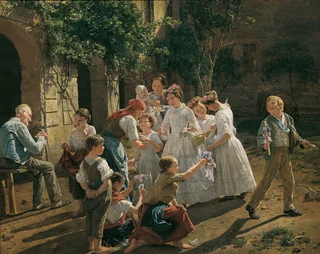
5. Corpus Christi Morning — Ferdinand Georg Waldmüller
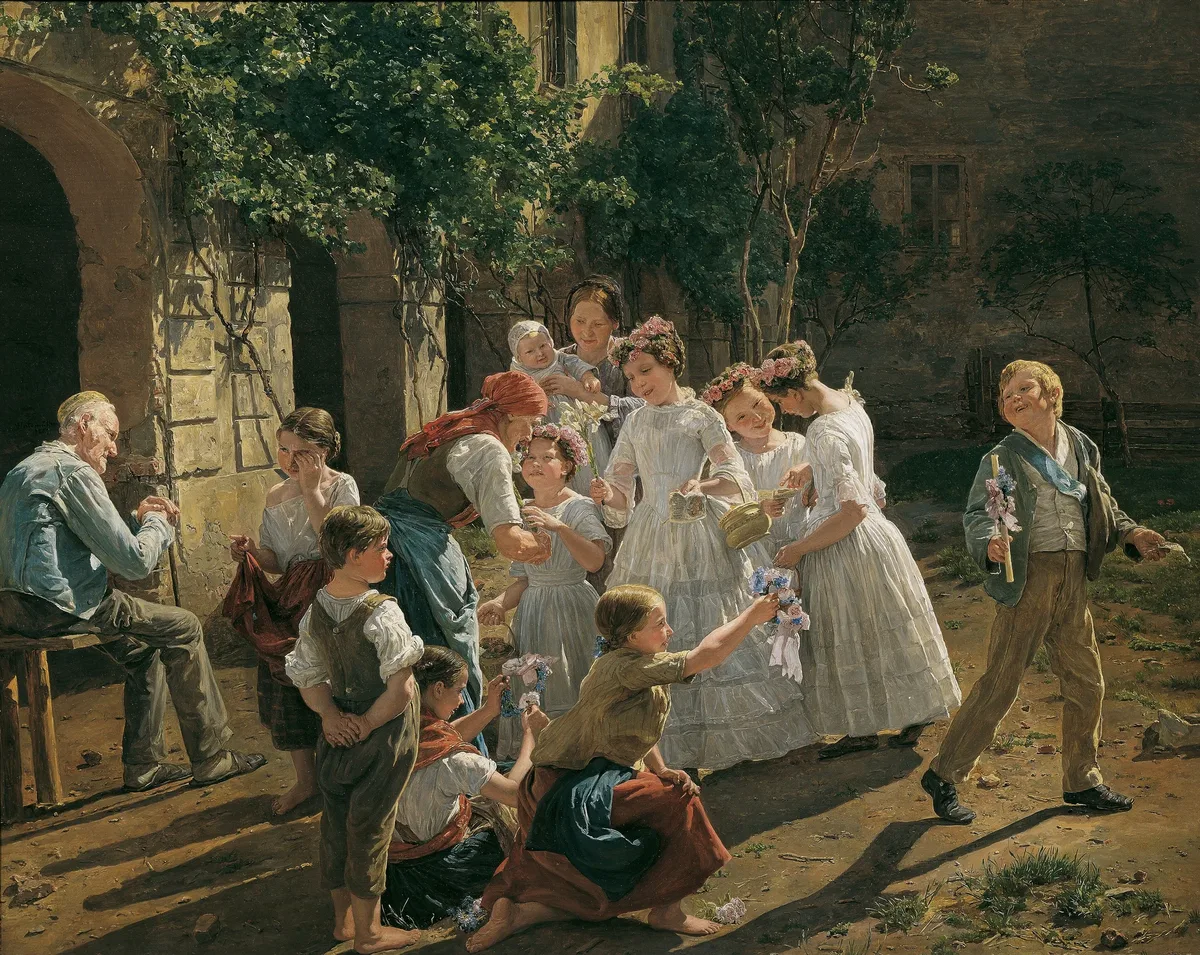
In 1857 Ferdinand Georg Waldmüller, curator of the picture gallery of the Vienna Academy of Fine Arts with the rank of professor, went over the heads of his superiors and sent the Minister of Finance a pamphlet on how to revive the nation's art. Earlier, in 1846 and 1849, he had attacked the Academy's teaching in print and demanded that students learn from nature instead of copying. For the 1857 pamphlet the State punished him by retiring him on half pay. In 1864 the emperor restored his full salary and rehabilitated him, and in 1865 Waldmüller died.
The painting is dated the same year, 1857. It has been in the museum since 1912, but it belongs to the Belvedere's friends' association, which that year made it its first purchase and lent it to the state gallery.
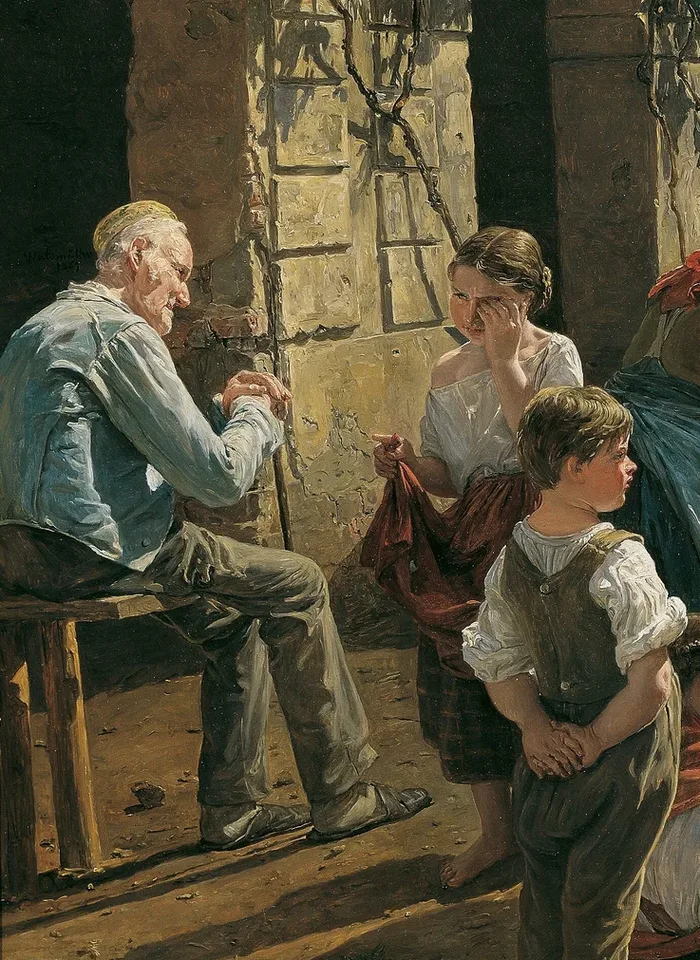
The morning sun falls on the middle of the courtyard, on four girls in white muslin dresses and wreaths of flowers, and they catch the brightest light in the picture. On the right a boy in a green jacket walks off with a tall candle wound with flowers and ribbons, looking back with a broad smile. In the foreground are children in everyday clothes, barefoot. One girl kneels and holds out a small wreath, and another has crouched down and reaches for the flowers in the hands of a friend in her best clothes. In 2021, in an exhibition on poverty in Viennese Biedermeier painting, the Belvedere spelled out the difference: barefoot children would not be walking in the procession. On the left, apart from everyone, an old man in a blue smock sits on a bench with his head bowed, and by the wall beside him a girl presses the back of her hand to her eye.
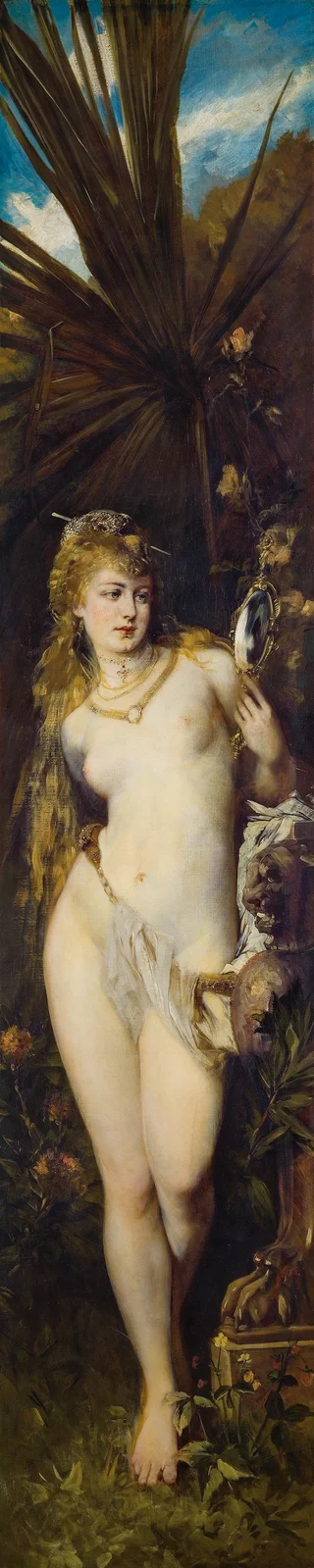
6. The Five Senses — Hans Makart
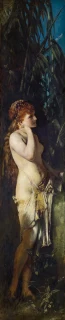
Baron Joseph Alexander von Helfert commissioned five paintings from Hans Makart for his apartment on the Parkring, one stretch of Vienna's Ringstrasse. Each shows a nude woman at full length and life-size, and each canvas is more than three metres tall and narrower than an ordinary door, because the paintings were to hang in the narrow walls between the windows. According to the museum, they never reached Helfert's apartment, and the museum gives no reason. Makart began the cycle in 1872 and finished it at the end of 1879, in the years when he was the most fashionable painter in Vienna.
The back of Sight bears the inscription “painted for H. O. Miethke 1879” and a note reserving the rights of reproduction. Miethke, a Viennese art dealer, published the cycle as prints and sent the paintings to exhibitions in Dresden, Vienna and Berlin. Researchers have not yet found a document that would connect Helfert's commission with this inscription.
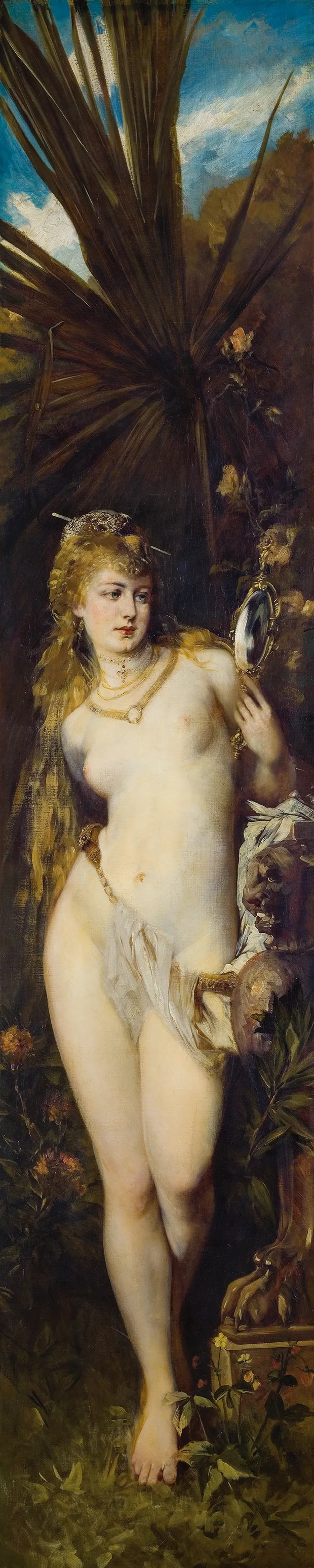
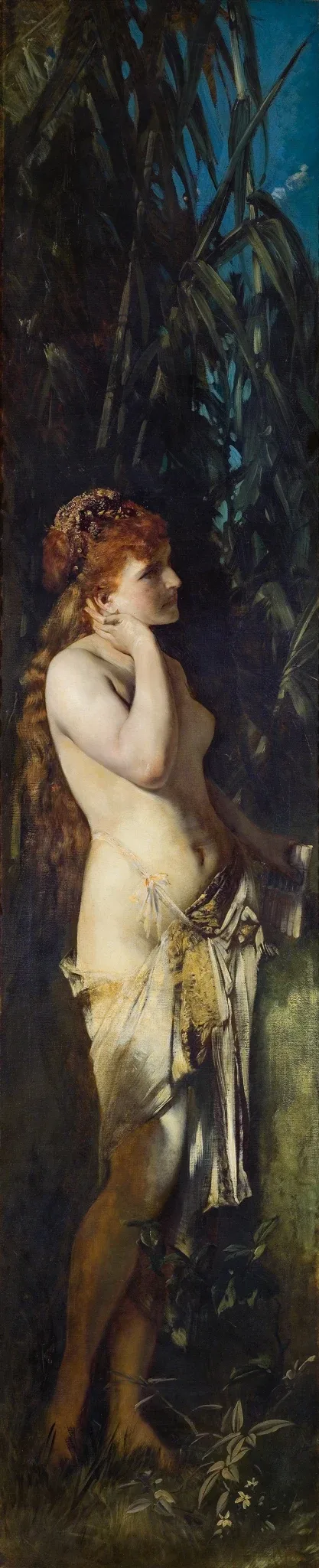
Of the five canvases, Sight and Hearing are the ones most often shown. In Sight the woman holds a small oval mirror in a gilt frame at her shoulder but looks away, and above her head spreads the huge fan-shaped leaf of a palm, the only place on the canvas where sky shows. In Hearing she has turned into profile and raised her fingers to her ear. The museum describes the five figures as positions of a single body turning slowly.
The State bought the cycle from Miethke in 1901, the year the emperor approved the founding of a state gallery of modern art.
7. Spring in the Prater — Tina Blau
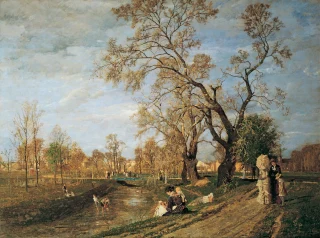
In 1882 Tina Blau sent a canvas about two metres high and three wide to the First International Art Exhibition at the Vienna Künstlerhaus, the exhibition building of the city's main artists' association. That was the size of the big Salon pictures of the day, and Blau had filled hers with the Prater, Vienna's great park, in spring. According to a story that all her biographers repeat, the selection committee wanted to turn the picture down: among the dark canvases in their gallery tones it was too bright and, as the committee put it, would make a hole in the wall. Hans Makart, the painter of The Five Senses, spoke up for it, and the picture was hung, though in a corner. In 1899 it was bought for the imperial picture gallery.
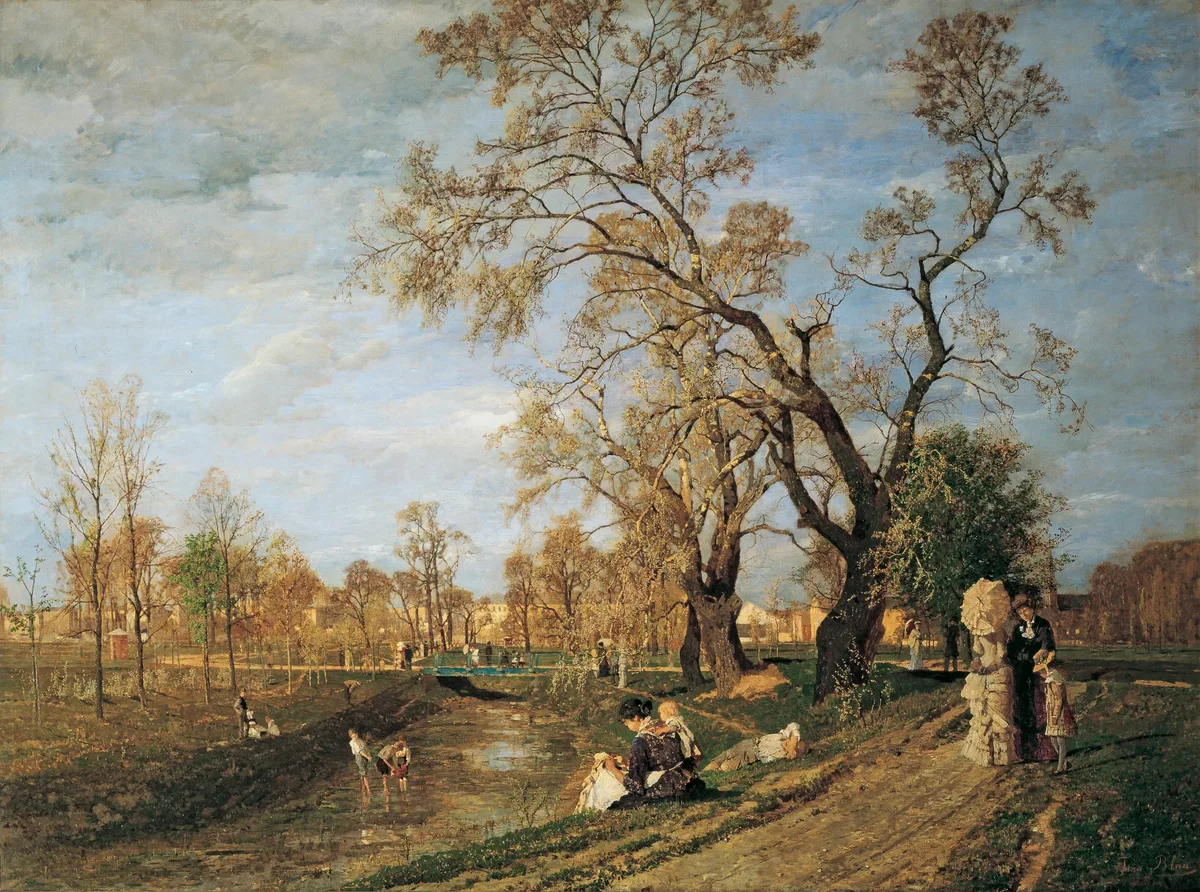
A pale blue sky with long clouds fills the upper half of the canvas. On the right stand huge old trees whose bare crowns are just beginning to take on pale yellow-green leaves. Along a sunlit path a lady with a cream parasol, a lady in a dark dress and a little girl walk towards the viewer, and on the left two boys with their trousers rolled up stand barefoot in a shallow pool. The picture is painted in ochre, straw yellow and pale blue, and the only dark patches in it are the dresses and the tree trunks.
Women were not admitted to the Vienna Academy of Fine Arts at the time, and Blau studied with private teachers and then in Munich. In 1883 Spring in the Prater was shown at the Paris Salon, where, according to most sources, it received an honourable mention.
8. Admiral Tegetthoff in the Naval Battle of Lissa — Anton Romako
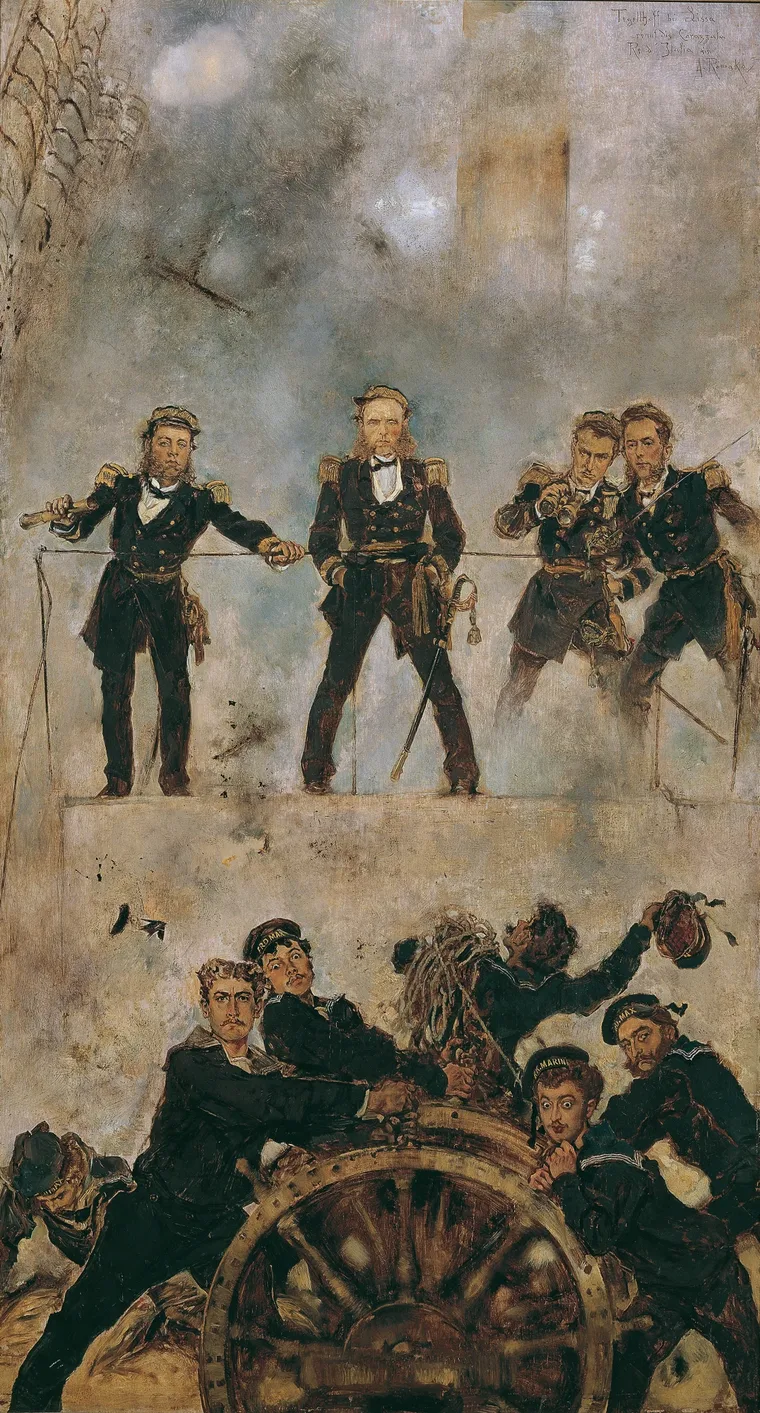
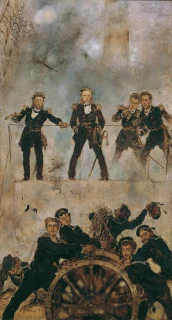
The Belvedere's description of Anton Romako's picture says that it has no sea, no flags and no burning ships, none of the things with which a naval victory was supposed to be celebrated. The battle off the island of Lissa in the Adriatic was fought on 20 July 1866. The flagship of Rear Admiral Wilhelm von Tegetthoff rammed and sank the Italian ironclad Re d'Italia, and the Austrians defeated the stronger Italian fleet, although that same year Austria lost the war on land and ceded Venetia to Italy.
The tall, narrow panel is divided into two bands. Above, four officers stand on the bridge, and Tegetthoff, in the centre, legs apart and arms hanging, looks straight at the viewer. Below, six or seven sailors throw their whole weight against a huge wheel cut off by the bottom edge of the picture: one has bulging eyes, another has clapped a hand over his mouth. Pale smoke drifts between the two bands. The event itself is named only in the inscription at the upper right, “Tegetthoff at Lissa rams the ironclad Re d'Italia”, and Romako chose the seconds before the impact.
Romako returned to Vienna in 1876 after almost two decades in Rome, where he had painted portraits for foreigners, and he wanted to make his name as a history painter. In 1882 one of the versions of the picture was shown at the Künstlerhaus, and the public laughed at it because they found Tegetthoff unheroic. The Belvedere owns two versions, a large one and a smaller one, and they are not always on display. The museum bought the large one in 1955 from Gustav Kauders, who was then living in New York. The picture won recognition only after Romako's death in 1889, and the painter Oskar Kokoschka named him as one of his most important models.
9. The Evil Mothers — Giovanni Segantini
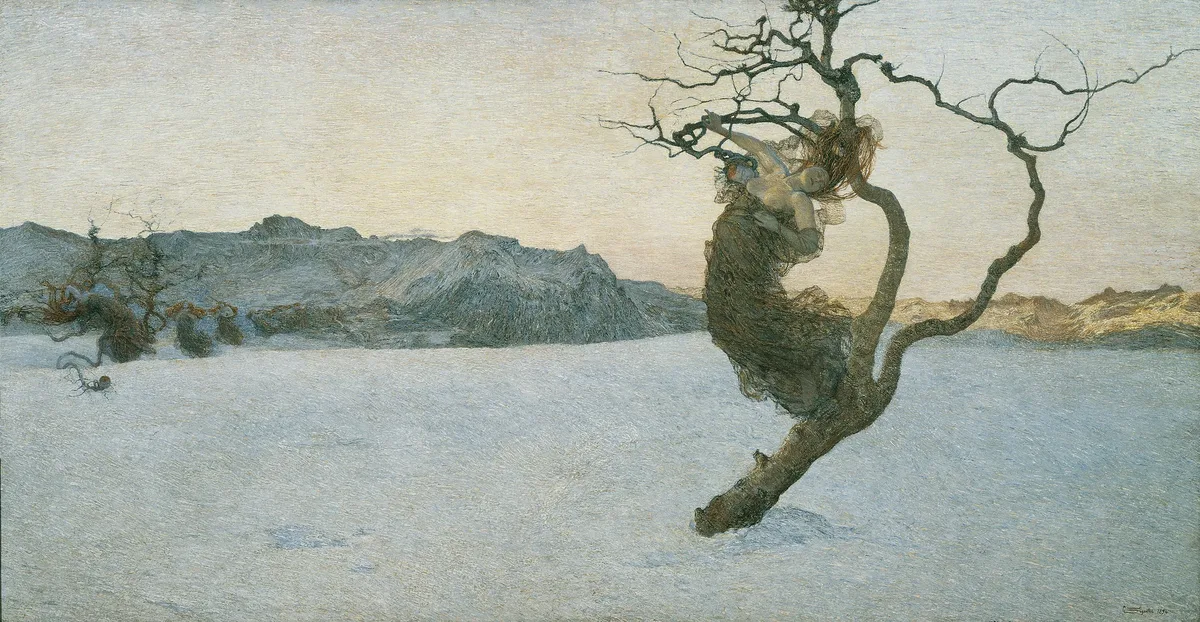
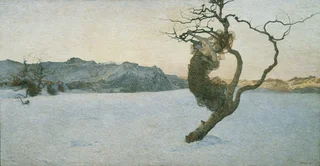
In 1901 the artists of the Vienna Secession gave the State a painting by Giovanni Segantini, which they had bought with money pooled with private art lovers. Klimt and his fellow artists had founded the Secession in 1897, when they broke away from the conservative Künstlerhaus, and ever since they had been pressing for Vienna to have a state gallery of modern art. When it opened in May 1903, The Evil Mothers hung in its first display. Segantini himself, whom the Secessionists regarded as their forerunner, had died in the Alps in 1899.
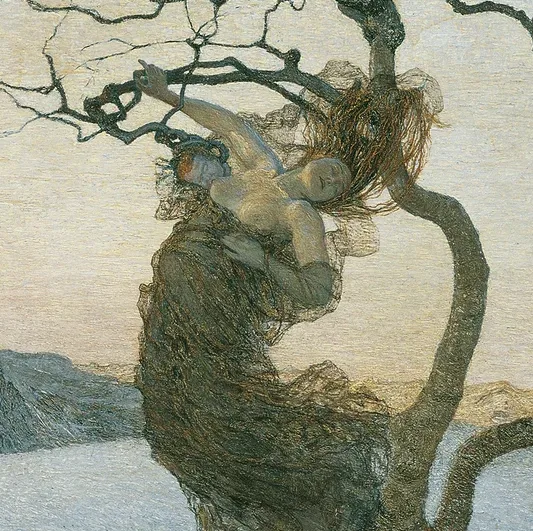
The picture shows a snowy valley below the mountains and a single bare, crooked tree. A woman is caught in its fork: her head is thrown back, her eyes are closed, her reddish hair is stretched out along the branches, and the lower part of her body is wound in a dark, torn cloth that turns into bark. At her breast is the small head of an infant, which grows out of a branch and suckles, and from a distance that head is easy to miss. Segantini painted the whole canvas, snow and sky alike, in fine separate strokes like threads.
Segantini took the subject from the poem Nirvana, which his friend Luigi Illica, later Puccini's librettist, passed off as a translation of an ancient Indian text. In the poem, mothers who have refused motherhood are punished by being tossed about an icy valley until they are reconciled with their children. Segantini's mother died when he was about seven. In 1911 Freud's Berlin disciple Karl Abraham built a psychoanalytic study of the painter on this, and it was published in Vienna.
10. The Plain of Auvers — Vincent van Gogh
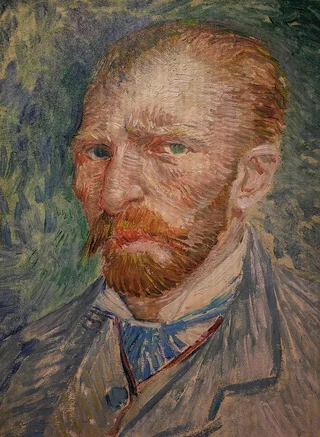
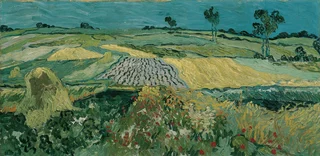
On 2 July 1890 Vincent van Gogh wrote from Auvers-sur-Oise to his brother Theo and Theo's wife about a long landscape with fields: a subject such as the French landscape painter Georges Michel might have taken, only the colour was soft green, yellow and blue-green. The canvas is twice as long as it is high, the horizon is pushed up almost to the top, and the sky is left as a narrow, even band of turquoise. Below it lie patches of field in pale yellow, lime green and blue-green, each outlined in dark paint, a large haystack stands on the left, and at the bottom red and orange dots of poppies are scattered in the grass, the only warm spot in the picture. Less than four weeks after the letter Van Gogh shot himself, and two days later he died.
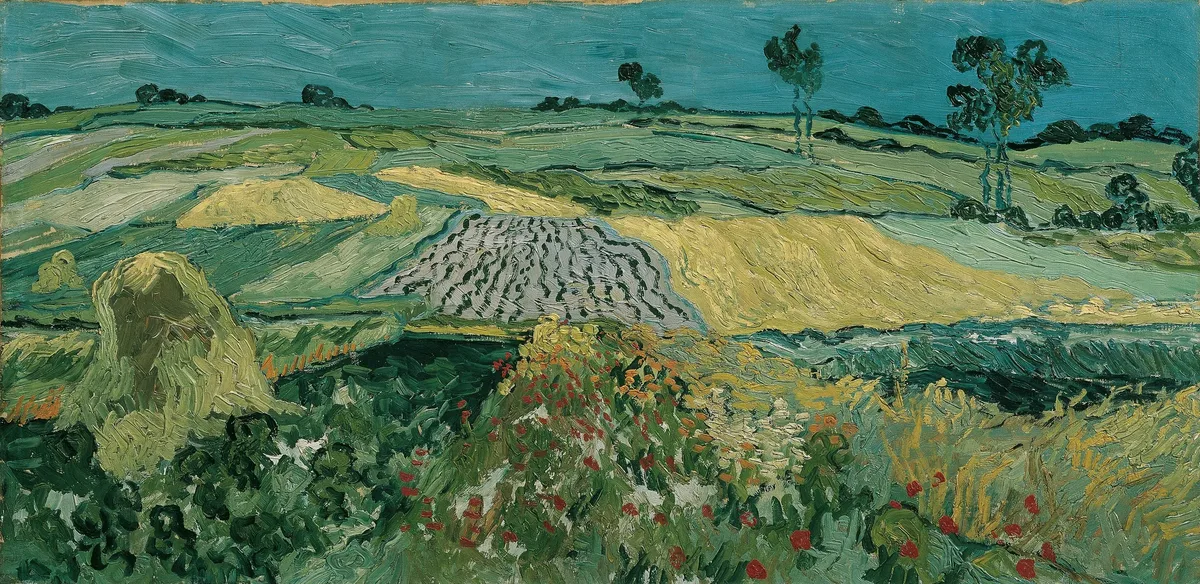
At the beginning of 1903 the Vienna Secession held an exhibition on the development of Impressionism, and in its last section five paintings by Van Gogh hung beside works by Gauguin, Toulouse-Lautrec and Bonnard. The Secession bought The Plain of Auvers at that exhibition for the new state gallery and formally handed it over in 1909. It is one of the earliest Van Goghs to enter a museum. Vienna bought little of his work, and by 1914 Viennese collections held 13 of his paintings, against 156 in Germany.
11. The Chef (Le Père Paul) — Claude Monet
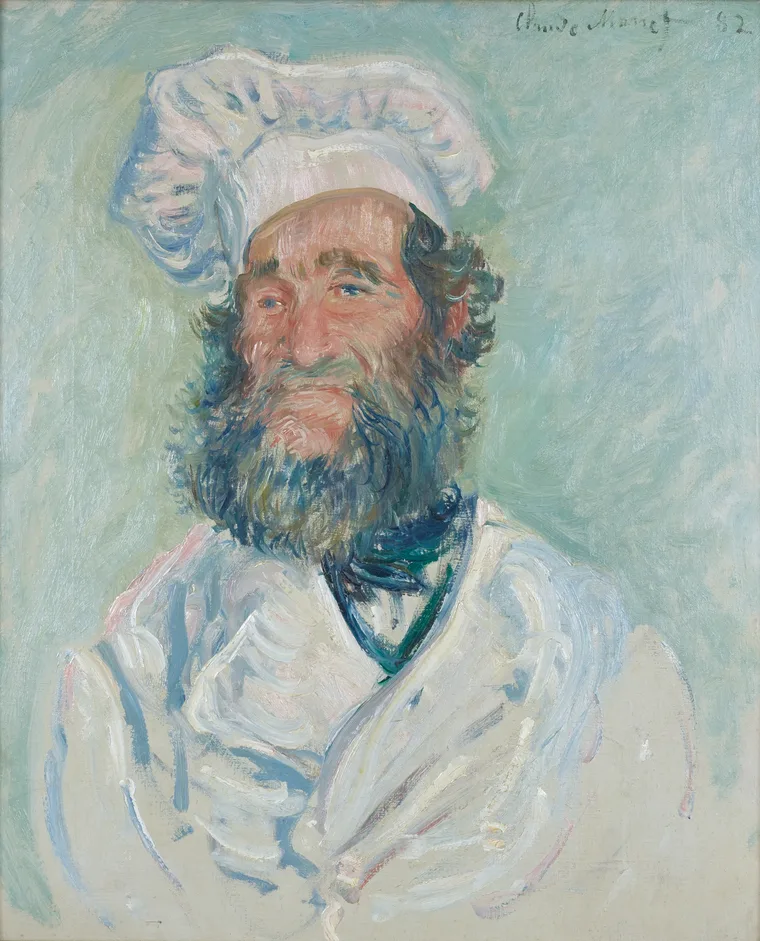
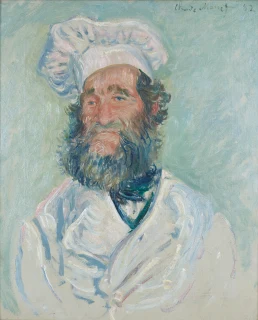
Paul Graff, an Alsatian, ran a hotel and restaurant with his wife Eugénie at Pourville near Dieppe, and in February 1882 Claude Monet came to stay there to paint the Normandy cliffs and the sea. In bad weather Monet worked indoors, and he painted two galettes, for which Graff's kitchen was famous, the shy Eugénie, and the host himself, “the shaggy old cook under his white toque”, as Daniel Wildenstein, the compiler of Monet's catalogue, called him.
The toque, tall and soft, slumps to the left, and Monet painted it in quick white loops with lilac, blue and pink in the folds, so thinly that the weave of the canvas shows through the paint. The beard is the most thickly painted part, a tangled mass of blue-black, bottle-green and olive strokes. It covers the chin and the mouth, so the smile can be guessed only from the cheeks. The mint-green background is laid on in broad strokes that circle the silhouette, and below the chest the white jacket is barely indicated.
In March 1883 Monet showed the portrait at his solo exhibition with the Paris dealer Paul Durand-Ruel, and the catalogue misprinted the host's surname as Graft. In 1903 the painting was bought at the Impressionist exhibition in the Vienna Secession, the same one at which the Secession acquired The Plain of Auvers, and in May it hung in the first display of the Modern Gallery. The museum's records do not say who paid for it, the ministry or the Secession. Of the two other Monets in the Belvedere, one, A Path in Monet's Garden at Giverny, reached the museum by a very different road, and only in 1942.
12. Judith — Gustav Klimt
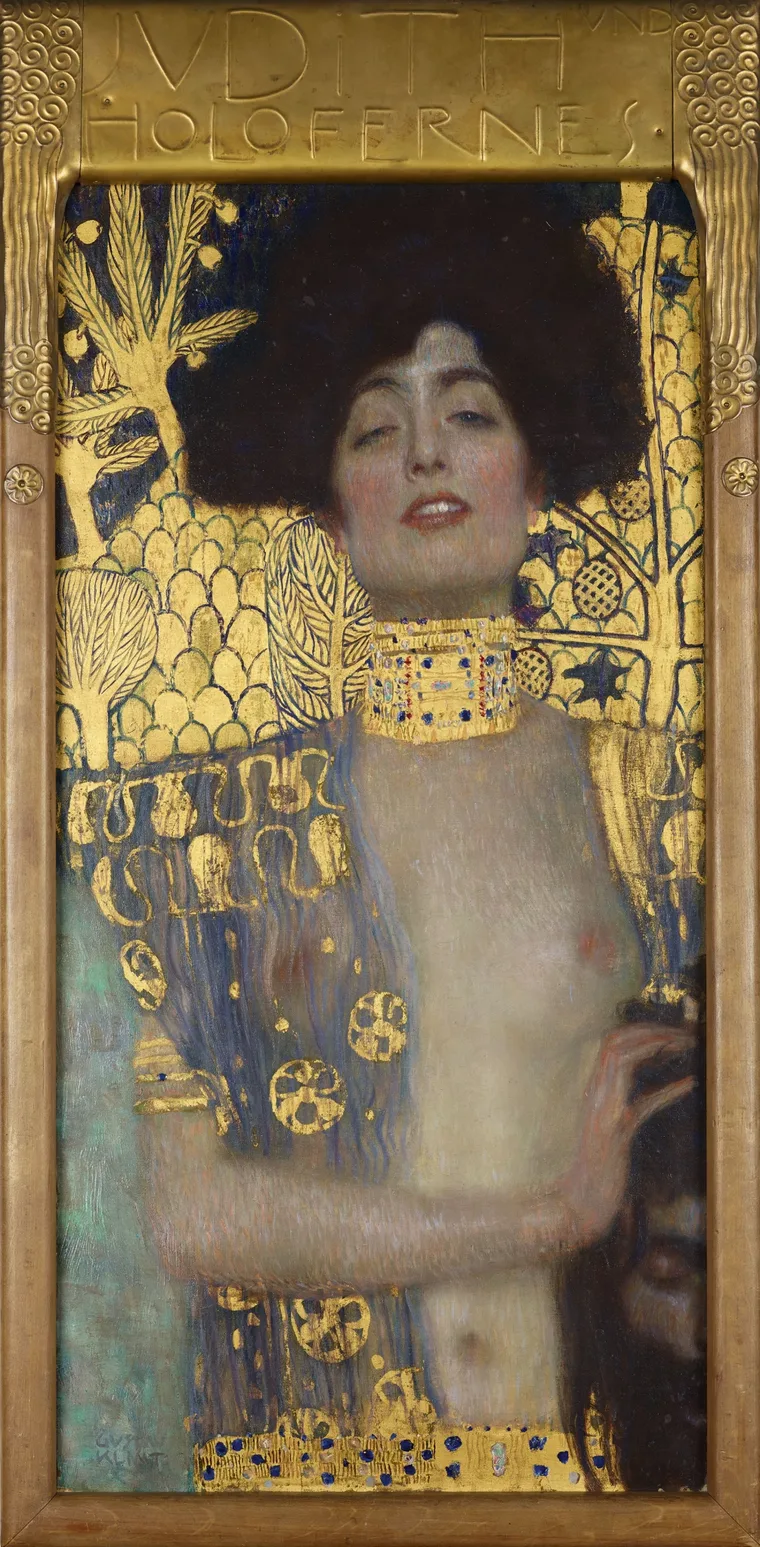
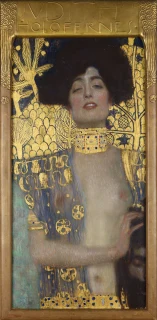
The frame for Judith was made by Gustav Klimt's younger brother Georg, a metal chaser and engraver. Its top rail is stamped in large letters with IVDITH, with HOLOFERNES beneath it and a small UND at the side. Sketches for the frame appear in Klimt's red sketchbook as early as 1898, and it was ready before the picture was first shown at the tenth exhibition of the Vienna Secession in March 1901. So the title stood on the frame before anyone had seen the picture, and even so in Vienna, Munich and Berlin people called her Salome. “She is much more Salome than Judith,” wrote the Wiener Zeitung on 1 April 1901, and in the catalogue of a Berlin exhibition of 1905 the picture appeared under that very name, Salome.
Klimt was the leading figure of the Secession and was in the second year of a dispute with the University over his paintings for the ceiling of its Great Hall: the professors had protested against Philosophy, and Medicine was shown at the same exhibition as Judith.
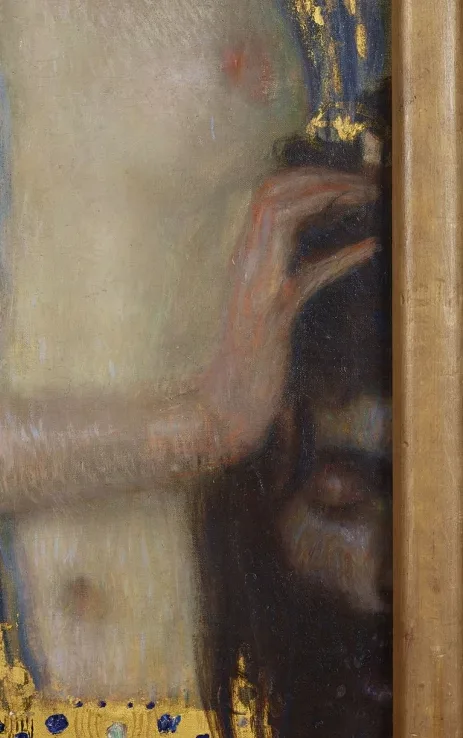
Judith has thrown her head back and looks at the viewer from under heavy lids, her lips parted. A broad gold collar grips her neck, and the blue and red stones in it are painted so thickly that they stand up from the surface of the canvas. Behind her head is gold, in which trees, mountains and vines emerge, taken, in the museum's view, from a relief in the palace of the Assyrian king Sennacherib at Nineveh. The head of Holofernes appears only in the lower right corner. Judith's hand, fingers spread, rests in his dark hair, and all that is left of his face is a closed eye and part of a cheek, after which the frame cuts it off.
In 1901 the picture was bought by the Viennese doctor Anton Loew. After his death in 1907 it stayed with his widow, in 1920 it was sold at auction in Geneva for 3,750 francs, and until 1954 it belonged to Berthe Hodler, widow of the Swiss painter Ferdinand Hodler. In 1954 the Austrian Gallery bought Judith from Berthe Hodler for 3,000 Swiss francs.
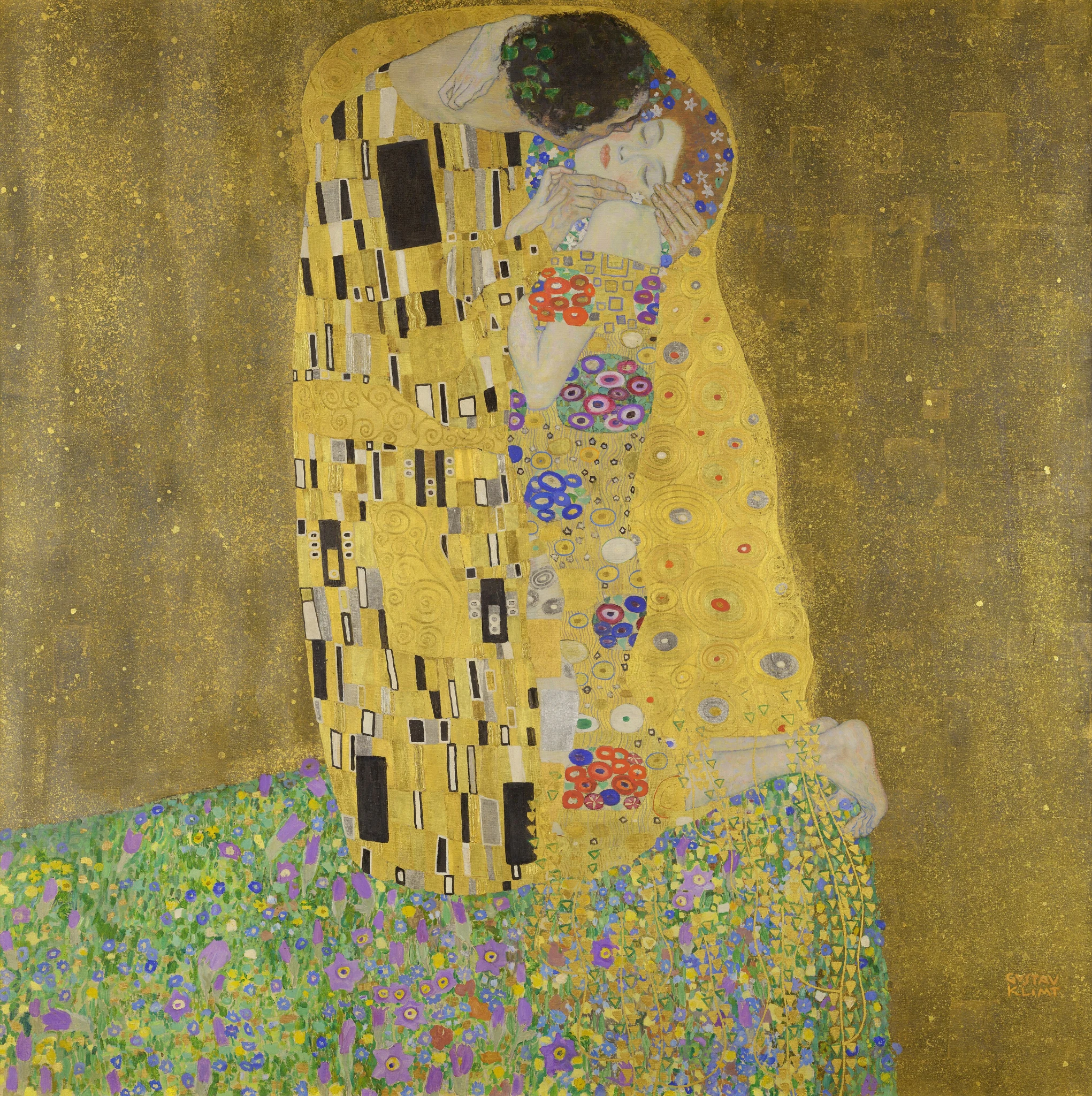
13. The Kiss — Gustav Klimt
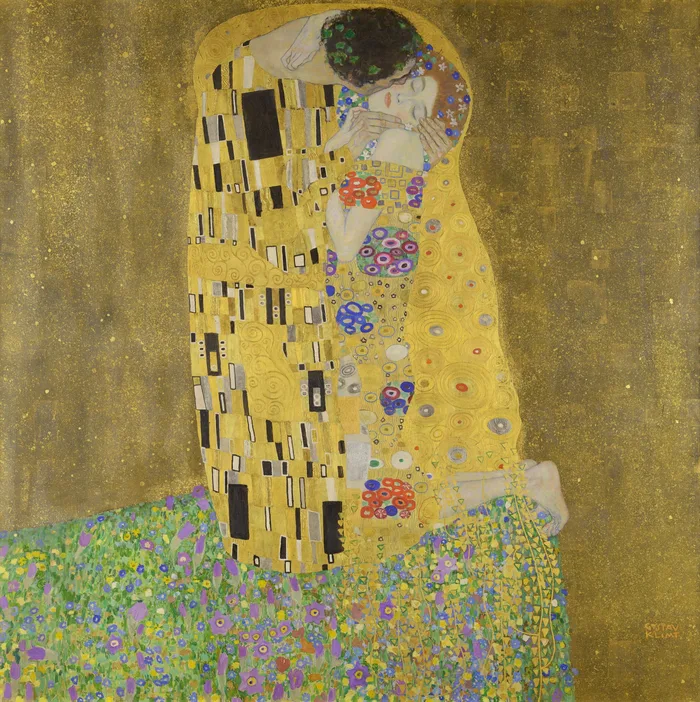
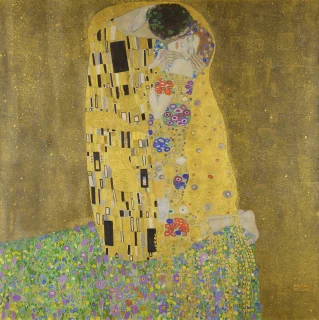
On 10 July 1908 the Ministry of Religion and Education bought from Gustav Klimt a painting then called Lovers, straight off the wall of the Kunstschau. Klimt and his circle had organised this exhibition after they left the Secession in 1905. The ministry paid 25,000 crowns, more than the Modern Gallery had ever paid a living artist, and it bought the picture unfinished. A ministry memorandum noted that the lower left corner was not yet completed, and on 16 July Klimt replied from Lake Attersee that he would finish Lovers as soon as the exhibition closed. He took the canvas back to his studio and handed it over to the gallery only on 22 July 1909. The picture was named The Kiss that same autumn, in a supplement to the Modern Gallery's catalogue.
A meadow of small violet, blue, yellow and white flowers takes up only the left part of the bottom and breaks off at a sharp edge, beyond which the background begins. The woman's bare feet stand on that very edge, her toes curled downward. Klimt covered the background around the couple with a dark olive-bronze glaze and, while it was still wet, scattered flecks of metal into it.
The reworking after the purchase shows when the picture is compared with photographs of the exhibition taken by the photographer Moriz Nähr. In them the flowers on the left of the meadow grow in separate clumps, which have since merged into a continuous carpet. X-rays showed that at the same time Klimt evened out the pattern on the hem of the man's robe and lengthened the woman's shins by several centimetres.
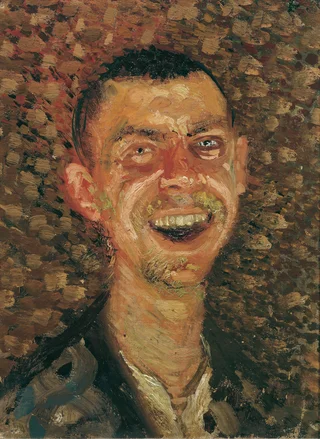
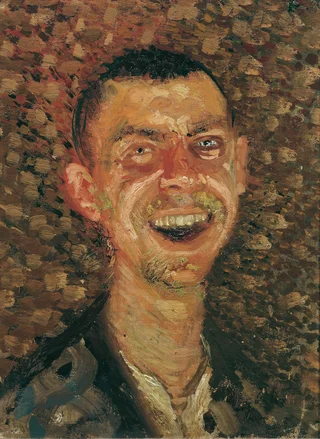
14. Self-Portrait, Laughing — Richard Gerstl
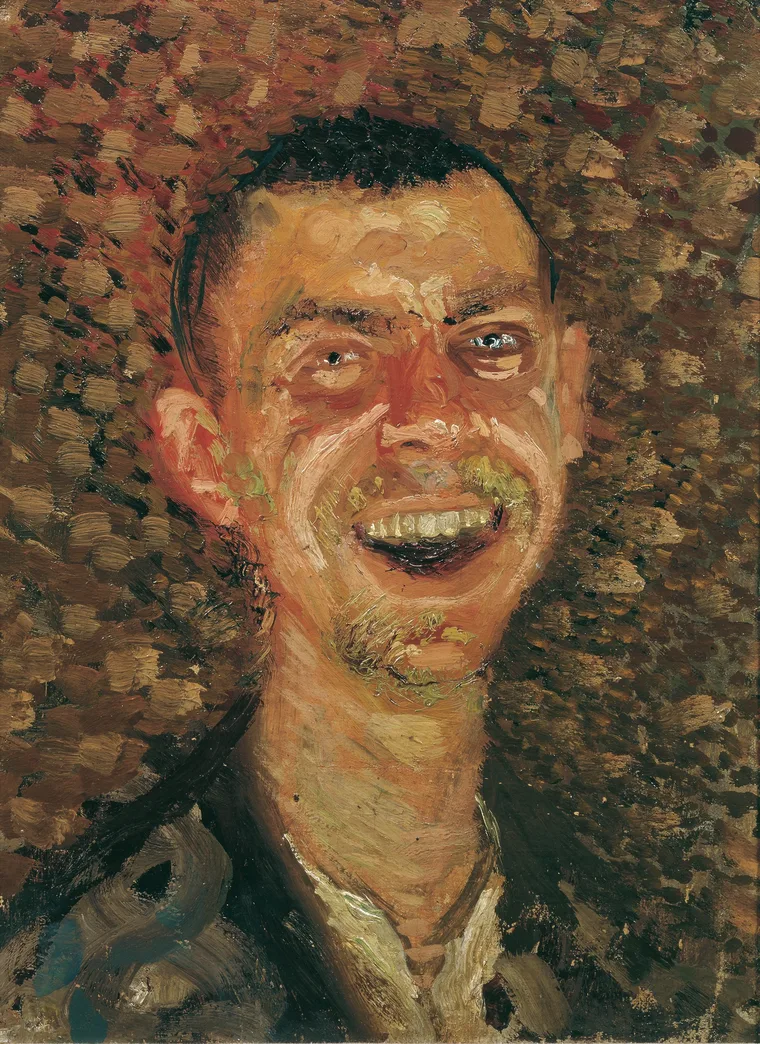
On 4 November 1908 the 25-year-old Richard Gerstl burned letters and papers in his studio and killed himself in front of a mirror. He had been close to the composer Arnold Schoenberg, painted alongside him and taught him painting, and in 1908 he had an affair with Schoenberg's wife Mathilde, who in the end went back to her husband. In his lifetime Gerstl never exhibited, and he kept apart from Vienna's artists' associations.
After his death the family kept the paintings, and in 1930 or 1931 his brother Alois showed them to the Viennese dealer Otto Kallir. In September 1931 Kallir opened the exhibition Richard Gerstl, A Painter's Fate at his Neue Galerie, and until then nobody outside the family had seen Gerstl's work for 23 years. From 1938 the Nazis counted him among the “degenerate” artists, and until 1945 his paintings could not be shown. In 1946 the Austrian Gallery bought the self-portrait from the Neue Galerie.
In the self-portrait Gerstl laughs with his mouth wide open, showing all his upper teeth, yet his eyes are narrowed and glassy, and at the Belvedere the laugh is described as more menacing than cheerful. The background is covered all over with short brown, olive and ochre strokes and presses right up to the head. The face is painted in hot orange, red and pink, greenish-yellow strokes lie around the mouth and in the stubble, and the neck rises as a long yellow-green column.
The Belvedere dates the portrait to 1908, the last year of Gerstl's life, while the compilers of the catalogue of his work place it in the summer of 1907, which he spent at Gmunden on the Traunsee close to Schoenberg's family.
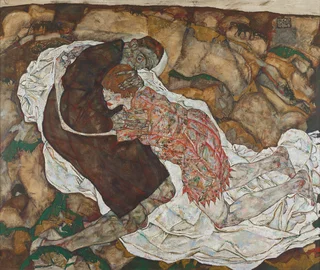
15. Death and the Maiden — Egon Schiele
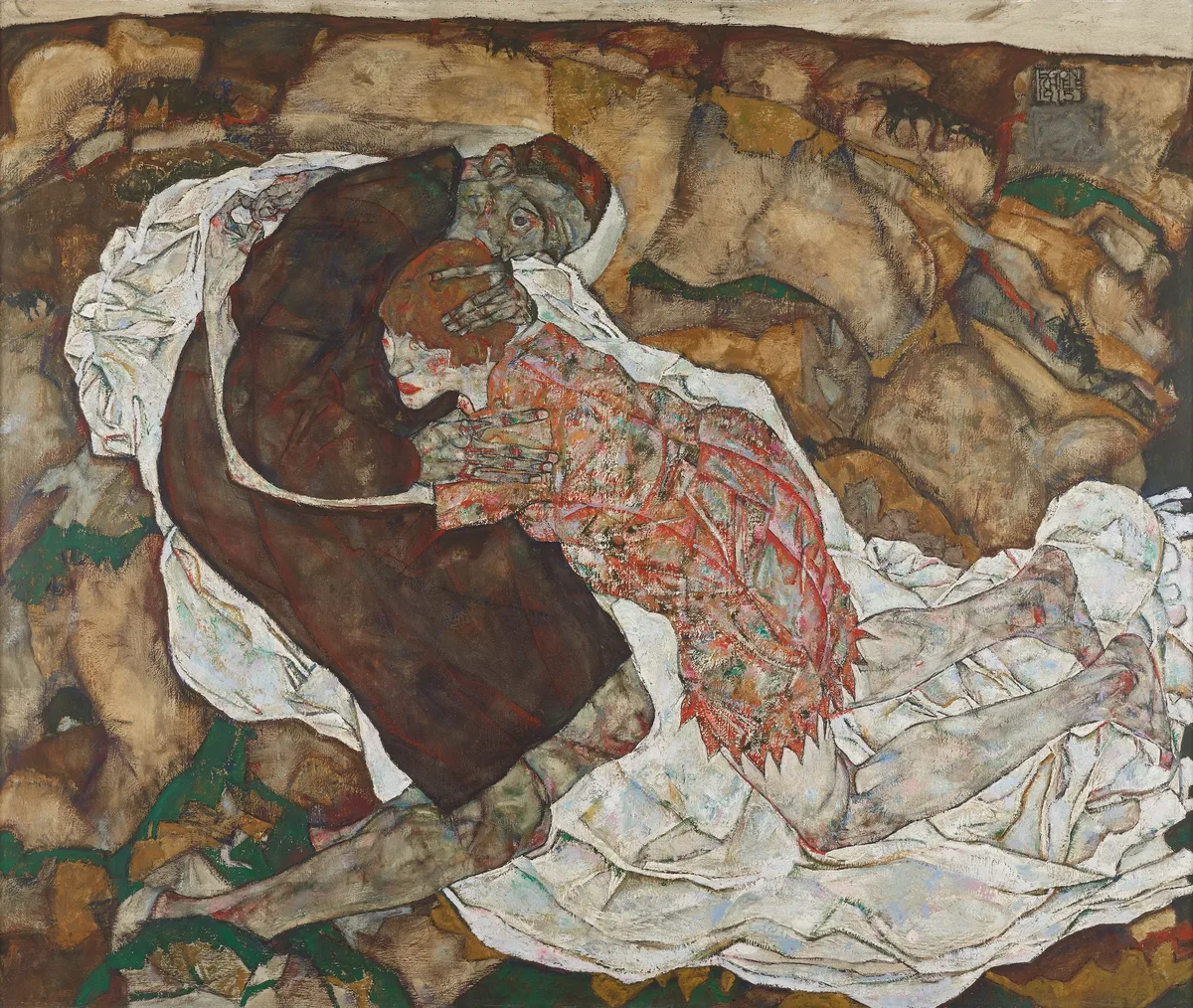
From 1911 Wally Neuzil was Egon Schiele's model and companion. At the end of 1914 he began courting Edith Harms, who lived in the house opposite his studio, and he married her on 17 June 1915. A few days later he was called up into the army. In that same year, 1915, he painted this picture. The Belvedere holds that it shows Wally and Schiele himself, although the artist called the canvas Man and Girl and Entwined People, and the title Death and the Maiden came later.
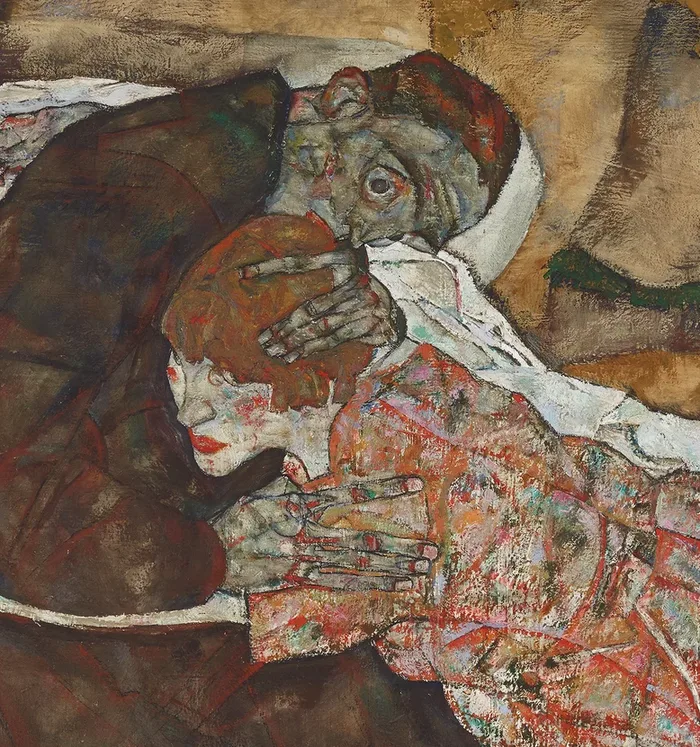
The two kneel on a huge crumpled white sheet thrown over brown, stony ground. The man in a dark brown habit stares with round, wide-open eyes past the viewer and past the woman, and lays a hand with long, bony fingers on the back of her head. She has put her thin arms around him, and both her hands, fingers spread, lie flat on his chest. Schiele drew the hem of her short dress as a sharp sawtooth of pink, red and pale green strokes.
The Munich Secession bought the picture during Schiele's lifetime, and in the spring of 1918 it hung in the big Schiele exhibition at the Vienna Secession, where the critic Hermann Menkes called it “a wonderful poem of imagination, drawing and composition”. The museum bought it from the Munich Secession in 1930, 12 years after the artist's death. Wally Neuzil trained as a nurse and died of scarlet fever in December 1917 in the Dalmatian town of Sinj, where she had been sent on war service.
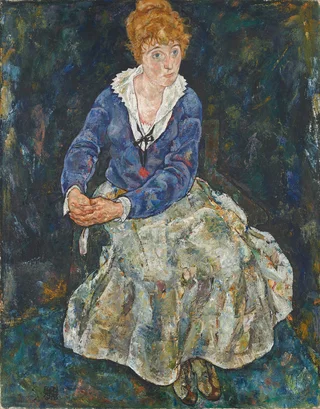
16. Portrait of the Artist's Wife, Edith Schiele — Egon Schiele
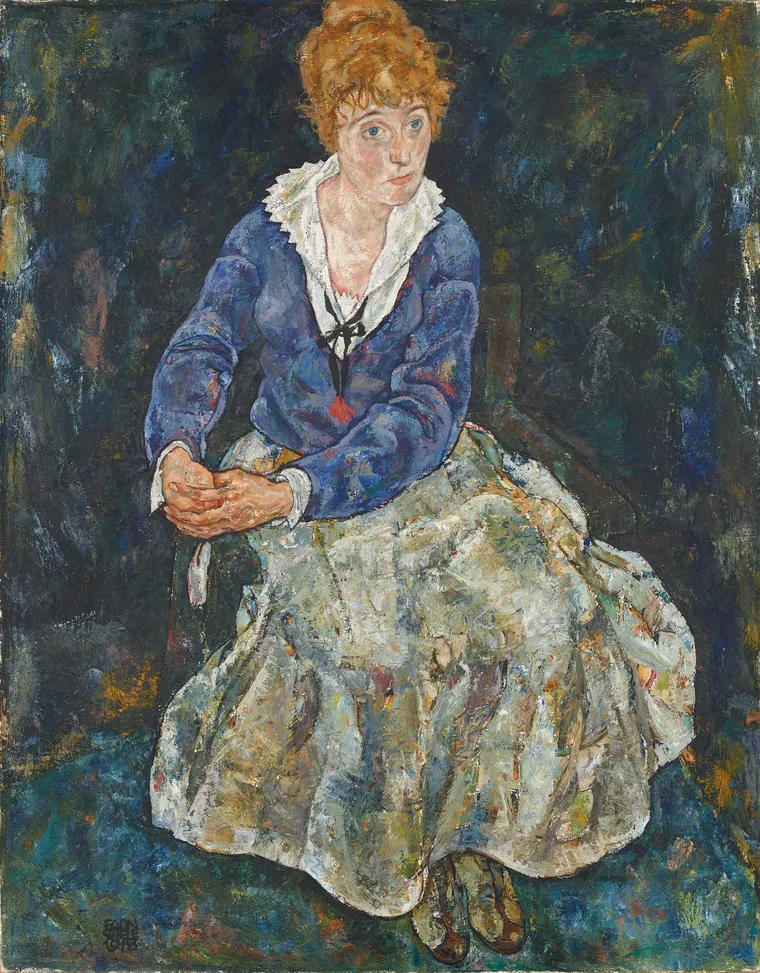
Franz Martin Haberditzl, director of the state gallery from 1915, bought this portrait in 1918 from the Viennese dealer Gustav Nebehay, shortly after the big spring exhibition of Schiele's work at the Secession. It was the first painting by Schiele bought by an Austrian museum, and it was bought in the artist's lifetime. Afterwards Schiele repainted the dress in the portrait. The Belvedere's record says that the director found the colourful checked skirt too bright and too much like applied art, and at his request it was painted over in muted tones. The Leopold Museum in Vienna, which holds the largest group of Schiele's work and owns a photograph of the first version, is more cautious and writes that the reason for the change has not been finally established.
In the old photograph Edith sits in the same pose, in a skirt of large squares, on a clearly visible wooden chair, against a light background with the floor below. In the painting the skirt has become a whitish grey with brown and green streaks, a black bow with long ribbons and a small red-orange tassel has appeared at her neck, brown boots peep out from under the hem, and the chair and the room have sunk into a dark background. In 2018 the Belvedere's conservators made a digital reconstruction of the first version from X-ray and infrared images.
The Belvedere shows its Schiele paintings in rotation, and this portrait is not always on display. The Leopold Museum bought the photograph of the first state in 2023.
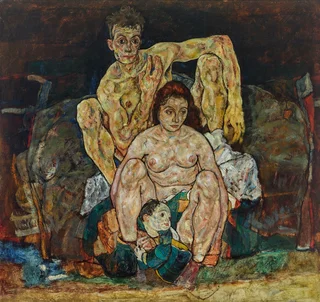
17. Squatting Couple (The Family) — Egon Schiele
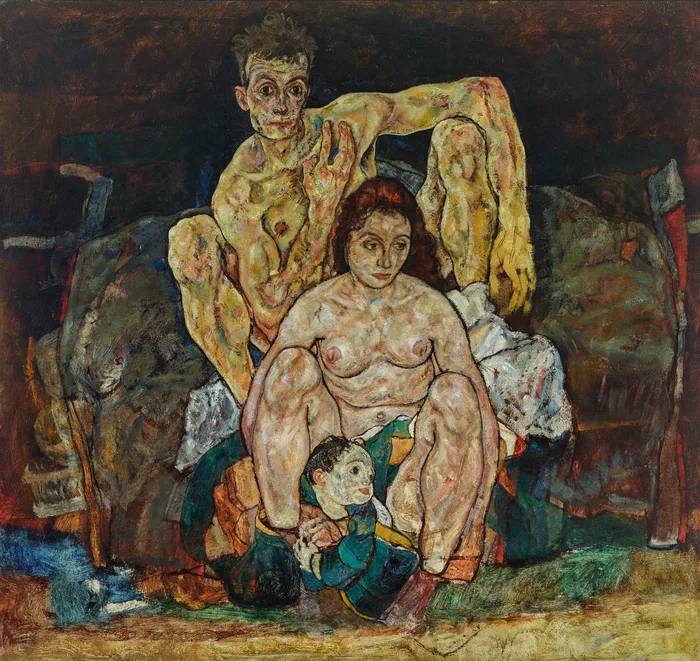
On an almost square canvas three figures are stacked in a pyramid against a dark brown ground. At the top squats a naked man with Schiele's own face, his knees spread wide so that his legs frame the woman, and he looks straight at the viewer. The woman sits lower down, paler and softer, her eyes lowered and turned aside, and between her feet a child in a dark green blanket looks sideways, past both adults. None of the three looks at any of the others.
Infrared photography in 2018 showed that the man at first propped his chin on his right hand. Schiele lowered that hand, and it is now raised in front of his chest, palm turned inward, fingers spread.
Schiele himself called the picture Squatting Couple, and it was named The Family after his death by Berta Zuckerkandl, the Viennese journalist and hostess of a literary salon. From 1918 the picture belonged to the painter Hans Böhler, from a family of steel industrialists, and the museum bought it from him in New York in 1948.
Edith Schiele had been expecting a child since the spring of 1918. She died of Spanish flu on 28 October, six months pregnant. Schiele died three days later, and the picture was left unfinished. The man's left hand, hanging from his knee, is barely indicated, and the lower corners of the canvas are only sketched in.
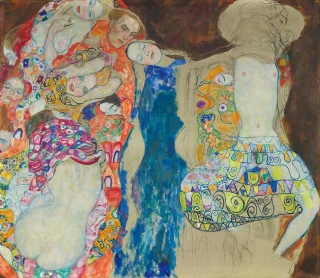
18. The Bride — Gustav Klimt
Gustav Klimt died on 6 February 1918 after a stroke in January, and several paintings he had begun were left on the easel in his studio in Hietzing. Among them was a large allegory that was named The Bride only after his death.
The left half of the canvas is finished. Nude female figures crowd together there in red-orange fabrics with a bright pattern, many of them with their eyes closed, an infant sleeps at the very edge, and at the top is a man in orange, the only one who looks with open eyes. The bride, with two long dark plaits, leans her head towards him, and in place of a body she has a dark blue column of a dress just begun. The right half has remained almost bare canvas. On it is a large nude figure with her legs apart, the head only outlined in charcoal, and over the hips Klimt had already laid a skirt of flat yellow, green, red and blue triangles, spirals and loops, through which the body painted underneath shows. Klimt first painted a figure entirely nude and only then clothed it in ornament, and here the work stopped halfway.
The picture belongs to the private Klimt Foundation in Vienna and has been on loan to the Belvedere since 2014. After the artist's death it passed to his companion and heir Emilie Flöge, then came into the hands of his illegitimate son, the film director Gustav Ucicky (the foundation does not say by what route), and in 2013 Ucicky's widow Ursula gave it to the foundation she had just set up.
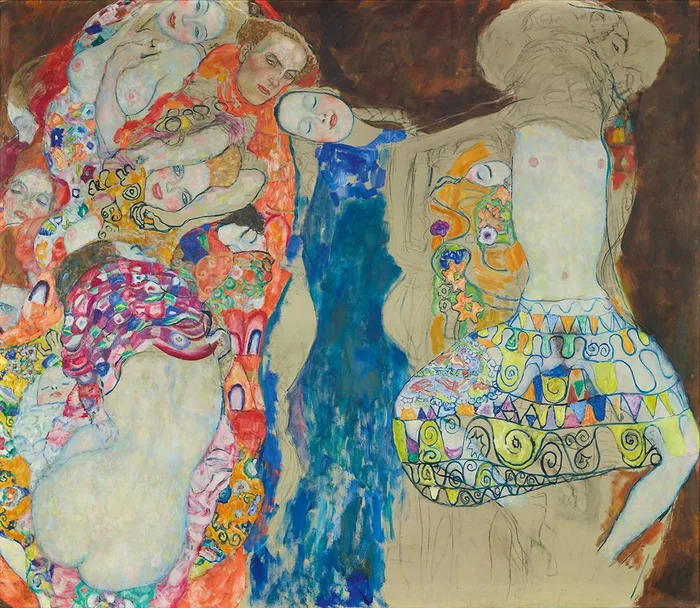
Klimt's last sketchbook holds more than 40 studies for this picture, and in several of them he tries out different tilts of the head of the right-hand figure.
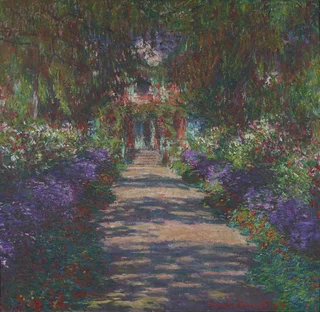
19. A Path in Monet's Garden at Giverny — Claude Monet
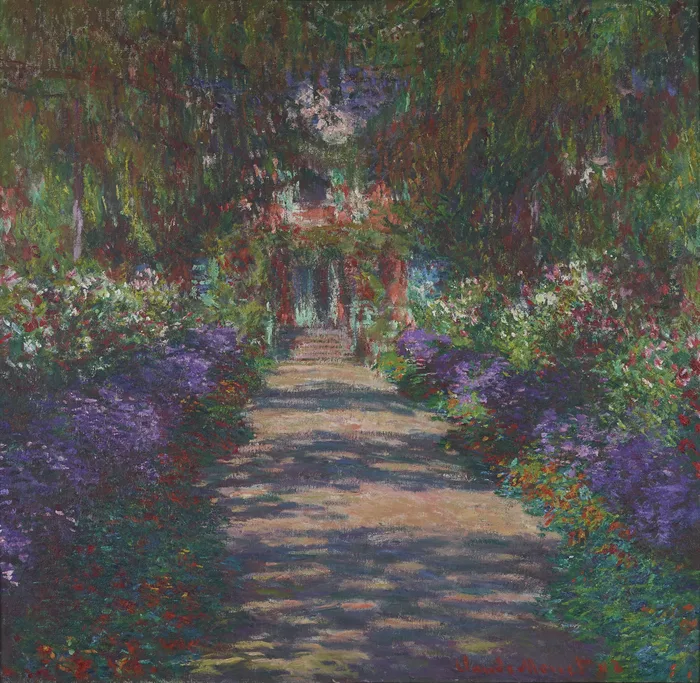
The Berlin banker Robert von Mendelssohn bought this picture in 1904 from the Paris dealer Durand-Ruel, and after his death in 1917 it passed to his widow, the Italian pianist Giulietta von Mendelssohn. In 1941 Giulietta, who was living in Italy, sold her villa in the Grunewald district of Berlin to the Reich, and agents brought the pictures from the collection to Vienna. In 1942 the office of the Nazi Reich Governor in Vienna bought 32 works through the Viennese dealer Otto Schatzker and shared them out among the museums. A self-portrait by Rembrandt went to the Kunsthistorisches Museum, and the Austrian Gallery received five paintings by Corot, Degas, Manet and Monet, this one among them. In January 1943 the gallery showed it in an exhibition of the acquisitions of 1942.
Monet painted the path in 1902 in his own garden at Giverny, where he had lived since 1883. A sandy path runs from the bottom edge, exactly down the middle of the canvas, straight to the house, of which only a pinkish-red piece of the façade and a dark door can be seen, half hidden by greenery. Blue and violet patches of shadow lie on the pale sand, beds of asters, nasturtiums and dahlias rise high on both sides, and at the top the trees almost close over into a tunnel. Monet signed “Claude Monet 02” in red paint at the lower right, among the red flowers.
In 2019 research into the provenance of the paintings from the Mendelssohn collection was taken up again, and in May 2023 Austria's Art Restitution Advisory Board recommended that A Path should not be returned, having found that the sale was not the result of political persecution or of hardship on the seller's part.
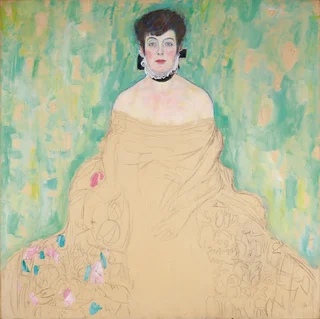
20. Portrait of Amalie Zuckerkandl — Gustav Klimt
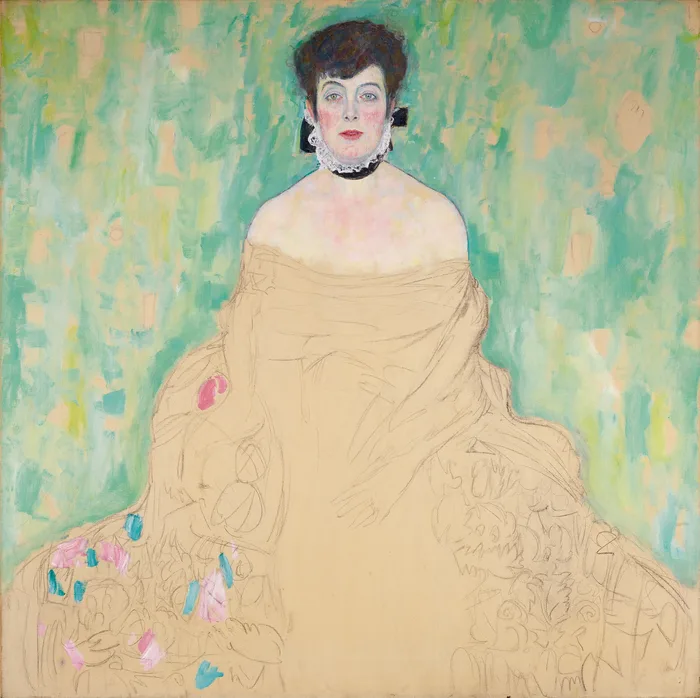
Amalie Zuckerkandl, daughter of the Viennese writer Sigmund Schlesinger, was the wife of the surgeon Otto Zuckerkandl, and in 1913 or 1914 her husband commissioned Klimt to paint her portrait. The work was broken off by the war, Klimt took it up again in 1917, and in February 1918, when he died, the portrait was still unfinished.
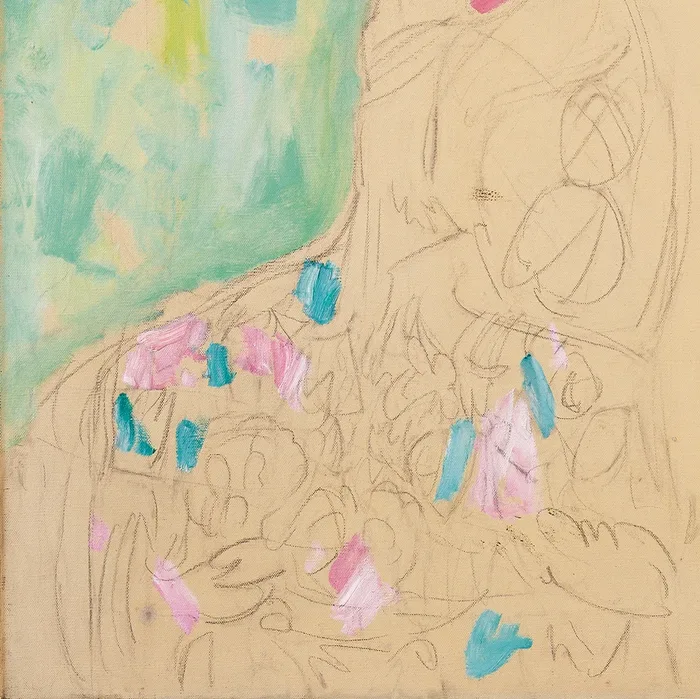
Only the head, the neck and the bare shoulders are finished: a pale face with pink cheeks, a small red mouth, dark hair piled high, a black ribbon with white lace at the throat. The background behind Amalie is painted in mint turquoise, and everything below the shoulders has remained bare ground with a pencil drawing of the folds of a shawl, a hand and a floral pattern. Here and there single patches of pink and pale blue lie on this drawing, as if Klimt had begun trying out colours. Infrared photography showed that the mouth was first drawn closed and then painted slightly open.
In 1919 the Zuckerkandls divorced, the portrait stayed with Amalie, and in the 1920s, needing money, she sold it to the sugar industrialist Ferdinand Bloch-Bauer, the husband of Adele of the golden portrait. When he left for Switzerland, Bloch-Bauer gave the picture back to the family without payment, to Amalie's daughter Hermine Müller-Hofmann. In 1942 Hermine sold the portrait for 1,600 Reichsmarks to Vita Künstler, who from 1938 had run the Neue Galerie in place of the emigrated Otto Kallir, the same Kallir who in 1931 first showed Gerstl's paintings. In that same year, 1942, Amalie was deported and murdered. In 1988 the portrait entered the Austrian Gallery as a gift from Vita Maria and Gustav Künstler.
Later the portrait was claimed by two groups of heirs, the heirs of Ferdinand Bloch-Bauer and the heirs of Hermine. Their dispute went before the same three-member arbitration panel that in January 2006 had ruled that the portrait of Adele be returned to the Bloch-Bauers. On Amalie the panel issued a separate award in May 2006, under which neither group was entitled to the picture, and the portrait stayed in Vienna. On 1 April 2008 the Supreme Court of Austria upheld that award.
The Modern Gallery opened in 1903 largely thanks to the artists of the Secession. After the Anschluss the new director bought works from confiscated Jewish collections. Since 1998 the Belvedere has been checking the provenance of these acquisitions. In 2006 the museum returned five Klimt paintings to the Bloch-Bauer heirs, and in 2008 the Supreme Court kept the portrait of Amalie Zuckerkandl in the state collection.
What Else to See
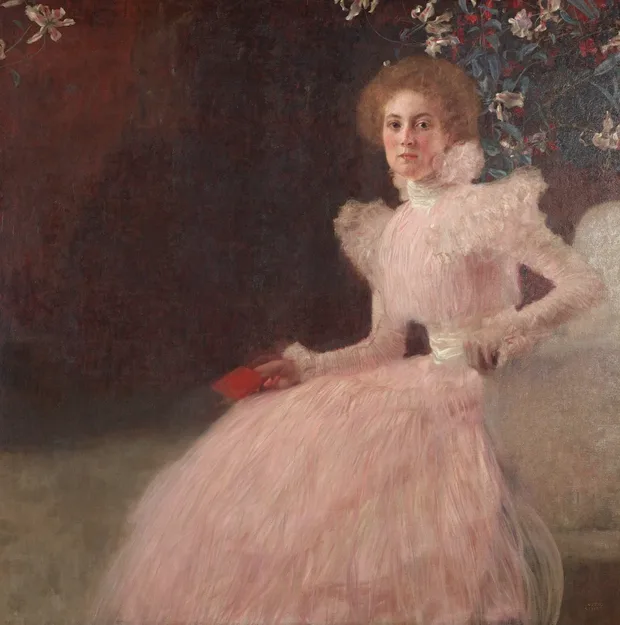
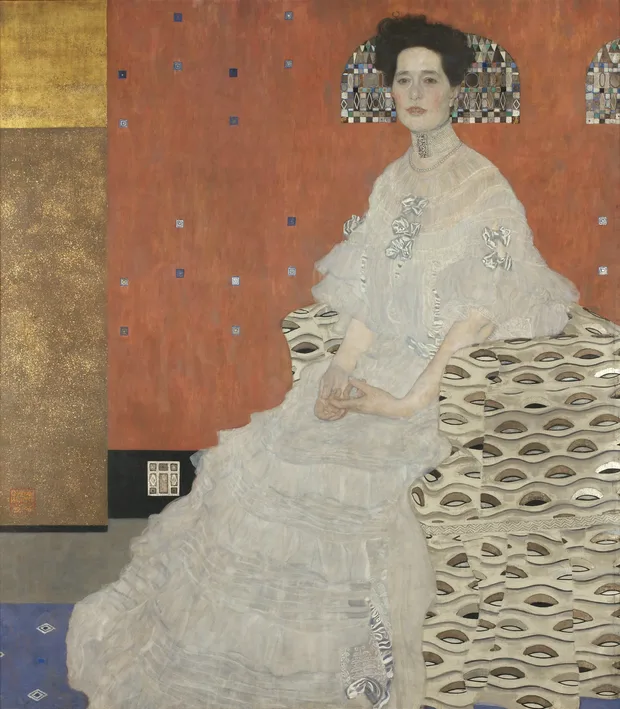
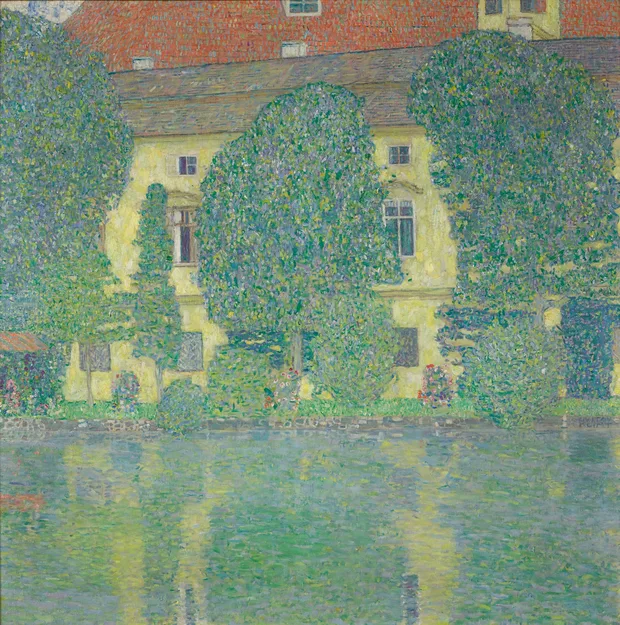
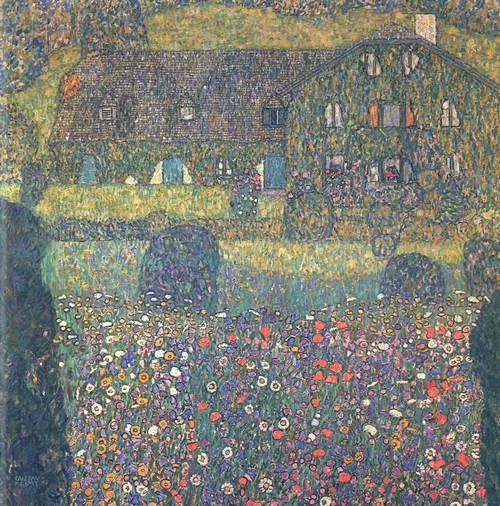
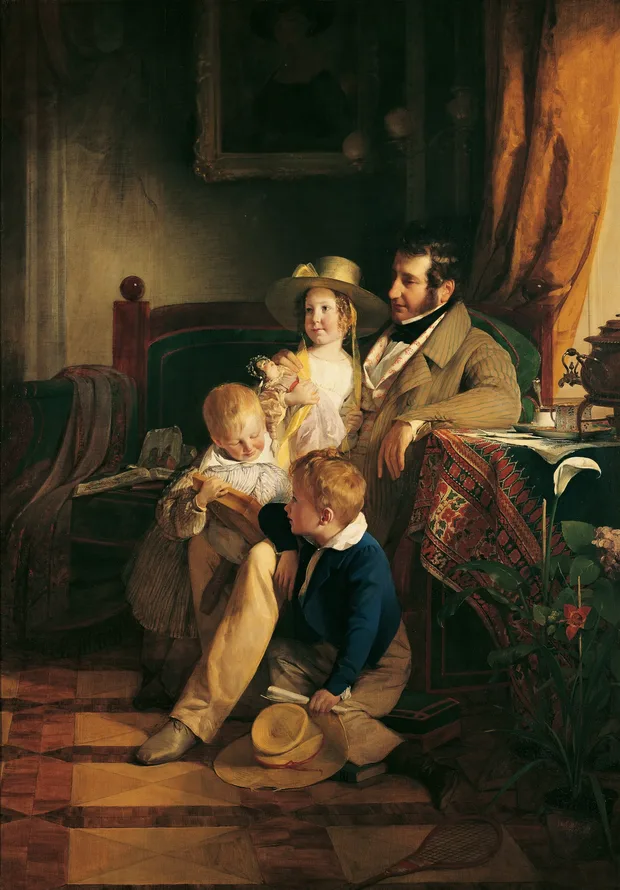
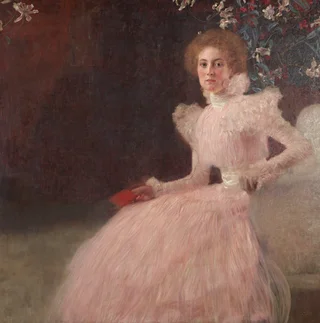
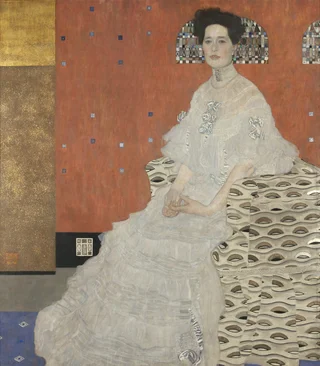
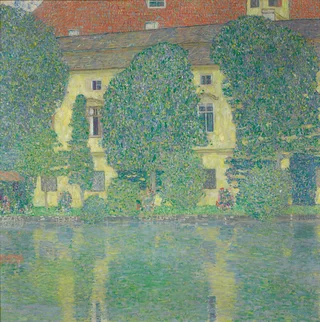
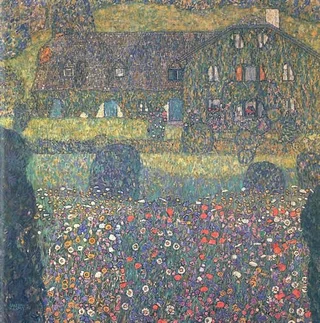
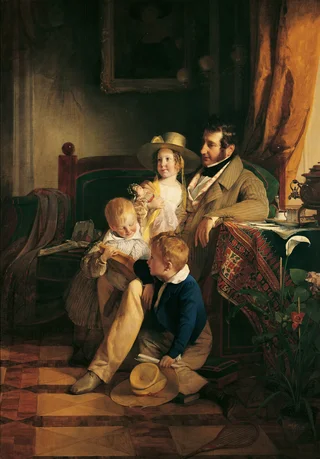
By the museum's own count the Belvedere has 24 oil paintings by Klimt, more than anywhere else in the world, and on a second visit it is worth starting with his portraits of Sonja Knips and Fritza Riedler and his landscapes of Lake Attersee. The paintings of Oskar Kokoschka deserve a visit of their own, as does Viennese Biedermeier painting, above all Friedrich von Amerling's portrait of Rudolf von Arthaber with his children, and so do the two paintings by Caspar David Friedrich. One more Klimt from the Belvedere's collection, the Beethoven Frieze, is in the Secession building.