Antonio Stradivari
1644–1737 · Duchy of Milan · Baroque
The story
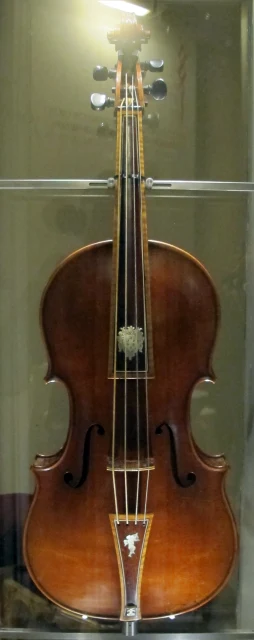
In 1690 a workshop in Cremona, the violin-making town in Lombardy, delivered five string instruments to Florence. They were for Ferdinando de' Medici, Grand Prince of Tuscany and heir to the throne, a keen musician who kept his own court players. The set held two violins, two violas of different sizes and a cello. Its tenor viola is still in Florence, in the instrument rooms of the Galleria dell'Accademia, the museum of Michelangelo's David. It carries the Medici arms in mother-of-pearl and has survived almost unaltered, probably because few players ever wanted so large a viola. One violin is lost. The other is in Rome, and the smaller viola is in the Library of Congress in Washington.
The maker, Antonio Stradivari, was then in his mid-forties. His birth is undocumented and is usually placed around 1644. On a violin of 1666 he called himself a pupil of Nicola Amati, whose family had started violin making in Cremona about a century before. In 1680 he bought a house on Piazza San Domenico and worked in its upper rooms for the rest of his life, later with his sons Francesco and Omobono beside him. Around the time of the Medici order he was trying out a longer violin pattern. The instruments players prize most date roughly from 1700 to 1725.
He kept working into his 90s. Estimates put his output at over 1,000 instruments, and around 650 survive. In 1729 he bought a family tomb in the church of San Domenico, across the square from his house, and he was buried there after his death in December 1737. The church was pulled down in 1869 and his remains were lost, while the tombstone itself is now kept in Cremona's Museo del Violino.