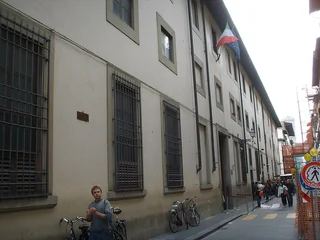
Grand Duke Pietro Leopoldo founded the Academy of Fine Arts in Florence in 1784, and the gallery attached to it began as the school's teaching collection. At first it held models for the students, then altarpieces from churches and convents closed under Pietro Leopoldo himself in the 1780s and under Napoleon in 1808–1810. The old gold-ground paintings were gathered here so that the students would have something to study.
In the 19th century the Academy also had paintings of its own made, competition pieces and exercises by its teachers and students, and these are kept in the gallery too. They are left out of this article because they were made for the Academy itself. Each of the ten works below was made for another place, a piazza, a garden grotto, a sculptor's workshop, a convent or the Medici music collection, and in each story what matters is why it was taken away from there and what became of it in the move.
The works follow the order in which they arrived in the Academy's buildings on Via Ricasoli. We begin with a clay model the Academy received in the year it was founded and end with a Stradivari viola brought here in 2001.
A model for the students (1784)
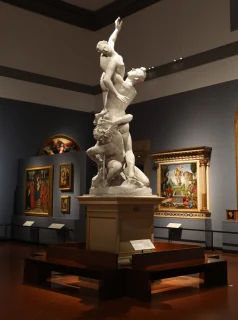
1. Model for the Rape of the Sabine Women — Giambologna, 1579–1580
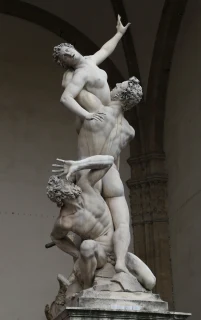
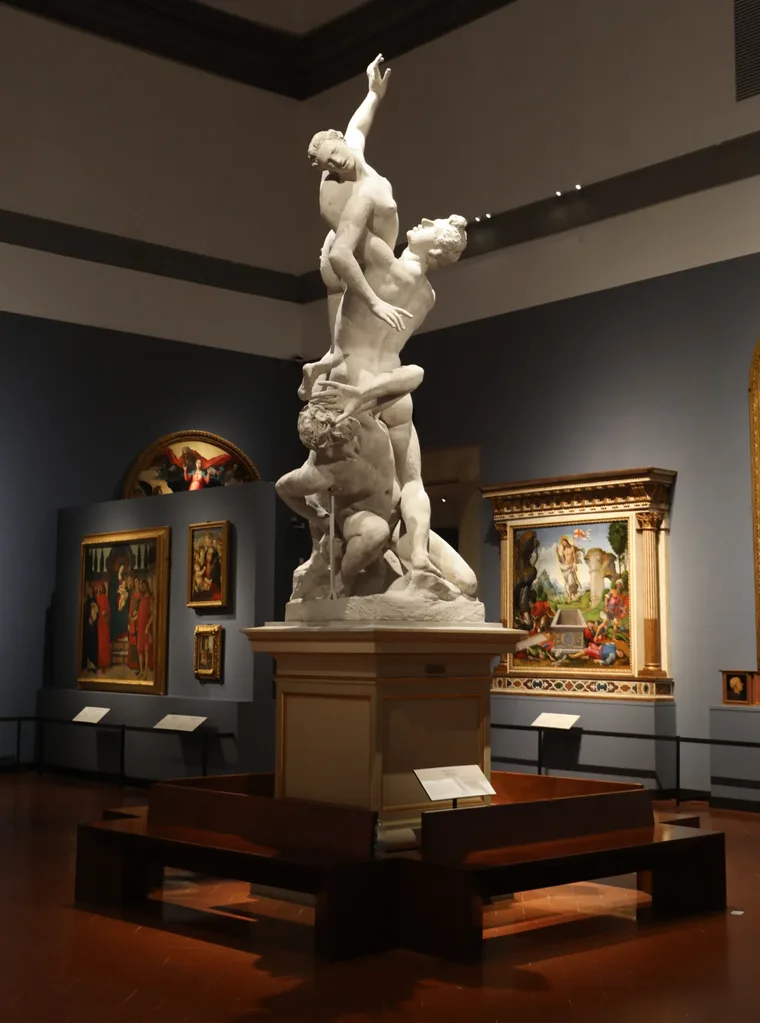
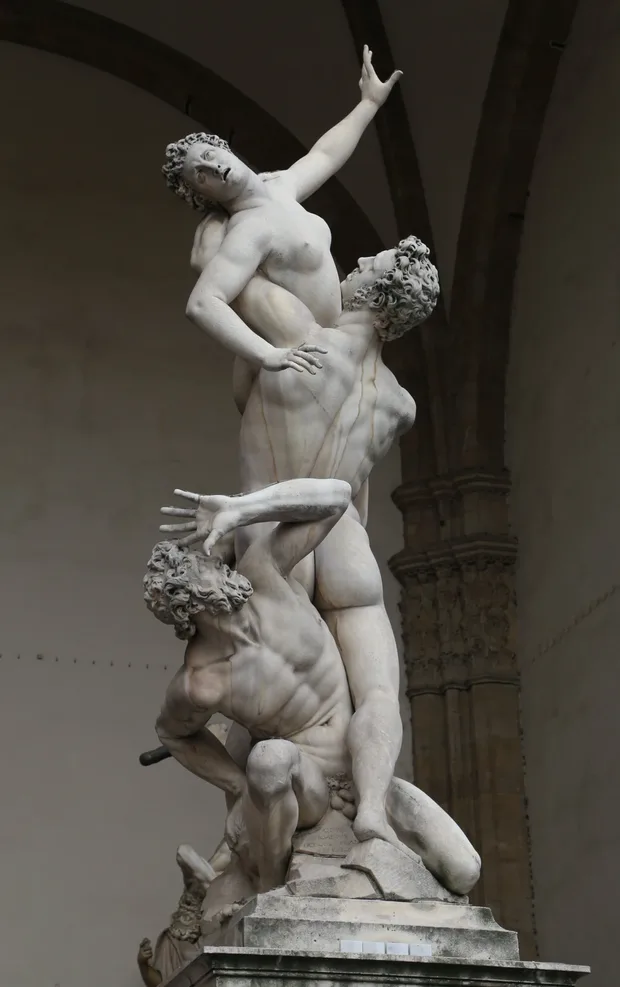
In June 1579 Giambologna, a sculptor from the Flemish town of Douai in the service of the Medici court, wrote to Ottavio Farnese, Duke of Parma, about a small bronze group of his with two figures. He had chosen the subject, he explained, to give his art room to show itself, and the group could be called the rape of Helen, of Proserpina or of a Sabine woman. Later he added a third figure and modelled the group at full size in a workshop that Grand Duke Francesco I had set up for him in Palazzo Vecchio. According to the museum, the model was made without a commission and without a fixed subject. Raffaello Borghini, in his book Il Riposo, published in 1584, relates that the title Rape of the Sabine Women was proposed once it had been decided to set the marble group up in the piazza.
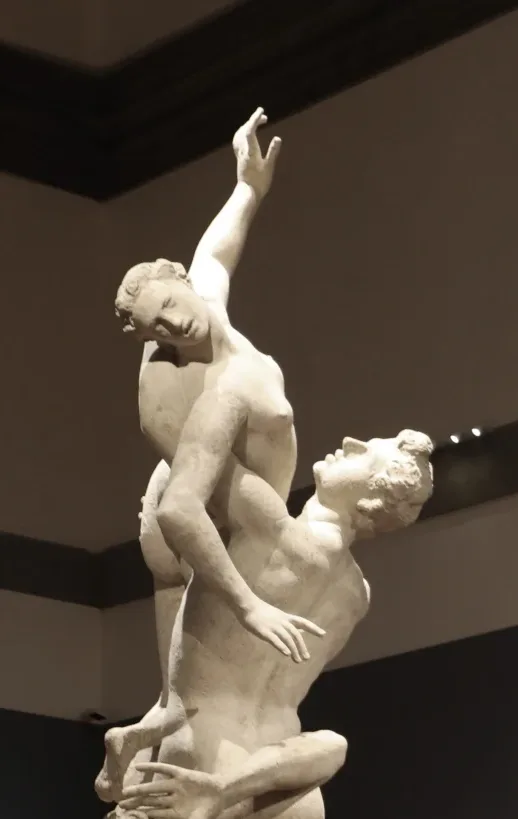
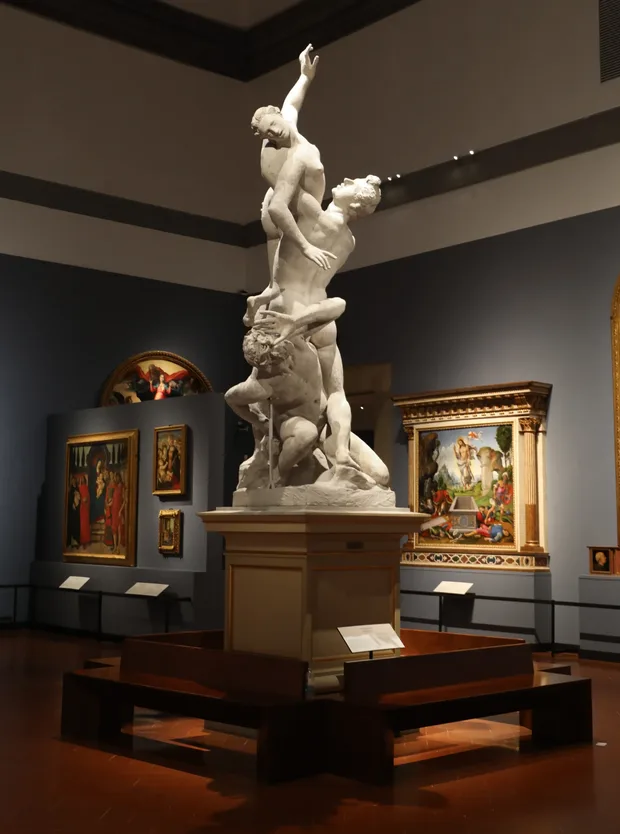
The model is made of unfired clay that was later coated with layers of plaster, which is why guidebooks often call it a plaster. Three nude figures wind into a single spiral taller than a man. A young man stands with his legs set wide, his arms wrapped round the woman's thighs, lifting her to his shoulder. She has thrown her head back and flung her left arm straight up with the fingers spread, and with her right hand she pushes against his head. Beneath them, between his legs, an old man has sunk to one knee and raises an open palm towards her. No single viewpoint shows all three faces at once, and from each side a different figure comes to the front. The thin metal rod under the old man's raised arm was added later as a prop.
The marble group was carved in 1581–1582 and set up in the Loggia dei Lanzi on Piazza della Signoria in 1582. The clay model was later moved to Giambologna's studio in Borgo Pinti, and it still appears in a 1687 inventory of the grand-ducal studio in Borgo Pinti. In 1784 the model was given to the newly founded Academy as a teaching aid, and in 1911 it passed into the gallery proper.
The model was moved many times and damaged along the way, its cracks filled with thick plaster and painted over, its lost pieces modelled afresh. Restorers working under Franca Falletti, then director of the gallery, spent about a year removing these layers behind a curtain without taking the model out of the room, and underneath they found quick, sketch-like modelling that the marble group lacks. The restored model was shown to the public on 25 February 2014.
From storerooms and closed convents (up to the 1850s)
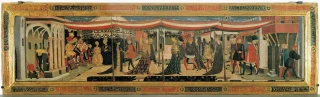
2. Dance at a Wedding (formerly the Cassone Adimari) — Lo Scheggia, c. 1450
Until the early 20th century this long painted panel was taken for the front of a cassone, a wedding chest, and connected with the Florentine Adimari family. It is too long for a chest, and it is now thought to be a spalliera, a painted panel set into the wooden panelling of a room. The museum has renamed it Dance at a Wedding and kept the old title, Cassone Adimari, only in brackets, marked “formerly”. By tradition it shows the wedding of Boccaccio Adimari and Lisa Ricasoli in 1420. Judging by its style it was painted around 1450, so it can have nothing to do with a wedding of 1420. According to one account, the panel has been in the Academy's collection since 1826.
An awning in broad red and white stripes is stretched over the street, from a loggia at the left edge to a house at the right. Under it couples move slowly, the partners holding each other only by the fingertips. The women have high bare foreheads, tall headdresses and very long trains of black and dark green brocade with a gold pattern. Left of centre, musicians sit on a bench covered with a carpet: one plays a long curved trumpet with a slide, the other two play straight trumpets, and from the straight trumpets hang white banners with the red lily of Florence. Behind the musicians stands the striped black and white marble wall of the Baptistery. On the left, under a loggia with twisted pink columns, a servant in black carries a large gold basin on his head.
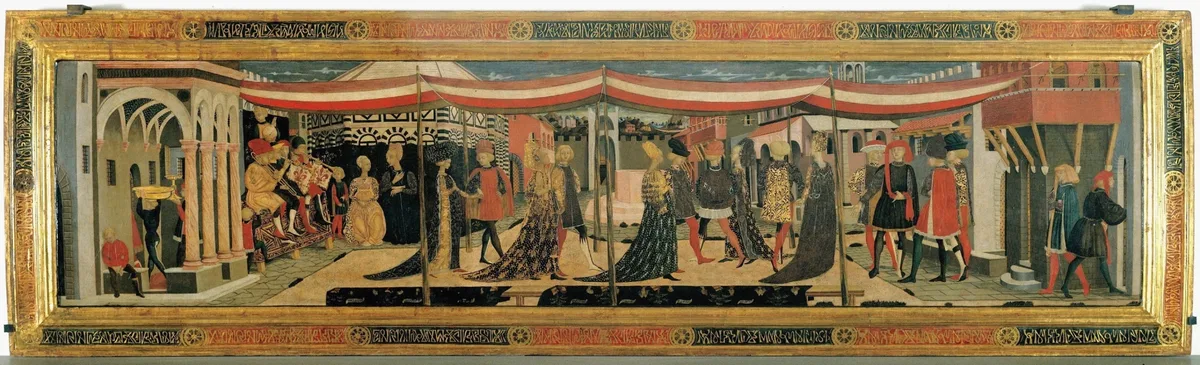
For a long time the painter was called the Master of the Adimari Cassone. In 1969 the art historian Luciano Bellosi, in a lecture in Florence, identified him as Giovanni di ser Giovanni, known as Lo Scheggia, the younger brother of Masaccio. Scheggia's workshop worked for noble Florentine families and turned out costly painting for the home, chests, wall panels and the trays given to women after childbirth. Bellosi compared the panel with Scheggia's signed fresco in his home town of San Giovanni Valdarno, and after meeting objections he held the lecture back for many years. The text came out only in 1999.
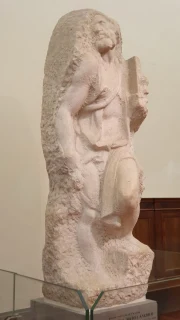
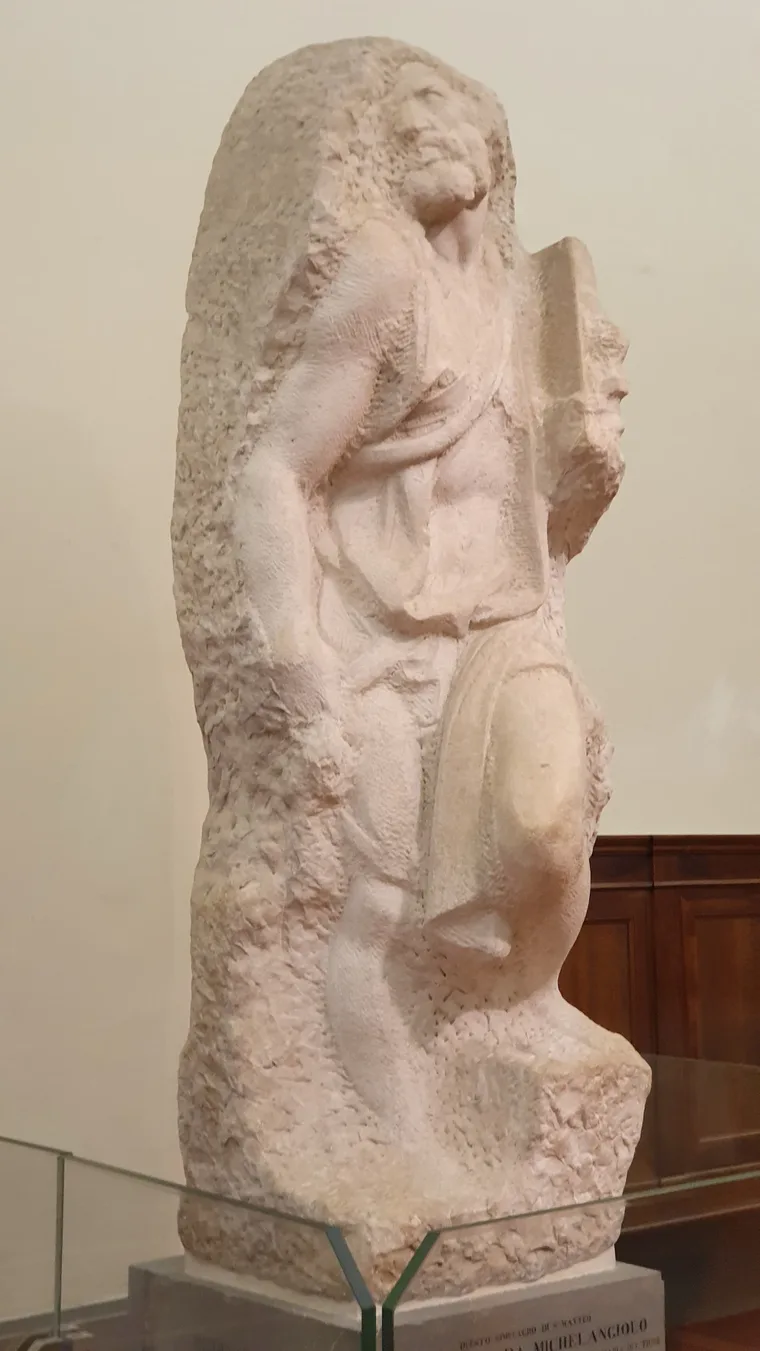
3. Saint Matthew — Michelangelo, 1505–1506
One part of Saint Matthew is almost polished, while another is still a block of stone. Matthew is carved into the front face of a tall, narrow block, almost like a very high relief, and at the edges and the bottom the stone has been left rough, chipped and pitted. The head is thrown back and turned sharply towards the left shoulder, the face only roughed out. The left knee juts forward out of the block and is smoothed almost to a shine, the most finished place on the statue. The chest, arms and folds of drapery are covered with the close cross-hatching of a toothed chisel, like woven cloth, and it shows clearly in raking light. The book pressed to his left shoulder has stayed a flat slab, its lower half still joined to the stone.
In 1503 the Opera del Duomo, the board of works of Florence Cathedral, together with the wool merchants' guild, commissioned from Michelangelo 12 Apostles larger than life for the niches at the piers of the cathedral dome, one statue a year. He was still working on the David (we come to it below), and the marble blocks for the Apostles were quarried only in 1504–1505. In December 1505, when Michelangelo left for Rome to work for Pope Julius II, the contract was cancelled. Of the 12 Apostles he began only Matthew, and, judging by a letter from Piero Soderini, head of the Florentine Republic, he went on working on it in 1506.
Vasari wrote in 1568 that this statue, left as it is, teaches sculptors how to bring figures out of marble without maiming them: by taking the stone away gradually and always leaving some in reserve, so that something can be changed later. The Opera del Duomo kept the statue in its yard and storerooms for more than three centuries, and by its own account several generations of sculptors learned from the Matthew.
In 1831 the statue was moved to the atrium of the Academy of Fine Arts, and on 21 July 1909, when the gallery was laying out the route to the David, it was brought from the neighbouring courtyard into the gallery itself. A long Italian inscription cut into the grey stone pedestal records that this statue of Saint Matthew, begun by Michelangelo, stood for a long time in the courtyard of the Opera of the cathedral of Santa Maria del Fiore and in MDCCCXXXI, that is in 1831, was moved to this Academy of Fine Arts.
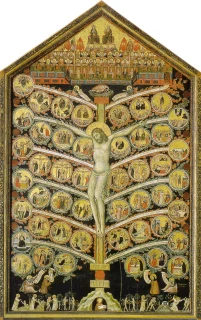
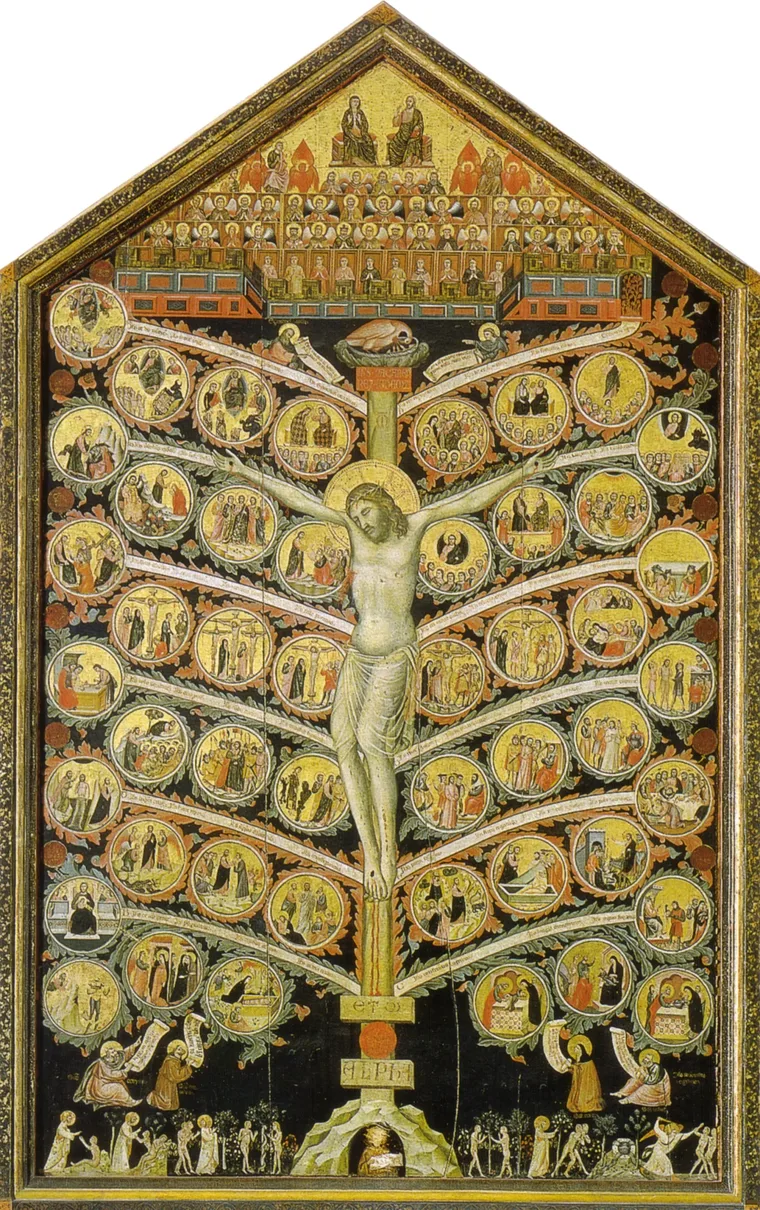
4. The Tree of Life — Pacino di Bonaguida, c. 1310–1315
In the middle of the large panel a pale Christ is crucified directly on the olive green trunk of a tree, his eyes closed, and thin red trickles of blood run from his feet down the trunk. To either side spread 12 pale ribbon-like branches carrying small Latin inscriptions, six on each side, and from them gold medallions with tiny scenes from the life of Christ hang like fruit.
Pacino illustrated The Tree of Life by the Franciscan Bonaventure, who wrote in the 13th century. It is a book for meditation that lays out the life of Christ along an imaginary tree, 12 branches with four chapters on each, so that it would be easier to hold in memory. There are 47 medallions, and the upper right branch has three instead of four, because the painter moved the book's last, 48th chapter, on Christ as Alpha and Omega, to the foot of the trunk as two tablets inscribed “ALPHA” and “ET ω”. Below them a monk sits in a cave on a rocky hill holding an open sheet. He is usually taken to be Bonaventure himself, although his face is almost rubbed away.
Pacino was above all a book illuminator who ran a large workshop in Florence, and on this panel he fitted 47 scenes the size of book miniatures. The painter's name stayed unknown until 1885, when the art historian Henry Thode attributed the panel to Pacino di Bonaguida.
The panel was painted for the Poor Clares of Monticelli, the oldest convent of the Order of Saint Clare in Florence, which stood outside the city's San Frediano gate. During the siege of Florence in 1529–1530 the convent was demolished, and in 1531 the nuns moved inside the city walls to Via dei Malcontenti, taking the panel with them. In 1808, when Napoleon suppressed the convents, the panel ended up in nearby Montedomini, a former convent turned into a workhouse for the poor. It was found there in October 1849, and by 1850 it was already on show in the Academy.
5. Venus and Cupid — Pontormo after a cartoon by Michelangelo, c. 1533
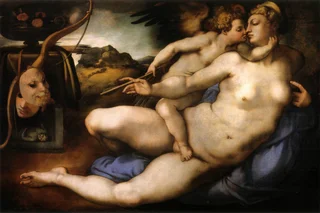
Vasari tells the story of this painting in his life of Pontormo, published in 1568. Bartolomeo Bettini, a Florentine merchant and banker and a friend of Michelangelo, had received from him a full-size cartoon of Venus and Cupid and wanted Pontormo to paint a picture from it. It was to hang in the middle of a room in whose lunettes Bronzino had already begun painting Dante, Petrarch and Boccaccio, and in time all the poets who had written of love in Tuscan were to join them. When Pontormo finished, people who wanted to spite Bettini, as Vasari tells it, took the finished picture from the painter almost by force and handed it to Duke Alessandro de' Medici. The duke paid Pontormo 50 gold scudi, and Bettini was given his cartoon back.
Venus lies across the whole width of the panel, her head towards the upper right, her body pale, almost white, with heavy thighs and a strongly modelled belly, as if carved from stone. She has turned her head to kiss Cupid, who has thrown an arm round her neck from behind and pressed his palm to her cheek. With her outstretched hand Venus has caught one arrow between her fingers and is drawing it out of the bundle Cupid holds in front of him. On the left two masks hang from a bow on a red ribbon, one old, with a grey moustache and beard, and one young, with half-closed eyes.
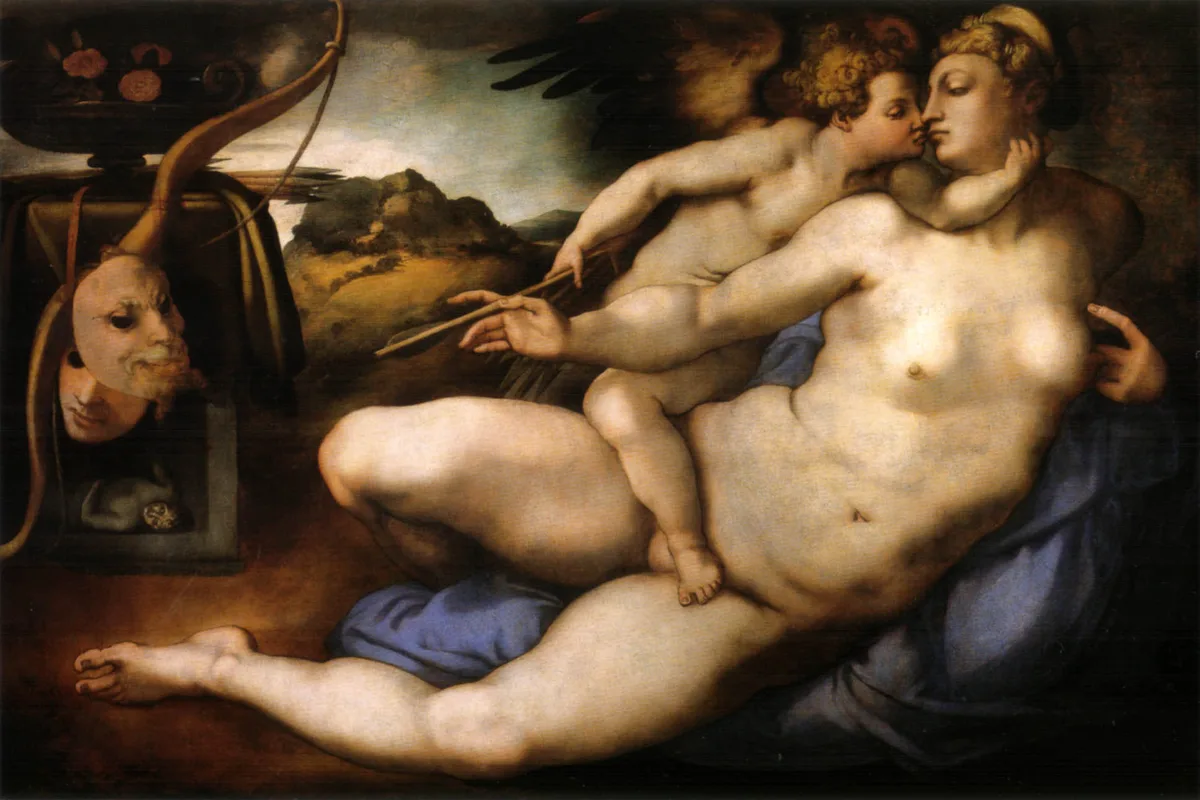
Later Venus's nakedness was covered with painted cloth from the breast to mid-thigh, and in that state the picture disappeared into the grand dukes' storerooms. In 1850 it was found there and recognised as Bettini's painting, and in 1852 the restorer Ulisse Forni removed most of the drapery. The museum names Pontormo as the painter, while the state catalogue records that scholars disagree, some taking the picture for Pontormo's original and others for a copy. Of copies of the composition, more than 30 are known. The last strip of cloth, over Venus's pubis, was removed only in the 2002 restoration.
Michelangelo brought indoors (1873–1909)
6. David — Michelangelo, 1501–1504
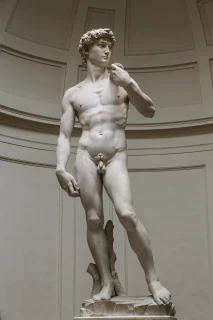
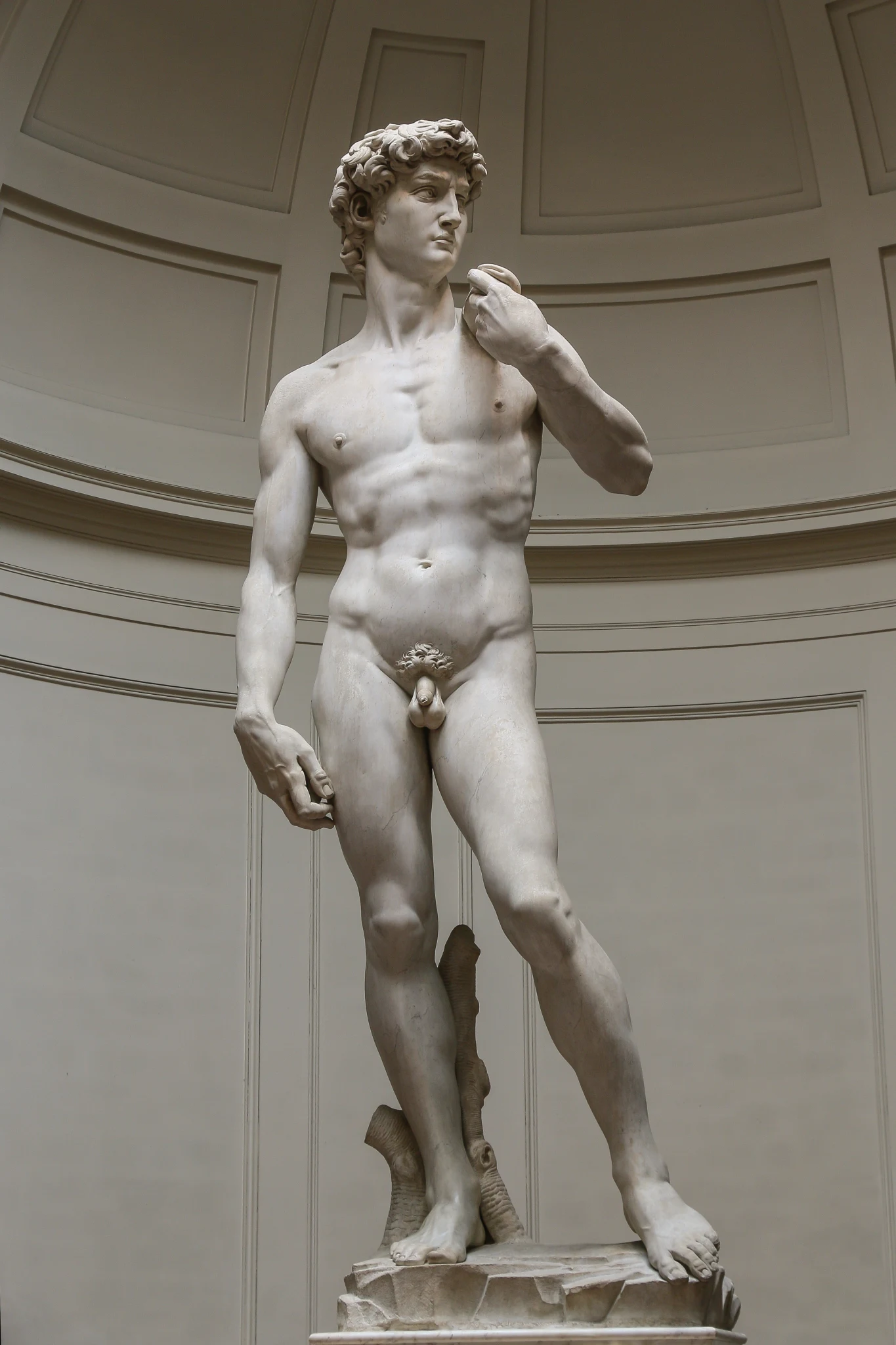
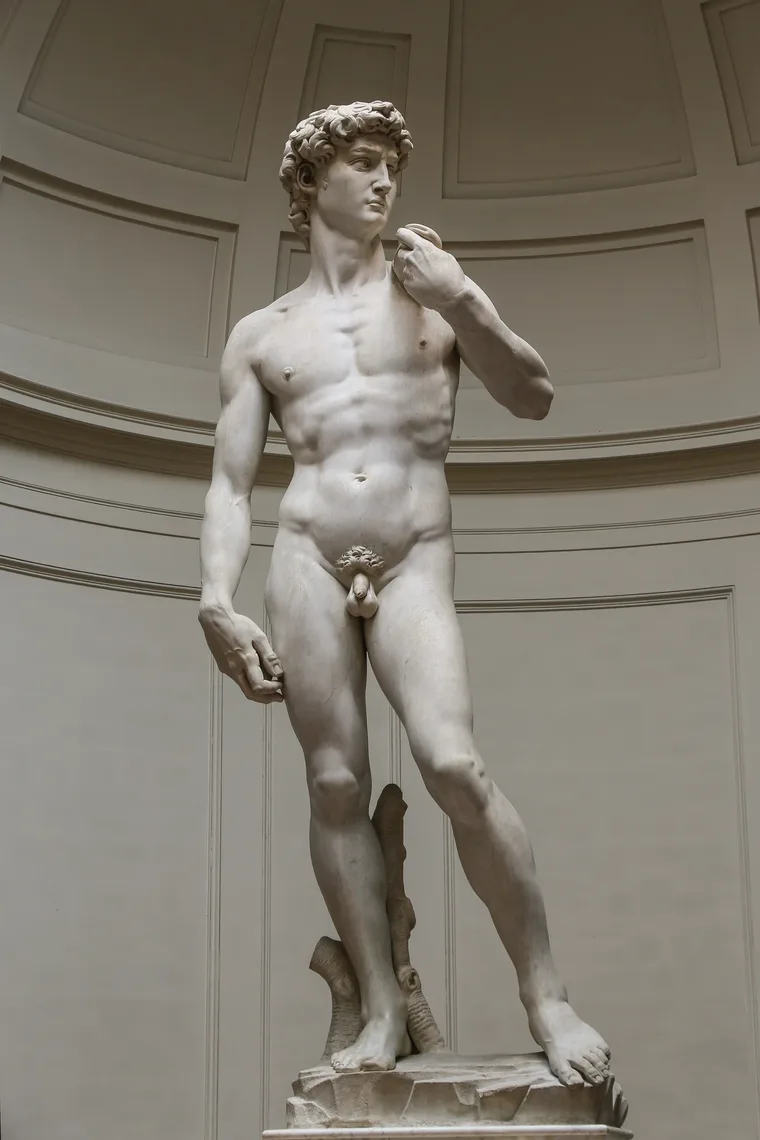
The tall, narrow block of Carrara marble had once been ordered by the Opera del Duomo for the statue of a giant, one of the prophets meant to stand on the cathedral's buttresses. In 1464 the sculptor Agostino di Duccio took on the block, began to rough it out and gave up. In 1476 Antonio Rossellino took it over and also abandoned it, and after that the block lay in the Opera's yard for about 25 years.
In the spring of 1501 the 26-year-old Michelangelo Buonarroti, whose Pietà for St Peter's had already made his name in Rome, came back to Florence. Florence was a republic at the time, and he was given the abandoned block. In January 1504 about 30 citizens and artists met to decide where the statue should go, and they chose a place by the entrance to Palazzo Vecchio, where Donatello's Judith had stood until then. The David was unveiled on 8 September 1504. It had been begun as a prophet for the cathedral, and it was set up at the door of the town hall as a sign of the republic restored after the Medici had been driven out.
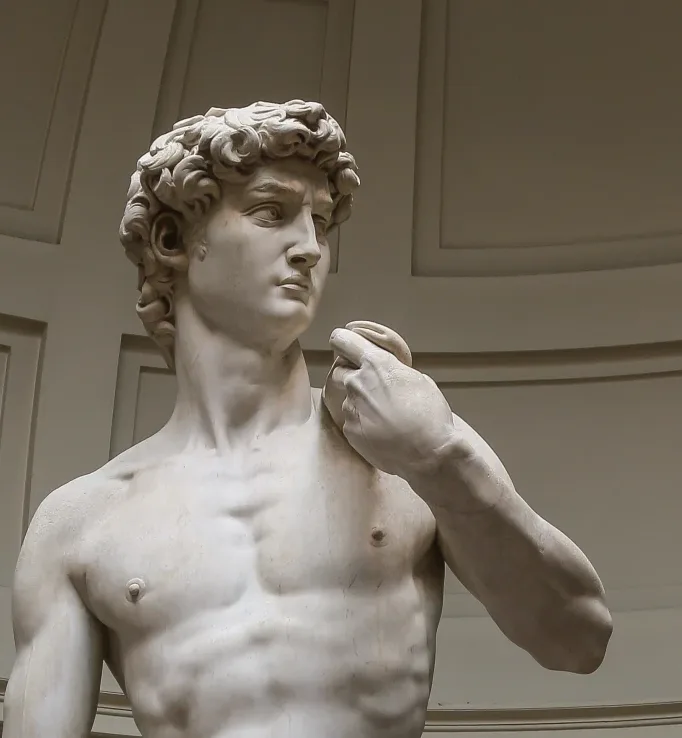
The David's weight rests on his right leg, with a tree stump carved behind the calf as a support, while the left leg is set out to the side and its toes hang over the edge of the rough stone base. The brows are drawn together, the head is turned sharply to the left, the tendons stand out on the neck. The left hand is raised to the shoulder and holds a fold of the sling. The strap of the sling runs diagonally across the whole back to the right hip and becomes a cord, whose end is gripped in the lowered right hand with its swollen veins. Seen from below, the head and hands look too large for the body.
The David stood in the piazza for 369 years. In 1527, during the uprising against the Medici, a bench thrown from the palace broke the statue's left arm into three pieces, and the arm was put back together only in 1543. In 1843 the sculptor Aristodemo Costoli cleaned the marble with a solution of hydrochloric acid and with sharp tools, and weakened its surface. The paving under the statue was sinking unevenly, the David was slowly tilting forward, and cracks opened in the ankles.
In 1873 it was decided to bring the statue indoors. From 31 July to 4 August it was taken to the Academy standing upright, in a wooden cart hung on steel springs and running on rails, and because of the heat the men worked only from four to eleven in the morning. The room for it had barely been begun, and the David stood in a crate until 1875, when it was unpacked for the 400th anniversary of Michelangelo's birth. The Tribune that the architect Emilio De Fabris built around the statue opened in 1882, and in 1910 a marble copy was put up on the old spot in the piazza.
On 14 September 1991 a man who had brought a hammer into the gallery under his clothes struck the statue's left foot and broke off the second toe. The fragments were collected, and a few days later restorers from the Opificio delle Pietre Dure, the Florentine conservation workshop, put the toe back in place.
7. The Prisoners — Michelangelo, c. 1520–1534
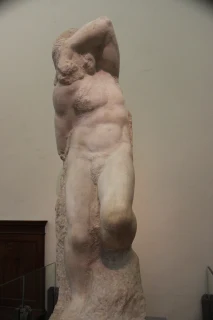
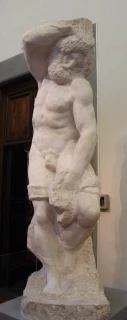
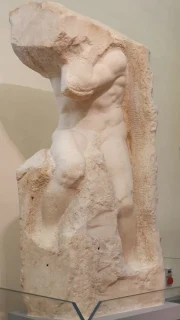
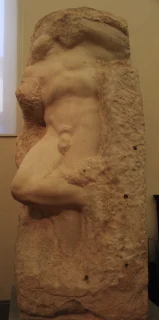
After Michelangelo's death in 1564 his nephew and heir, Leonardo Buonarroti, gave Duke Cosimo I de' Medici four unfinished marble figures from his uncle's Florentine workshop on Via Mozza. Michelangelo had been carving them for the tomb of Pope Julius II, a project redrawn and cut down many times between 1505 and 1542. The contract of 1542 dropped the prisoners from the design altogether, and in 1545 the tomb was set up in the Roman church of San Pietro in Vincoli without them. Scholars disagree about when Michelangelo worked on them, some putting it in 1519 and others in the early 1530s.
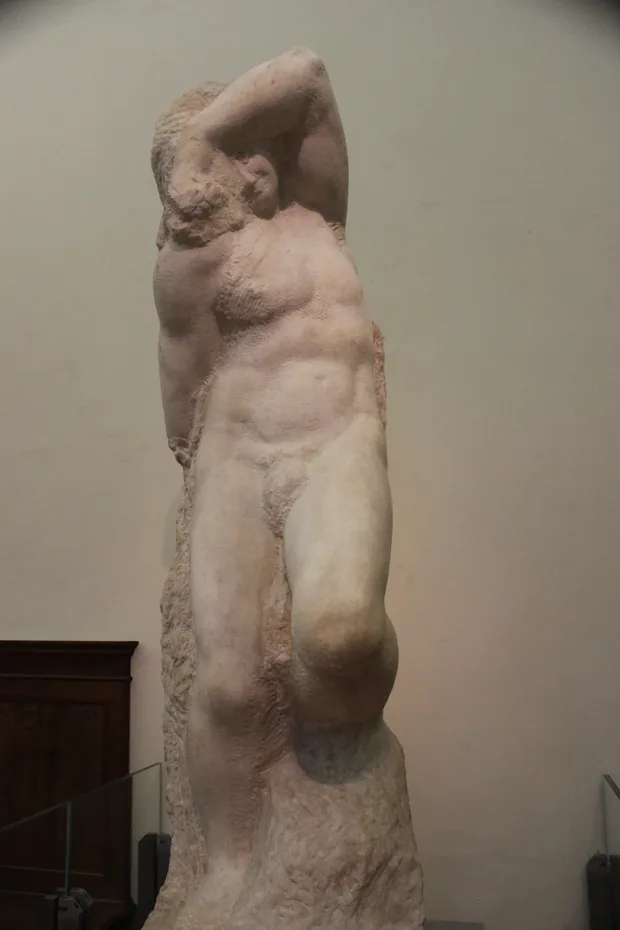
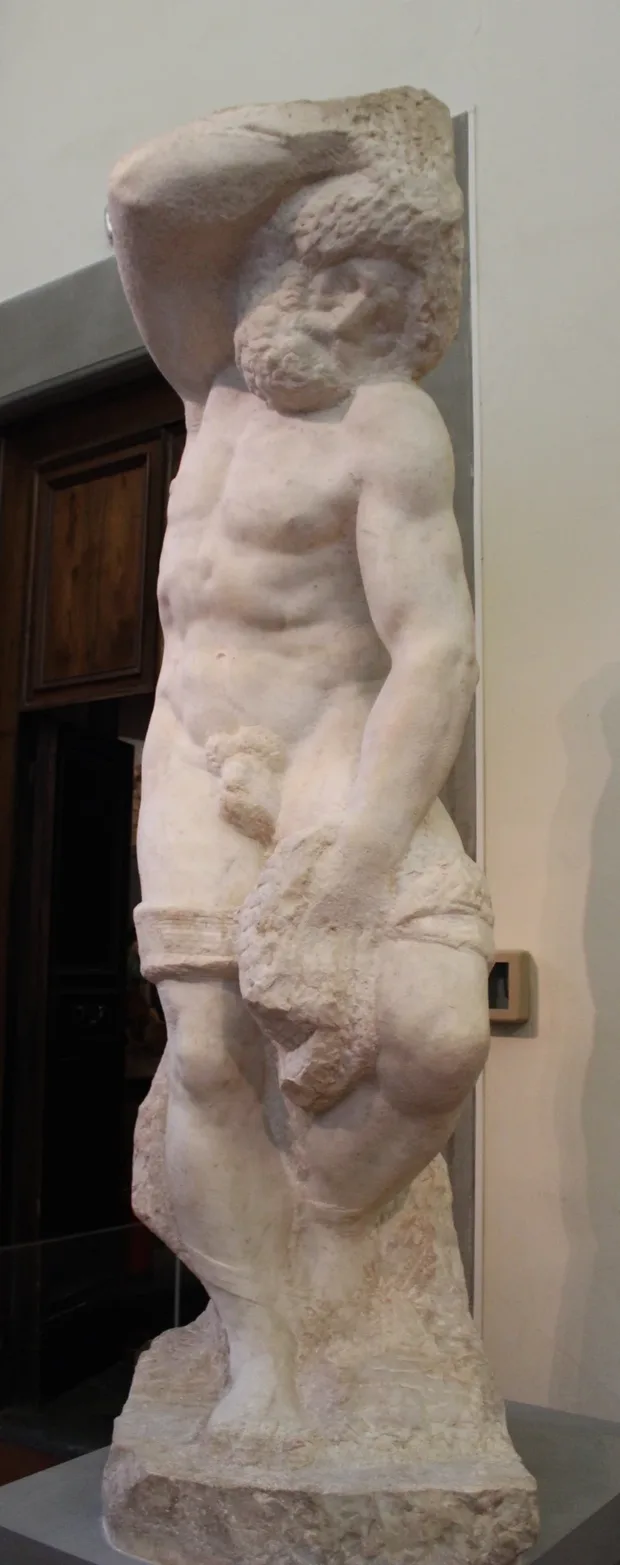
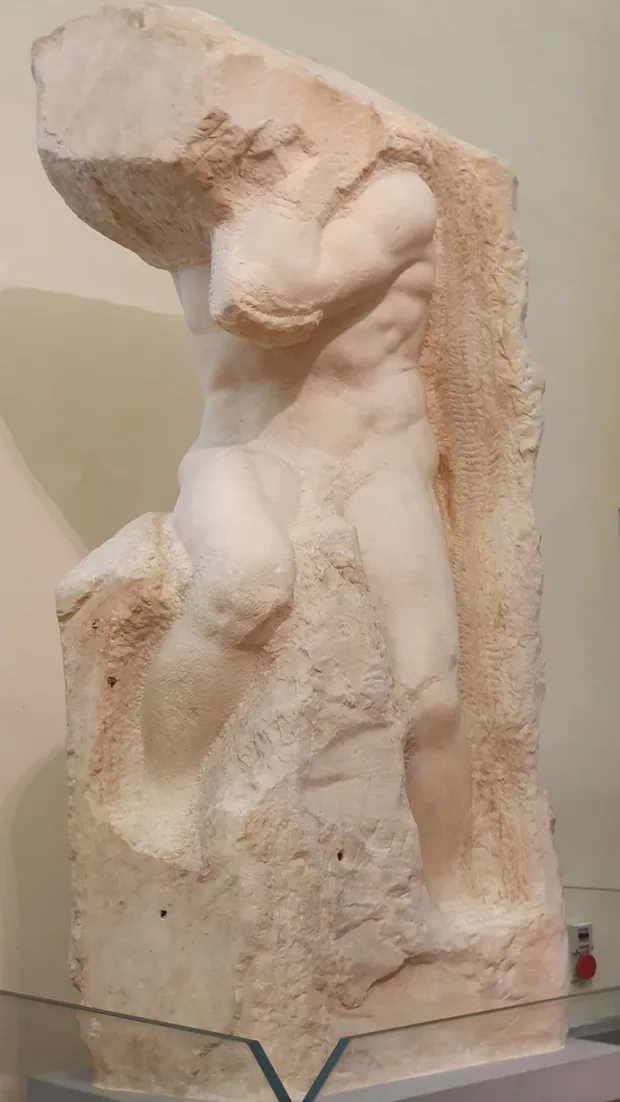
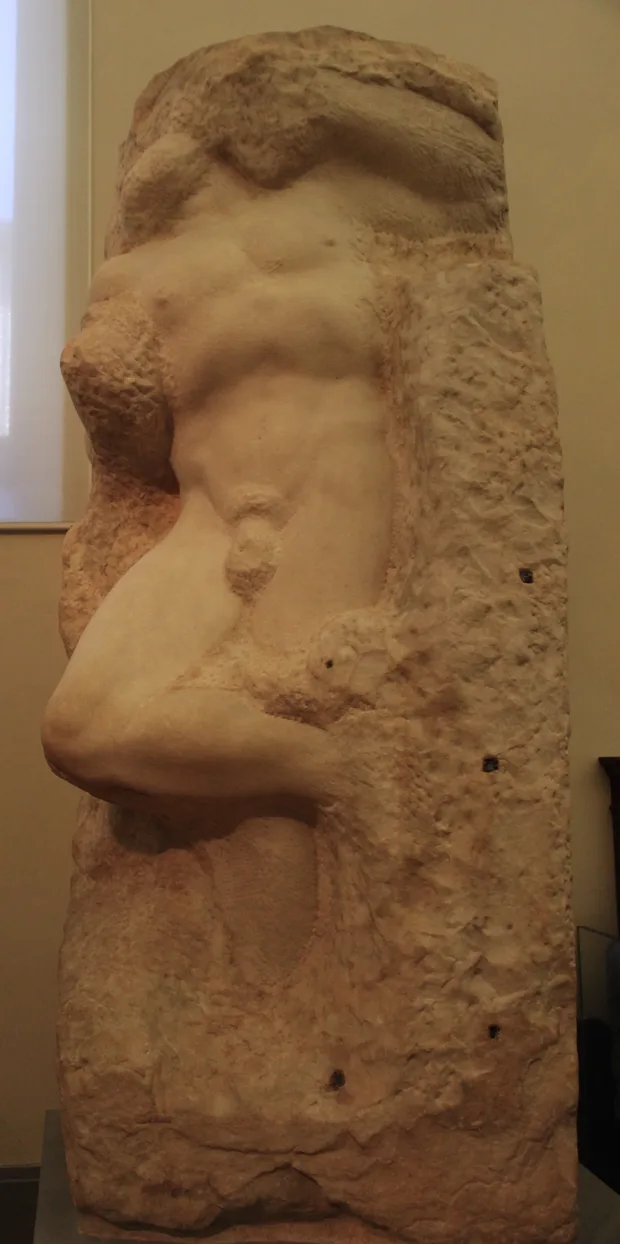
The figures were named later, after their poses, as the Young Slave, the Bearded Slave, the Atlas Slave and the Awakening Slave. Where the Atlas Slave should have a head there is a rough square lump of stone, and the figure seems to carry that stone on its shoulders as the mythical Atlas carried the sky. The Bearded Slave is the furthest advanced: the muscles of his chest and belly are crisp and almost polished, although the hand of his lowered arm is still a shapeless lump. The Young Slave hides his face behind an arm bent over his head, and from behind he is almost all untouched block, out of which only the shoulders are beginning to emerge.
In the 1580s their unfinished state turned out, unexpectedly, to suit a new setting. Under Cosimo's son, Grand Duke Francesco I, the prisoners were set into the four corners of the first chamber of the Grotta Grande, which the Medici architect Bernardo Buontalenti was building in the Boboli Gardens. There they stood among shepherds and animals modelled in porous stone, as though holding up the vault of the cave, and the rough marble made the bodies look as if they really were coming out of the rock. In 1909 they were taken from the grotto to the Academy to line the approach to the David. Casts stand in their places in the corners of the grotto.
The Uffizi gives up an altarpiece (1954)
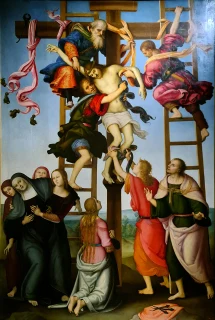
8. Deposition from the Cross — Filippino Lippi and Pietro Perugino, 1504–1507
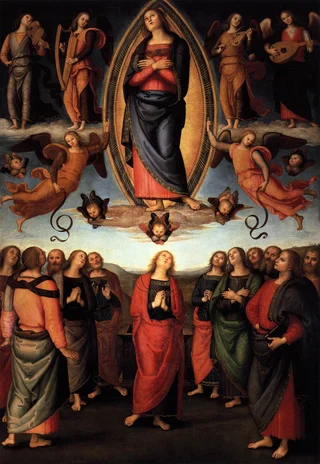
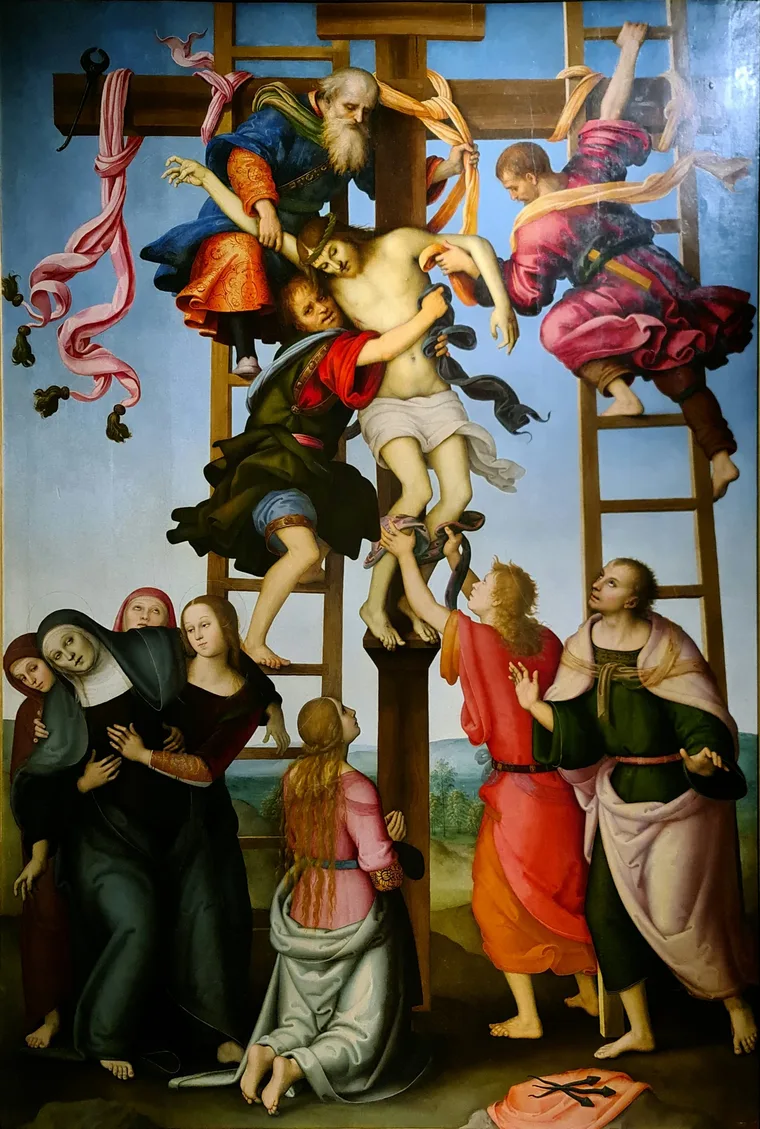
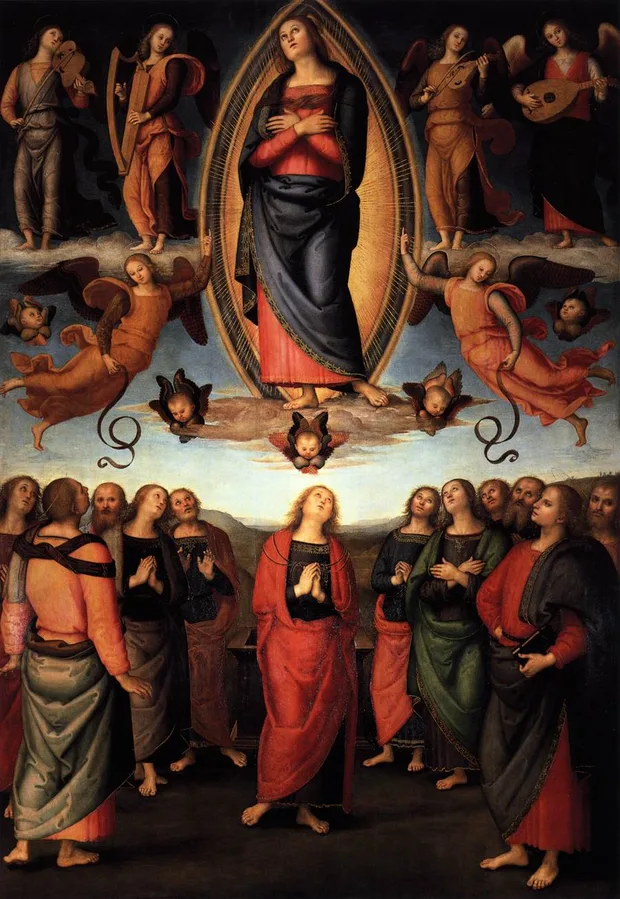
Filippino Lippi, son of the painter Fra Filippo Lippi and a pupil of Botticelli, died in April 1504 with only the upper half of this panel painted. It had been commissioned by the Servite friars for the high altar of the Florentine church of the Santissima Annunziata, a huge double-sided altarpiece with the Deposition from the Cross on one face and the Assumption of the Virgin on the other. The contract with Filippino was signed in 1503. On 5 August 1505 the work passed to Pietro Perugino, who ten years earlier had been the most successful painter in Italy, and in November 1507 the finished paintings were valued.
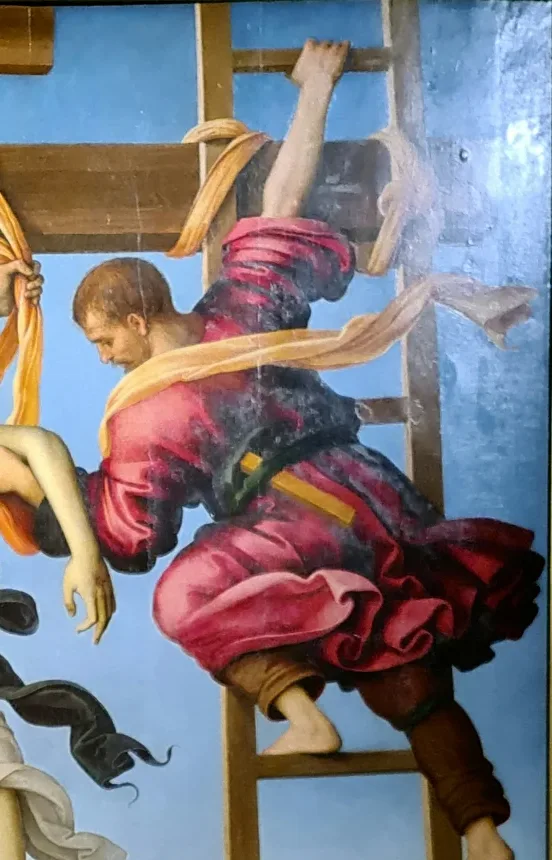
At the top everything is in motion: a long pink cloth wound round the left end of the crossbar flies out in loops, the yellow ribbons that tie the right-hand ladder to the cross flap in the wind, and a man in crimson hangs almost head down on the right-hand ladder, one bare foot hooked over the top rung, holding Christ's arm. Below, the figures stand still in heavy folds. The Virgin sinks into the arms of three women, the Magdalene with her long golden hair kneels at the foot of the cross with her back almost turned to us, and in the lower right corner three nails lie on an orange cloth.
The change from one painter to the other did not please everyone at the time. Vasari writes that the young painters of Florence greeted the finished altarpiece with sonnets and public abuse because Perugino had repeated his old figures in it. Perugino answered that he had used the very figures they had once praised.
Historians differ over the details, but the men on the ladders are usually given to Filippino and the group on the ground to Perugino, while the body of Christ is thought to have been begun by Filippino and finished by Perugino.
In 1546 the altarpiece was dismantled and a wooden ciborium put in its place. The Assumption stayed in the church, and the Deposition eventually entered the collections of the Grand Dukes of Tuscany. Historians have not established where the panel was in between. In 1954 the Uffizi handed it over to the Academy because it did not fit the Uffizi's own route.
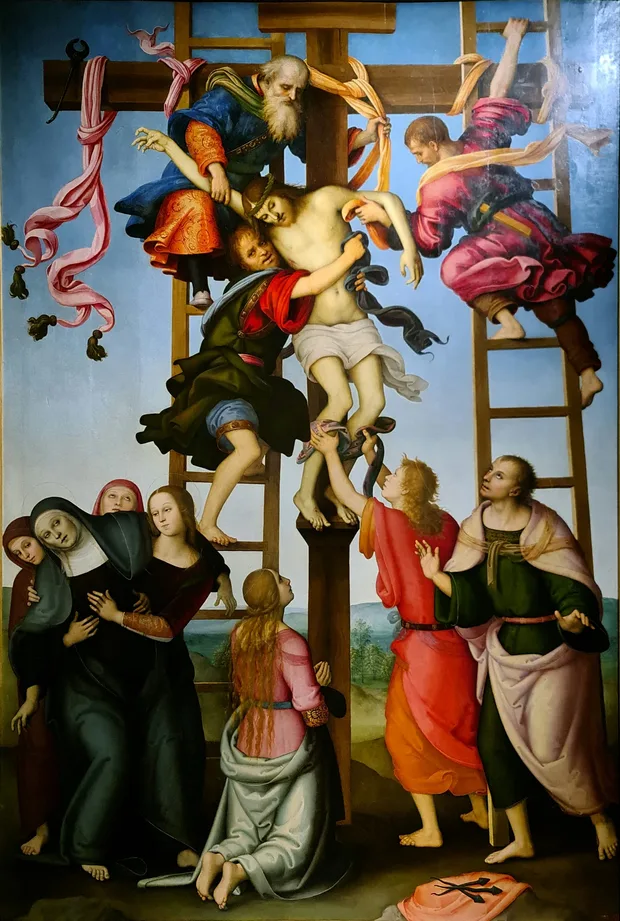
Because of the panel's size and poor condition, the 1996–1997 restoration was carried out in the Academy itself. Specialists from the National Institute of Optics photographed it in infrared and found Filippino's underdrawing beneath the paint, with the Magdalene in a different position. Perugino moved her when he took over the work.
After the flood, and from the conservatory (1966–2001)
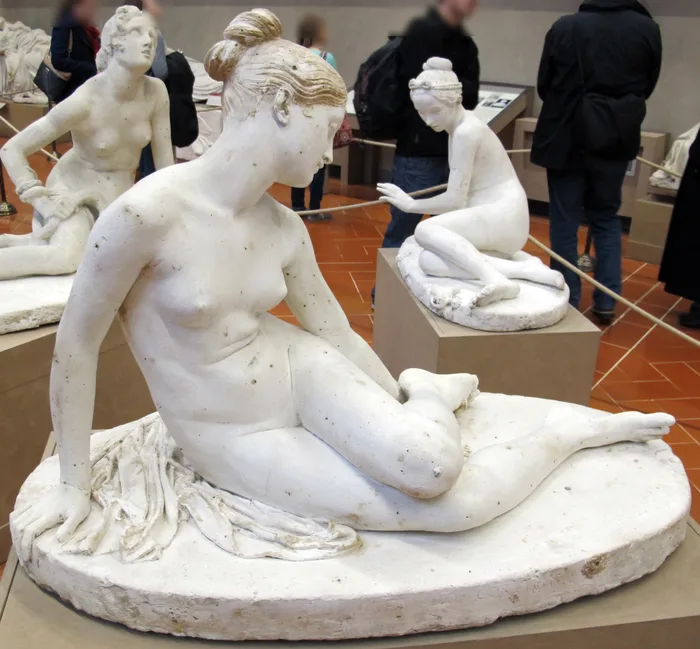
9. Lorenzo Bartolini's plasters and the Nymph with a Scorpion, before 1837
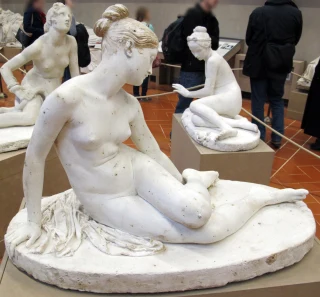
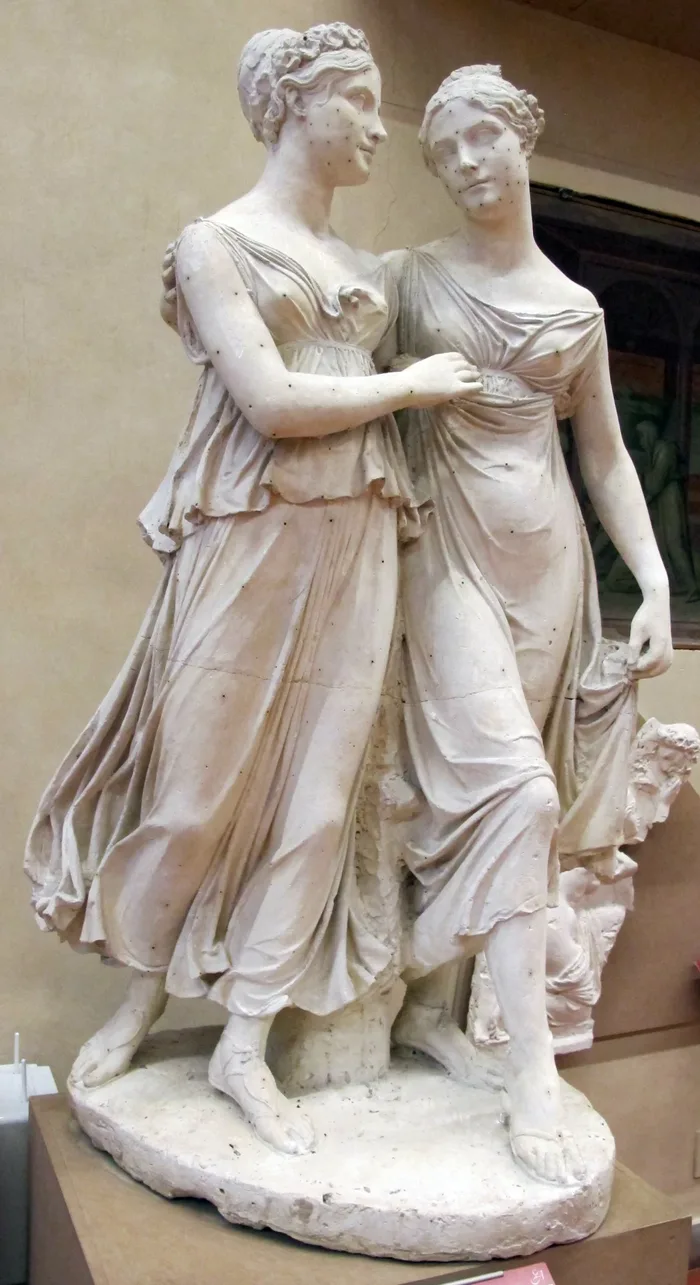
Small dark dots are scattered over Lorenzo Bartolini's plaster nymph, on the shoulder, the collarbone, the breast, the belly, the thighs, the knee and right at the hairline. They are the heads of little metal nails driven into the plaster as fixed marks. From them a measuring instrument transferred distances to the marble block, and the more nails there were, the more exact the copy came out.
The naked girl sits low on an oval slab, one leg stretched out, the other bent so that its foot lies across the outstretched leg. She bends her head and stares at that foot, holding its toes in her hand, as if she has just been stung. The scorpion is right there, small and flat, modelled in low relief on the slab between the outstretched leg and the raised foot. It is white on white, and it is easiest to spot from the side of her feet.
The marble Nymph with a Scorpion was commissioned by Prince Charles-Juste de Beauvau-Craon for his Château d'Haroué in Lorraine. The plaster was already in the studio in 1837, when Bartolini was asked what a repeat in marble would cost. The marble was shown at the Paris Salon of 1845 and has been in the Louvre since 1994. A second marble was commissioned by the Russian emperor Nicholas I and finished after Bartolini's death by the sculptor Giovanni Duprè, and that statue is in the Hermitage.
Bartolini kept a large studio in Florence, in Borgo San Frediano, where he worked for foreign patrons, and the plaster models stayed there. He died on 20 January 1850, and that same month his family began negotiating the sale of the plasters. In 1884 the heirs placed the collection with the state for safekeeping, and on 17 September 1889 the state bought the whole of it for 12,000 lire. The plasters were split up and stored in several places, among them the refectory known as the Cenacolo di Fuligno and San Salvi, and on 4 November 1966 the Arno burst its banks and flooded and damaged them. After the flood the models were gathered at Palazzo Pitti and later moved to the Academy, into the long hall of the former women's ward of the 14th-century Hospital of San Matteo, where more than 400 plasters have been on show since 1985.
In 1825 the Academy turned Bartolini down for its chair of sculpture. He got the chair only in 1839, at the age of 62. After his death it was the Academy that became the main home of hundreds of his study plasters.
10. Medici Tenor Viola — Antonio Stradivari, 1690
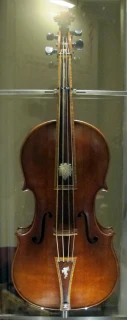
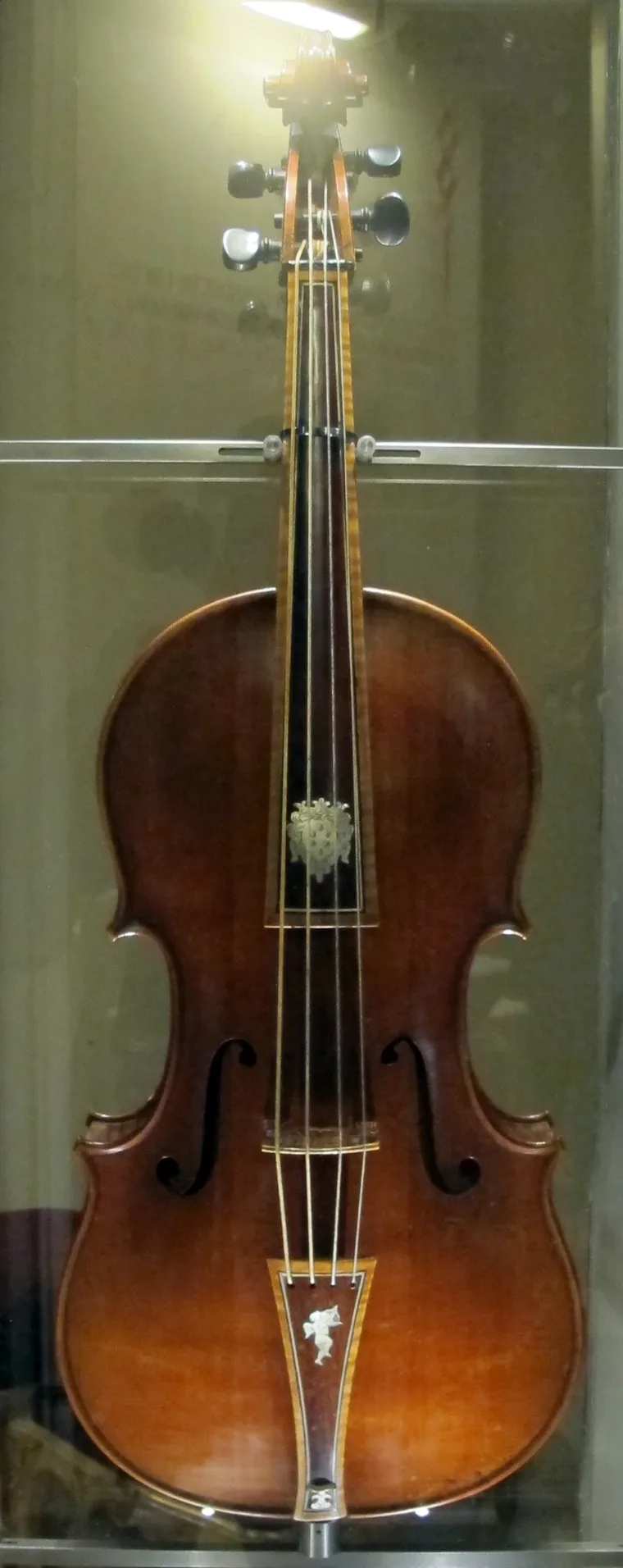
Large tenor violas have almost disappeared, because by the end of the 17th century they were already falling out of use and most such instruments were later cut down to the size of an ordinary viola. This one was never cut down, and as far as is known it is the only tenor viola Stradivari made.
Bartolomeo Ariberti, a Cremonese nobleman and an admirer of Stradivari, ordered two violins and a cello from him as a gift for Grand Prince Ferdinando de' Medici, son of Grand Duke Cosimo III. The gift was well received, and Stradivari was asked to complete the set with two violas, a large tenor and a smaller contralto, to make a quintet. Inside the tenor viola, near the bass bar, is written “Prima 20 ottobre 1690 per S. A. da Fiorenza”, that is, 20 October 1690, for His Highness in Florence.
Its body is large for a viola, with broad upper and lower bouts, and the spruce top has straight, even grain. Set into the lower end of the fingerboard, just above the f-holes, is the Medici coat of arms in mother-of-pearl: a crowned shield with six balls, held by two putti, chubby infants. On the tailpiece a winged Cupid with a bow is inlaid in mother-of-pearl.
The 1700 inventory of Ferdinando's instruments lists the viola as part of the quintet. After the Medici line died out in 1737 and the House of Lorraine came to rule Tuscany, the instruments were looked after less well, and by 1776 the contralto viola had vanished from the inventories while the tenor remained. On 10 March 1863 it was handed over to the Istituto Musicale, the future Luigi Cherubini Conservatory, and a viola this large, hardly fit for playing, was valued at 1,000 lire. In December 1869 the institute's keeper and restorer, Giuseppe Scarampella, opened it to treat it for woodworm and found inside a patch bearing a note by Stradivari himself, “Correto da me Antonius Stradivarius”, that is, “corrected by me”. The viola has stayed in Florence since 1690. Since 2001 it has been on show in the Academy's musical instruments department, and it still belongs to the conservatory.
Of the other instruments in the quintet, the cello is also in the Academy, one violin is at the Accademia Nazionale di Santa Cecilia in Rome, and the contralto viola is in the Library of Congress in Washington.
Beyond these ten
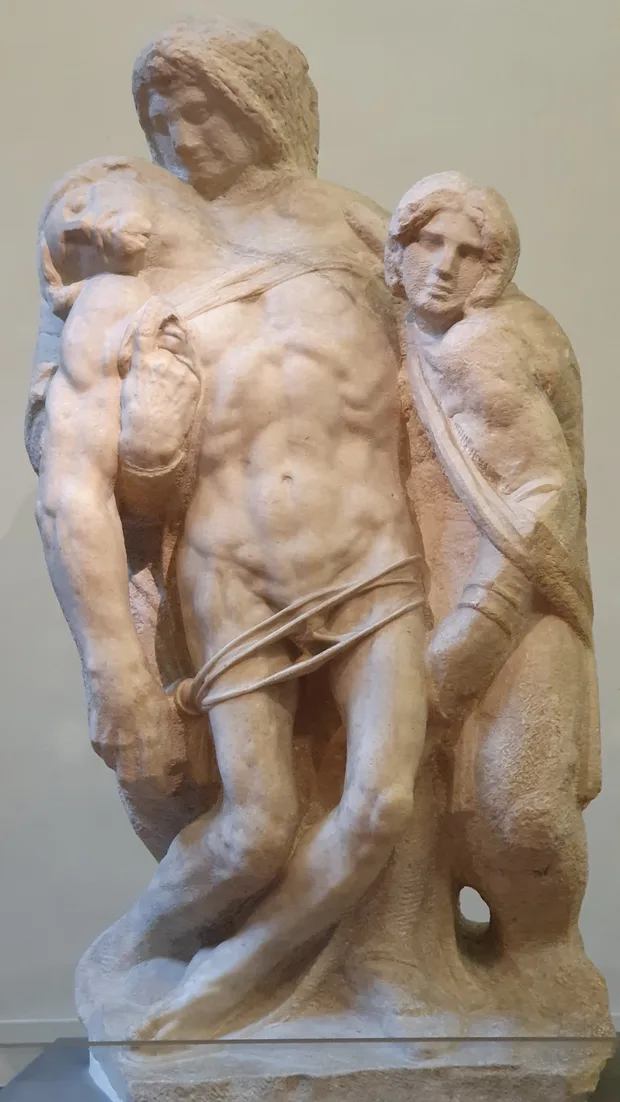
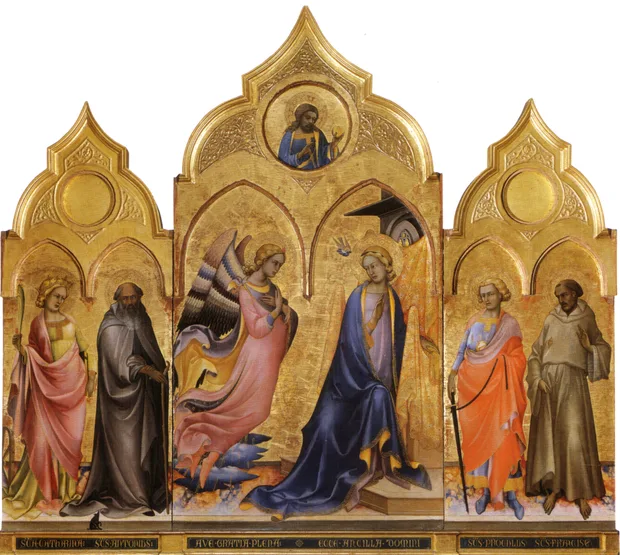
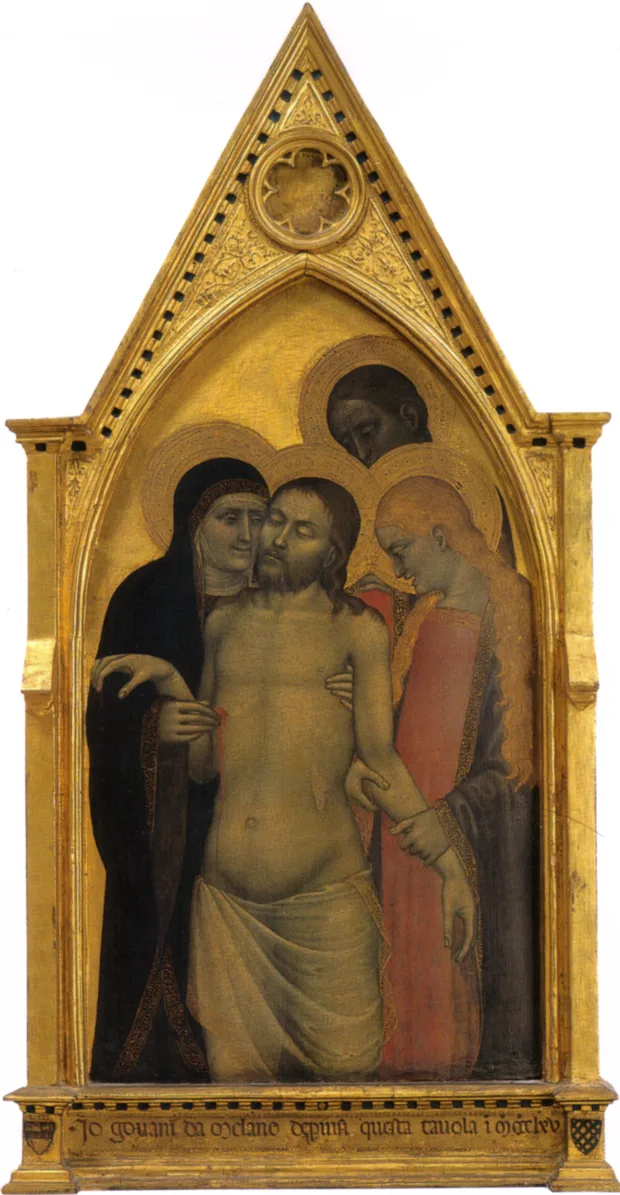
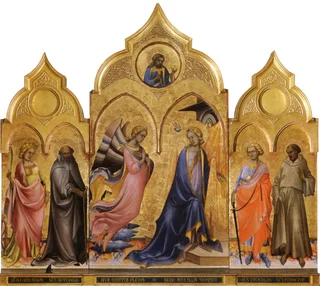
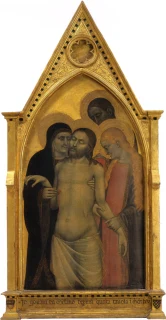
We chose works whose move has a documented history, with a reason why they were taken from where they had been. The closest to making the list was the Palestrina Pietà, which the Academy bought in 1939, although Michelangelo's authorship is contested and the museum itself calls it disputed. Among the gold-ground panels, Lorenzo Monaco's Annunciation Triptych and Giovanni da Milano's Pietà of 1365 are worth seeing. In the musical instruments department, besides the viola, there are an oval spinet and an ebony harpsichord by Bartolomeo Cristofori, keeper of instruments at the Medici court, who invented the piano.