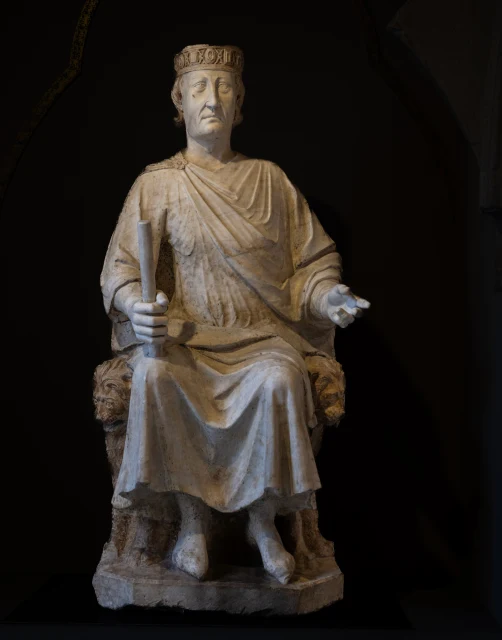
Arnolfo di Cambio
Republic of Florence · Gothic
The story
In 1300 the commune of Florence voted that Master Arnolfo should pay no city taxes for the rest of his life. The reason was written into the decision. Judging by the magnificent beginnings of the new cathedral he was in charge of, the Florentines expected to have a more beautiful and honourable church than any other in Tuscany. The first stone of that cathedral, Santa Maria del Fiore, had been laid in 1296 to his design.
He came from Colle di Val d'Elsa, a small town between Florence and Siena, and he first appears in the 1260s among the assistants of the sculptor Nicola Pisano on the marble pulpit of Siena Cathedral. Then came about two decades in Rome and central Italy, working as sculptor and architect at once. In Rome he made two ciboria, the stone canopies raised over a high altar, one for San Paolo fuori le Mura, finished in 1285 and signed by Arnolfo with his partner Petrus, the other for Santa Cecilia in Trastevere in 1293. In Orvieto he signed the tomb of the French cardinal Guillaume de Braye.
Much of the rest is attribution. Giorgio Vasari, the 16th-century biographer of artists, credited him with the Palazzo Vecchio and the church of Santa Croce, and scholars still argue over both. Even his dates are uncertain. He was born around 1240 or 1245 and died in Florence some time before 1310. The statues he carved for the cathedral front came down when its medieval facade was demolished in the 16th century, and several of them are now in the cathedral museum, the Museo dell'Opera del Duomo.