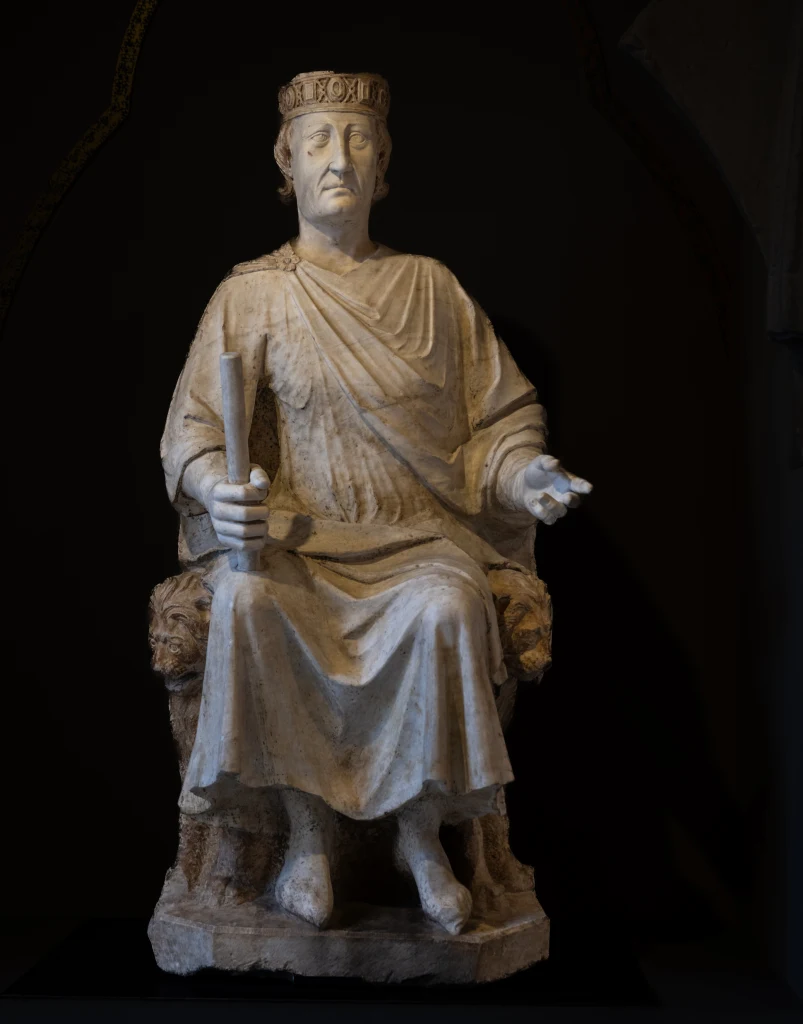
Statue of Charles I of Anjou
Details
The story
Around 1277 the king who ruled all of southern Italy was also a Roman city official. Charles of Anjou, a younger brother of King Louis IX of France, had taken the kingdom of Sicily in 1266, and he held the office of Senator of Rome, head of the city's government on the Capitol, which Pope Clement IV had granted him for ten years. Arnolfo di Cambio shows him in that role, seated on a throne decorated with lions' heads, holding a sceptre. The face is lined and individual, and art historians count it among the first portraits of a living ruler carved in Europe since antiquity.
The figure was cut from a block of an ancient building's entablature and worked as a high relief, meant to be seen against a wall. It was painted in bright colours and gilded, set about two metres above the floor under a pointed trefoil arch with a trumpeter in relief on each side, probably in the Palazzo Senatorio. It did not mirror his power for long. In July 1278 Pope Nicholas III ruled that no king or prince could serve as Senator of Rome, and Charles gave up the office when his term ran out that September. One of the trumpeters from the frame is displayed in this room.