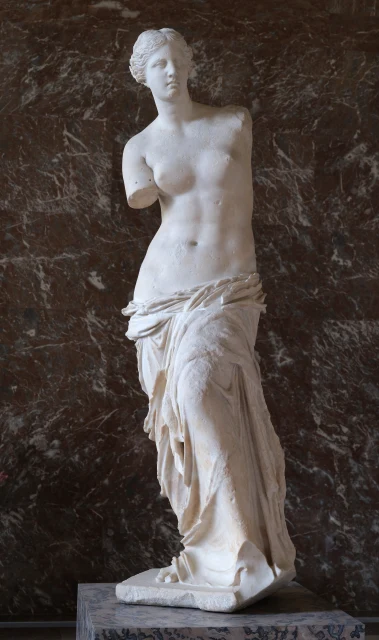
Attributed to Alexandros of Antioch
Ancient Greece · Hellenistic art
The story
Everything known about this sculptor comes from one block of marble that no longer exists. It was found on Melos in 1820 together with the Venus de Milo, and it carried a broken line of Greek: "…andros, son of Menides, of Antioch on the Maeander, made it". Antioch on the Maeander was a Greek city in a river valley inland from the Aegean coast of today's Turkey.
The block reached Paris with the statue, and a young artist, Auguste Debay, drew it there. Soon afterwards it vanished, and it has never been found. Its lettering pointed to a date well after Praxiteles, the classical master many in Paris hoped had carved their Venus, and it has often been suggested that the stone was quietly set aside for that reason. Nobody has proved it.
The opening letters were already missing. "Alexandros" is a modern restoration, and Debay's drawing allows other names, such as Hagesandros. The Louvre names no sculptor for the Venus, and some scholars doubt the block belonged to her at all. The father's name, Menides, turns up in no other Greek inscription known today.