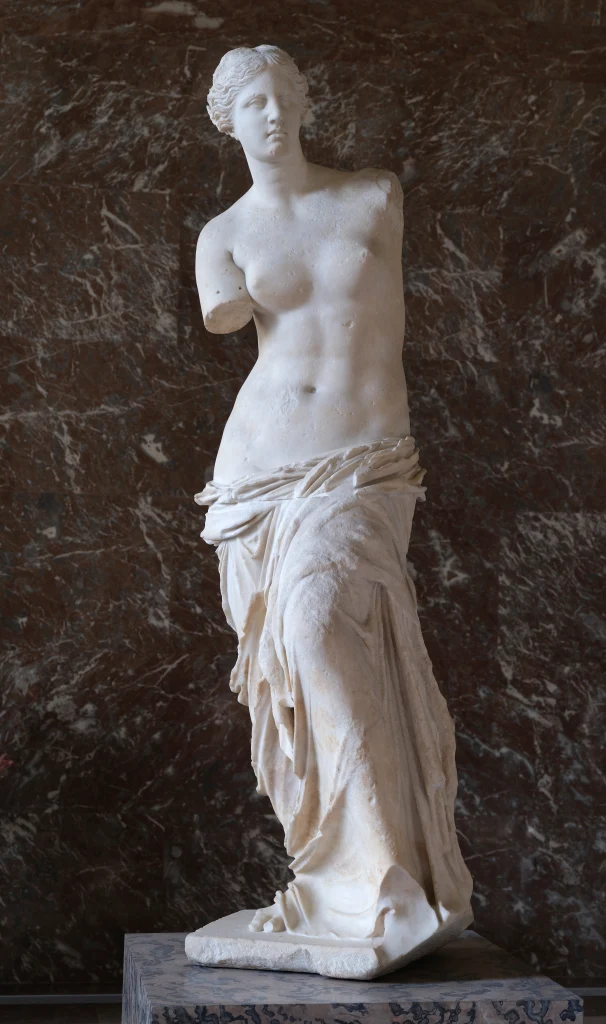
Venus de Milo
Details
The story
In 1815, after Napoleon's defeat, the Louvre had to give back much of the art French armies had brought to Paris. One of the pieces that left was the Venus de' Medici, then probably the most admired ancient statue in Europe, which went home to Florence. Five years later, on 8 April 1820, a farmer on the Greek island of Melos, then under Ottoman rule, was clearing a field near the ruins of the ancient town when he found this figure in two large pieces. A young French naval officer, Olivier Voutier, happened to be ashore and urged him to keep digging. French diplomats moved quickly. The marquis de Rivière, ambassador to the Ottoman court, acquired her and presented her to King Louis XVIII, who gave her to the Louvre in 1821. Within a few decades she had taken over the place the Florentine Venus used to hold.
Her arms were never recovered. A fragment of an arm and a hand holding an apple were found nearby, and the apple, an attribute of Aphrodite, is one reason she is read as the goddess of love rather than Amphitrite, a sea goddess worshipped on Melos. Whether those pieces belong to her is still debated, and the Louvre decided early on not to give her new arms. She was carved in the 2nd century BC from two blocks of marble from Paros, and the join runs round her hips, hidden in the folds of the drapery.
