Attributed to Jan de Baen
Dutch Republic · Dutch Golden Age painting
The story
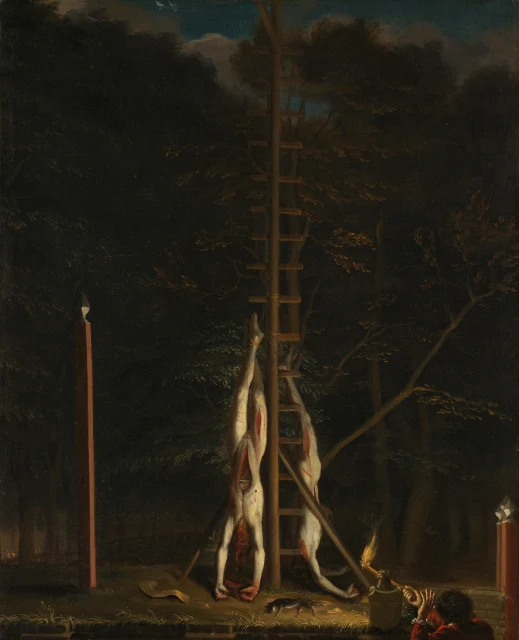
On the night of 20 August 1672 a crowd in The Hague lynched Johan de Witt, the leading statesman of the Dutch Republic, and his brother Cornelis, and hung their bodies on the public scaffold on the Vijverberg, in the heart of the city. A small canvas in the Rijksmuseum shows them there, lit by a man with a torch. An old inscription on the back says a distinguished painter made it from life that same night, and calls it the only original of the scene.
Nothing else names that painter, so the museum writes attributed to. The picture entered the new national collection in 1802 as one of its first purchases, offered as the work of Frans van Mieris, a Leiden painter of small, fine scenes. It was given to Jan de Baen soon afterwards. The guess made sense, since de Baen was a fashionable portrait painter in The Hague and had painted both brothers in life. Scholars still call the attribution doubtful.
His link to the family broke in the same weeks. In Dordrecht, the brothers' home town, a mob pulled down the large portrait-allegory of Cornelis that de Baen had painted for the town hall and tore it up, and the painted head was cut out and nailed to the city gallows across the river Merwede.