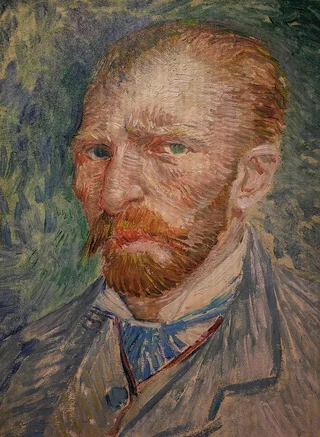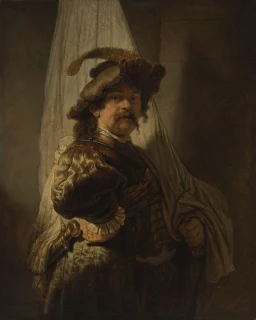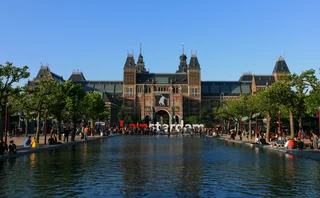
Every work in the Rijksmuseum has an inventory number, and the number of Rembrandt's Night Watch begins with the letters SK-C. The C means that the painting belongs to the City of Amsterdam and has been in the museum on loan since 1885, when the present building by the architect Pierre Cuypers opened. Rembrandt's Syndics, which the city handed over to the museum as early as 1808, are numbered the same way, and so are the paintings that the banker Adriaan van der Hoop, who died in 1854, left to Amsterdam. Paintings with the letter A belong to the state.
The National Art Gallery, from which the Rijksmuseum grew, opened in The Hague in 1800, under the Batavian Republic, and in 1808 King Louis Bonaparte, Napoleon's brother, moved the collection to Amsterdam. It holds about a million objects made between 1200 and 2000, and the museum owes its fame to the Dutch 17th century.
We will tell you about 25 works that show who paid for them, who altered or damaged them, and who fought for the right to own them: a church, a militia company, a merchant, a republic, a nation. We begin with a polyptych painted in 1504, probably for an almshouse in Alkmaar, and end with a Rembrandt that the state bought from the Rothschilds in 2022 for 175 million euros.
Before the Republic: pictures for the church and the court
1. The Seven Works of Charity — Master of Alkmaar, 1504
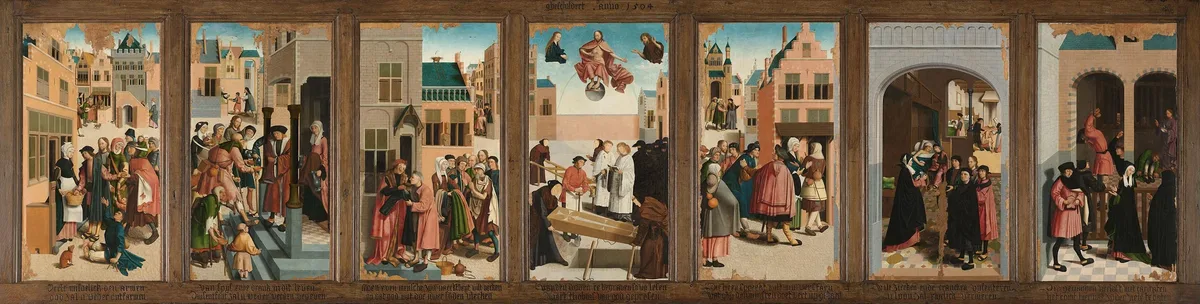
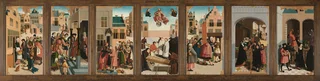
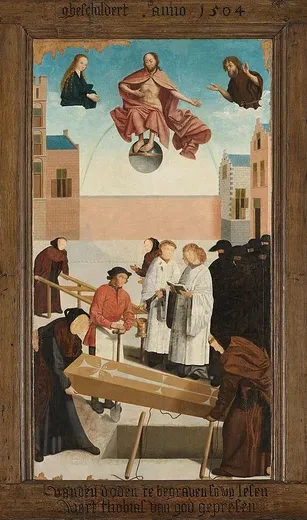
On 24 June 1582 Jacob Dircsz Wijncoper, a churchwarden in Alkmaar, wrote in his chronicle that miscreants had forced their way into the Church of St Lawrence and smeared the pictures on the pulpit and The Seven Works of Charity with black paint. Ten years earlier the town had gone over to the revolt against the King of Spain, and the church had become Protestant. The black paint was later washed off. Even before that, in 1566 or 1572 (the museum gives both dates), someone had taken a knife to the panels and scraped the paint away, most of all from the faces.
The seven tall panels stand in one plain dark frame, and on its top rail, above the middle panel, are the words “gheschildert Anno 1504”, meaning painted in the year 1504. They are read from left to right: feeding the hungry, giving drink to the thirsty, clothing the naked, burying the dead, sheltering travellers, visiting the sick and visiting prisoners. Everything takes place in a Dutch town around 1500, among brick houses with front steps and green roofs. A woman in a white cap stands in her doorway with a basket of loaves, a man in a red gown trimmed with fur pours from a pewter jug into a beggar's wooden bowl, and the pilgrims have badges sewn on their hats, scallop shells and crossed keys. On almost every panel a long-haired Christ stands among the poor, and the viewer has to search the crowd for him. Under the fifth panel the frame carries the words from the Gospel of Matthew saying that whatever is done for the least of people is done for Christ himself.
The middle panel, the burial, is arranged differently. At the top Christ in a red cloak sits on a rainbow with his feet on a globe, as at the Last Judgement, with Mary and John the Baptist on either side. Below, in a walled yard, a coffin marked with white crosses is lowered into the grave on ropes, and almost everyone in this lower half, the bearers, the priests in white surplices, the gravedigger with his spade and the mourners in black hoods, has had their face scraped down to a smooth pale blank. In the restoration of 1971–1975 these losses were deliberately left as they were, so that the mark of the iconoclasts would stay visible, while on the other panels the damage was filled.
No document has turned up with the painter's name. In 1914 the art historian Valentiner called him the Master of Alkmaar, after this very work. The name most often put forward is Cornelis Buys, who worked in Alkmaar until his death in 1524 and was the brother of the Amsterdam painter Jacob Cornelisz van Oostsanen, although the museum considers none of the attempts to identify the painter convincing.
The museum believes the polyptych was commissioned by the regents of the Holy Spirit almshouse in Alkmaar. The house gave poor travellers shelter for three days and nights, nursed the sick, and at Easter, Christmas and All Saints fed 72 poor people, so the panels show its own work. The almshouse was closed in the years of the Reformation, and the polyptych ended up in the Church of St Lawrence, where it hung behind the font, beneath the great organ, until 1918, when the churchwardens sold it to the Rijksmuseum. In the 1990s the Alkmaar Rotary Club gave the church a copy.
2. Portrait of an African Man (Christophle le More?) — Jan Mostaert, c. 1525–1530
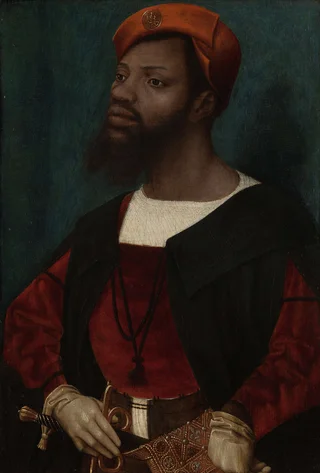
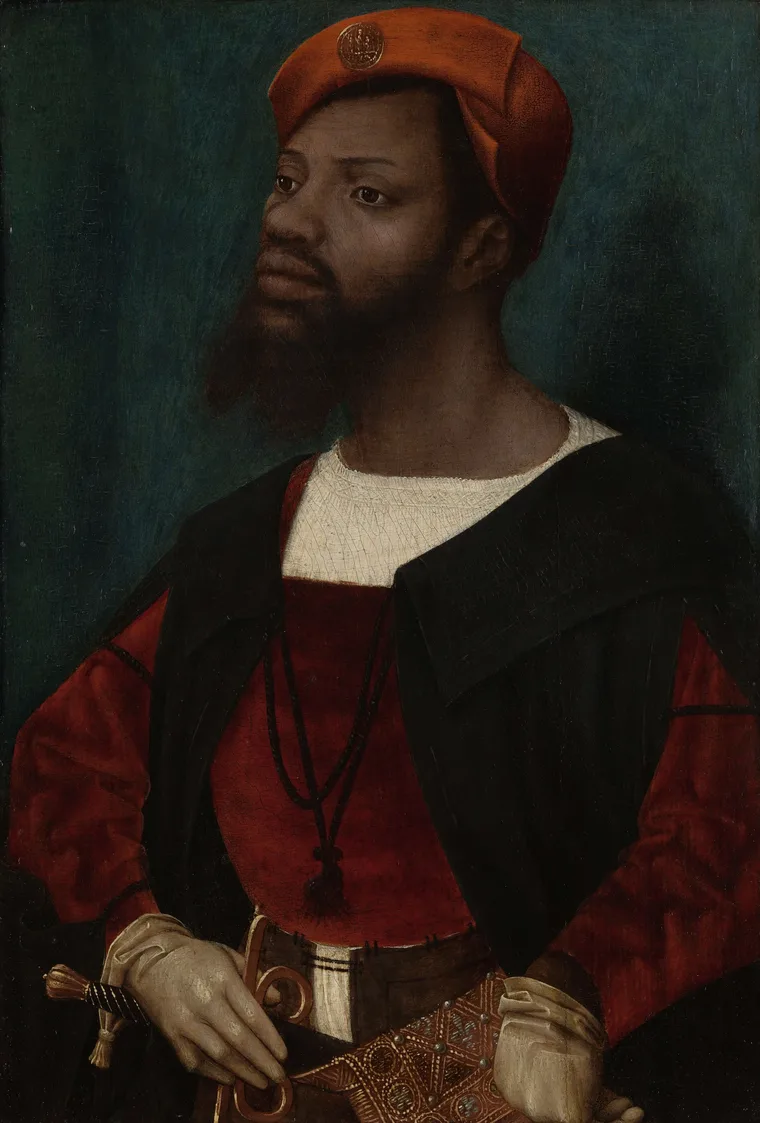
The man in the portrait may be Christophle le More, a Black courtier of the Habsburgs. Le More appears in the court lists from 1503, first as a groom and by 1521 as an archer in the guard of Charles V, and in that role he was at Aachen for the coronation. The Rijksmuseum proposes the name cautiously and puts it in the title with a question mark. The historian Kate Lowe reads his costume and bearing as those of a nobleman from the circle of Margaret of Austria, regent of the Netherlands, who held her court at Mechelen.
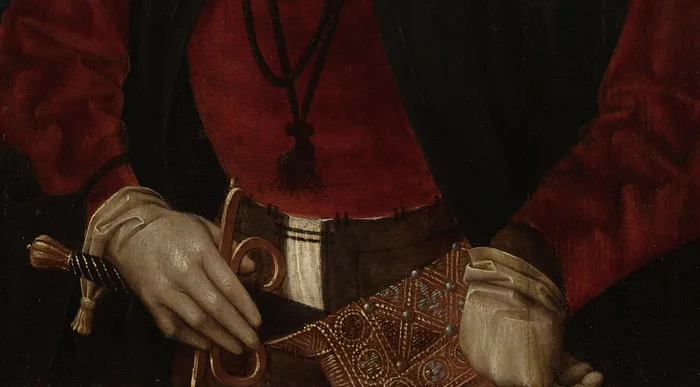
The man, whose dark beard comes to a point, is shown half-length, turned three-quarters, looking to the left past the viewer against a flat blue-green background. Pinned to his soft orange-red cap, folded over at one side, is a round medallion with tiny figures in relief. Under a black gown with a broad collar he wears a red doublet and a white shirt. His right hand, in a pale leather glove, rests on the hilt of a sword whose grip is bound in black and gold, and his left rests on a red pouch at his hip, embroidered with a gold lattice, silver studs and small fleurs-de-lis.
It is the earliest surviving painted portrait of a particular Black man in which he is the only figure. Albrecht Dürer had drawn a charcoal portrait of an African man earlier, in 1508. Mostaert himself worked in Haarlem, and Karel van Mander, the biographer of Netherlandish painters, wrote that he spent 18 years in the service of Margaret of Austria, though the painter is mentioned only twice in her accounts and historians today doubt that service.
The panel's history can be traced only from 1920, when it was with a London dealer. In 1934 the Manchester collector Sir Thomas Barlow bought it, his heirs lent it to Kenwood House in London from 1998 to 2003, and in 2005 the Rijksmuseum bought the portrait for 600,000 euros together with the Rembrandt Association, a private society that helps Dutch museums buy art, and several foundations, among them the national lottery. Old labels on the back of the panel still carry its earlier titles, first The Black King, meaning one of the three Magi, and then Portrait of a Moor.
The city orders its own portrait
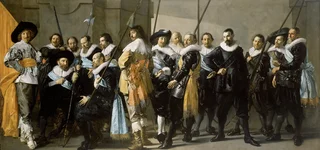
3. Officers and Guardsmen of District XI under the Command of Captain Reynier Reael (“The Meagre Company”) — Frans Hals and Pieter Codde, 1633–1637
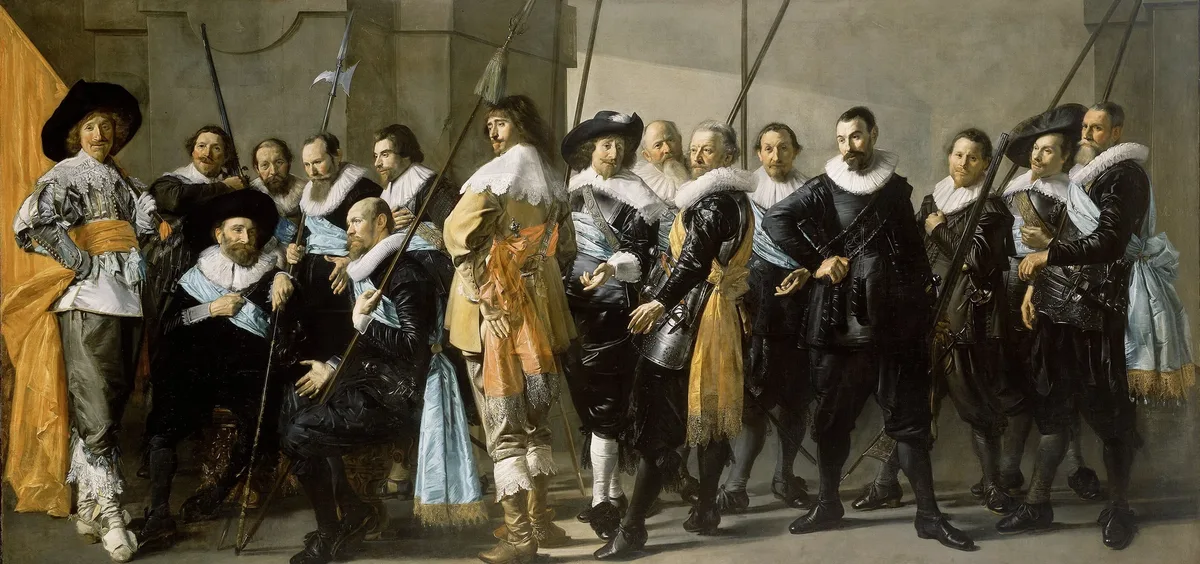
On 19 March 1636 Reynier Reael, captain of an Amsterdam militia company, and his lieutenant Cornelis Blaeuw declared before a notary that Frans Hals had taken on the company's group portrait back in 1633 and still had not finished it. He was given 14 days to come to Amsterdam, or another painter would paint the company and Hals would return the money. The next day Hals answered from Haarlem, lying in bed with a bad leg. He reminded them that it had been agreed he would paint in Haarlem, that the guardsmen could not possibly be got together, and that living in Amsterdam cost him too much. The officers offered 60 guilders for each figure and six more on top if he finished them in Amsterdam. In July Hals again proposed that the canvas be brought to him in Haarlem, and promised that if six or seven of the men would not come, he would still deliver the picture complete to all intents and purposes.
Hals was about fifty and had already painted five large group portraits of Haarlem militia companies. The Amsterdam commission was the only one he ever accepted from another town. The guardsmen would not travel and hired the Amsterdam painter Pieter Codde, who painted small portraits and merry companies and was taking on full-length guardsmen for the first time. The picture was finished in 1637, and an inventory of 1653 records that it was begun by Frans Hals and completed by Codde.
Sixteen men stand and sit in a row along the long, low canvas, almost all in black with white collars and pale blue sashes. On the left, in front of a huge orange-gold banner, stands the ensign in silvery-grey satin, with an orange sash at his waist and his hand on his hip, the lightest figure in the picture. Hals painted the left part in quick broad strokes over a rapid grey sketch. The seven figures on the right are usually given to Codde, who in his own pictures painted smoothly, with hardly a trace of the brush, and here imitated Hals's handling. In 2017 the canvas was scanned for 25 days in front of visitors, and the researchers judged this division too simple, because they found Codde's hand on the left as well and Hals's on the right.
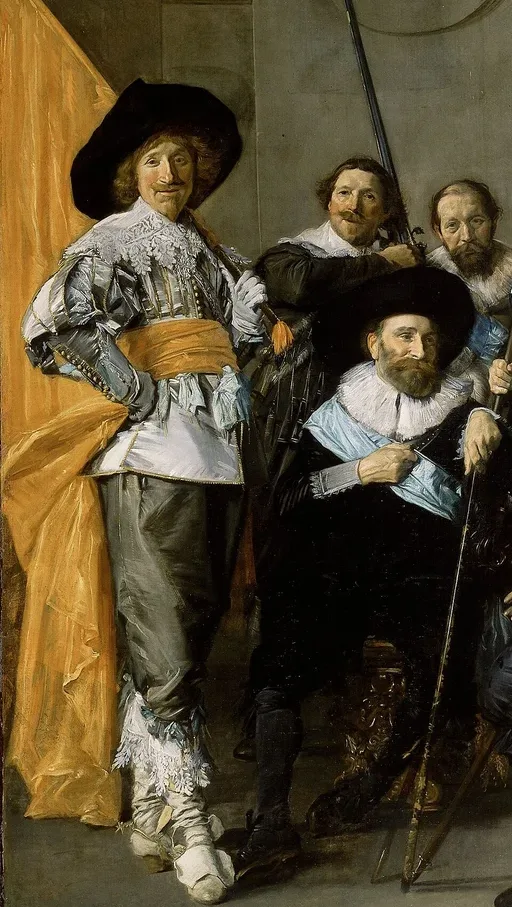
From the militia hall the painting had been moved to the Amsterdam town hall by 1758, and in 1885 the city, which still owns it, lent it to the Rijksmuseum. The nickname was born in that town hall. In 1758 Jan van Dyk, who was drawing up an inventory, wrote that the guardsmen in it were so withered and slender that one could justifiably call them the meagre company.
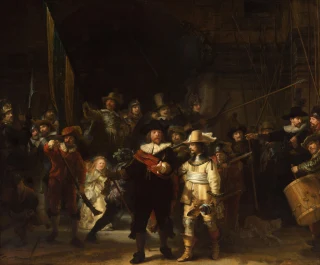
4. The Night Watch — Rembrandt, 1642
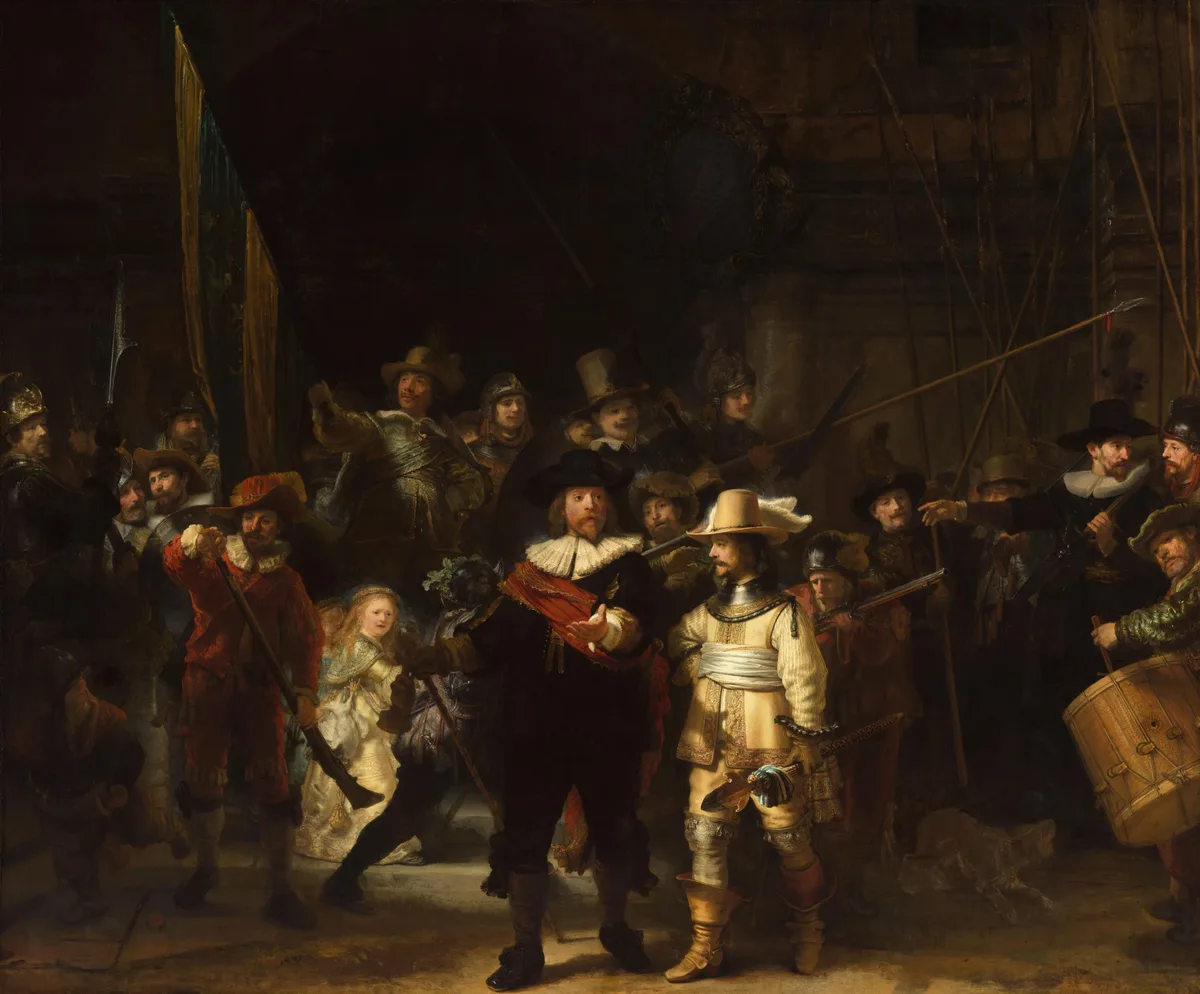
In 1715 The Night Watch was moved to the Amsterdam town hall on Dam Square and cut down on all four sides so that it would fit on the wall between two doors. The most was cut from the left, and with that strip three figures were lost, two militiamen and a child. The pieces that were cut off have never been found.
Rembrandt painted the picture for the great hall of the new headquarters of the Amsterdam arquebusiers, where a whole row of company portraits by different painters hung. His pupil Samuel van Hoogstraten wrote in 1678 that beside it the other pictures in the hall looked like playing cards, though he himself would have liked Rembrandt to put more light into it. The title The Night Watch first appears in a document of 1797, by which time the varnish had darkened. Rembrandt painted a daytime scene: the company is coming out of a dark archway, and the light picks out a few figures at the front while the rest stay in brown shadow.
In the middle, Captain Frans Banninck Cocq, in black with a red sash across his chest, holds out his open left hand towards Lieutenant Willem van Ruytenburch, and the shadow of his hand falls on the lieutenant's pale gold jerkin, just below the white sash. Further left, behind the captain, stands a girl lit more brightly than anyone around her, and from her belt hangs a dead bird with its claws painted distinctly, because the claw was the emblem of the arquebusiers. Lower right, by the big drum, a greyish-white dog in a spiked collar crouches and barks with its muzzle raised. In 2025 the curator Anne Lenders found the model Rembrandt copied it from, a pen drawing of 1619 by Adriaen van de Venne (no. 17). According to an old tradition, the face between the ensign's hat and the young man in the helmet, of which only an eye and the edge of a beret can be seen, is Rembrandt's self-portrait.
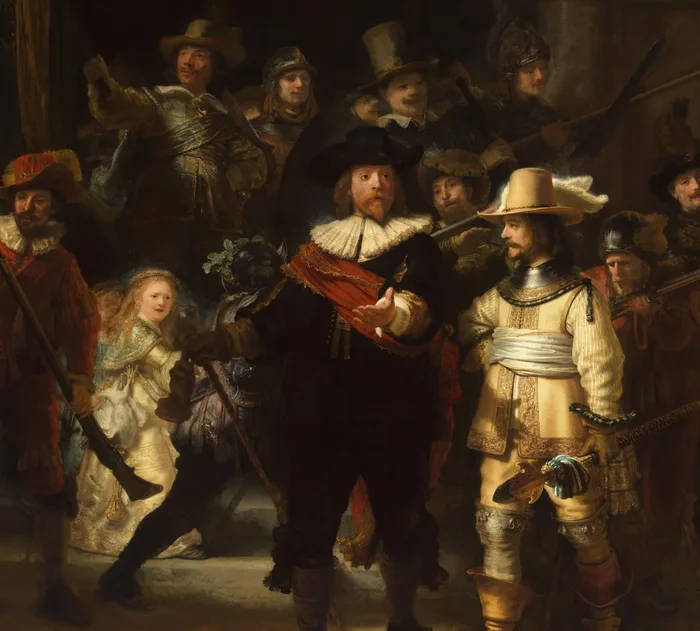
On 13 January 1911 an unemployed former navy cook struck the painting with a knife, and the blade stuck in the thick layer of varnish without reaching the paint. On 14 September 1975 a teacher who had been turned down for a job came into the museum just after opening with a serrated table knife from a restaurant, slashed the painting 12 or 13 times and cut a triangular piece out of the canvas between the captain's legs. The restoration took about eight months. On 6 April 1990 a visitor splashed sulphuric acid on the guardsman in red who is loading his musket on the left. The museum said at the time that only the varnish had been harmed, but in 2025 researchers found traces of the acid in the paint layer itself.
In July 2019 the painting was enclosed in a glass chamber, and research began in front of visitors. On 12 November 2024 eight conservators started taking off the varnish applied after 1975, using tissues dampened with a drop of solvent and clearing the remnants with cotton swabs under a microscope.
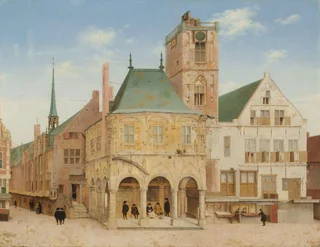
5. The Old Town Hall of Amsterdam — Pieter Saenredam, 1657
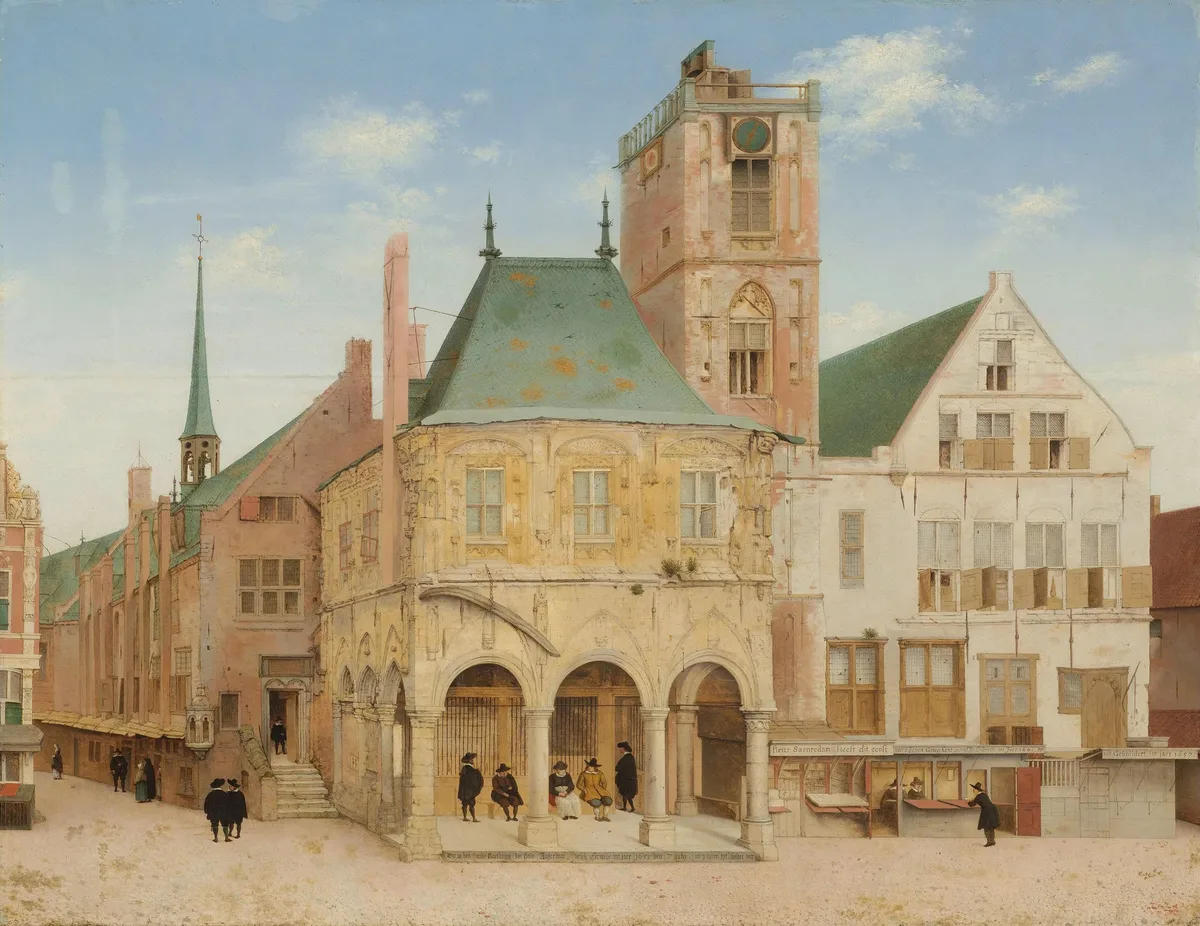
When Saenredam painted this picture in 1657, the old town hall on Dam Square had been gone for five years. As early as 1639 the burgomasters complained that the building was so dilapidated that an accident was bound to happen, in 1648 the first stone of the new town hall was laid, and most of the old buildings were pulled down to make room for it. The front part that remained caught fire on 7 July 1652, and only a shell was left. Saenredam reconstructed the building from his own pen-and-watercolour drawing, made on the spot over six days in July 1641. That was also how he worked on the church interiors he was known for, first a precise drawing on site, then the painting, sometimes many years later.
On 30 July 1658 the Amsterdam treasurers, among them Dr Nicolaes Tulp, the same Tulp who gives the anatomy lesson in Rembrandt's painting, accepted the picture by the Haarlem painter Pieter Saenredam on behalf of the burgomasters, and the next day they paid 400 guilders for it. Saenredam kept a memorandum of the sale with a tiny colour sketch of the picture, and it is now in the Teylers Museum in Haarlem. Everything was done, as he wrote, “in all courtesy and friendliness, accompanied by promises to consider me more in the future”, and the painting was to be hung in the burgomasters' chamber. The city still owns it, and it has been in the Rijksmuseum since 1945.
The facades face the viewer directly across a broad, empty, pinkish square. In the middle is the tribunal of yellowish-cream sandstone, carved and crumbling, with a steep green roof spotted with orange lichen, and on its upper cornice a tuft of grass grows out of a crack. Below is an open arcaded gallery where a few people sit on a bench. Behind the tribunal rises a pink brick tower with a clock face that has a single gold hand. The spire had already been taken down by then, and abandoned blocks and beams lie on the flat roof. On the right stands a white plastered house with wooden shutters and a row of low stalls at its foot.
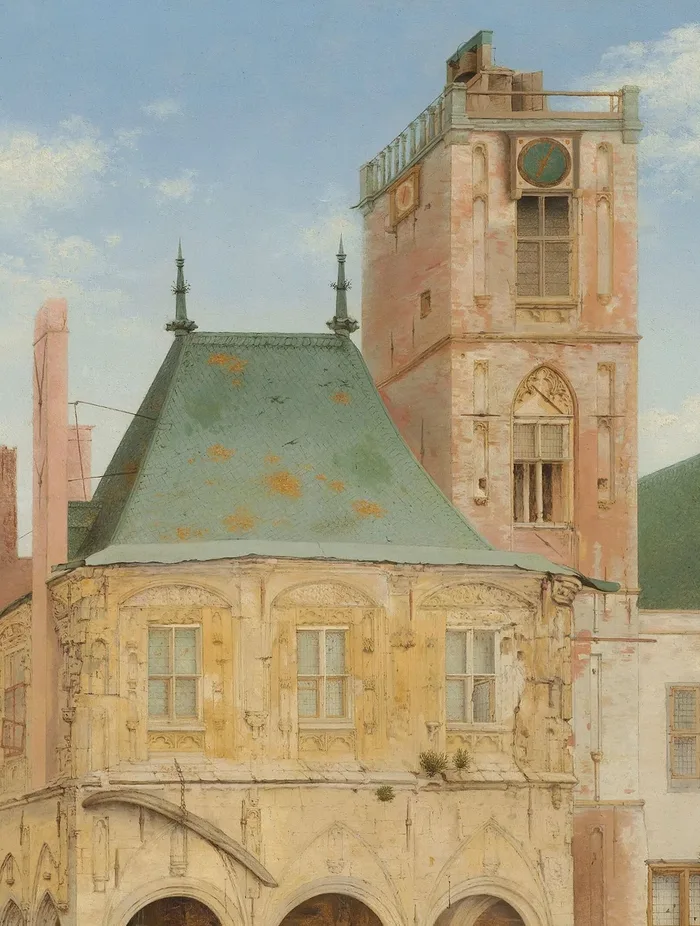
On the boards above the stalls Saenredam wrote that he first drew this building from life with all its colours in 1641 and painted it in 1657. A second inscription runs along the edge of the gallery step and says that this is the old town hall of the city of Amsterdam, which burned down on 7 July in three hours. The museum reads the year of the fire in this inscription as 1651, so the painter was one year out.
In 1663 Olfert Dapper, describing the new town hall, noted where the picture hung. It had been placed in the burgomasters' chamber, opposite the seat of the presiding burgomaster, and a framed poem by the poet Constantijn Huygens about the new building hung as its pendant.
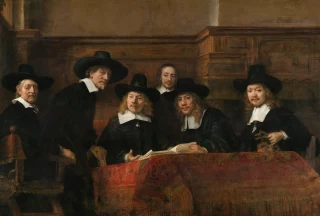
6. Syndics of the Drapers' Guild — Rembrandt, 1662
Rembrandt, who was born in Leiden, had been painting portraits of Amsterdammers since the early 1630s, and in 1656 he declared himself insolvent and surrendered his property to his creditors. By 1662 he was living in a rented house on the Rozengracht canal, and, as the museum puts it, “the Amsterdam élite no longer knocked on his door as often as they had done before.” Historians long ago rejected the story that The Night Watch ruined him, with dissatisfied guardsmen and lost commissions, because he went on receiving large commissions after 1642. One of them came from the drapers' guild, which wanted a group portrait for its hall on the Staalstraat.
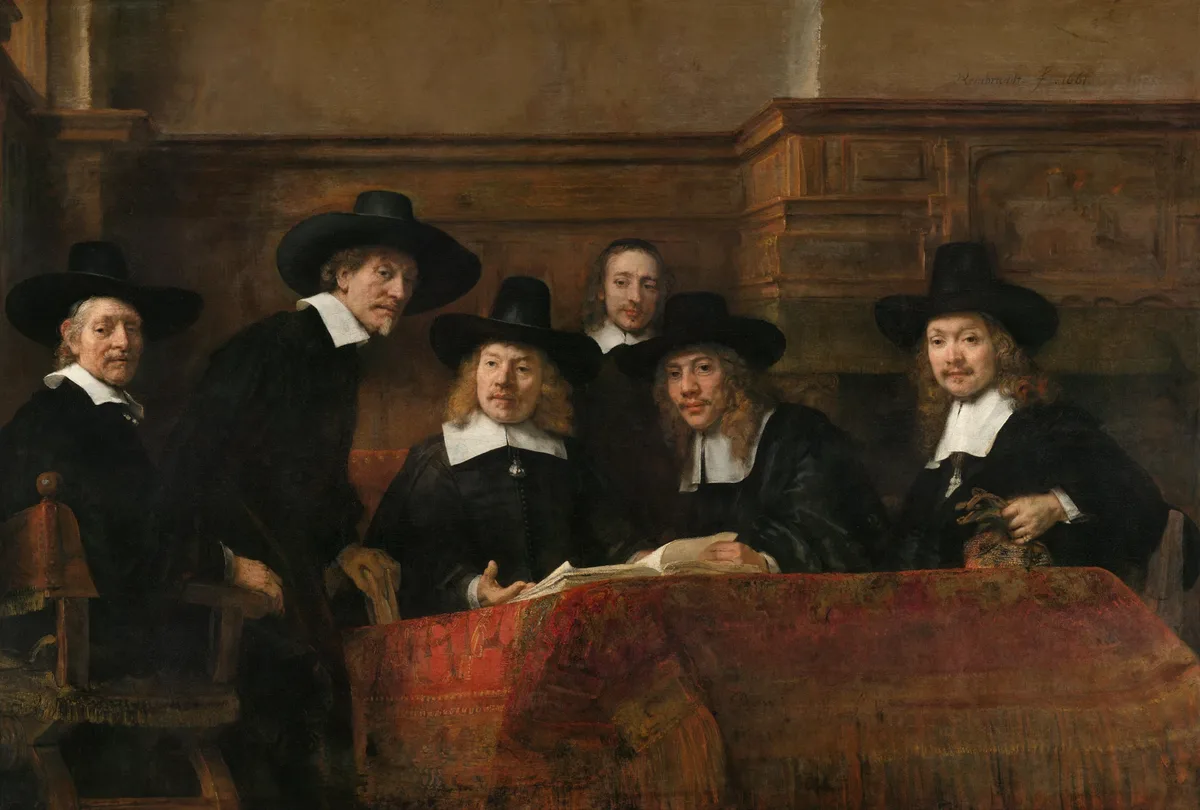
The portrait was commissioned by the syndics, five guild members who for one year, from Good Friday to Good Friday, checked the quality and colour of dyed cloth against samples. Rembrandt painted them behind a table, seen from slightly below, so that the tabletop is hardly visible, only the hanging edge of the carpet, dull red with an ochre-gold pattern and a heavy fringe. All five wear tall black hats and flat white collars. A sixth man, a servant, stands behind them bareheaded, with long dark hair. On the far left a grey-haired old man sits in a chair upholstered in red, beside him the tallest of them has half risen, pressing his hand on the arm of the chair, the man in the middle has turned his palm upwards over an open book, and the man on the far right grips a pair of crumpled brown gloves. Almost all of them look straight at the viewer, and the museum writes that they look “as if we just opened the door and interrupted their meeting.”
X-rays show Jacob van Loon, seated on the left, with his head and hand in three different positions, and the man rising from his chair first stood further to the left. Rembrandt made two preparatory drawings, of Van Loon and of the rising syndic, on sheets of ledger paper. At the upper right, on the plastered wall, “Rembrandt. f. 1661” can be read clearly. The museum considers this signature false, and the painting is signed with the date 1662.
The Syndics hung in the guild's hall until 1771, when the painting was moved to the town hall, and in 1808 the city handed it over to the museum. It still belongs to Amsterdam. Later the syndics and their servant came to be printed on the boxes of the American cigar brand Dutch Masters.
For private houses and for the market
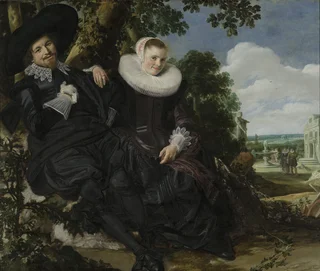
7. Portrait of a Couple, Probably Isaac Massa and Beatrix van der Laen — Frans Hals, c. 1622
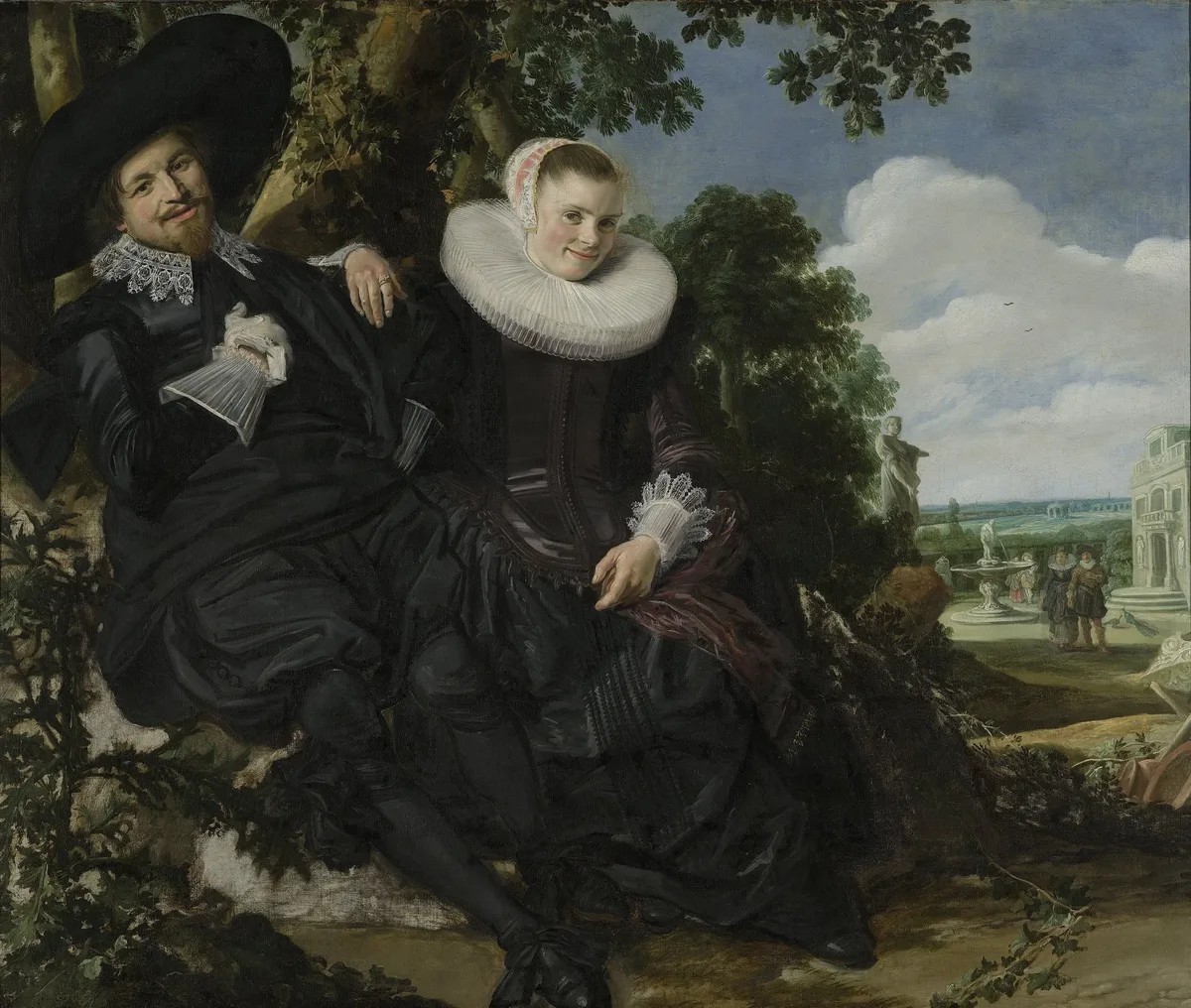
Dutch couples usually commissioned two separate portraits, while Hals put husband and wife side by side on a single canvas, relaxed, smiling and almost leaning into each other. Who they are has never been conclusively proved. Since 1934, when the Rijksmuseum's catalogue first proposed the names, they have been taken to be the merchant Isaac Massa and Beatrix van der Laen, who married in Haarlem on 25 April 1622, but some historians disagree, because in their view the man looks little like Massa in his other portraits. That is why the title says “probably”.
Isaac Massa, a grain merchant from Haarlem, was sent to Moscow as a young man, and the museum writes that he spent eight years there, years that took in the end of Boris Godunov's reign, the False Dmitry and Vasily Shuisky. On his return he presented Maurice of Orange, the stadholder, that is, the head of the Republic, with his Short History of the Beginnings and Origins of These Present Wars in Moscow, which was printed only in the 19th century. Beatrix van der Laen was the daughter of a Haarlem burgomaster, and the museum dates this canvas to about the year of their wedding.
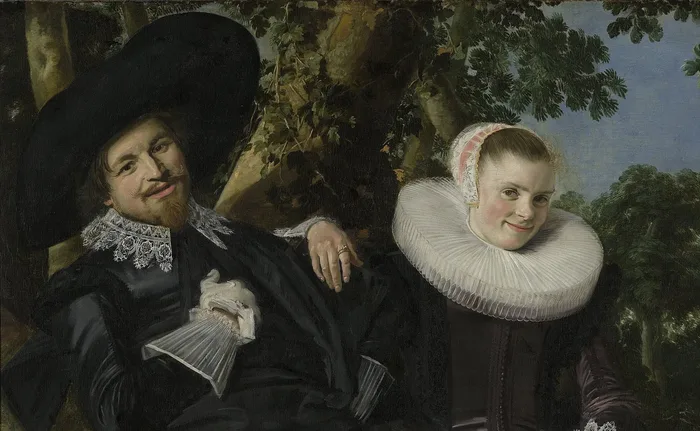
The couple sit on a hillock at the foot of a large tree and take up the left two thirds of the canvas, while on the right a sunlit garden opens out. The man leans back against the trunk, his black hat with its enormous brim pushed back, his beard reddish, his right hand at the middle of his chest clasping a white glove. The woman, in a large white pleated ruff and a white cap edged with pinkish red, leans towards him and has laid her right hand on his shoulder, showing a gold ring. Both smile at the viewer without looking at each other, and the museum notes that an openly smiling woman is a great rarity in a 17th-century portrait.
Around them grow plants that the historians Eddy de Jongh and Pieter Vinken read in 1961 as emblems of marriage. A vine climbs the trunk behind his hat, clinging to the tree as she clings to her husband, at her feet is ivy, a sign of fidelity, beside it a thistle, and on the right lie overturned clay pots, a reminder of how fragile life is. Deep in the garden couples stroll, a fountain plays, a statue stands, and two peacocks walk by the steps of a pale country house.
The painting belonged to the Amsterdammer Jan Six, Rembrandt's friend and patron, and at the sale of 1702 it was listed simply as “Man and Woman, life-size, by Frans Hals”. Six's widow bought it back, and it passed by inheritance to Hendrik Six van Hillegom, whose marriage brought two more pictures from this list into the Six family (nos. 10 and 11). In 1851, at the sale of his collection, the portrait was offered as a likeness of Hals himself and his wife, and it was bought for the Rijksmuseum for 600 guilders. Hals and Massa were close. In 1623 Massa stood witness at the baptism of Hals's daughter, and in 1626 Hals painted him again, in a portrait now in Toronto, where fir trees can be seen through the window, and scholars recognise them as a Muscovite landscape.
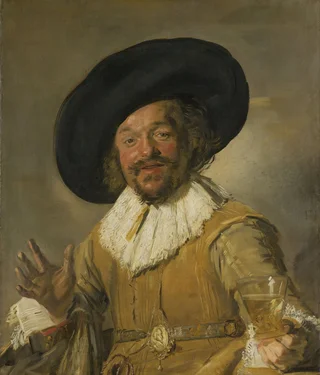
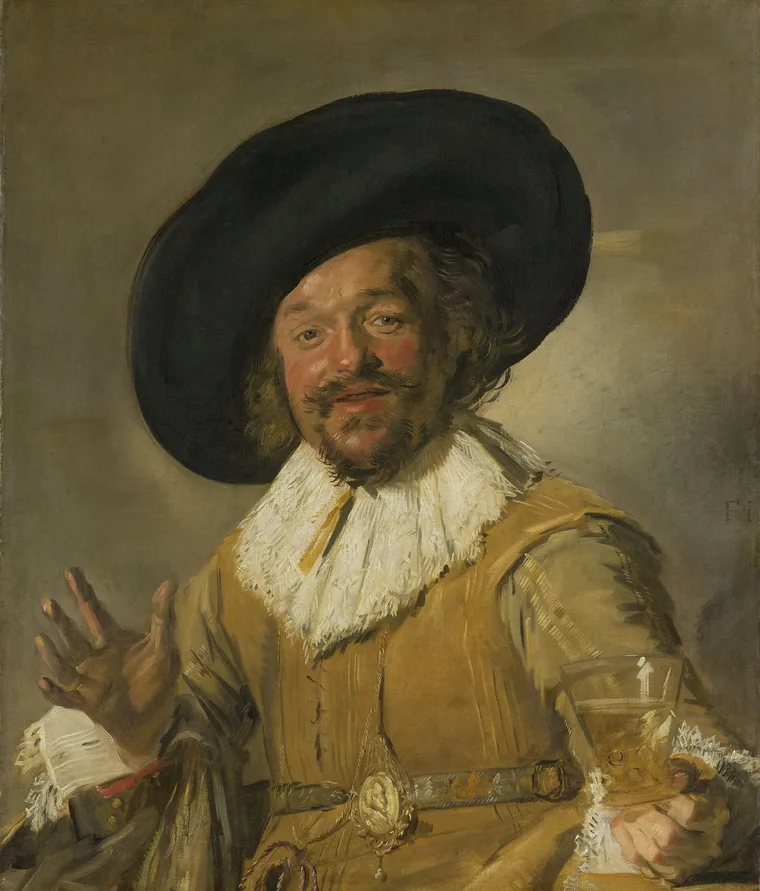
8. The Merry Drinker — Frans Hals, c. 1628–1630
The collection of the late Baroness van Leyden was auctioned on 31 July 1816 in her own castle at Warmond, and lot 13 in the catalogue was described as a warrior with a laughing face and a glass in his hand. It was bought for 325 guilders for the recently founded national museum, one of the earliest purchases of a Hals by a Dutch museum. Researchers have found no record of a commission, and no name for the sitter. The museum calls the painting A Militiaman Holding a Berkemeyer, Known as the “Merry Drinker”, because the leather jerkin and the medallion mark him out as a guardsman of a civic company or a soldier, and scholars still argue over whether it is a portrait or a genre scene.
The man, in an enormous black hat pushed to the back of his head, leans towards the viewer, his cheeks red, his lips parted, his eyes narrowed. He raises his right hand with the palm open and the fingers spread, and with his left he holds by its base a tall clear glass studded with raised glass prunts, half full of pale gold wine. An oval gold medallion hangs on a cord at his belt, and its relief is only suggested in a few strokes. The historian Hofstede de Groot recognised in it a portrait of Prince Maurice of Orange. Only the face is carefully painted. The hair is laid on in separate flicks, the collar is built of short criss-crossing strokes, the highlights on the glass are a few dashes, and on the right, at shoulder height, stands the monogram FH.
Hals was long reproached for leaving his work unfinished, until the French critic Théophile Thoré-Bürger, in articles of 1868, declared his broad brushwork a virtue. In 1872 Édouard Manet saw the painting, and his Le Bon Bock, which he showed at the Salon of 1873, has often been linked with this canvas ever since.
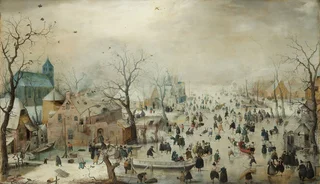
9. Winter Landscape with Skaters — Hendrick Avercamp, c. 1608
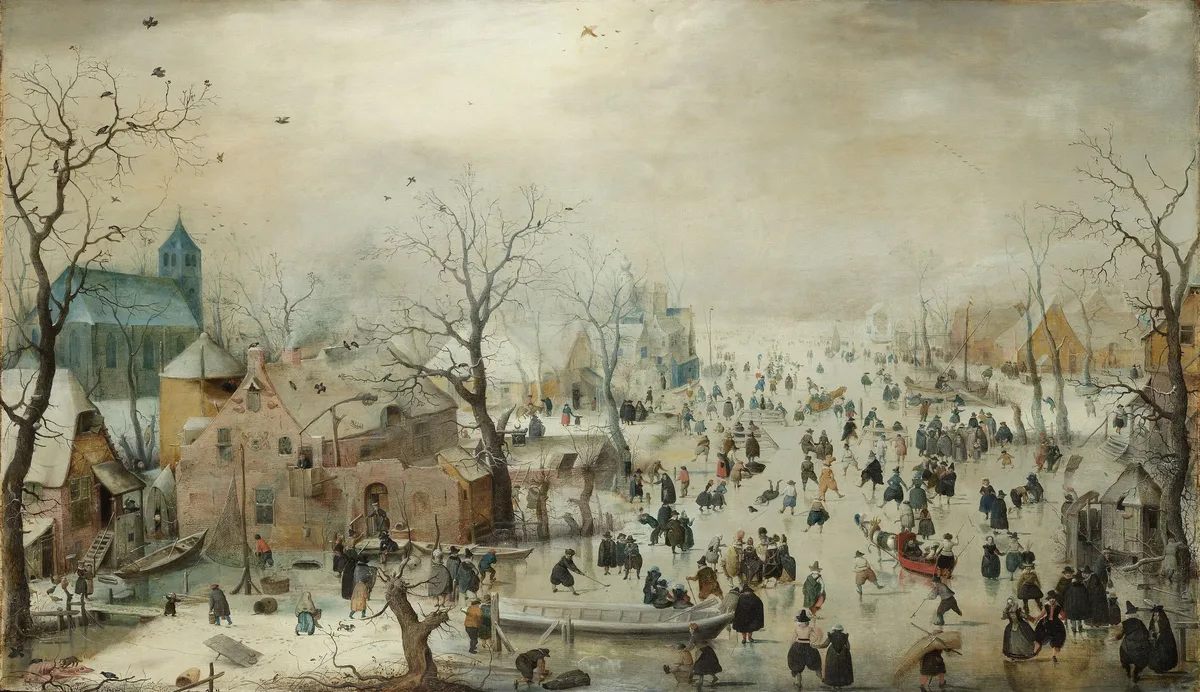
Hendrick Avercamp was born in Amsterdam in 1585, grew up in Kampen, where his father was an apothecary, and was deaf and unable to speak, so his contemporaries called him the Mute of Kampen. In 1607 the buyers at the studio sale of the Amsterdam painter Pieter Isaacsz included one entered as the mute who lived at Pieter Isaacsz's, and historians conclude that Avercamp lived and trained with him. He painted this panel around 1608, when he was about 23, and went on to become the first Dutch painter to paint almost nothing but winters with people on the ice. According to the museum, they sold so well that he even painted them in summer. In her will of 1633 his mother described him, her unmarried eldest son, as mute and wretched, and provided for his keep. He died in Kampen in 1634.
The frozen river runs from the foreground to a pale horizon and is seen from above, as if from a hill. The museum counts about 200 figures on it. Some are playing kolf with clubs, others skate in couples arm in arm, in the middle a man lies sprawled flat on the ice, and on the right a red horse-drawn sleigh goes by. On the left stand a church with a pointed tower, a round haystack under a conical roof on poles, and a brick house with a coat of arms held by two red lions. The jokes in the picture are listed by the museum itself. Next to the brick house stands a narrow hut made from a boat set on end, a privy, and a bare pink backside sticks out of its low doorway. Under the roof of the haystack two people huddle together, and in the lower left corner a dog and crows tear at a carcass that the museum takes to be a horse's. The signature HAENRICUS AV is scratched in white among other scrawls on the plank wall of a shed at the right edge.
The picture is often cited as evidence of the Little Ice Age, the cold winters of those years. In 2020 Alexis Metzger, a researcher at the University of Lausanne, compared 49 Dutch winter paintings with weather records. The painters chose clear, dry frost, the weather for skating, and fewer than a fifth of winter days were like that.
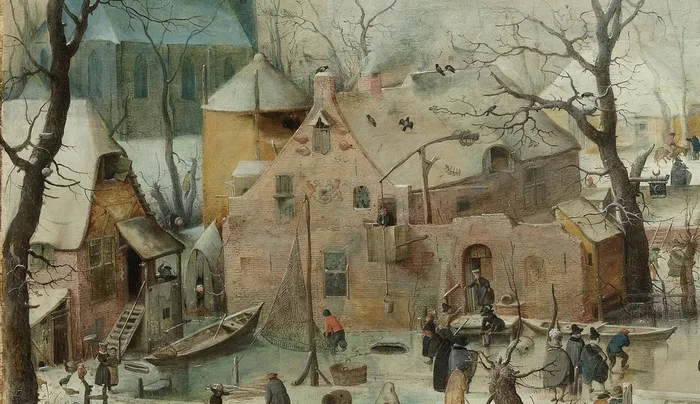
In 1897, at the sale of Gijsbert de Clercq's collection, the dealer Roos bought the panel for 345 guilders, and a few months later he sold it to the Rijksmuseum for 550, with the Rembrandt Association paying part of the money.
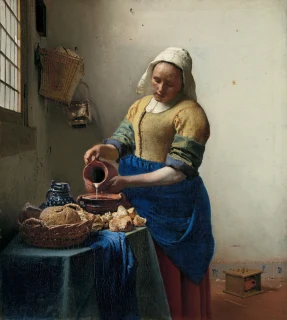
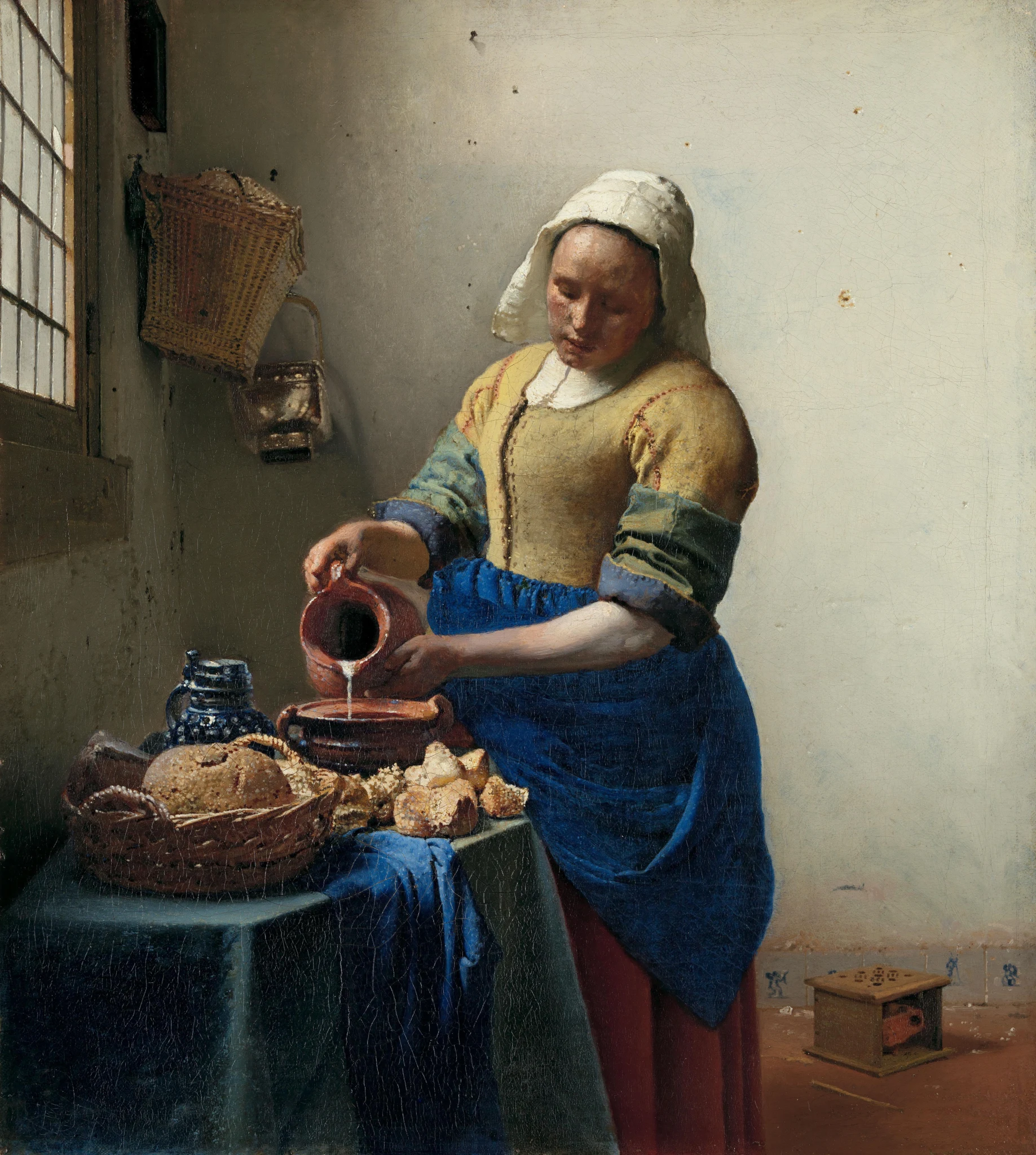
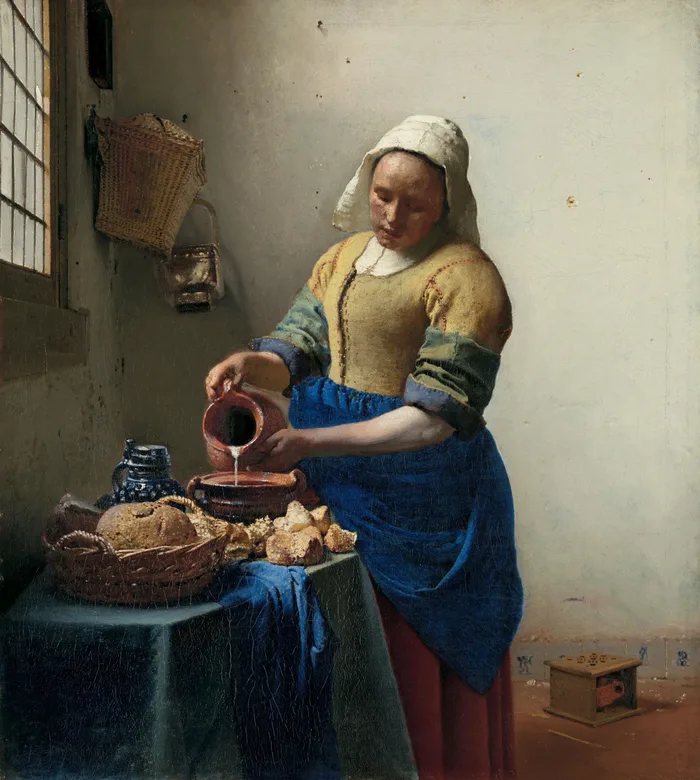
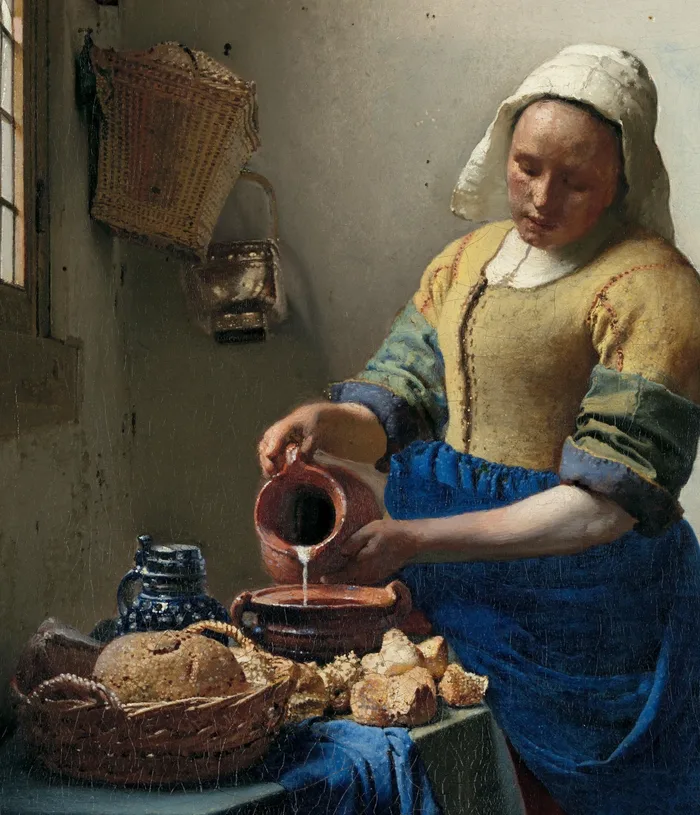
10. The Milkmaid — Johannes Vermeer, c. 1660
In 1907 the heirs of the Amsterdam Six family offered to sell Vermeer's Milkmaid to the state, but only together with 38 other paintings from the family collection, all at once, for 750,000 guilders. Frits Lugt, an expert on Dutch painting, counted only five significant pictures among those 38. Abraham Bredius, director of the Mauritshuis in The Hague, feared that the American banker John Pierpont Morgan would buy The Milkmaid, and newspaper cartoonists drew the best-looking milkmaid in Holland turning her back on Uncle Sam. In parliament the socialist Troelstra objected to spending so much on old masters, while the member Victor de Stuers, who had fought for years to preserve the Dutch heritage, demanded that the picture stay in the country at any price, and the majority backed him. The state paid 550,000 guilders, the Rembrandt Association another 200,000, and on 13 January 1908 all 39 paintings went on show in the Rijksmuseum.
Vermeer painted The Milkmaid in Delft around 1660, when he was moving from large scenes to single figures in quiet rooms lit by a window on the left. His main buyer was the Delft collector Pieter van Ruijven, and wider fame came to Vermeer only in the 19th century. However, as early as 1696, when the collection of Jacob Dissius, Van Ruijven's son-in-law, was sold in Amsterdam, the maid pouring out milk, described as extraordinarily good, fetched 175 guilders, more than any other Vermeer at that auction except the View of Delft.
The maid stands at a table under a window in the upper left corner and pours milk from a reddish-brown earthenware jug into a pot with two handles, and in the middle of the picture the milk runs in a thin white stream. She wears a yellow bodice, green oversleeves pushed up above the elbows and a dark blue apron painted in ultramarine, an expensive pigment made from lapis lazuli, and a red skirt shows beneath the apron. The crusts of the bread, the handle of the basket and the rim of the grey-blue jug are covered in raised dots of light paint. In one pane of the window there is an irregular white patch that looks like a hole, and the back wall is bare, with a nail and the marks of nails.
In 2022 scans showed what Vermeer had painted on that wall and then taken out. Behind the maid's head he had sketched a rack with earthenware jugs hanging from it, and in the lower right corner a wicker basket for coals, on which laundry was dried, and he later covered it with a foot warmer, tiles and floor. The rack and the basket both appear in the inventory of his house drawn up after the painter's death.
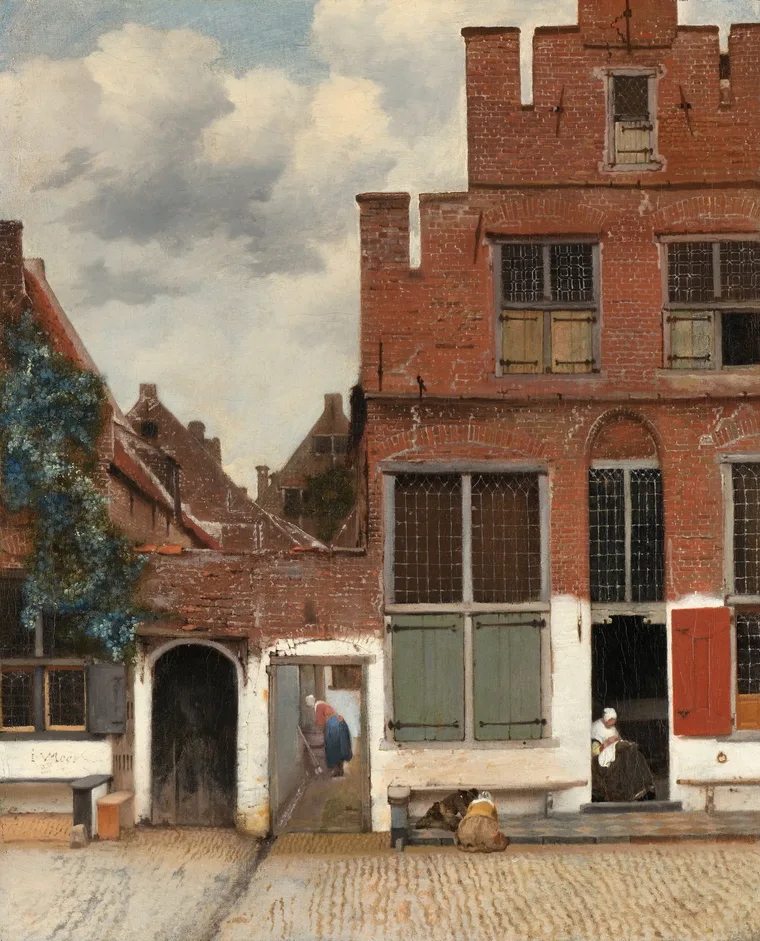
11. View of Houses in Delft (“The Little Street”) — Johannes Vermeer, c. 1658
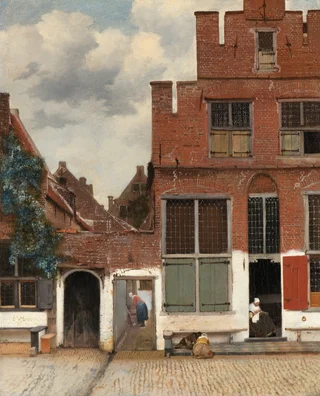
The brick house with a stepped gable takes up the right two thirds of the picture, and its top step just touches the edge of the canvas. On the left is a lower house under a tiled roof, its facade covered right up to the roof in blue-green climbing foliage. Between the houses are two passageways. The left one is entered through an arch with a dark wooden door, and in the open one on the right a whitewashed alley can be seen, where a maid in a red bodice bends over a barrel. In the open doorway of the large house a woman in a white cap sits sewing, and on the tiles in front of the house two children kneel with their backs to the viewer. The whitewash on the lower storeys is flaking and stained, a crack runs along the top step of the gable, a single bright red shutter hangs by the door, and on the white wall of the left house, below the window, is written “I V Meer”.
In 2025 the museum's researchers described what they had found under the top layer. At first a woman doing needlework sat at the entrance to the left passage, then Vermeer painted her out and made the woman in the doorway a mirror-image copy of her. The door of the large house was at first closed and painted green, like the shutters, and only later did Vermeer “open” it.
The painting passed through the same family that sold The Milkmaid to the state. In 1800 Pieter van Winter bought it, his daughter Lucretia inherited it, and in 1822 she married Hendrik Six. In 1921 the art historian Jan Six put The Little Street up for auction, the bidding fell short of the reserve, and the oil magnate Henri Deterding, head of Royal Dutch Shell, bought it for 625,000 guilders and later gave it to the Rijksmuseum.
Where the house stood was argued over for more than a century. In 2015 the art historian Frans Grijzenhout found a Delft register of 1667, kept for the tax that paid for dredging the canals, which recorded the width of every frontage and passage, and from it he identified the houses at Vlamingstraat 40–42, two houses of the same width with two narrow passages between them. The museum presents this address as fact, while the researcher Philip Steadman disputes it, pointing to discrepancies in the measurements. According to Grijzenhout, the house belonged to the half-sister of Vermeer's father, Ariaentgen Claes van der Minne, a widow with five children who made her living selling tripe, and until the 19th century the right-hand passage was called the Tripe Gate.
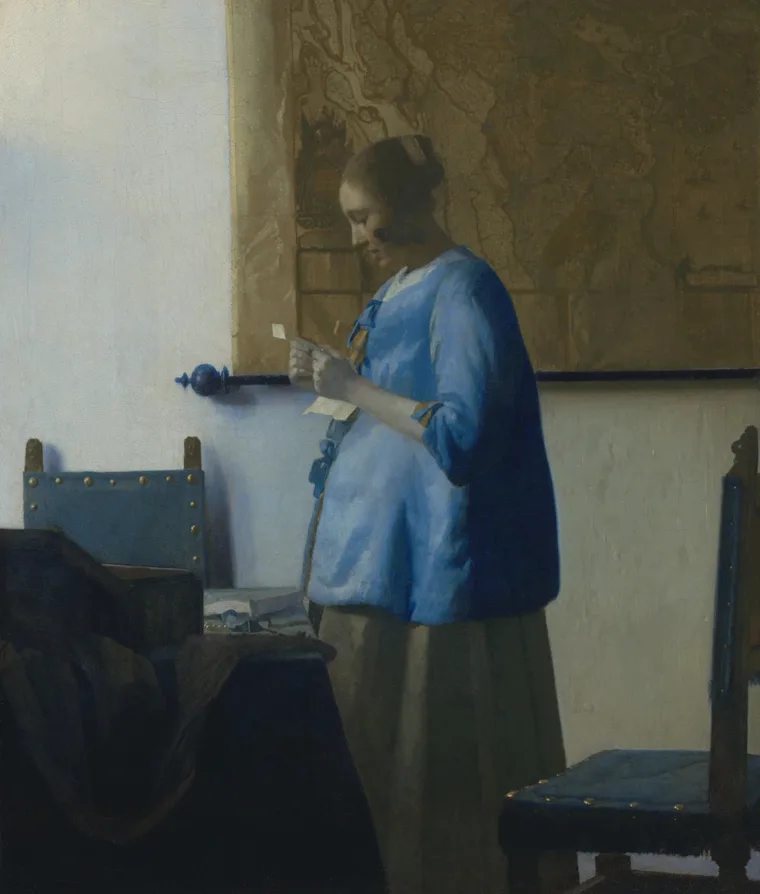
12. Woman Reading a Letter (“Woman in Blue Reading a Letter”) — Johannes Vermeer, c. 1663
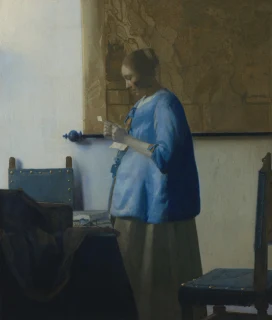
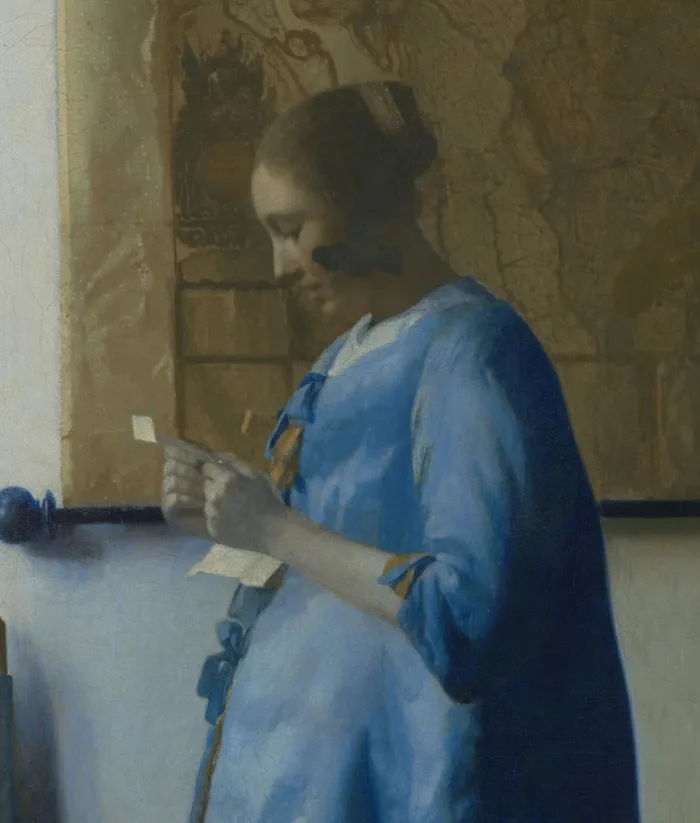
The restorer who relined the canvas in 1928 mistook the white dots of light that Vermeer had set down for pearls and painted them over in yellow, to match the necklace on the table. Those dots were removed in the restoration of 2010–2011, together with the thick, yellowed and uneven varnish that had turned the blues of the picture green. The conservator Ige Verslype said her greatest surprise was a copper-green layer on which Vermeer had laid the ultramarine of the jacket.
The young woman stands in profile, facing left towards a window we never see, and holds the letter in both hands just below her chest, while a second sheet hangs down from her hands. She wears a pale blue padded jacket with dark blue bows, and an ochre-yellow lining shows at its edge and on the turned-back sleeve. On the table lie an open box, a string of pearls, a crumpled blue ribbon and papers. Almost the whole wall behind her is taken up by a brown map of Holland and West Friesland on a dark rod with a blue knob at the end, and the shadows of the chair back on the whitewashed wall are painted pale blue. The woman is often taken to be pregnant, but costume historians explain her silhouette by the fashion of the 1660s.
In 1839 the Amsterdam banker Adriaan van der Hoop bought the painting from the London dealer John Smith. In 1847 he left his collection to the city in his will, on condition that it be kept together and shown in Amsterdam under his name, and that the admission money go to the poor. When he died in 1854, the city hesitated for a long time to accept the bequest, because tax was due on it, and according to the press most of that money was put up by private donors. The collection was shown as the Museum Van der Hoop in the Oudemanhuispoort until 1885, when the city lent it to the Rijksmuseum.
After the restoration the painting went first to Japan, where it was shown in Kyoto, Sendai and Tokyo, and then to Shanghai, São Paulo and Los Angeles. In 2025 the city asked the Amsterdam court whether such journeys broke the condition that the collection be kept in Amsterdam, and on 9 January the court ruled that temporary exhibitions do not conflict with the will.
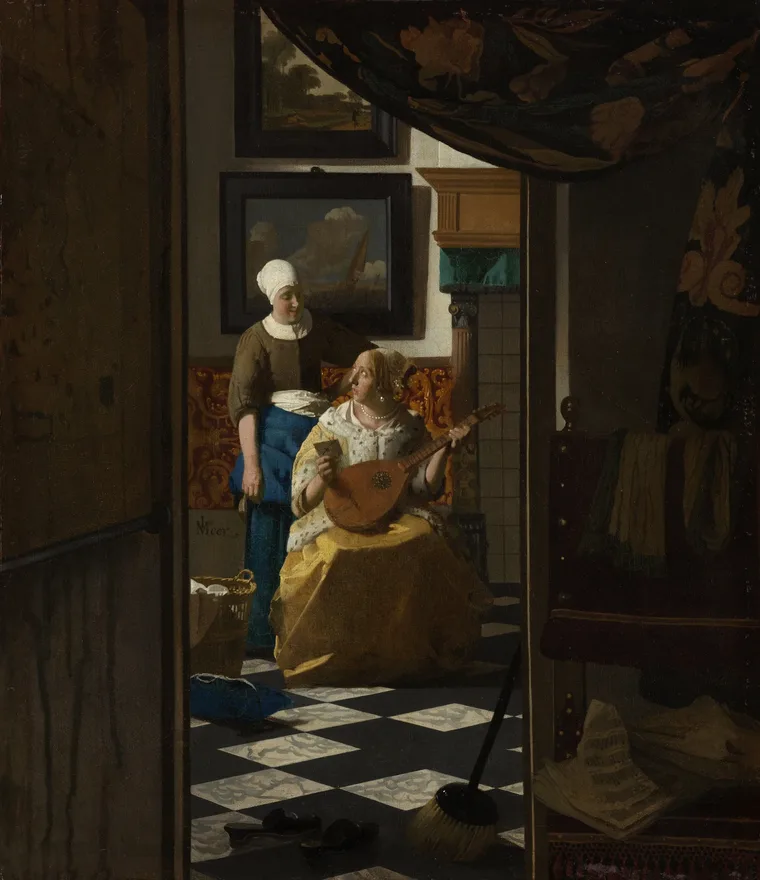
13. The Love Letter — Johannes Vermeer, c. 1669–1670
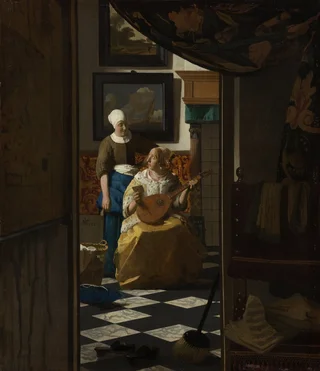
On the evening of 23 September 1971 Mario Roymans, a 21-year-old trainee waiter from Belgian Limburg, hid before closing time in an electrical cupboard of the Palace of Fine Arts in Brussels, where the exhibition Rembrandt and His Time was on and The Love Letter, lent by the Rijksmuseum, was hanging. He took the painting off the wall, but in its frame it would not fit through the window he meant to leave by, so he cut the canvas out of the frame with a small kitchen knife, folded it and pushed it into the waistband of his trousers. At first he hid the picture at home, then buried it in a forest, dug it up again because of the rain, and kept it in a pillowcase under the mattress at the hotel where he worked. Through journalists he let it be known that he would return the painting if 200 million Belgian francs were given to refugees from East Pakistan, where the Bangladesh War of Independence was then being fought. He signed himself with the name of Tyl Ulenspiegel, the Flemish folk hero, and many Belgians took his side. On 6 October he phoned a radio station from a petrol station, was recognised, and was arrested an hour later after a chase.
The painting was found under the mattress two weeks after the theft. Paint had flaked off along the cuts, worst of all in the upper right corner. Luitsen Kuiper, the Rijksmuseum's chief restorer, spent almost a year restoring the canvas, and an international committee assembled by the museum's director decided that the losses should be filled so that they could not be seen. Roymans was sentenced to two years and served about six months.
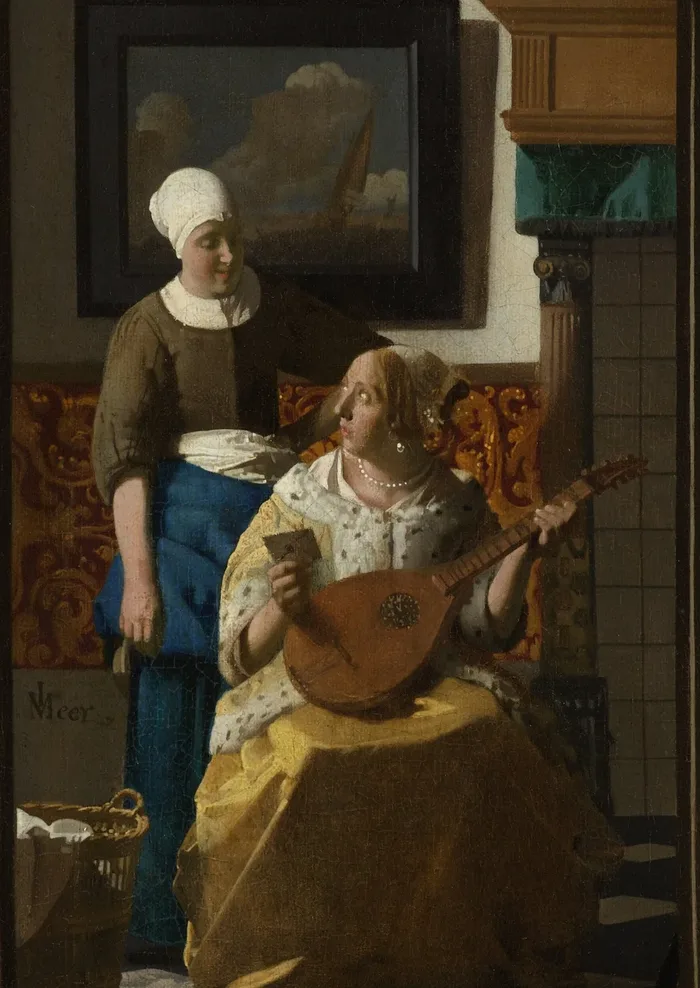
Vermeer painted The Love Letter shortly before 1672, when the French invasion brought down the Dutch art market, and in 1675 he died in debt. The viewer looks from a dark front room through a doorway into a bright room beyond, and above the doorway a dark curtain with a large ochre-gold pattern has been drawn aside. On the threshold stand a pair of dark slippers and a propped-up broom, on the left is a laundry basket, above which the signature “IVMeer” is on the wall, and on the right sheet music lies on a chair with a dark red seat. In the room, the mistress, in yellow satin and a yellow jacket trimmed with ermine, holds a cittern on her lap and a folded letter in her right hand, and with her lips parted she looks up at the maid in a blue apron, who smiles down at her. On the wall behind them hang two paintings, a landscape with a traveller and a seascape with a sailing ship, and the museum suggests that the sea may well allude to what the letter is about.
In 1892 the Rembrandt Association bought the painting at auction for 41,000 guilders, an enormous price at the time, and the next year handed it over to the Rijksmuseum. Four years after the Brussels theft, Luitsen Kuiper restored The Night Watch, slashed with a knife in 1975.
14. The Merry Family — Jan Steen, 1668
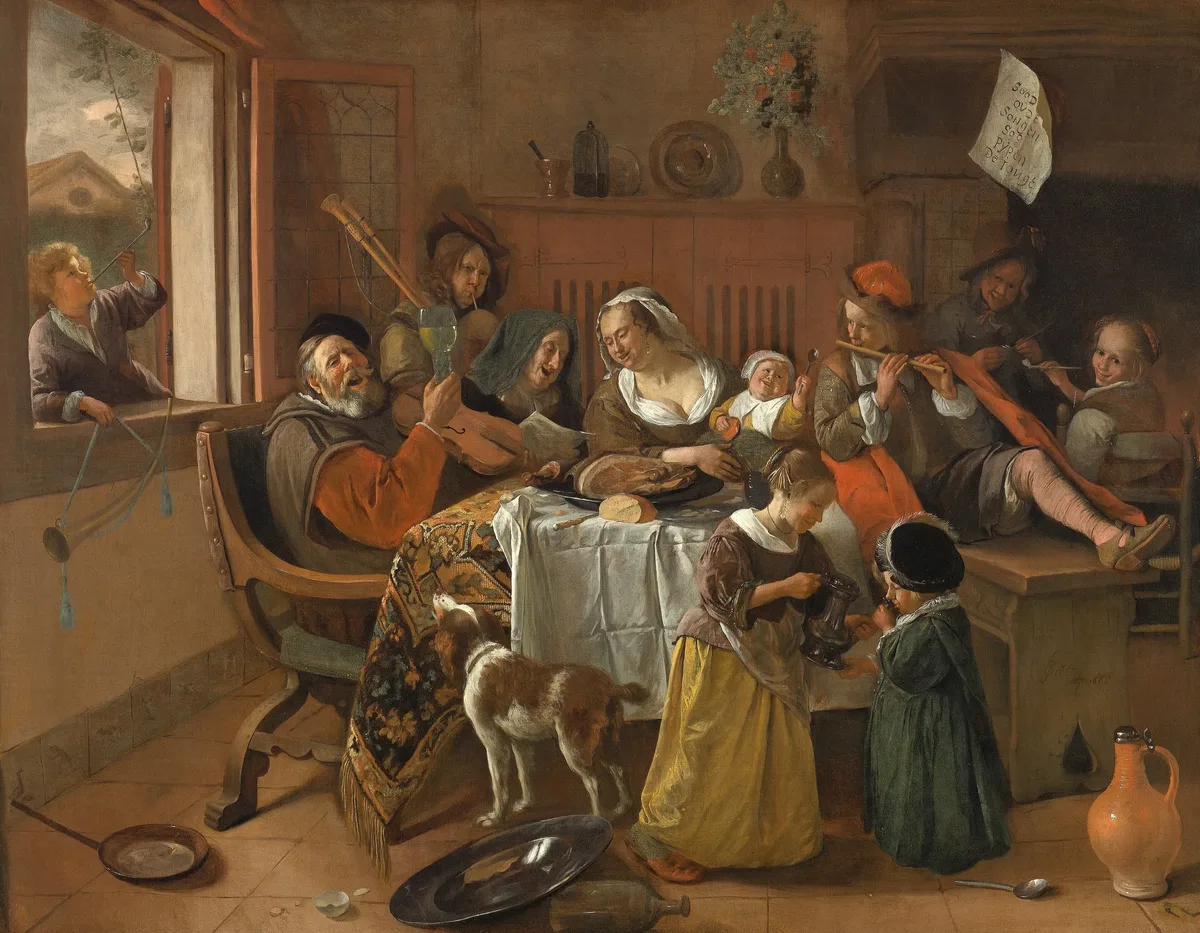
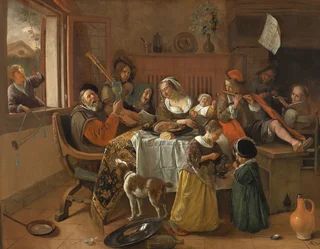
On a sheet pinned to the wall above the fireplace, in the upper right corner, is written a Dutch proverb, “As the old sing, so pipe the young”. The Dutch word for “pipe” here means both to play a pipe and to smoke one, and the children in the picture do both. The boy and girl on the right are smoking long clay pipes, a curly-haired boy at the window is blowing a pipe, and in front a girl in a yellow skirt pours wine from a pewter jug straight into the mouth of a little one in a fur hat.
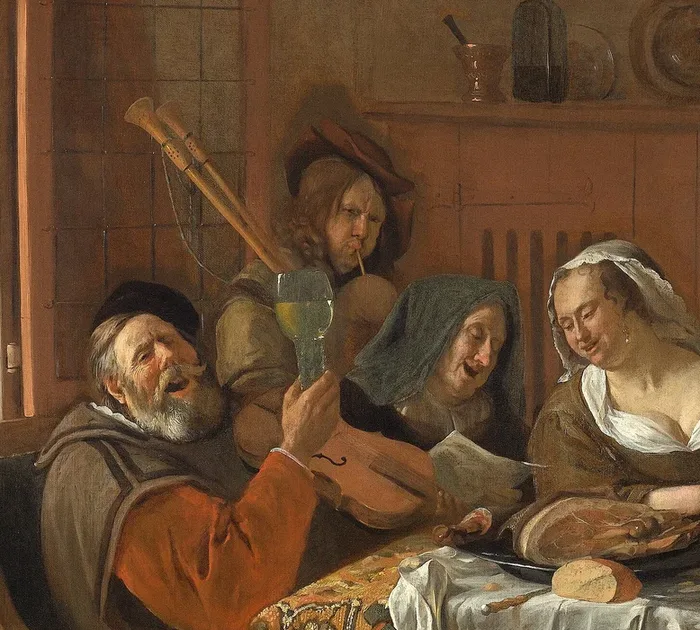
At the table a grey-bearded old man in a black skullcap sits in an armchair with his head thrown back, singing with his mouth open and raising a tall glass of white wine. An old woman in a grey-green hood sings from a sheet with her eyes closed, a young woman in a white headscarf smiles at a laughing baby holding a spoon, and a young man in a red cap plays the flute with his legs stretched out on the bench. Behind the old man a young man in a brown hat blows the bagpipes, which the museum calls “the instrument of fools”, and in him the museum sees Jan Steen himself. On the floor lie a frying pan, a bottle on its side and eggshells, a spotted spaniel stands by the table, and on the front board of the bench on the right is written “JSteen 1668”.
Steen painted this picture in Haarlem, where he had lived since 1661, in the years of his large, crowded family scenes. In the Netherlands a house where everything is upside down is still called a Jan Steen household, and the museum connects the expression with The Merry Family. Steen's reputation as a drunkard also grew partly out of pictures like this, though art historians see in the bagpiper a part the painter played for laughs. Van der Hoop left the picture to Amsterdam, and it has been in the Rijksmuseum since 1885. Steen obtained the right to keep an inn in Leiden only in 1672, four years after The Merry Family.
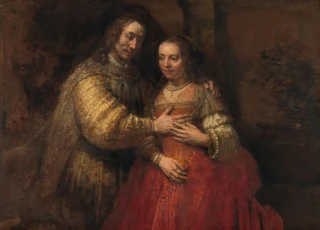
15. Isaac and Rebecca (“The Jewish Bride”) — Rembrandt, c. 1665–1669
In 1828 the London dealer John Smith put this painting up for auction as Jephthah and his Daughter, and nobody bought it. In 1833 the Amsterdam banker Adriaan van der Hoop acquired it for 6,825 guilders, and his inventory lists it as “a representation of the Jewish bride, whom the father adorns with a necklace”. That is the first known appearance of the name, and the 1855 catalogue of the Museum Van der Hoop already describes the picture as known by the name of the Jewish bride. The museum calls it Isaac and Rebecca and puts the old name in quotation marks.
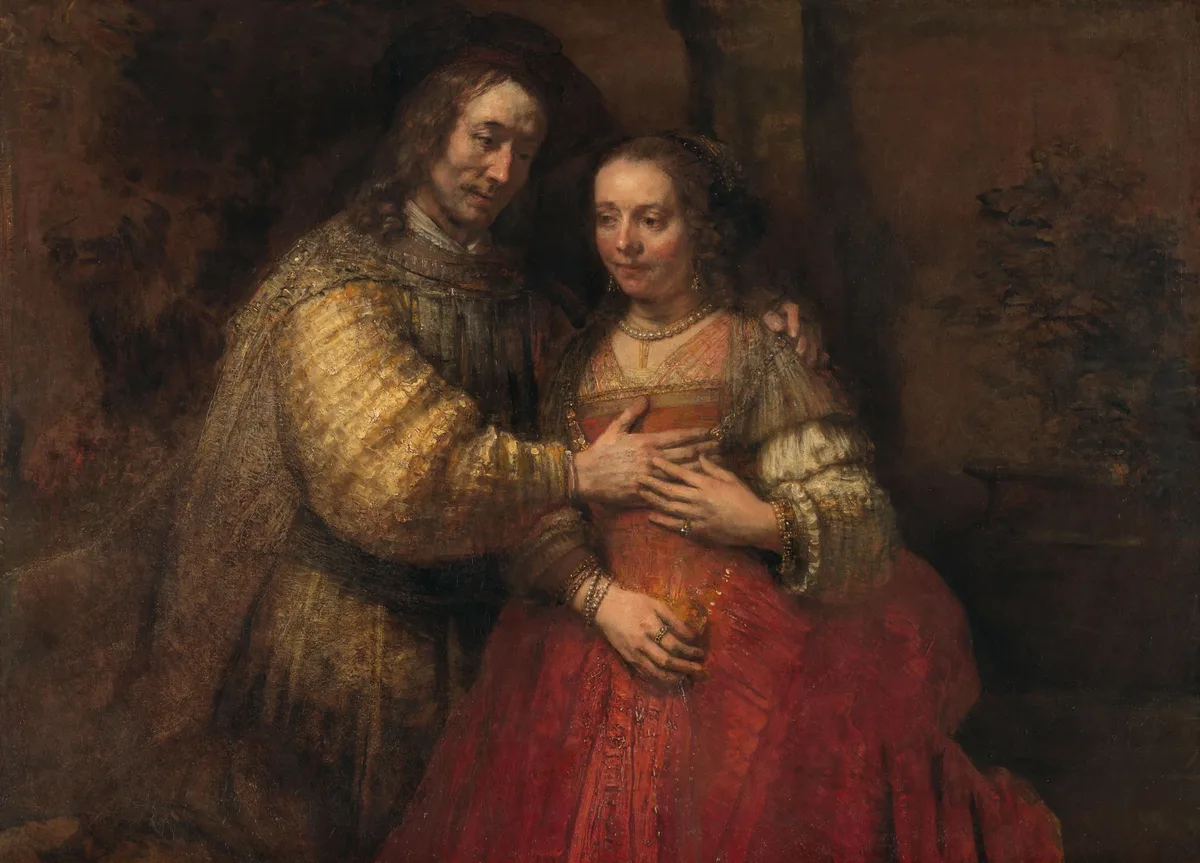
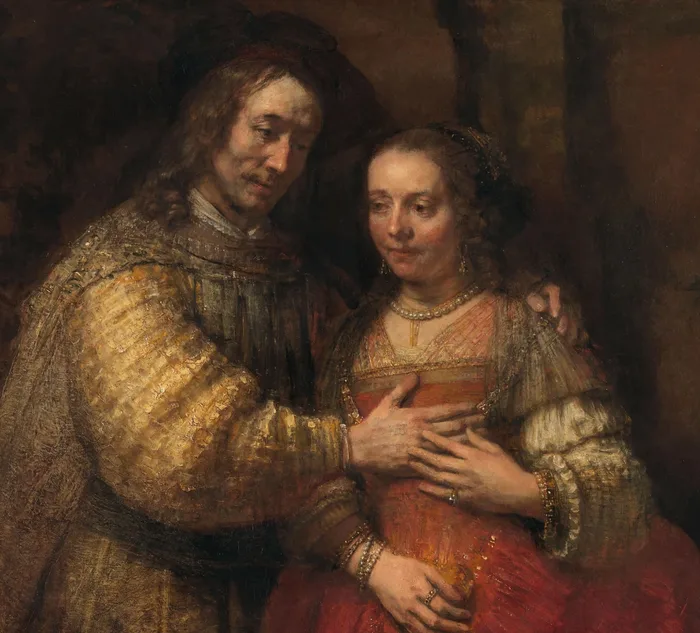
Scholars worked out the subject from a preparatory drawing by Rembrandt, made around 1662 and now in a private collection in the United States. In it the couple embrace, the woman sitting on the man's lap, and in the upper right corner a figure at a window is barely sketched in. He is King Abimelech from the Book of Genesis, who saw Isaac caressing Rebecca and realised that the woman Isaac had passed off as his sister was his wife. X-rays have shown that on the canvas, too, Rembrandt first sat the woman on the man's lap, then repainted them both standing, and he left Abimelech out of the picture. Jonathan Bikker, a curator at the Rijksmuseum, allows that it may be a commissioned portrait of a real couple in the roles of Isaac and Rebecca, as was customary at the time.
The man's right hand lies flat on the woman's breast, her left hand lightly touches it, and she wears rings on both hands. They do not look at each other, and both have lowered their eyes. Rembrandt built up the man's huge golden-yellow sleeve in thick ridges and crusts of paint, partly with the palette knife, and scratched into it with the end of the brush handle, so that the sleeve glitters like metal. The whole picture is painted in red and gold on brownish black, and only the sleeve, the hands, the faces and the red skirt glow.
In October 1885, a few months after the city had lent the painting to the new Rijksmuseum, Vincent van Gogh (no. 24) sat in front of it. He wrote to his brother what an intimate, what an infinitely sympathetic painting it was, painted with a hand of fire, and that one must have died many times to paint like that. His pupil Anton Kerssemakers recalled in 1912 that Van Gogh said he would give ten years of his life to sit in front of this picture for a fortnight with only a crust of dry bread. Kerssemakers added that Vincent always ate his bread dry so as not to pamper himself.
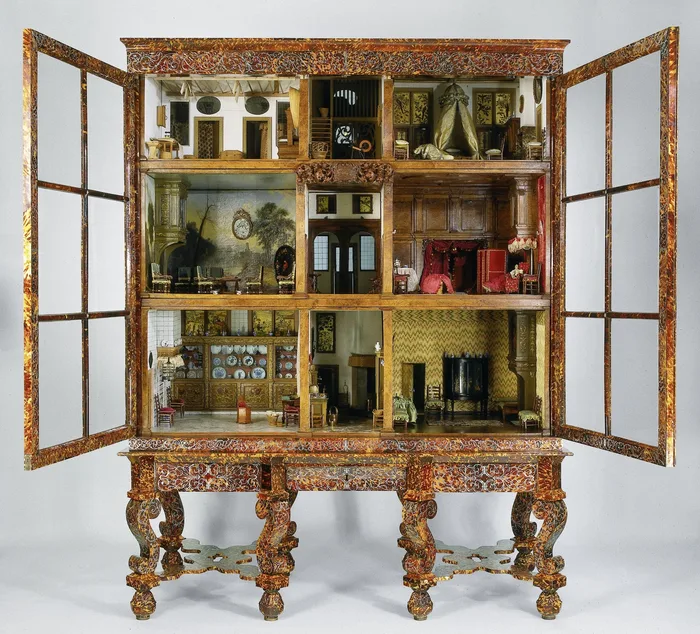
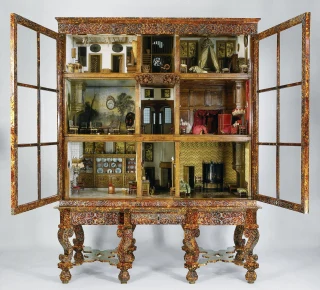
16. Dolls' House of Petronella Oortman — unknown Amsterdam craftsmen, c. 1686–1710
Petronella Oortman, the daughter of an Amsterdam gunsmith, was first married to Carel Witte, a silk merchant from Hamburg. Their only daughter died in 1684 before she was a year old, Witte died a year later, and in 1686 Petronella married the silk merchant Johannes Brandt. At about the same time she began commissioning this cabinet, and she went on furnishing it for some 25 years. The museum writes that dolls' houses in cabinets like this were made for show, for grown women, as a picture of the ideal household.
The tall cabinet on legs is veneered with tortoiseshell, and thin pewter tendrils wind over its whole surface. Behind its two glazed doors are nine rooms, three on each of three floors. The carcase was made by an unnamed French cabinetmaker working in Amsterdam, and dozens of craftsmen worked on the rest, from carvers and basket-makers to silversmiths and glassblowers. The painter Nicolaas Piemont covered the walls of the salon on the middle floor with a single continuous landscape of trees and a distant tower. In the best kitchen downstairs a gilded dresser is crowded with blue-and-white porcelain and a birdcage hangs by the window, the lying-in room has a bed under a red canopy, and upstairs in the linen room laundry dries on rails below the ceiling and an iron lies on a little table.
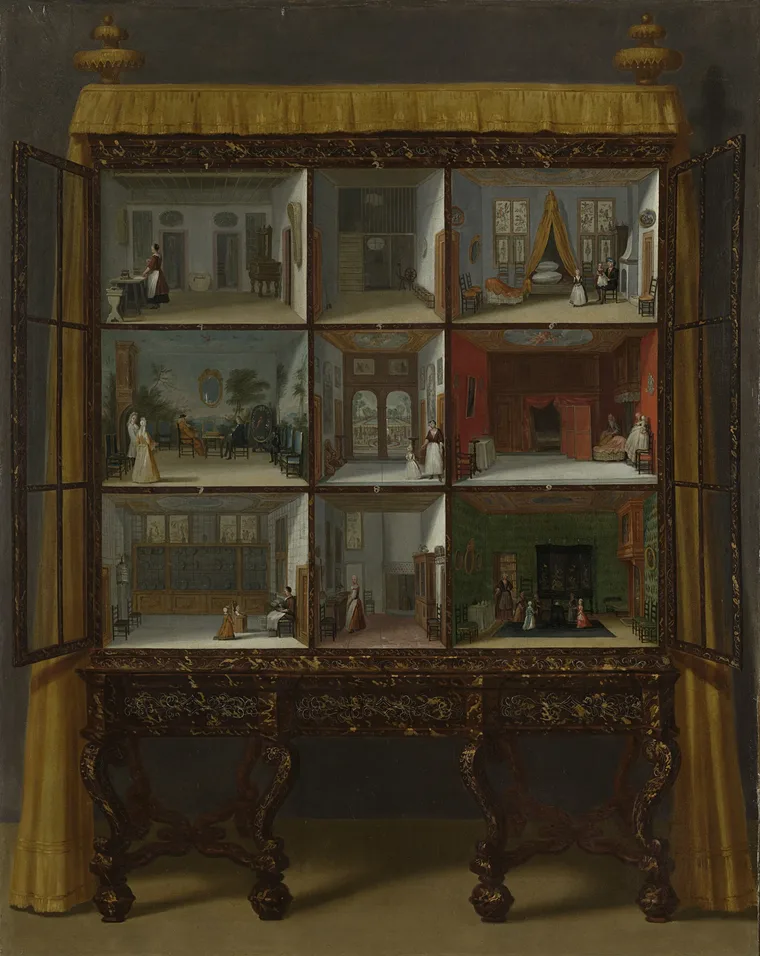
The Brandts told the German traveller Zacharias Conrad von Uffenbach, who came to their house to see the cabinet, that it had cost 30,000 guilders. The Rijksmuseum compares that sum to the price of a house on the Herengracht, the canal of the city's grandest families. That figure is the family's word, and in her son's inventory of 1743 the cabinet is valued at 700 guilders. There is also a legend that Peter the Great wanted to buy it but found the price beyond him. In 1821 the cabinet was bought by the state.
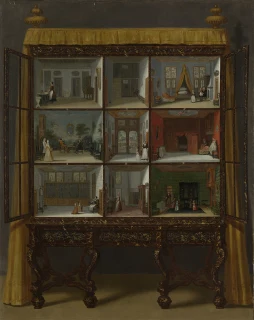
In 1710 the painter Jacob Appel painted the cabinet in oils, and his picture shows the dolls, the yellow curtains that were drawn across the cabinet, and the garden. Of the dolls only a baby with a wax face survives, in a christening gown of pink and blue silk with ribbons and lace.
The Republic argues with itself
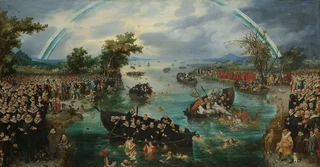
17. Fishing for Souls — Adriaen van de Venne, 1614
In 1609 the Republic of the United Provinces concluded the Twelve Years' Truce with Spain and with the Archdukes Albert and Isabella, who ruled the Spanish Netherlands. The fighting stopped, yet north and south kept competing for the souls of believers on both sides of the new border. Adriaen van de Venne, who came from a family of immigrants from the south and whose drawing Rembrandt later copied for the dog in The Night Watch, was living in 1614 in Middelburg, in strictly Calvinist Zeeland, and painted a wide panel about this rivalry.
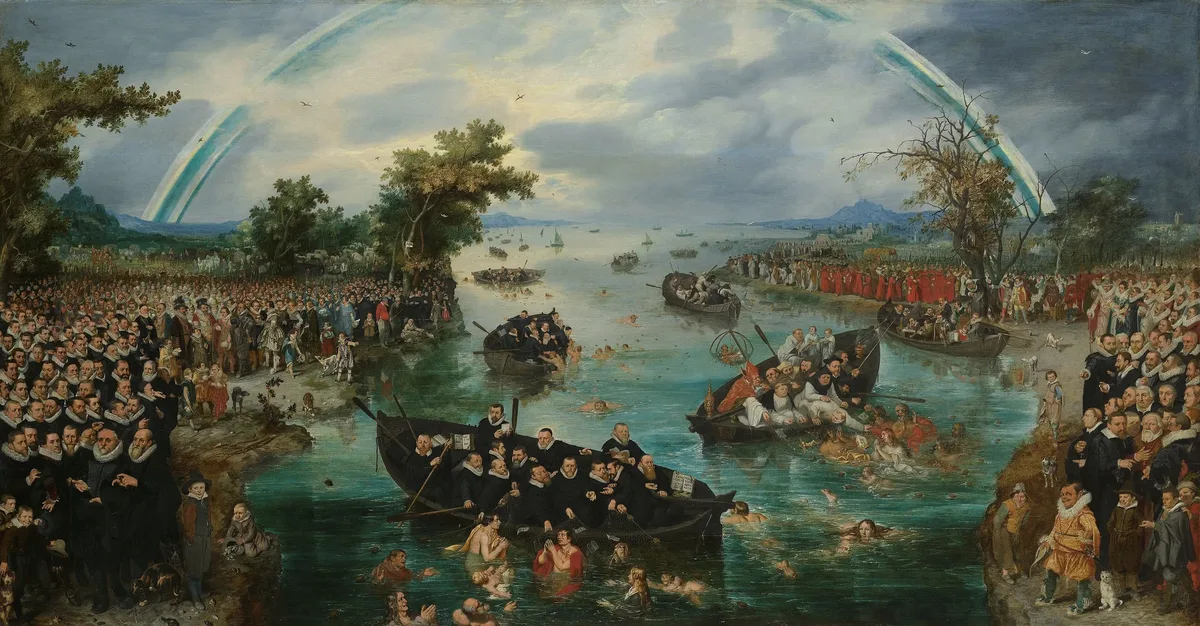
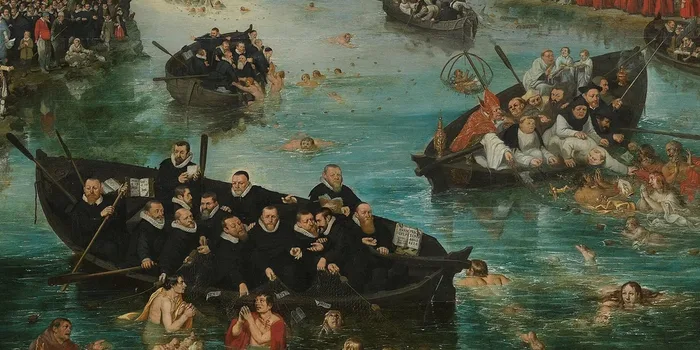
A broad river runs from the foreground to a misty horizon and divides the picture in two. On the left bank stands a dense crowd of Protestants in black with white ruffs, and in the front rows every face is a portrait, among them a recognisable Maurice of Orange, the stadholder. On the right bank a procession of cardinals in red moves along, the pope is carried under a golden canopy, and the archdukes stand nearby. The sky clears over the left bank and storm clouds gather over the right, while a double rainbow spans the whole sky. On the river souls are being fished, and in the Protestant boat preachers in black, among them the Middelburg minister Willem Teellinck, haul in a net with little labels reading FIDES, SPES, CHARITAS, faith, hope and charity, while in the stern lies a book whose inscription calls them fishers of the Gospel, with the year 1614. In the Catholic boat sits a bishop in a red chasuble and mitre, a gold monstrance stands at the bow, choirboys sing, and a lure-cage with the figure of an infant hangs from the bow. According to the museum, the Protestant fishermen are painted as portraits and the Catholic ones as caricatures.
People are floundering in the Catholic net too, but they were added later, in the 1640s or 1650s, quickly and so thinly that the water shows through the figures. At first the net was empty. The museum suggests that this was done to soften the hostility towards Catholics, because the times or the owner had changed, and that Van de Venne himself may have painted them in. In 1735 the painting was sold in The Hague as a work by Jan Brueghel the Elder, and it was probably bought by the stadholder William IV. In 1795 the stadholders' collection was declared national property of the Batavian Republic, and in 1798 Fishing for Souls was transferred to the National Art Gallery. Only in 1878 was it given back to Van de Venne, and until then the figures and the landscape had been attributed to different painters. A little to the left of the bow of the Protestant boat a painted fly sits on the water, a joke in the manner of Jan Brueghel, and it is easy to take it for a real one.
18. The Corpses of the De Witt Brothers — attributed to Jan de Baen, c. 1672–1675
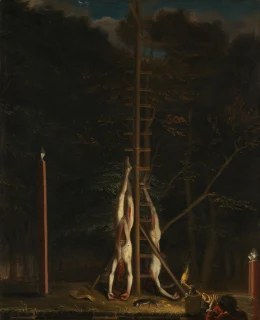
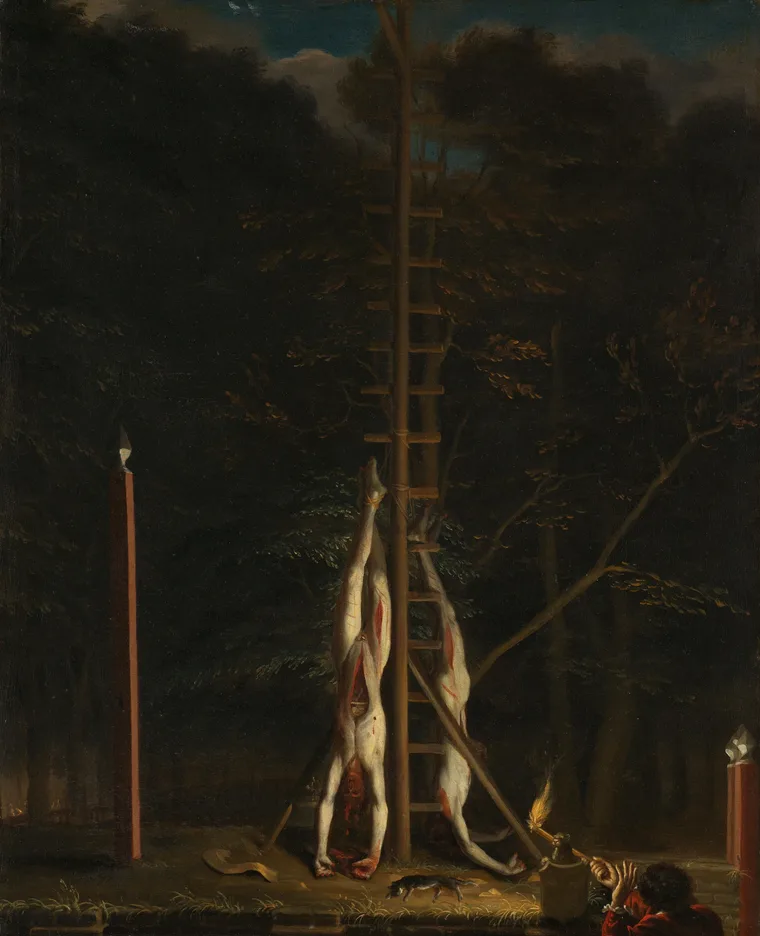
In 1801 Cornelis Sebille Roos, keeper of the National Art Gallery (no. 20), wrote to Alexander Gogel, who was in charge of the finances of the Batavian Republic, that this painting was too horrible for a museum and not even worth a new frame. If His Excellency nevertheless insisted, Roos wrote, the frame should be repaired and a small curtain hung in front of the picture. Gogel wanted it for what it showed, and in 1802 the gallery acquired the painting by exchange.
On 20 August 1672, the year France attacked the Republic, a mob that included men of the civic militia killed the De Witt brothers in The Hague, by the prison gate known as the Gevangenpoort. Johan de Witt had been Grand Pensionary of Holland, the Republic's leading statesman, for almost 20 years, and Cornelis, burgomaster of Dordrecht, had been convicted of plotting against Prince William III of Orange. The brothers' bodies were stripped, mutilated and hung up at the place of execution on the Vijverberg.
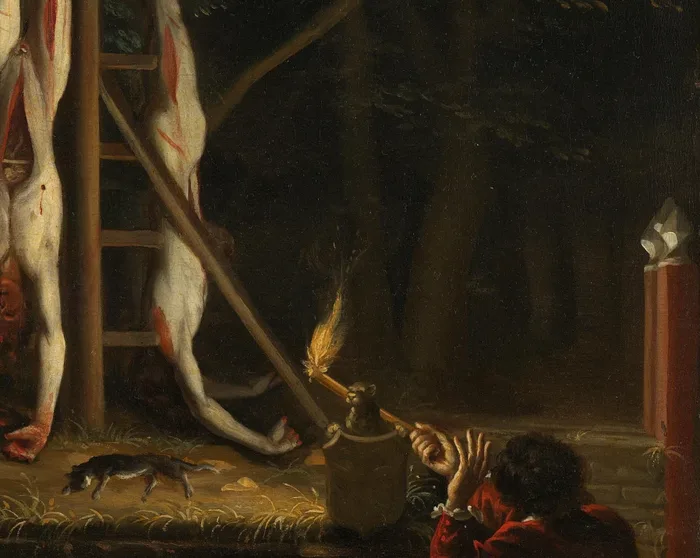
It is night in the picture, dark trees take up almost the whole field, and only a strip of blue sky shows at the top. In the middle stands a tall post with crossbars like a ladder, and on it two naked bodies hang head down, their feet tied. The left one is lit, its belly slit open, with long red wounds along the legs and trunk, and its head hangs close to the ground over a red pool. The right body is half hidden behind the post. In the lower right corner a man in a red coat stands with his back to the viewer, holding out a torch at arm's length, his other hand raised to his head, and he has turned away. On the ground beneath the bodies lies a dead animal that looks like a cat.
The painting is attributed to Jan de Baen, a portrait painter in The Hague who had painted both brothers in their lifetime, although the art historian Frans Grijzenhout considers the attribution doubtful. For the town hall of Dordrecht De Baen had painted an allegory in praise of Cornelis, and in 1672 a mob tore it from the wall and slashed it, cut Cornelis's head out of the canvas, carried it across the river Merwede and nailed it to the gallows.
Roos thought the painting was a copy after a print, and the historian Van Luttervelt also believed it repeated a print of 1672 in which two men hold the torch and verses hostile to the brothers are printed below the image. The inscription on the back of the canvas claims otherwise. It states that these are the bodies of Jan and Cornelis de Witt, painted from life by a distinguished painter while they were still hanging on the post at 11 at night, that this is the only original made from life on 20 August 1672, and that it is therefore worth a great deal of money.
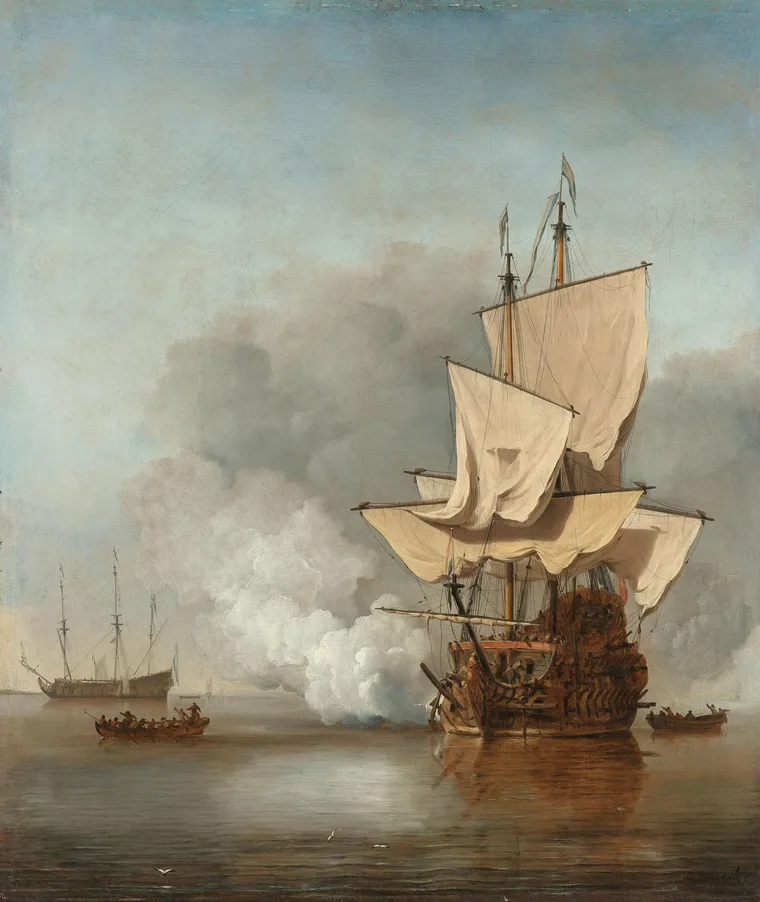
19. The Cannon Shot — Willem van de Velde the Younger, c. 1680
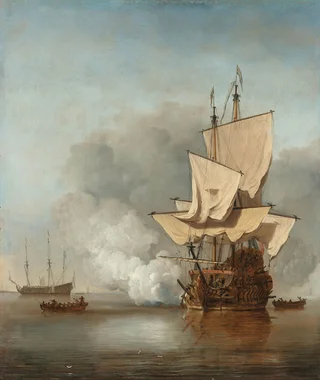
In the winter of 1672–1673, when France had attacked the Republic by land and at sea the war with England had broken out again, the painter Willem van de Velde the Elder, a draughtsman of sea battles, left Holland for England together with his son Willem. In 1674 King Charles II granted each of them 100 pounds a year, the son for putting his father's drawings into colours “for our particular use”, and paid separately for each picture. They were given a studio in the Queen's House at Greenwich. The Anglo-Dutch war ended only in 1674, and until then father and son had been working for the enemy's navy.
The banker Adriaan van der Hoop bought the painting and left it to Amsterdam with the rest of his collection, and since 1885 it has been in the Rijksmuseum. Its pendant, The Gust, in which an English warship with a broken mast battles a storm, was bought separately by the museum at the beginning of the 20th century.
The museum dates The Cannon Shot to about 1680, the painter's English years, and in it a Dutch warship lies becalmed. The canvas is upright, and two thirds of it is sky, grey clouds on pale blue. The ship faces the viewer bow-on and slightly turned, with a carved red lion at its bow, its sails loosed and hanging from the yards in heavy cream folds, and long red, white and blue pennants trailing from the masts. To the left of the bow a dense white cloud of powder smoke bursts out, spreads low over the water and higher up drifts apart in a grey mass that merges with the clouds. The dark hull with its rows of gunports is reflected in the mirror-smooth water. On the left a second ship lies at anchor, in a sloop one man has risen to his feet and is waving, three gulls sit on the water in the foreground, and in the lower right corner is the signature “W v velde J.”.
A nation gives the pictures their meaning
20. The Threatened Swan — Jan Asselijn, c. 1650
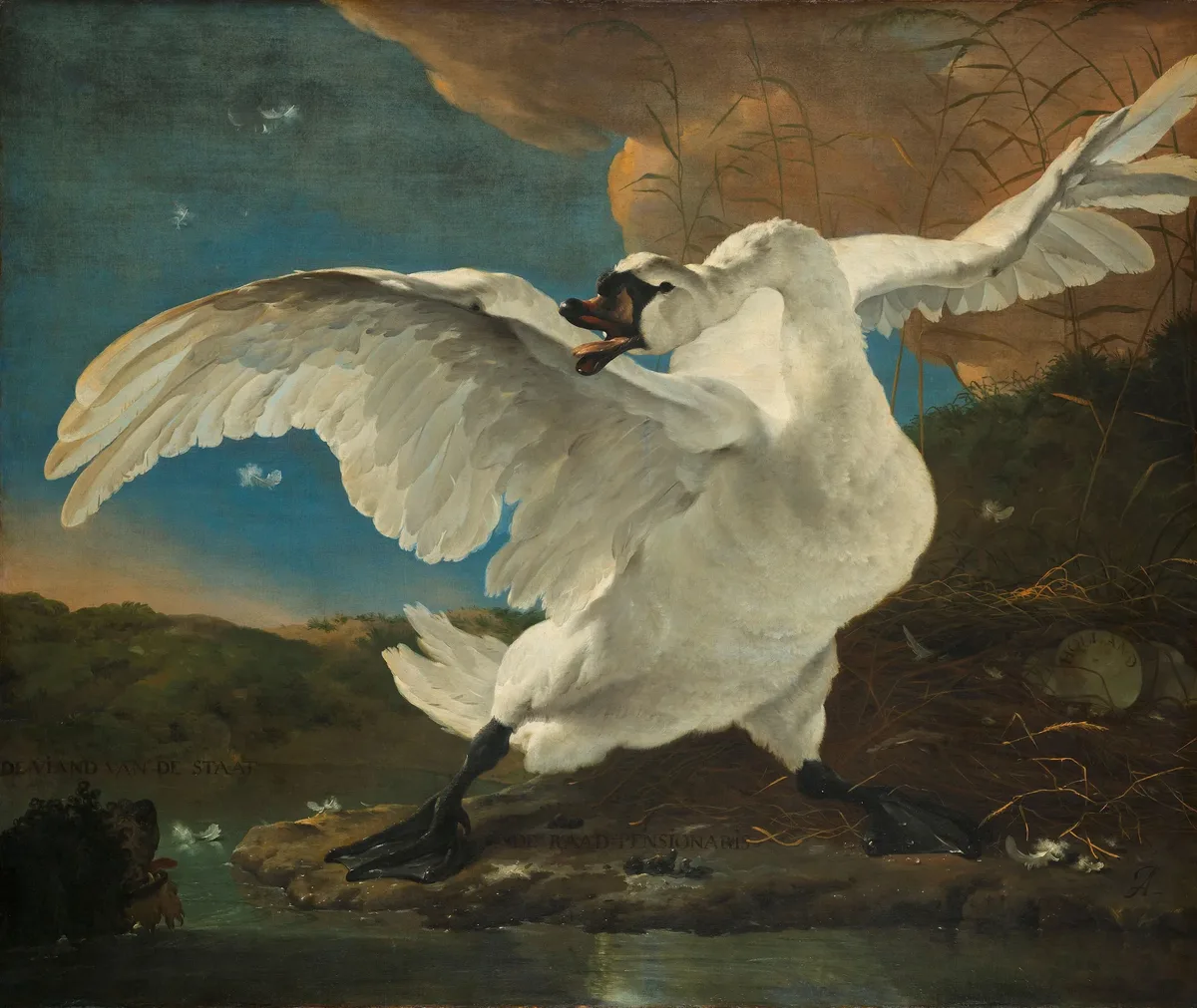
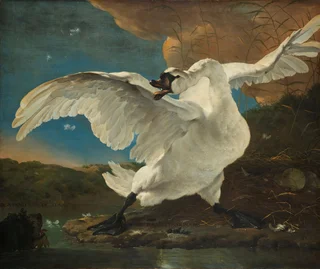
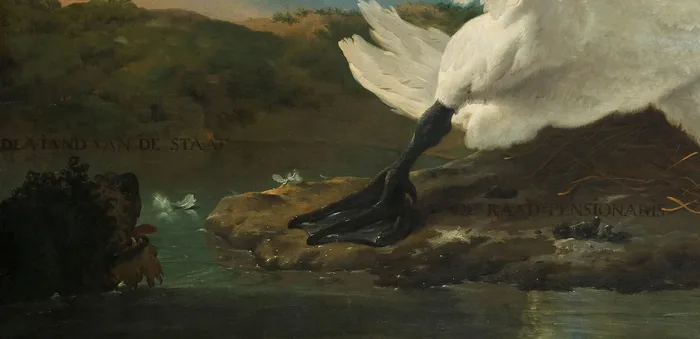
A white swan rears up on a low bank by the water and spreads its wings almost across the whole canvas, so that the tip of the right one is cut off by the edge. Its neck is bent, its head turned to the left, its orange beak open so wide that the tongue shows, its black webbed feet planted wide apart. In the lower left corner, where it is easy to miss, the head of a dark curly-coated dog rises from the water, teeth bared and red tongue showing, and feathers knocked loose float beside it. On the right, in a nest of dry reeds, lies a pale egg.
The picture carries three inscriptions in dark capital letters. Above the dog's head is “DE VIAND VAN DE STAAT”, the enemy of the state, on the bank between the swan's feet “DE RAAD-PENSIONARIS”, the Grand Pensionary, and around the egg is written “HOLLAND”. Technical analysis has shown that they were added after the painter's death. Asselijn died in Amsterdam in 1652, and Johan de Witt became Grand Pensionary in 1653 (no. 18). The inscriptions were most likely made in the 18th century. The inscription calls the dog only the enemy of the state, and some historians see William III in it.
In Rome, where Asselijn lived in the late 1630s and early 1640s, his fellows in the Roman society of Netherlandish painters nicknamed him Little Crab because of his crippled left hand. By 1647 he was back in Amsterdam, and around then Rembrandt made an etching of his portrait. Asselijn painted mostly Italian landscapes, and a single animal on this scale appears nowhere else in his work.
On 11 June 1800, at the sale of the collection of the Amsterdam merchant Jan Gildemeester, one of the brokers running the auction, Cornelis Sebille Roos, the same man who later asked for a curtain in front of the De Witt brothers' bodies, bought the swan for 95 guilders, exactly 100 with the fees. He was buying for the National Art Gallery, which had opened in The Hague 11 days earlier, in the confiscated palace of Huis ten Bosch, and the swan became its first acquisition.
21. The Battle of Waterloo — Jan Willem Pieneman, 1824
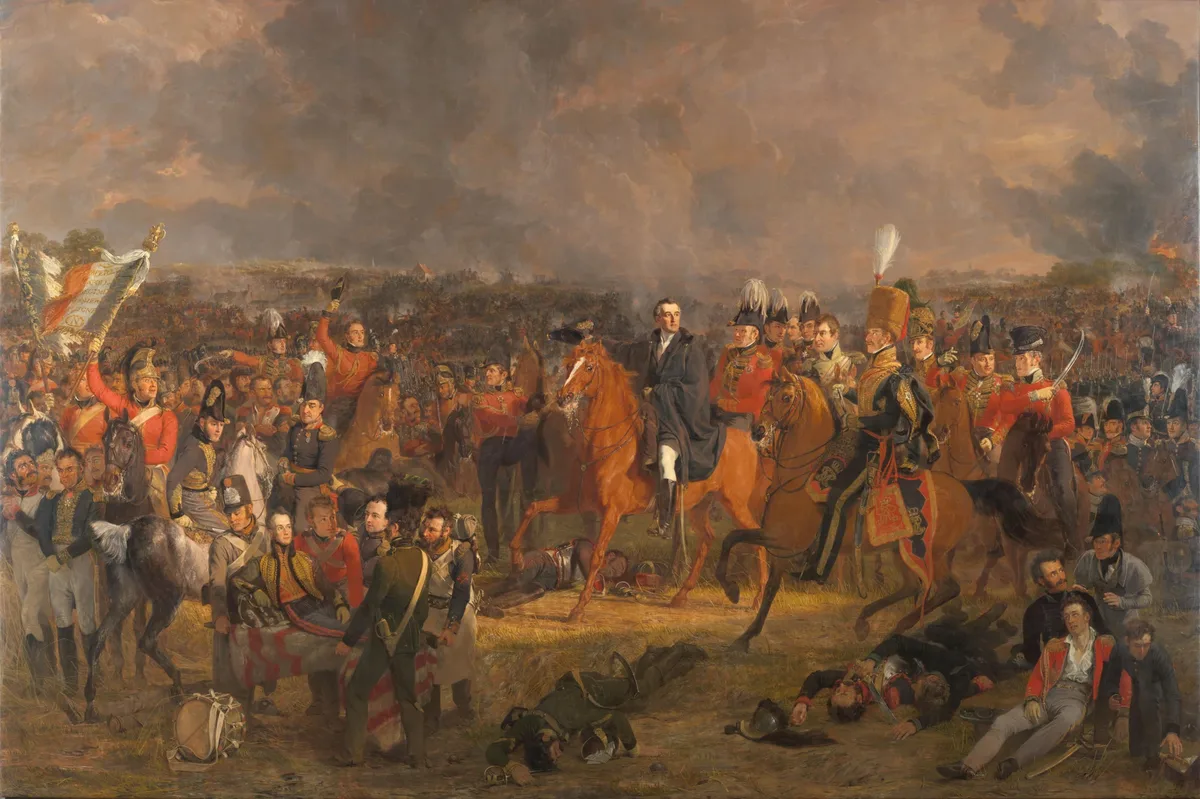
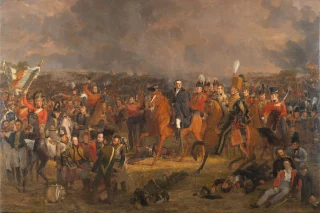
The Amsterdam painter Jan Willem Pieneman, made famous three years earlier by his picture of the Prince of Orange in action at Quatre Bras, crossed to London in February 1821 to paint Waterloo. The Duke of Wellington drew up a list of about 30 officers for him, gave him a room in his house, Apsley House, had his secretary summon the officers to sit, and had his horse Copenhagen brought up from the country. Pieneman was uneasy because the horse kept looking at him, and Wellington then offered to sit on it himself, since that was what the painter needed. Officers lent him the uniforms they had worn on the day of the battle. Four months later Pieneman returned to Amsterdam with at least 14 portraits from life and built a wooden studio in his garden for the canvas he had ordered in advance.
Pieneman painted the picture without a commission, at his own risk, and in the view of the Rijksmuseum's curator Michael Putter he hoped to exhibit and sell it in England. Wellington, judging by what contemporaries wrote, assumed it would come to him. In the spring of 1824 the Prince of Orange came to the studio and offered 40,000 guilders on the spot, many times more than the painter was asking, and the picture was paid for by his father, King William I, who made it a gift to his son. It is the largest painting in the Rijksmuseum, more than five and a half metres high and more than eight metres wide.
The museum describes the moment when Wellington learns that the Prussians are coming to his aid. The battle was won by Wellington's allied army and the Prussians. In the centre Wellington, bareheaded, sits on a chestnut horse with a white blaze and holds out his black bicorne at arm's length. Behind him stretches a row of staff officers in red coats, on the left cavalrymen in brass helmets raise two captured French standards with gold eagles above their heads, and on the nearer one “L'EMPEREUR NAPOLEON” can be read. In the lower left corner, on a stretcher under a grey blanket with red zigzags, sits the pale, wounded Prince of Orange in a gold-braided hussar dolman, looking at the viewer, and in the foreground lie the dead. Some scholars believe Pieneman deliberately brought the wounded Prince of Orange to the front to give more weight to the Dutch share in the victory. Putter, on the contrary, reads the picture first of all as a group portrait of British officers among whom the prince is almost lost, and in 1825 a London paper called the way the Dutch painter had pushed the prince forward “a patriotic anachronism”.
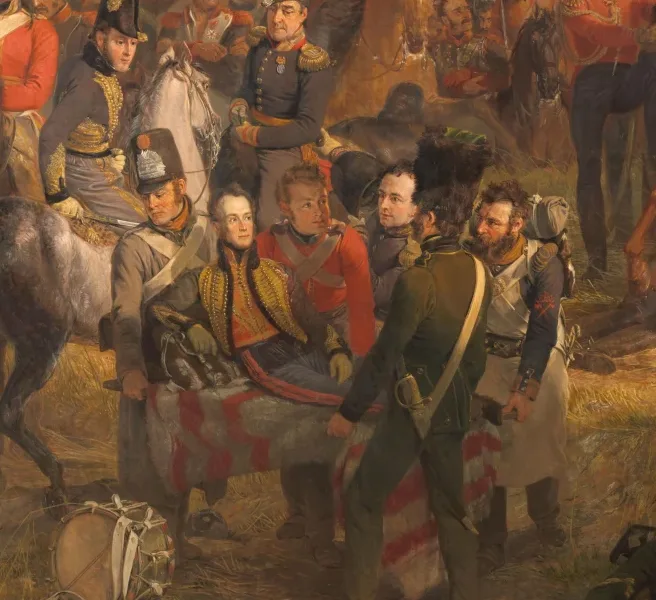
In the summer of 1824 Pieneman showed the painting in his studio for an entrance fee, and the newspapers attacked him for making money from a work he had already sold. In 1825 he took it to London, to a pavilion built for it in Hyde Park, and then to Ghent. Pieneman himself said he had lost more than 6,000 guilders on these exhibitions and gained nothing but fame.
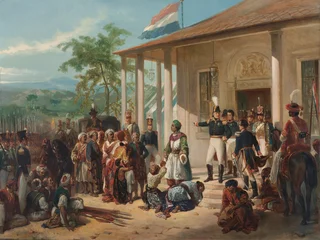
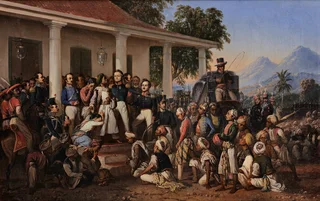
22. The Arrest of Diponegoro by Lieutenant-General De Kock — Nicolaas Pieneman, c. 1830–1835
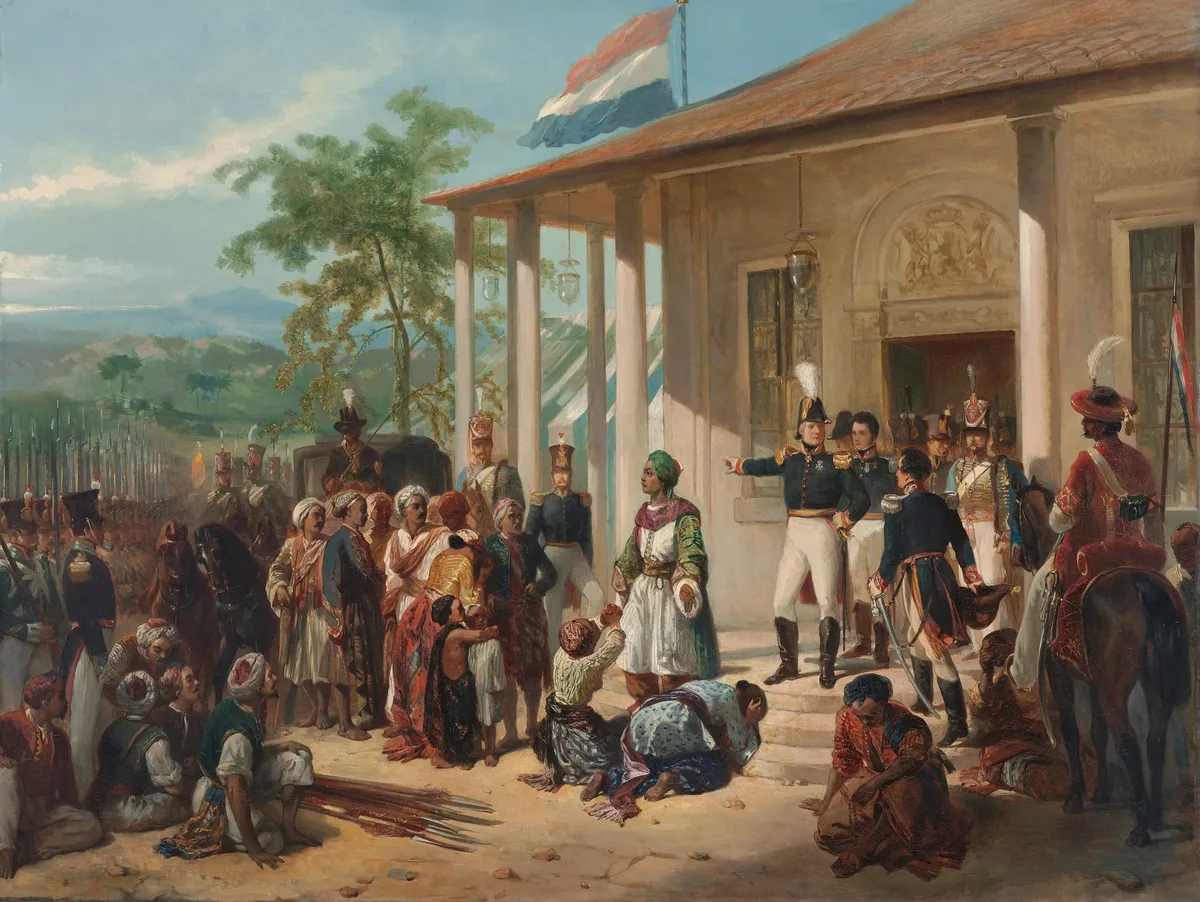
On 28 March 1830, at the end of Ramadan, the Javanese prince Diponegoro came for talks to the house of the Dutch Resident in Magelang, having been promised safe conduct. For five years Diponegoro and his followers had fought the Dutch colonial army, and in this Java War about 200,000 Javanese died, most of them civilians, many from famine. At the talks Diponegoro demanded to be recognised as the Islamic ruler of Java, and Lieutenant-General Hendrik de Kock declared him under arrest. The prince was sent into exile and died in Makassar in 1855.
According to the museum's record, the painting was commissioned by De Kock himself. It was painted by Nicolaas Pieneman, son of Jan Willem Pieneman (no. 21). Nicolaas was only a little over twenty and had never been to Java. On the right stands a pale house with a red tiled roof and a veranda on white columns, a red, white and blue flag flies above the roof, and a coat of arms with lions is carved over the door. De Kock, in a dark blue uniform with gold epaulettes, stands on the top step with his left hand on his hip and points with his right to the left, where a closed carriage waits beyond the crowd. Diponegoro, in a green turban and a long white robe, stands below at the foot of the steps, his head raised, frowning, women kneel at his feet, and on the sand in front of him lances with red tassels are piled up.
The De Kock family kept the painting for about 75 years, and in 1907 Baron de Kock gave it to the Rijksmuseum. For a long time the museum's title spoke of the submission of Diponegoro to Lieutenant-General Baron de Kock, an even older title on the frame calls him the chief mutineer and the scene the end of the war in Java, and now the painting is called The Arrest.
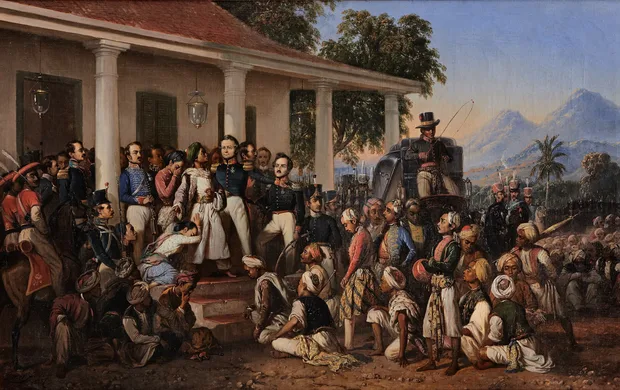
In 1857 the Javanese painter Raden Saleh, who had lived in Europe for more than 20 years, painted his own Arrest of Pangeran Diponegoro. In his version the prince and De Kock stand on the same level, Diponegoro, holding his anger in check, looks straight at the general, and there is no Dutch flag in the picture. Saleh presented it to King William III, in 1978 it was returned to Indonesia, and it belongs to the collection of the Indonesian presidential palaces, kept since 2014 in the palace in Yogyakarta.
The modern city and what it gave the museum
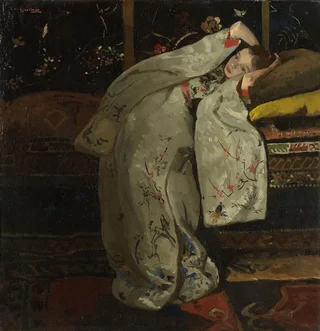
23. Girl in a White Kimono — George Hendrik Breitner, 1894
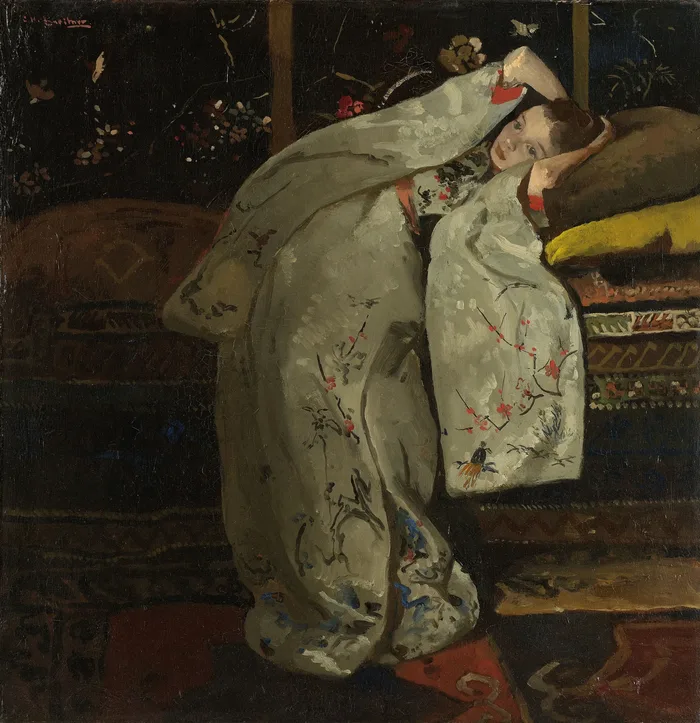
Geesje Kwak was 16 when, in 1893, she began to pose for George Hendrik Breitner. The museum calls her a housemaid, other sources a shop girl at a milliner's, and the museum gives her name with the word “probably”. Breitner was known for rainy Amsterdam streets, building sites, workers and horses, painted fast and roughly, and photographed his models with a hand camera so that he could work from the photographs afterwards. In 1892, at the Haagse Kunstkring art society in The Hague, he saw an exhibition of Japanese prints, after which he bought kimonos and screens and in about three years painted 13 pictures of girls in red, white and blue kimonos. In a letter he called them his little Japanese women.
The girl lies diagonally on a couch, from the upper right corner to the middle of the bottom edge. Her right arm is thrown back behind her head, and with her left hand she props up her cheek, leaning on a large olive-brown cushion with a bright yellow one beneath it, and she looks straight at the viewer. The kimono is silvery white, painted in broad strokes, with red plum blossom on black branches running along the sleeve, and the long sleeves hang down on either side of her body like two lengths of cloth. Red shows only in the lining of the cuffs and as a strip at the collar. Behind her stands an almost black folding screen scattered with flowers and butterflies, and in the upper left corner “G.H. Breitner” is written in red paint. A study in 2016 showed that Breitner had painted over another picture, and beneath the girl in the kimono there turned out to be a seated woman of a different build, possibly nude.
A critic of the time wrote of Japanese women in flowered clothes, their heads resting on cushions, women of suspicious appearance and shameless posture. The collectors Jean Charles Drucker and his wife Maria Drucker-Fraser lent Girl in a White Kimono to the Rijksmuseum in 1919 together with 70 other paintings, and in 1944 they bequeathed it to the museum. A separate wing had been added to the museum building for their collection as early as 1909.
In July 1895 Geesje Kwak left for South Africa with her sister and died there in 1899, at 22, probably of tuberculosis.
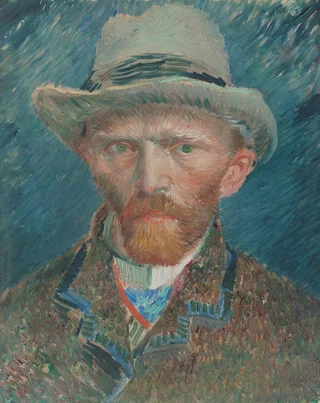
24. Self-portrait — Vincent van Gogh, 1887
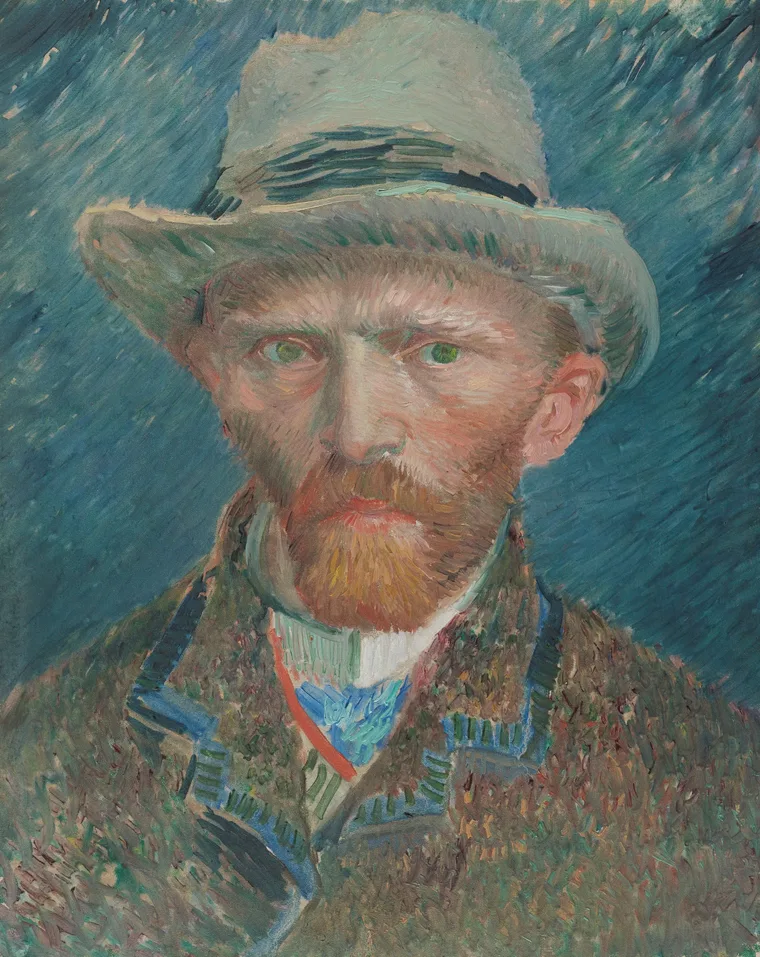
Andries Bonger worked in Paris from 1879, became friends there with Theo van Gogh and introduced him to his sister Johanna, whom Theo married in 1889. Vincent called him André. By 1893 Bonger owned this self-portrait, which, according to the museum's record, the artist had given him himself, though researchers have not established when. Bonger collected Odilon Redon, Émile Bernard, Cézanne and Van Gogh. He died in January 1936, and that same year his widow Françoise gave the portrait to the Rijksmuseum. Most of Van Gogh's paintings in Amsterdam came from his family's collection and are in the Van Gogh Museum, which opened in 1973, while this self-portrait belongs to the Rijksmuseum itself.
Vincent van Gogh came to Paris in 1886 from Antwerp, and before that, in the Brabant village of Nuenen, he had painted in dark, earthy colours. In Paris he lived with his brother, an art dealer, saw the Impressionists and Neo-Impressionists, and painted himself a great deal, because he was his own cheapest model. According to the museum, Theo told him about the new, brightly coloured French painting, and in Paris Vincent began to try out its methods on his own self-portraits. In February 1888 he left for Arles.
The portrait is painted on cardboard. The head is turned three-quarters to the left, the green eyes look at the viewer, and he wears a grey felt hat with a broad brim. The red beard is laid on in small vertical strokes, and the face is built of short pink, orange, green and cream dashes that fan out around the eyes and run down the nose. He wears a white stand-up collar and a bright blue tie, and the museum calls him “a fashionably dressed Parisian”. The brown jacket is flecked with coloured dashes like tweed, and the turquoise background is laid in with short slanting strokes from upper right to lower left.
Together with Van Gogh's self-portrait, Bonger's widow gave the museum a self-portrait of 1897 by Émile Bernard, which Bernard had inscribed to his Dutch friends.
Buying it back
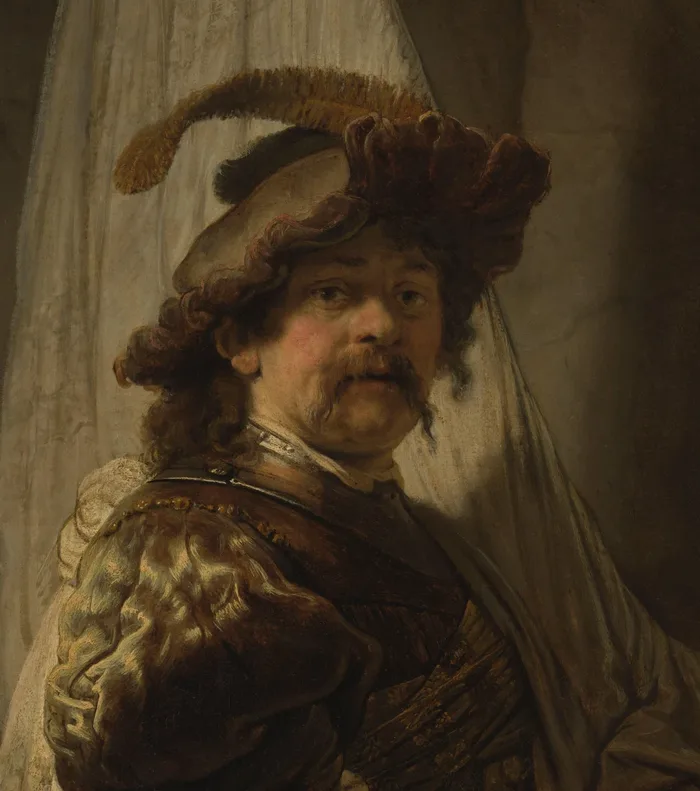
25. The Standard Bearer — Rembrandt, 1636
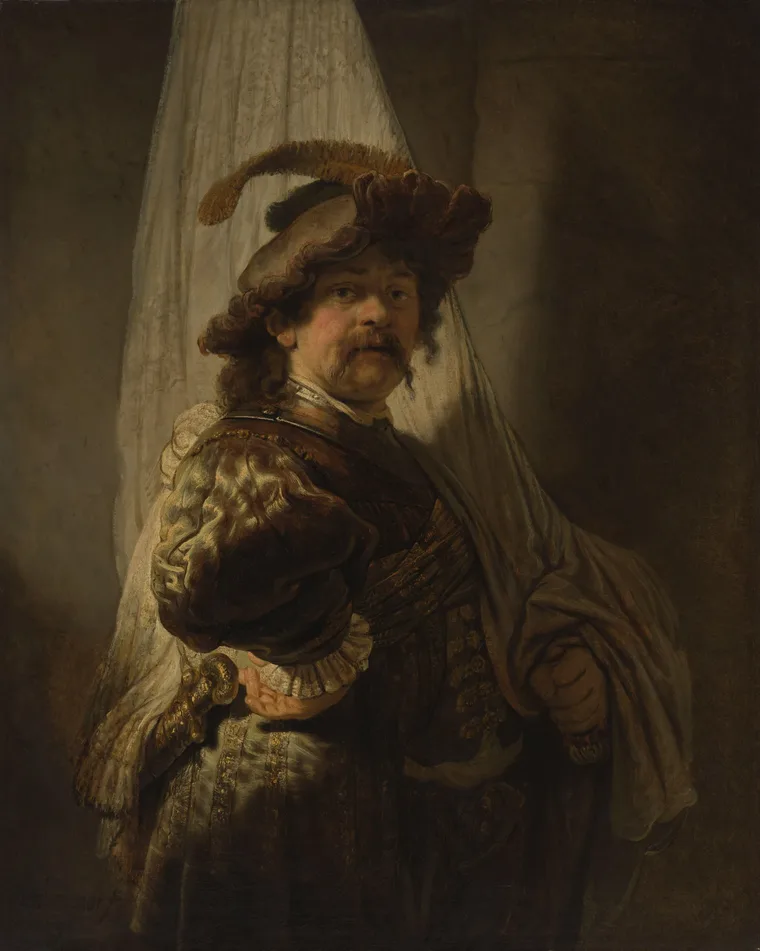
In 2019 the heirs of Élie de Rothschild decided to sell The Standard Bearer, and France declared it a national treasure to hold up its export for 30 months. However, the Louvre could not raise the money and gave up the purchase. In December 2021 the Dutch government announced that it was buying the painting for 175 million euros. The state put up 150 million, the Rembrandt Association 15 and the Rijksmuseum Fund 10. In parliament members asked why the money was going to a trust in the Cook Islands, and doubted whether such sums should be spent while theatres and museums were losing money because of the pandemic. Parliament asked for the painting to be shown in every province, and from May 2022 to April 2023 it hung for three weeks in each of 12 museums across the country, from Leeuwarden to Maastricht. On 14 June 2023 schoolchildren welcomed it at the Rijksmuseum.
The French Rothschilds had owned The Standard Bearer since 1840, when Baron James de Rothschild bought it at a London sale for 840 pounds, and before that it had belonged to King George IV. In 2016 the Netherlands and France had already bought two pendant portraits by Rembrandt from the Rothschilds together, of Marten Soolmans and Oopjen Coppit, and since then the Rijksmuseum and the Louvre have owned them jointly.
Rembrandt was about 30, and two years earlier he had married Saskia van Uylenburgh. The man in the picture, in whom scholars recognise Rembrandt's own features, is seen to just below the waist, in a costume a century out of date, and looks straight at the viewer. He thrusts his right elbow out to the side with his hand on his hip, on his head is a velvet beret with a shaped brim and a long gold-brown ostrich feather, and at his throat a steel gorget. From the top edge of the canvas behind him a pale grey banner falls in enormous folds and is thrown over his shoulder, and with his left hand he grips its cloth at his hip. The light falls from the upper left on his face, the banner and the full sleeve, and the rest sinks into brown and olive.
The museum calls the painting Rembrandt's artistic breakthrough, painted six years before The Night Watch, which also has a standard bearer. The art historian Eric Jan Sluijter sees it as a comedy, a vain, theatrical ensign, and cites textile specialists who say the banner looks like a large linen bedsheet with ornamental trim.
After the twenty-five
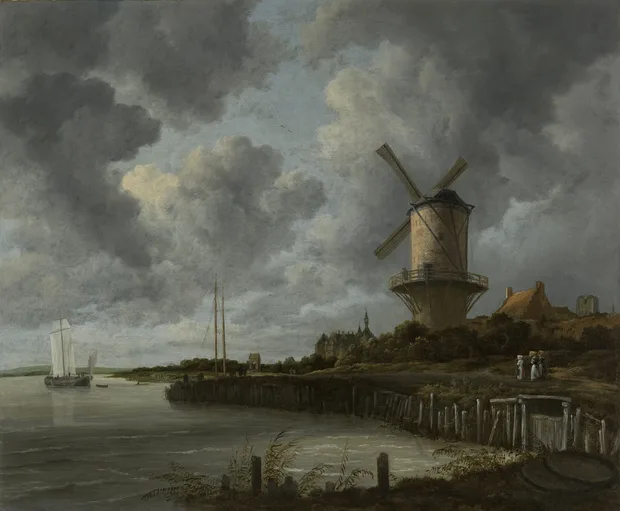
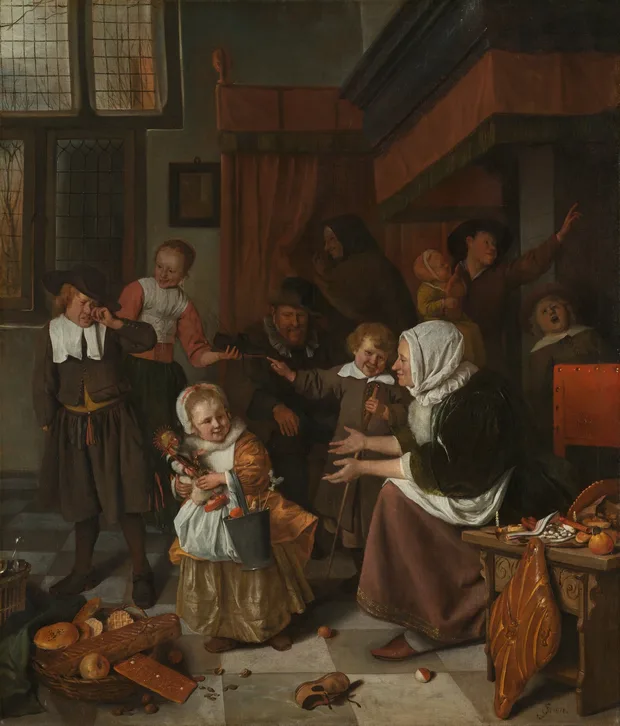
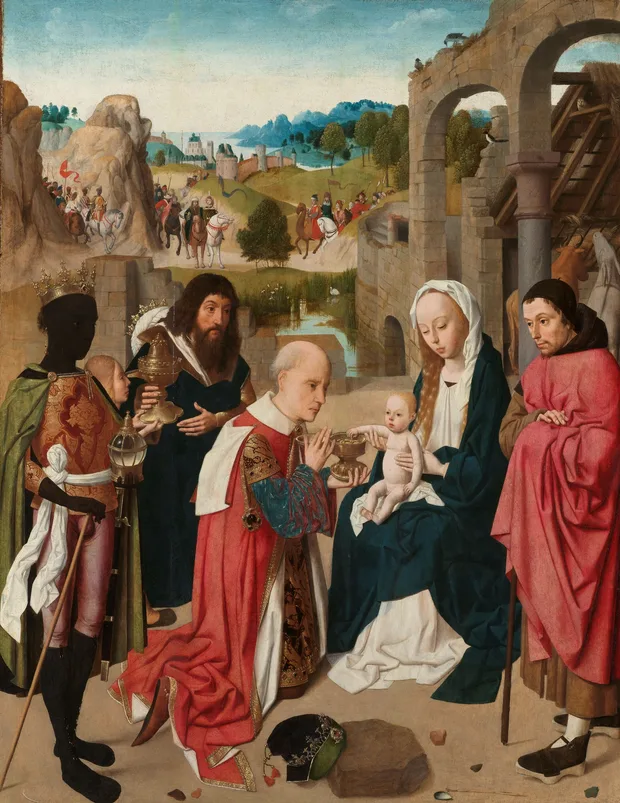
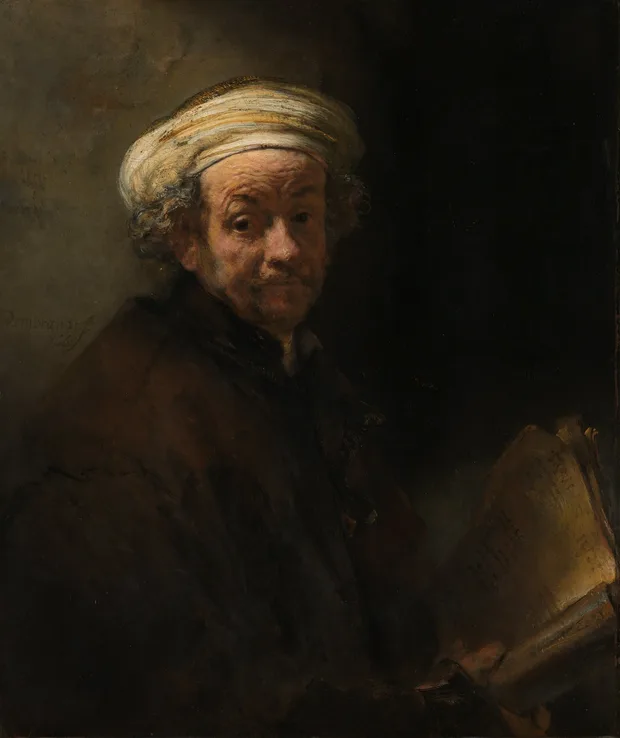
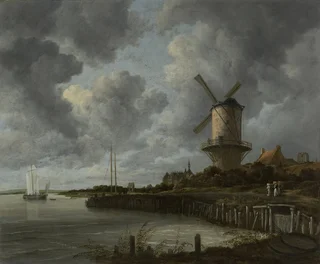
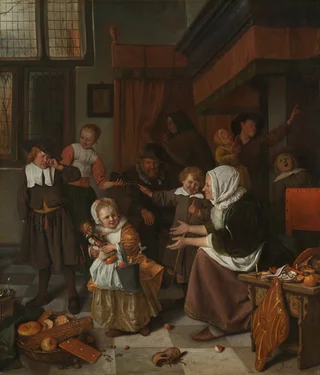
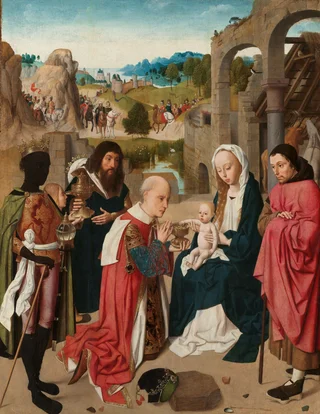
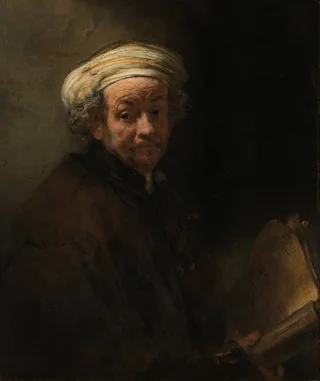
We chose works that show who paid for them, who changed them and who fought for the right to own them, from an Alkmaar almshouse to the government that bought a Rembrandt from the Rothschilds. On a second visit it is worth finding Jacob van Ruisdael's Windmill at Wijk bij Duurstede, Jan Steen's Feast of Saint Nicholas, Geertgen tot Sint Jans's Adoration of the Magi and Rembrandt's Self-portrait as the Apostle Paul. Beyond painting, the best places to begin are the Delftware, the ship models and the temple guardian sculptures in the Asian Pavilion.