Balthasar Permoser
1651–1732 · Holy Roman Empire · Baroque
The story
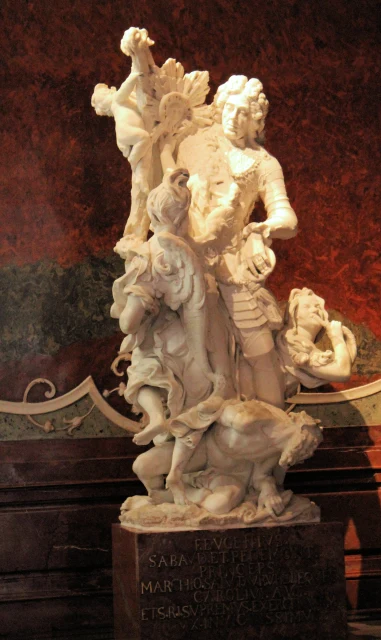
In the Lower Belvedere in Vienna stands a marble group more than two metres tall. Prince Eugene of Savoy, the Habsburg general who drove the Ottoman armies back from Central Europe, is lifted up with the attributes of Hercules, while a figure of Fame rises beside him and a defeated Turk crouches at his feet as a captive. The museum notes that this despairing captive may carry the sculptor's own features. Balthasar Permoser carved the group around 1718 to 1721, in his late sixties.
Eugene commissioned it, perhaps as a memorial for after his death, yet he gave it a modest place, the dining hall of his household officers in the Upper Belvedere. The crowded, twisting Baroque design may have been further from classical models than the prince liked. The group reached the Lower Belvedere only in 1922, when the palace was being set up as a Baroque museum.
Permoser learned that restless style in Italy, in the Florence workshop of Giovanni Battista Foggini, sculptor to the Medici. In 1689 the Elector of Saxony called him to Dresden, and he stayed there for the rest of his life. His best-known work is in the Zwinger, the festival courtyard built for Augustus the Strong. On its Wallpavillon he carved straining, grimacing atlantes, stone giants bent under the cornices, and his workshop also filled the Nymphenbad, the fountain grotto next to it, with figures.
Before he died in 1732, Permoser made his own gravestone, a large Crucifixion group in sandstone, for the Old Catholic Cemetery in Dresden.