Benvenuto Cellini
1500–1571 · Republic of Florence · Mannerism, Renaissance
The story
The most famous night of Benvenuto Cellini's life is one he described himself. He was casting the bronze Perseus for Duke Cosimo de' Medici, the ruler of Florence, and the metal in the furnace began to thicken before it could fill the mould. Cellini had taken to his bed with a fever. He got up, had dry oak thrown on the fire, and when the bronze still would not run, ordered every pewter plate, bowl and dish in the house tipped into the melt, some 200 pieces. The figure came out whole except for the toes of one foot, a flaw he says he had predicted to the duke. Perseus, holding up the severed head of the Gorgon Medusa, was unveiled in 1554 under the Loggia dei Lanzi, the open arcade on Florence's main square, and it still stands there.
Almost everything vivid we know about him comes from that same source, the autobiography he dictated from 1558 onward. In it he is a goldsmith of genius who also admits to killing men, brawls, is jailed in the pope's fortress of Castel Sant'Angelo in Rome and escapes down a rope of knotted bedsheets. Historians accept the outline and treat the heroics with caution. The book stayed in manuscript until 1728, and it made him a famous character long before most readers had seen his work.
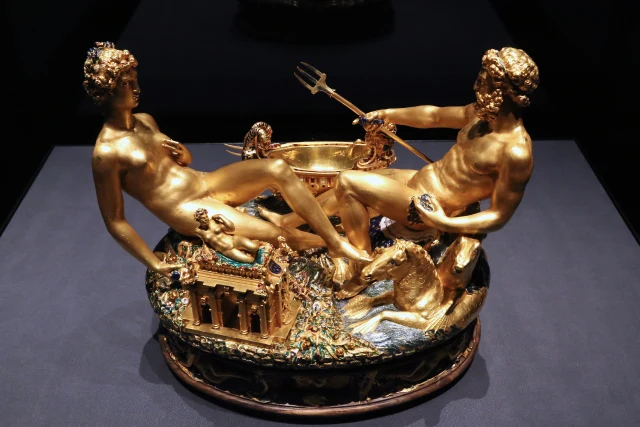
He trained as a goldsmith in Florence, and for most of his career medals, seals, jewellery and precious tableware were his trade. Very little of it survives, because gold and silver were melted down when fashions or finances changed. He spent five years at the court of the French king Francis I, and came home in 1545 to remake himself as a sculptor in bronze and marble. He died in Florence in 1571 and was buried in the church of the Santissima Annunziata.